









How to Develop a Growth Mindset: Unlock Your True Potential

Before you can really start building a growth mindset, you first have to internalize a core truth: your abilities aren't set in stone. They can absolutely grow with effort and the right kind of learning.
This means you start actively looking for challenges, you welcome feedback instead of fearing it, and you reframe failure as just a stepping stone—not a final verdict on your worth. It's a massive shift from thinking, "This is just who I am" to "I'm always a work in progress".
Jump To Section

Earn As You Learn
Earn 25% commission when your network purchase Uplyrn courses or subscribe to our annual membership. It’s the best thing ever. Next to learning,
of course.
What a Growth Mindset Really Is and Why It Matters
At its heart, a growth mindset is the rock-solid belief that your intelligence, skills, and talents can be developed through sheer dedication and hard work. This isn't just wishful thinking; it’s grounded in the science of neuroplasticity.
Neuroplasticity is the brain's incredible ability to rewire itself by forming new connections. Think of your brain less like a static hard drive and more like a muscle—the more you use it and push its limits, the stronger it gets.
This is the polar opposite of a fixed mindset, which is the assumption that our abilities are just innate traits we can’t really change. To truly get a handle on this, you have to understand the key differences between a growth mindset vs fixed mindset.
Fixed vs. Growth Mindset in Action
Let’s put this into a real-world scenario. Imagine two students both get a C- on a tough math test.
The student with a fixed mindset might immediately think, "See? I'm just terrible at math. There’s no point in even trying." They see that grade as a permanent label, a final judgment on their mathematical ability. Their actionable insight is to give up.
Now, the student with a growth mindset has a totally different reaction. They think, "Okay, that was rough, but I can figure this out. Where did I go wrong? I’ll go over my mistakes, ask the teacher for help, and practice those specific problems more." They see the C- as temporary feedback—a clue on where to focus their effort next. Their actionable insight is to create a specific study plan.
The real difference isn't the setback itself; it's the response to it. A growth mindset turns an obstacle into a clear opportunity to get better, which builds resilience and a genuine love for the process of learning.
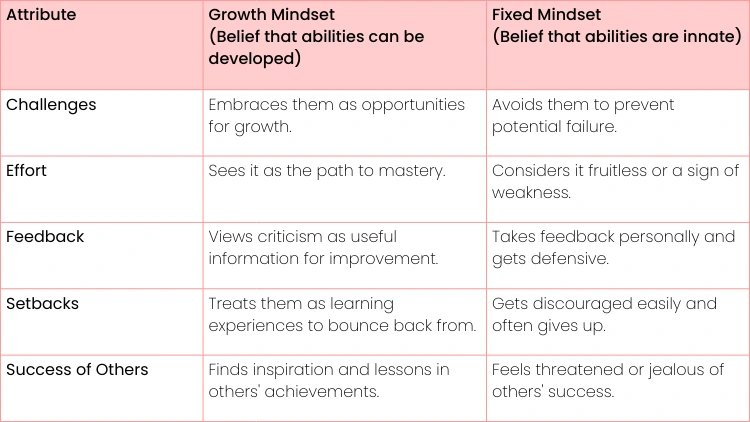
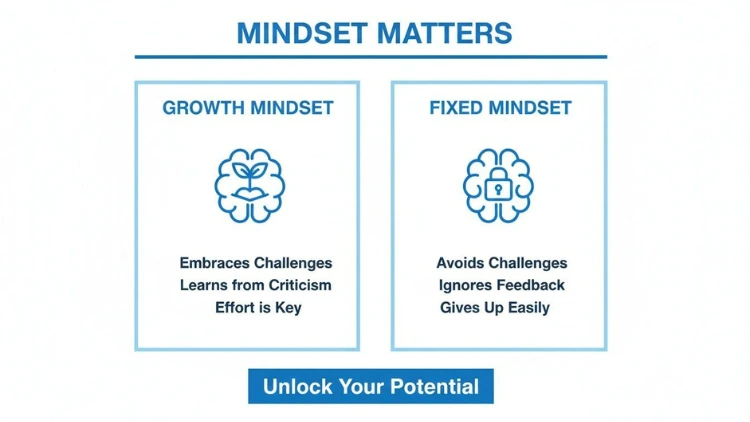
This simple comparison shows how each mindset views challenges, effort, and feedback.
A fixed mindset leads you down a path of avoidance and defensiveness. A growth mindset, on the other hand, encourages you to persist, learn, and ultimately, succeed.
To make this even clearer, let's break down the key differences side-by-side.
Growth Mindset vs Fixed Mindset Key Differences
Seeing it laid out like this really highlights how your core belief about ability shapes every single action and reaction you have when faced with a hurdle.
The Proven Impact on Success
And just to be clear, this isn't some fluffy, feel-good theory. It has a very real, measurable impact on achievement.
A massive global study in 2021 found that almost two-thirds of students showed a growth mindset. The results were staggering. These students scored significantly higher across all subjects, including 31.5 points higher in reading and 23 points higher in mathematics, compared to their peers who believed intelligence was static.
This principle doesn't just stop at graduation, either. It extends into every corner of your career and personal life. Fully embracing the idea that you can improve is the single most important step in this entire journey. As you get started, remember a simple but powerful truth: you become what you think.
Daily Exercises to Build Your Growth Mindset
Knowing what a growth mindset is and actually living it are two different things. The real shift happens when you move from theory to daily, intentional practice. These aren't complicated psychological gymnastics—just simple, practical exercises you can weave into your everyday life to start rewiring your brain for resilience and continuous learning.
Embrace the Power of "Yet"
One of the quickest and most powerful changes you can make is adding a single, three-letter word to your internal monologue: yet. It’s a tiny tweak that completely reframes a statement of limitation into one of potential. It acknowledges where you are now without accepting it as a permanent state.
So, instead of thinking, "I can't master this new software", try this on for size: "I can't master this new software... yet." See the difference? That simple addition implies that mastery is just a matter of time and effort.
Here’s how this looks in a few different situations:
- Instead of "I'm not good at public speaking", try "I'm not good at public speaking yet".
- Instead of "I don't understand this data", try "I don't understand this data yet".
- Instead of "This project isn't working", try "This project isn't working yet".
This isn't about ignoring difficulty. It’s about seeing it as a point on a journey, not a dead end.
- Actionable insight: Write the word "YET" on a sticky note and put it on your computer monitor as a constant reminder.
Actively Seek Constructive Feedback
Someone with a fixed mindset usually dreads criticism. They often see it as a personal attack on their intelligence or ability. But a growth mindset craves it, viewing feedback as the ultimate roadmap for improvement. The trick is to ask for it proactively and make it easy for people to be honest.
Don't just ask, "What did you think?" That's way too broad and puts the other person on the spot. Get specific.
- Practical Example: Asking a Colleague for Feedback. Imagine you’ve just finished a presentation. You could go up to a trusted teammate and say:
Could you give me your thoughts on the presentation? I'm specifically working on my pacing and how I handle Q&A. Was there a point where I went too fast, or an answer that felt unclear to you?
A targeted request like this does two things: it shows you genuinely value their insight, and it frames the feedback as collaborative problem-solving rather than a personal critique.
- Actionable insight: Before your next project review, write down two specific areas you want feedback on and ask about them directly.
Celebrate the Effort, Not Just the Outcome
We live in a world that glorifies the win, the final result. But a growth mindset is built by rewarding the process. When you acknowledge the hard work, the persistence, and the clever strategies you used along the way, you build the mental muscle for resilience. This is absolutely critical for those times when the results are slow to appear.
Practical Example: Celebrating Process Over Outcome. Let’s say you spend weeks pouring your heart into a detailed proposal that ultimately gets rejected. It’s easy to focus only on the "no". Instead, make a conscious effort to recognize the real progress you made.
- "I learned so much about our competitor's strategy during that research."
- "My financial modeling skills are way stronger now than they were a month ago."
- "I built a great relationship with the marketing team while we were working on this."
This practice helps validate the journey itself, making sure your motivation isn't completely tied to external wins. The impact of this shift is massive. Research on academic performance, for example, has shown that students with a growth mindset were three times as likely to score in the top 20% nationally.
- Actionable insight: At the end of each work week, write down one thing you learned or a skill you improved, regardless of the project's outcome.
If you’re looking for more ways to cultivate this mindset, athletes have been doing this for years. You can Master Your Mindset With These Sports Psychology Techniques to find some excellent, battle-tested strategies. The key is building these exercises into your day-to-day life until they become second nature, which you can read more about in this guide on the power of routine.

Using Reflection to Reinforce Your Mindset
Developing a growth mindset isn’t just about the things you do; it’s about the internal conversations you have with yourself. Intentional self-reflection is how you tune into that dialogue, catch those pesky fixed-mindset thoughts in the act, and start rewriting the script.
This practice turns reflection from something passive into a powerful tool for forging new neural pathways. It's about getting past generic diary entries and using sharp, targeted questions to dissect your experiences through a growth-oriented lens.
Asking Better Questions
The quality of your reflection comes down to the quality of your questions. Instead of just rehashing what happened in your day, specific prompts force you to hunt for the lesson, give credit for the effort, and pinpoint exactly where you can improve.
Think about a recent challenge—maybe a tough client meeting or a project that hit an unexpected wall. A fixed-mindset reflection might sound like, "Well, that was a total disaster." But a growth-mindset reflection, prompted by better questions, sounds completely different.
Try asking yourself things like this:
- What specific lesson did that difficult meeting teach me about how I prepare or communicate?
- Which part of my effort today am I proud of, completely separate from the final result?
- Where did I feel stuck, and what’s one different strategy I could try next time I'm in that spot?
See the shift? These questions pivot you from judgment to curiosity and analysis. This whole process is a cornerstone of building self-awareness, which you can dig into deeper in this guide on how to increase self awareness.
A Simple Template for Daily Reflection
Consistency is what makes this whole thing work. You don’t need to write a novel every day; five focused minutes can make a world of difference in your journey to develop a growth mindset.
The goal of journaling isn't to create a perfect record of the past. It’s to consciously design a more resilient and capable version of your future self, one reflection at a time.
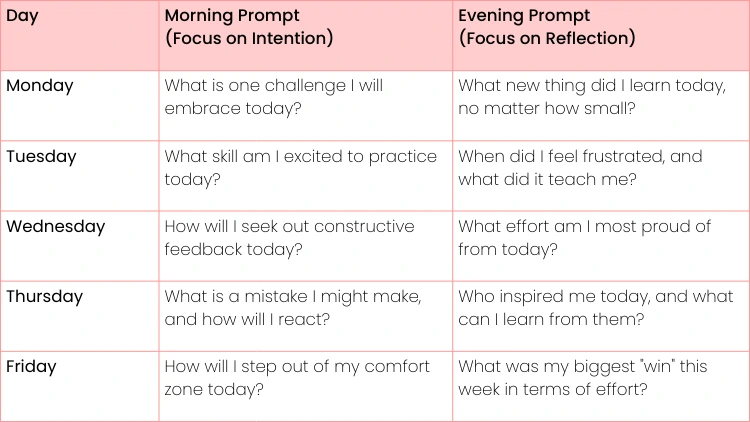
For most people, a simple morning and evening check-in is the easiest way to stay on track. The morning prompt sets your intention for the day, and the evening one helps you process and learn from whatever came your way.
To get you started, here’s a weekly template you can try out and make your own.
Growth Mindset Journaling Prompts for a Week
Following a structure like this helps you train your brain to actively scan for growth opportunities all day long. After a while, this reflective habit stops feeling like an exercise and just becomes your default way of thinking. You start to hardwire the belief that every experience—good or bad—is just valuable data for your own development.
Reframe Failure as Feedback
So, you've decided to cultivate a growth mindset. That’s a fantastic first step, but let's be real—the path isn't always a smooth, straight line.
True growth happens when you start bumping up against obstacles. Two of the biggest hurdles you'll face are the sting of setbacks and that nagging voice in your head, your inner critic. Learning how to deal with these is where the real work begins and where a growth mindset is truly forged.
Setbacks can feel deeply personal, almost like a verdict on your abilities. They have a nasty habit of triggering a fixed-mindset response that screams, "See? I told you. Time to give up."
The trick is to consciously reframe failure. Stop seeing it as an endpoint and start treating it as valuable, non-judgmental data.
Think about the last time something didn't go your way. Maybe you bombed a presentation you worked on for weeks, or a project you were leading missed its key objectives. A fixed mindset internalizes this as proof of inadequacy: "I'm not good at this."
A growth mindset, on the other hand, immediately asks, "Okay, what can I learn from this?"
Instead of letting "I failed" be the final word, put on your detective hat and analyze the situation objectively.
- What was the original goal? Get specific about what success was supposed to look like.
- What actually happened? Stick to the facts. List the outcomes without any emotional spin.
- What was the gap between the two? Pinpoint exactly where things fell short.
- What factors contributed to that gap? Was it a lack of preparation? Poor communication? Something completely out of your control?
This simple, analytical process pulls the emotional sting out of a painful event and turns it into a practical lesson. The failure is no longer about you as a person; it's about the strategy, the process, or the approach you took. This shift is essential for building the mental toughness you need for the long haul. If you want to go deeper on this, this guide on how to develop emotional resilience and overcome adversity is a great next step.
Taming Your Inner Critic
That persistent voice loves to feed on fixed-mindset thinking. It whispers things like, "You're not smart enough for this" or "Don't even try, you're just going to embarrass yourself."
The first step to getting a handle on this voice is to separate it from your actual identity.
Give it a name—something a little silly works best. Call it "Nervous Norman" or "Debbie Downer". The next time it pipes up, you can mentally respond, "Thanks for the warning, Norman, but I've got this." This small act creates just enough distance to remind you that these are just thoughts, not undeniable facts.
Acknowledge the voice, thank it for trying to protect you from risk, and then consciously choose a growth-oriented thought instead. This isn't about silencing criticism; it's about choosing which voice gets to be in charge.
While your environment can influence your default mindset, this ability to manage your inner world is absolutely a skill you can learn. Research has found that even in cultures that tend to foster more fixed mindsets, targeted interventions can successfully teach growth-oriented thinking. You can dig into the full findings on how interventions impact mindset across cultures.
By actively reframing setbacks and managing your inner dialogue, you build the resilience needed to keep moving forward, turning every obstacle into an opportunity to get better.

Making a Growth Mindset a Lifelong Habit
Think of cultivating a growth mindset less like a project with a finish line and more like a daily practice you weave into your life. The real magic happens when conscious effort turns into an unconscious habit. You stop trying to have a growth mindset and simply start living it.
This is the final, crucial step: embedding these principles so deeply that they become your default response to just about everything life throws your way, from career curveballs to personal challenges.
Curate a Growth-Oriented Environment
The people you talk to and the content you consume have a massive impact on your thinking. It's incredibly difficult to sustain a growth mindset if your daily environment is constantly dragging you back into a fixed-mindset swamp. You have to be deliberate about this.
This means actively surrounding yourself with people and resources that reinforce the simple truth that skills are built, not born.
- Find a Mentor: Connect with someone in your field who just gets it. Look for the person who talks openly about their mistakes as learning moments and is always picking up new skills.
- Join a Community: Immerse yourself in a group of fellow learners. This could be a professional development group, an online forum for a new software you’re tackling, or even a book club that dives into challenging topics.
- Filter Your Information Diet: Seriously, hit unfollow. Ditch the social media accounts that showcase a world of effortless perfection. Instead, follow genuine experts who share their entire process—the struggles, the messy middles, and all.
The easiest way to make a growth mindset stick is to make it the path of least resistance. When your environment celebrates effort and learning, your brain naturally gets on board.
Connect Your Mindset to Your Career Goals
A growth mindset feels a lot less like an abstract concept when you tie it to tangible, meaningful goals. It stops being a nice idea and becomes the engine actually driving you forward. By linking this way of thinking to your real-world ambitions, every bit of effort suddenly has a clear and compelling purpose.
A real-world example: Upskilling for that promotion. Let's imagine you're eyeing a leadership role, but it requires some serious data analysis skills—something that’s always been a weak spot for you.
- A fixed mindset immediately throws up a wall: "I'm just not a numbers person. I'll never get that promotion."
- A growth mindset, on the other hand, sees a roadmap. You start breaking it down: "Okay, to get that promotion, I need to get good at data. I'll start with an online course. Then, I'll volunteer for a small project to get some hands-on practice. I'll even ask Sarah from the analytics team if she'd mind looking over my work."
See the difference? A perceived weakness just turned into an actionable development plan. If you want to build that kind of dedication, check out this guide on how to improve self discipline.
Make It a Continuous Process
If there’s one thing to take away from all of this, it's that developing a growth mindset is a journey, not a destination. You're going to have days where you slip back into old thought patterns. Your inner critic will get loud. It happens.
That’s not failure; it's just part of the process.
The real habit isn't about achieving perfection. It’s about consistently returning to the core principles of learning, effort, and resilience. Every single setback is just another chance to practice what you've learned and strengthen those new neural pathways. By embracing this as a lifelong commitment, you ensure you’re always evolving, adapting, and unlocking the next level of your potential.
Common Questions About Growth Mindset
Even with a clear roadmap, stepping into this new way of thinking usually brings up a few questions. Let's tackle some of the most common ones just to clear the air before you dive in.
How Long Does It Really Take to See a Change?
This is probably the number one question, and the honest-to-goodness answer is: it's different for everyone. Developing a growth mindset isn't like flipping a switch; it's much more like learning a new language or a musical instrument. You won't be fluent overnight.
Instead of watching the clock, look for the small, consistent wins. You might notice a subtle shift in your self-talk after a week or two of journaling. Maybe within a month, you'll find yourself actually seeking out feedback on a project instead of dreading it.
The goal here isn't speed, it's consistency. Think of it like this: small, daily efforts to reframe your thoughts and celebrate the process are what compound over time. That’s how you build a resilient mindset that actually lasts. True, deep-rooted change often takes several months of conscious practice.
How Does This Help in a Competitive Job Market?
In a crowded field, a growth mindset isn't just a nice-to-have; it's a massive competitive advantage. Employers aren't just looking for a perfect track record. They're looking for people who are adaptable, resilient, and genuinely eager to learn and improve.
Let's make this real. Picture a job interview where two candidates are asked about a time they failed.
- Candidate A (Fixed Mindset): "I was in charge of a project that missed its deadline. It was a really tough situation, and honestly, the team wasn't the right fit." Notice the deflection? It implies the situation was completely out of their control.
- Candidate B (Growth Mindset): "I led a project that unfortunately missed its deadline. It taught me a critical lesson about resource planning. In fact, on my very next project, I implemented a new check-in system based on that experience, which helped us finish 15% ahead of schedule."
Candidate B takes ownership, shows they learned something valuable, and provides concrete evidence of improvement. Who would you hire? It’s a no-brainer.
What if I Slip Back Into Old Habits?
First off, you will. Slipping up isn't a sign of failure—it's an inevitable, totally normal part of the process. The real key is how you respond when you catch yourself falling back into that fixed-mindset thinking.
Don't beat yourself up. Instead, get curious.
- Acknowledge the Thought: Just notice it, without any judgment. ("Ah, there's that thought again: 'I'll never be good at this.'")
- Analyze the Trigger: What set it off? Was it a tough piece of feedback from your boss? Scrolling through LinkedIn and comparing yourself to a coworker?
- Gently Reframe: Consciously choose a growth-oriented alternative. ("Okay, this is challenging, but it's a solid opportunity to learn a new skill I don't have yet.")
This kind of self-compassionate approach reinforces the core idea: even setbacks are just another chance to practice and strengthen your new mindset.
At Uplyrn, we believe that the right skills and mindset are the keys to unlocking your potential. Our platform is built to support your growth journey with courses and expert guidance every step of the way. Explore our catalog and find your next learning adventure today.


Leave your thoughts here...
All Comments
Reply