









How to Develop Soft Skills for Real Career Growth

Developing soft skills isn't some abstract art form; it's a straightforward, repeatable process. You just need to identify the abilities you need, practice them intentionally, apply them in real-world situations, and then refine your approach based on what you learn. This cycle is how you turn vague personal goals into tangible career assets.
Jump To Section

Earn As You Learn
Earn 25% commission when your network purchase Uplyrn courses or subscribe to our annual membership. It’s the best thing ever. Next to learning,
of course.
Why Soft Skills Are Your Career Superpower
Let's be honest—technical expertise might get your foot in the door, but your soft skills are what land you the job and actually propel your career forward. While your hard skills prove what you can do, your soft skills show how you do it. They’re the essential human skills that dictate how well you collaborate, lead, and come up with new ideas.
Imagine two candidates interviewing for a project manager role. On paper, they’re identical—same qualifications, same experience. The first one aces all the technical questions but is stiff and struggles to build any real rapport. The second not only nails the technical stuff but also actively listens, shows empathy for the team's potential challenges, and clearly lays out a collaborative vision.
Who gets the job? The second candidate, every single time. Their soft skills demonstrated they could not only manage a project, but lead a team.
The Real-World Impact
This isn't just a feeling; the demand for these abilities is fundamentally reshaping the job market. For instance, subtle communication nuances can have a huge effect on your career path, which is why it's worth exploring the real impact of accent on your career.
Companies are putting their money where their mouth is. The global market for soft skills training was valued at around USD 33.4 billion in 2024 and is projected to skyrocket past USD 92.6 billion by 2033. This isn't just a trend; it's a massive investment signaling that businesses are desperate for people who have mastered these skills.
Soft skills are no longer a "nice-to-have"—they are a core requirement for staying relevant and getting ahead. They are the engine behind successful teamwork, effective leadership, and happy clients.
Your Development Framework
The thought of developing a soft skill can feel a little fuzzy and overwhelming. Where do you even start? I've broken the process down into a simple, repeatable cycle. This guide is built around a four-stage framework designed to give you a clear path forward for any skill you want to master.
This framework isn't just for leadership or sales roles, either. You can also take a look at this guide on the seven soft skills that empower engineering professionals to show just how universal these abilities are.

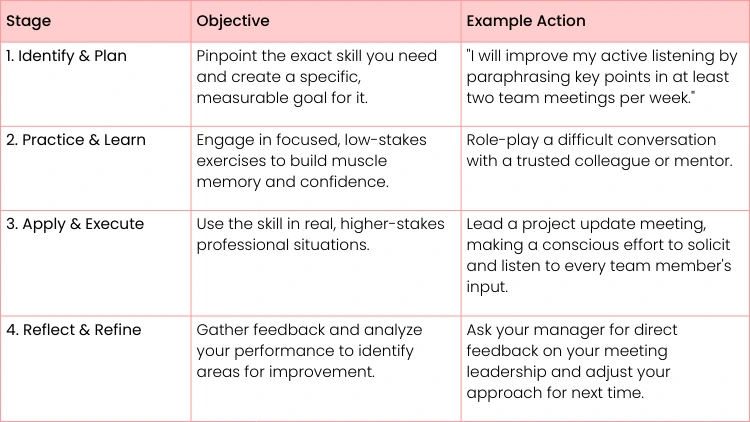
The Four-Stage Soft Skill Development Cycle
This entire process can be visualized as a continuous loop. Let's break down what that cycle looks like.
By following this Identify, Practice, Apply, and Refine loop, you create a structured system for growth. It’s the foundation we will build on in the sections to come.
Before you can start improving your soft skills, you have to figure out which ones will actually move the needle in your career. Setting a vague goal like "I want to be a better communicator" is a recipe for going nowhere fast. It's impossible to measure and rarely leads to any real, tangible progress.
The secret is to get specific. Instead of thinking in broad categories, you need to pinpoint actionable skills that directly tie into where you want to go professionally.
Think of it like being a detective. Your career goals and recent work experiences are full of clues. Let's dig in and find the skills that will give you the biggest return on your effort.
Deconstruct Your Dream Job
One of the best ways to find high-impact skills is to look at the jobs you want in the next one to five years. Job descriptions are basically a cheat sheet, telling you exactly what companies are looking for.
Actionable Insight: Go find three to five job postings for roles that genuinely excite you. Don't just skim the qualifications; dive deep into the "Responsibilities" and "Who You Are" sections. You're looking for recurring keywords and phrases.
- Does stakeholder management or cross-functional collaboration pop up over and over?
- Is influencing without authority a common thread?
- Are they asking for experience mentoring junior team members or navigating ambiguity?
Practical Example: A software developer aiming for a Senior or Lead role might notice that job descriptions consistently mention "mentoring junior developers" and "communicating technical concepts to non-technical stakeholders". These are the two high-impact soft skills to prioritize, not just "communication" in general.
Use a Self-Reflection Framework
Looking at job descriptions is great, but you also have to look in the mirror. Your own recent experiences—especially the tough ones—are a goldmine for this kind of insight.
Think back to a recent challenge. Maybe it was a project that went completely off the rails, a tense conversation with a coworker, or a time you just felt stuck and didn't know how to move forward.
Now, let's break it down with a simple framework. Ask yourself:
- What was the situation? (e.g., A key project deadline was missed.)
- What did I do (or not do)? (e.g., I avoided telling the client about the delay until the very last minute.)
- What was the outcome? (e.g., The client was furious, and my team's credibility took a hit.)
- Which specific skill could have changed things? (e.g., Proactive communication or managing stakeholder expectations.)
This isn't about beating yourself up. It's about pinpointing a specific, high-leverage skill that would have made a real difference.
Practical Example: A marketing manager who did this after a messy campaign launch realized her problem wasn't just "bad communication". It was a very specific weakness in giving constructive feedback to her design team and a failure in managing stakeholder expectations with the sales folks. That kind of clarity is incredibly powerful.
Plus, understanding your own patterns can reveal a lot about how you learn best. You can go deeper on that topic by exploring this guide on the 9 types of intelligence and how they learn.
Ask for Targeted Feedback
Let's be honest: we all have blind spots. Self-reflection is critical, but getting an outside perspective can uncover things you'd never see on your own.
The trick is, asking a vague question like "what should I work on?" will get you a vague, unhelpful answer. To get feedback you can actually use, you need to be specific. Pick a trusted manager or a colleague who sees you in action.
Instead of putting them on the spot, give them something concrete to look for.
Pro Tip: Don't ask for general feedback. Try a script like this: "Hey, I'm really focused on improving my effectiveness in team meetings. In our next project sync, could you pay attention to how I handle questions from the engineering team? I'm trying to make sure my explanations are clear and that I'm creating an open environment for discussion. Would love your honest take afterward."
This simple shift does two amazing things. First, it shows you're proactive about your own growth, which managers love. Second, it gives your colleague a specific lens to look through, so the feedback you get back will be focused, relevant, and immediately actionable.
Building Your Personal Growth Playbook
Once you’ve pinpointed the skills that will really move the needle in your career, it’s time to get strategic. A vague wish like "get better at public speaking" just isn't going to cut it. To see real, tangible progress, you need a personal growth playbook—a structured, realistic plan that turns your ambitions into clear, actionable steps.
Think of this playbook as your personal roadmap. It won't just detail what you want to improve, but precisely how and when you’ll do it. It transforms a fuzzy idea into a concrete project you can actually manage and track.
Setting Smarter Goals with SMART-C
To build a playbook that actually works, we need to go beyond old-school goal-setting. A far more powerful method is the SMART-C framework. It takes the classic SMART model and adds a crucial layer: context. This ensures your goals are firmly grounded in real-world application.
Here’s the breakdown:
- Specific: Get crystal clear on what you want to achieve.
- Measurable: Define what success looks like so you know when you've hit the mark.
- Achievable: Set a goal that stretches you but is still realistically within reach.
- Relevant: Make sure the goal directly supports your bigger career aspirations.
- Time-bound: Give yourself a deadline. It creates focus and a healthy sense of urgency.
- Contextualized: Pinpoint the specific situation or environment where you’ll apply this new skill.
Let's see how this transforms a generic goal into a powerful, actionable objective.
SMART-C Goal Example: "I will confidently present the quarterly update to my 10-person team in two months (Specific, Achievable, Time-bound, Contextualized). I’ll know I’ve succeeded when I get feedback that my key messages were clear and my delivery was engaging (Measurable, Relevant)."
This level of detail makes your goal real and gives you a clear finish line to aim for. For a deeper dive, check out this guide on how to set personal goals that you'll actually stick with.
Curating Your Learning Resources
With a sharp, clear goal in place, the next step is to gather your tools. Your playbook needs a curated list of resources specifically chosen for your target skill. The key here is to be selective—don't just create a digital pile of articles and videos you'll never get to.
Aim for a healthy mix of passive learning (reading, watching) and active practice (courses, workshops). This combination builds both knowledge and real-world ability.
Practical Example: For someone targeting "influencing without authority":
- Foundational Book: Start with a classic to grasp the core principles. For building influence, you can't go wrong with Crucial Conversations by Kerry Patterson and Joseph Grenny. It gives you incredible frameworks for navigating high-stakes discussions.
- Structured Course: An online course offers guided learning and, most importantly, practical exercises. Platforms like Uplyrn have specialized programs like "Influencing People" that provide structured lessons and valuable peer feedback.
- Expert Content: Follow a few key thought leaders in your target area. For anyone working on their leadership skills, following thinkers like Simon Sinek or Brené Brown provides a steady stream of high-quality insights.
Choosing the right skills is more critical than ever, especially with how fast the workplace is changing. The World Economic Forum predicts that by 2030, roughly 39% of workers' core skills will shift, with a huge spike in demand for abilities like emotional intelligence and communication.
Breaking It Down into Micro-Habits
The final, and maybe most important, piece of your playbook is turning knowledge into action. This happens through small, consistent habits. Big goals aren't achieved in giant leaps; they're the result of tiny, daily actions that compound over time.
Instead of trying to change everything at once, identify micro-habits you can weave into your existing workweek.
Practical Example: Developing Active Listening
- Goal: To become a more active and engaged listener in team meetings.
- Micro-Habit 1: In one meeting each day, use the "Playback Technique". Before you respond, paraphrase what a colleague just said to confirm you understood them correctly. ("So, if I'm hearing you right...")
- Micro-Habit 2: When a team member brings up a challenge, commit to asking at least two clarifying questions before jumping in with a solution. ("Can you tell me more about X?" or "What have you tried so far?")
- Micro-Habit 3: At the end of each week, take five minutes to journal about one conversation where you applied these techniques well and one where you could have done better.
These tiny habits are the engine that drives your playbook forward. They make the process of how to develop soft skills feel manageable and ensure you’re constantly practicing and cementing what you learn.
Mastering Skills Through Deliberate Practice
Knowing your goals is one thing, but real growth? That only happens with consistent, focused action. Theory is a great starting point, but developing soft skills isn't like reading a book—it's more like learning to play the guitar. It takes dedicated, deliberate practice to build the muscle memory you need to perform when it counts.
This is where the rubber meets the road. We're going to dive into practical, low-stakes exercises you can weave into your daily work to build up skills in communication, leadership, and emotional intelligence. The secret is to start small in safe environments before you need these skills in a high-stakes meeting or a critical negotiation.
Concrete Exercises For Core Soft Skills
The best way to get better at soft skills is to break them down into smaller, bite-sized behaviors you can practice over and over. Forget trying to "be a better leader" overnight. That's way too vague. Instead, focus on mastering one specific leadership behavior at a time. This approach cuts through the overwhelm and helps you make real, tangible progress.
Here are a few actionable exercises you can try this week:
- For Active Listening (The Playback Technique): During your next team meeting, listen intently to a colleague's point. Before jumping in with your own opinion, paraphrase their idea back to them. Say something like, "So, if I'm hearing you right, you're suggesting we shift focus to... Is that correct?" This simple act forces you to listen to understand, not just to respond, and it makes your colleague feel genuinely heard.
- For Adaptability (The Weekly Stretch Task): Once a week, intentionally volunteer for a small task that sits just outside your comfort zone. This could be anything from learning a new function in the software your team uses to offering to present a single slide in a low-stakes internal update. The goal isn't to become an expert instantly but to train your brain to greet new challenges with curiosity instead of resistance.
- For Empathy (The Perspective Shift): Before you send an important email or walk into a potentially tough conversation, take just two minutes to put yourself in the other person's shoes. Ask yourself: What are their main concerns? What pressures are they dealing with? This micro-habit helps you frame your communication in a way that acknowledges their reality, which almost always leads to more collaborative outcomes.
This idea of focused, repetitive training is a cornerstone of high performance in any field. If you want to see how elite performers use this, look into how athletes approach mastering sports psychology and performance to gain a competitive edge.
This kind of structured framework is your roadmap for practice. By making sure your goals are specific, measurable, achievable, relevant, and time-bound, you stop wandering and start making targeted progress.
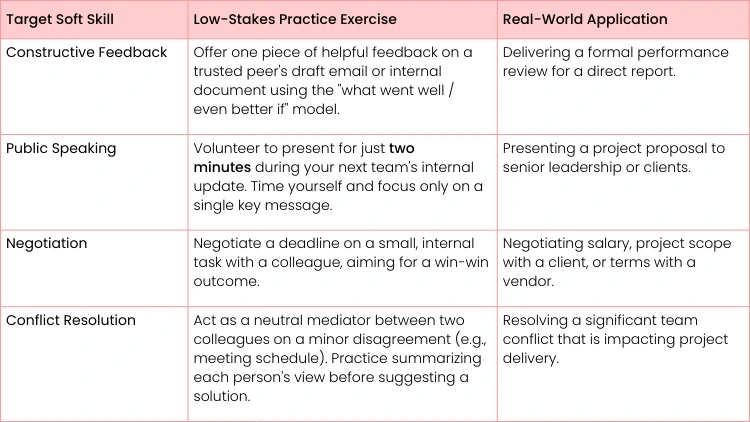
To make this even more practical, here’s a quick guide matching some key soft skills with exercises you can start doing today.
Actionable Exercises for Key Soft Skills
These small, intentional actions build the foundation for handling bigger challenges with confidence and skill.
Integrating Practice Into Your Daily Workflow
The most effective way to build soft skills is to stop treating practice like a chore you have to schedule. Instead, integrate it directly into what you already do. Every email, meeting, and conversation is an opportunity to be deliberate about the skills you're building.
This process of turning knowledge into an ingrained habit is pure neuroscience. When you consistently practice a new behavior, you're literally rewiring your brain's neural pathways to make that behavior automatic over time. If you're curious about the science behind this, we've done a deep dive into how the brain learns.
Actionable Insight: Before your next one-on-one with your manager, pick one specific skill to focus on. Maybe it's asking better, more open-ended questions. Then, during the meeting, consciously practice that single behavior. This simple shift turns a routine meeting into a powerful learning experience, making skill development a natural and continuous part of your professional life.
Tracking Your Progress and Refining Your Approach
Putting new skills into practice is where the real growth happens. But how can you be sure you're actually getting better?
Trying to measure something as squishy as "better communication" can feel like trying to bottle fog. Without some way to see your progress, though, all that hard work can feel aimless and, frankly, a little frustrating.
The good news is you don't need a complicated analytics dashboard. The trick is to stop focusing on subjective feelings and start looking at observable behaviors. By setting up a few simple habits for self-reflection and asking for the right kind of feedback, you can build a powerful cycle of improvement that keeps you moving in the right direction.
The Power of a Feedback Journal
One of the most effective, low-effort tools you can use is a feedback journal. This isn't a diary for your deepest thoughts; it's a practical log of your actions and their results. Think of it as connecting the dots between your practice sessions and what actually happens in the real world.
Actionable Insight: Set aside 10 minutes every Friday to reflect on moments where you intentionally used the soft skill you're developing.
For each situation, jot down three things:
- Action: What skill did you use, and what did you specifically do? (e.g., "Used the 'Playback Technique' during Tuesday's project sync to confirm I understood the designer's feedback.")
- Outcome: What was the result? (e.g., "The designer said, 'Yes, that's exactly it!' The whole conversation got more productive, and we solved the problem in under five minutes.")
- Reflection: What did you learn? What would you tweak next time? (e.g., "This technique is a game-changer for avoiding misunderstandings. I need to remember to use it when a conversation starts getting tense.")
This simple habit transforms fuzzy goals into hard data. Over time, you'll start to see clear patterns in what works for you and where you still need to adjust your approach.
How to Ask for Feedback That Is Actually Useful
While looking inward is essential, we all have blind spots. To get the full picture, you need an outside perspective.
The problem? Asking a vague question like, "So, how am I doing?" almost always gets you a vague, unhelpful answer like, "Oh, you're doing great!"
If you want genuinely actionable advice, you have to ask about specific behaviors, not your overall personality. Frame your request around a concrete situation and a particular skill. This makes it much easier for a colleague or manager to give you useful, objective input.
Requesting feedback on specific, observable behaviors is the key to unlocking meaningful growth. It shifts the conversation from a subjective judgment of character to a constructive analysis of action, making it easier for others to be honest and for you to implement changes.
For example, after a presentation, don't just ask if it was "good". That's a dead end. Instead, try getting more specific. This gives the other person a clear lens to look through, resulting in advice you can actually use right away.
A Template for Requesting Constructive Feedback
Here’s a simple script you can adapt when asking a trusted peer or your manager for some input:
- The Goal: Get better at handling tough questions during presentations.
- The Request: "Hey [Name], I'm actively working on how to develop soft skills, specifically how I handle challenging questions in Q&A sessions. In that last presentation, could you give me your take on how I handled the questions from the finance team? I'm curious if my answers came across as clear and if I managed to keep a confident tone."
This focused approach is far less intimidating for the person you're asking and guarantees the feedback is directly related to your goals. Learning how to gather this kind of input is a cornerstone of professional growth.

Common Questions About Developing Soft Skills
As you start getting serious about developing your soft skills, it’s totally normal for a few questions—and hurdles—to pop up. Let's be real, the path to mastering something like communication or adaptability isn't always a straight line.
I've dedicated this final section to tackling some of the most common questions I hear. My goal is to give you direct, no-fluff advice to bring some clarity and keep you moving forward.
How Long Does It Really Take to Develop a New Soft Skill?
This is the big one, isn't it? And the honest-to-goodness answer is: there's no magic number.
Developing a soft skill isn't like finishing a course with a set end date. It's much more about achieving consistency over a specific timeframe than it is about hitting a deadline. You're building new habits and literally rewiring your brain.
While you can often see and feel real progress in as little as 30 to 60 days of focused, deliberate practice, true mastery is a lifelong journey.
A much better way to think about this is to set a performance-based goal instead of a time-based one.
- Instead of: "I will learn public speaking in three months."
- Try this: "Within three months, I will be able to confidently present our team's weekly update without being glued to my notes."
This simple switch moves your focus from the calendar to a tangible, real-world outcome. That's a much healthier and more motivating way to track your growth.
What Are the Best Resources to Get Started?
You absolutely don't need to break the bank to start building your skills. There's a goldmine of incredible resources out there if you know where to look.
The trick is to be selective. Pick one or two high-quality sources at a time to avoid drowning in information.
Here are a few of my favorite starting points:
- Podcasts: Just search for topics like "leadership", "communication" or "emotional intelligence". Shows like HBR IdeaCast and The Jordan Harbinger Show consistently bring on world-class experts who break down complex ideas into things you can actually use.
- TED Talks: These are short, powerful, and perfect for getting your head around a core concept quickly. Check out Brené Brown on vulnerability or Julian Treasure on active listening for absolute masterclasses in communication.
- Online Platforms: Uplyrn provides the courses and expert guidance you need to master the skills that matter most.
Actionable Insight: The goal with free resources isn't to consume everything. It's to find one actionable insight you can apply this week. Pick one podcast episode or one TED Talk and focus on implementing a single piece of advice from it.
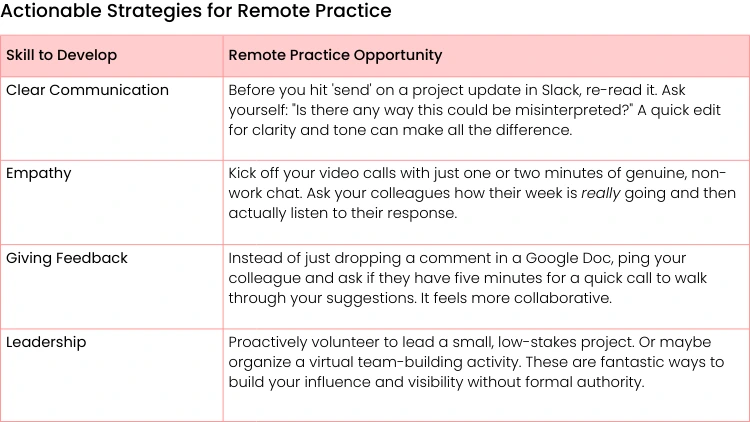
How Can I Practice Soft Skills in a Remote Work Environment?
Trying to practice soft skills when you’re not physically in an office can feel a bit abstract, but it's entirely doable—and frankly, it's more critical than ever. The remote world doesn't remove the need for practice; it just changes the arena.
Opportunities are hiding in plain sight all over your daily digital workflow. You just have to be intentional about spotting them.
The main takeaway here is that every single Slack message, email, and video call is a rep. By being deliberate in these digital interactions, you can effectively build and sharpen your soft skills, no matter where your desk is.


Leave your thoughts here...
All Comments
Reply