









How to Develop Strategic Thinking and Advance Your Career

Developing strategic thinking is really about one thing: connecting what you're doing today with where you want to be tomorrow. It’s the ability to see the whole board, not just the next move. It means you’re anticipating what’s coming down the pike and making calls now that set you up for long-term success.
Jump To Section

Earn As You Learn
Earn 25% commission when your network purchase Uplyrn courses or subscribe to our annual membership. It’s the best thing ever. Next to learning,
of course.
What Strategic Thinking Really Means For Your Career
Let's be clear: strategic thinking isn't some esoteric concept reserved for the C-suite. It's an absolutely essential skill for any professional who wants to do more than just tread water in their career.
This is what separates someone who simply completes tasks from someone who understands why those tasks matter in the grand scheme of things. Instead of constantly reacting to problems, a strategic thinker is proactively shaping what comes next.
It all comes down to asking bigger questions. Imagine a marketing manager who was blindsided by a new, aggressive competitor. The tactical, knee-jerk reaction would have been to slash prices. But she paused. She took a step back and analyzed the competitor’s biggest weakness—a flimsy distribution network.
What did she do? She doubled down on her company's strong retail partnerships and launched an exclusive in-store campaign. It was brilliant. Not only did she neutralize the immediate threat, but she also strengthened key business relationships. A potential crisis became a long-term strategic win.
The whole process boils down to a simple, repeatable cycle. You start with the frameworks, put them into practice, and then build them into your daily routine until they become second nature.
This isn’t a one-and-done deal. Mastering strategy is a continuous loop of learning, applying what you've learned, and integrating it into how you operate.
Why It's A Non-Negotiable Skill Today
The demand for people who can think this way has absolutely exploded. One recent survey found that a staggering 90% of business leaders see strategic skills as essential for both hiring and promotions.
Understanding the difference between short-term tactics and having a truly strategic brain is what separates the top performers from everyone else.
This shift means that your ability to think strategically is directly tied to your professional value. It’s what allows you to:
- Anticipate and adapt to industry shake-ups before they hit.
- Spot unique opportunities that others completely miss.
- Make smarter, more impactful decisions by thinking through the second- and third-order effects.
- Align your work with the company's big-picture goals, making your contributions far more visible and valuable.
Strategic thinking is your ability to solve problems on a foggy day. You don’t have all the information, but you can see the general direction and make the best possible move with what you know.
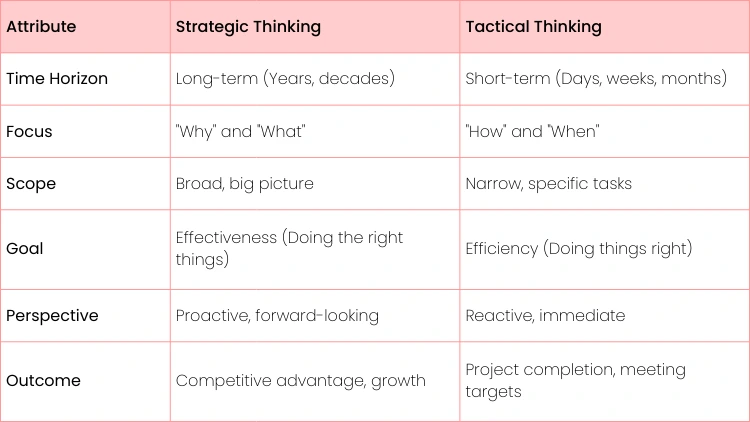
Strategic Thinking vs Tactical Thinking at a Glance
It’s easy to get these two confused, but they serve very different purposes. This table breaks down the key differences to help clarify their distinct roles.
Understanding this distinction is crucial. You need both to succeed, but strategy must always lead the way for tactics to be truly effective.
Ultimately, strategic thinking is a close cousin to another critical skill. If you're looking to build out your toolkit, you might find this guide on how to develop business acumen a perfect next step.
Mastering Core Frameworks for Strategic Thought
Alright, let's move past the theory and get our hands dirty. This is where strategic thinking really comes to life. Frameworks aren't rigid, unbreakable rules; they're mental models that help you organize your thoughts, challenge your assumptions, and ultimately see the insights that others miss.
Think of them as a good set of blueprints. They give you a structure to build a clear, forward-looking perspective.
The idea is to get so comfortable with these tools that they stop feeling like textbook exercises and become reliable instruments you can pull out of your back pocket for any big decision. Let’s walk through four of the most powerful ones you can start using today.
See the Full Picture with SWOT Analysis
The SWOT Analysis (Strengths, Weaknesses, Opportunities, Threats) is a classic for a reason—it’s simple, fast, and shockingly effective. It forces you to look both inward at what you control and outward at the bigger world you operate in.
- Strengths: What do you or your team knock out of the park? Maybe it's a brilliant engineering team or a brand people genuinely love.
- Weaknesses: Where are your internal gaps? This could be anything from outdated tech to a shoestring budget. Be honest here.
- Opportunities: What's happening out there that you could jump on? Think new markets, a competitor's stumble, or a shift in consumer behavior.
- Threats: What external challenges could throw a wrench in your plans? This might be new regulations, a shaky economy, or a disruptive new technology.
Actionable Insight: Don't just list items. The real strategy comes from connecting the quadrants. For example, use a Strength to capitalize on an Opportunity, or use a Strength to mitigate a Threat. If your strength is a "loyal customer base" and a threat is "new competitors entering the market", your strategy is to launch a loyalty program that rewards your existing customers and makes them less likely to switch.
Prepare for the Future with Scenario Planning
Look, nobody can predict the future. But you can prepare for multiple possible futures. Scenario planning is all about making yourself more agile and resilient by imagining different outcomes and deciding how you’d handle each one before it happens.
First, pinpoint the big "what ifs". For a small e-commerce shop, the uncertainties might be, "Will our main supplier jack up prices by 30%?" or "Will a huge new competitor crash our party?"
With those questions in mind, you can build out a few distinct scenarios:
- Best Case: Supply costs stay put, and the competitive landscape is quiet.
- Worst Case: Costs go through the roof just as a well-funded competitor launches.
- Mixed Case: Costs are fine, but that new competitor is suddenly everywhere.
Actionable Insight: For each scenario, create a simple "if-then" plan. For example: If the 'Worst Case' scenario happens, then we will immediately activate our backup supplier and launch a 'buy one, get one 50% off' promotion to retain customers. Having these pre-planned responses prevents panicked decision-making. For a deeper dive into structured strategic thought, explore practical product strategy frameworks that help turn hunches into data-backed plans.
Understand Ripple Effects with Systems Thinking
Systems thinking is the art of seeing the whole board. It’s about understanding how different parts of a system—your company, a project, an entire market—are all connected and influence one another. Instead of seeing isolated events, you see a web of cause and effect.
This perspective is your best defense against unintended consequences.
Practical Example: A product manager gets the bright idea to launch a "freemium" version of their software to boost user acquisition. A classic systems thinker wouldn't stop at the potential for user growth. They'd immediately start asking about the ripple effects:
- What’s this going to do to our server costs?
- Is our support team ready for a flood of non-paying users?
- Could this devalue the paid product in the eyes of existing customers?
Actionable Insight: To practice this, take a recent decision made by your team. Grab a whiteboard and map out all the potential consequences—not just the immediate ones, but the second and third-order effects. Who does this decision impact? What other processes will it touch? This visual exercise builds the mental muscle for seeing connections. This type of thinking is critical, and it's built on a strong analytical foundation.
A strategist must think in terms of connections. A great decision made in isolation can become a terrible one when its ripple effects are ignored.
To get better at this, you need to be able to process information and spot patterns effectively. Sharpen that muscle by checking out this guide on how to develop analytical skills.

Building Your Strategic Muscle with Practical Exercises
Knowing the frameworks is one thing. Actually using them when the pressure is on? That's a different game entirely. This is where you move from theory to instinct, turning abstract concepts into decisive action. It's time to build your strategic muscle.
Let's get into some powerful, hands-on drills you can start using today. These aren't just thought experiments; they’re designed to forge real strategic capability.
Run a Pre-Mortem to Avert Disaster
We're all familiar with the post-mortem, where we dissect what went wrong after the fact. A Pre-Mortem flips that on its head. You get your team together and imagine your big project or launch has already failed—spectacularly. Then, you work backward to figure out why.
This simple trick brilliantly sidesteps the natural optimism that can blind teams to very real risks.
How to run one: Before a major project kickoff, gather your team and say, "Let's jump forward six months. This project was a total flop. Spend the next 15 minutes silently writing down every single reason you can think of for why it failed."
Suddenly, the floodgates open with raw, honest feedback:
- "Our marketing message was confusing and didn't connect with anyone."
- "A competitor beat us to the punch and launched a similar feature a week earlier."
- "We weren't ready for the volume of support tickets, and our customers were furious."
Actionable Insight: After gathering all the reasons for failure, group them by theme (e.g., Marketing, Technical, Competitive). Then, as a team, assign an "owner" to each theme. That person is now responsible for developing a mitigation plan to prevent that specific failure from happening. This turns the exercise from a simple risk list into a proactive action plan. This technique is great for organizing your thoughts, but for even more structure, you can learn how to declutter your mind doing this mind mapping exercise, which is a perfect complement to this kind of forward-thinking.
Practice Connecting the Dots
Real innovation rarely happens by just staring harder at the same old problem. Strategic breakthroughs often come from connecting ideas that seem completely unrelated. To get good at this, you have to intentionally feed your brain information from outside your day-to-day bubble.
Strategic thinking is the art of seeing connections others miss. To do that, you have to look in places others aren't looking.
Practical Example: If you're in tech, read a biography about a fashion designer. If you're in finance, study the supply chain logistics of a fast-food empire. A project manager get a game-changing idea for organizing their team’s workflow after reading an article on urban planning and how cities manage traffic flow.
Actionable Insight: Give yourself a simple goal: once a week, spend 30 minutes reading an article or watching a video totally unrelated to your industry. At the end, write down one single idea from that content that could, however strange it seems, be applied to a challenge you're facing at work. The point isn't to find a perfect solution; it's to train your brain to make novel connections.
Challenge Assumptions with Question Bursting
Our assumptions are the invisible walls that box in our thinking. The Question Burst is a rapid-fire drill designed to tear those walls down. You take a core challenge or a deeply held belief and generate as many questions about it as you can in a short burst—without attempting to answer a single one.
Let's say a team is working under the assumption that "our customers want more features".
A question burst session would throw that wide open:
- What if they actually want fewer, but better, features?
- How do we really know what they want? Have we asked them lately?
- What problem does adding more features solve for us? Is it just keeping us busy?
- What could we achieve if we stopped building new features for six months and focused on something else?
Actionable Insight: After your rapid-fire question session, select the top 2-3 most provocative questions—the ones that make the team most uncomfortable. Turn those questions into small, low-effort research tasks. For instance, the question "How do we really know what they want?" can become an action item: "Let's survey our top 20 users this week with that exact question."
Weaving Strategic Thinking into Your Daily Routine
Strategic thinking isn’t something you schedule on your calendar. It's a muscle you have to build through small, consistent actions every single day. The real goal is to make that forward-looking analysis a natural, almost automatic part of how you operate, separating fleeting knowledge from deeply ingrained skill.
This doesn't mean you need to block out hours for deep work. It can start with just 15 minutes each morning. Instead of mindlessly scrolling through emails, actively scan industry news and start asking provocative 'what if' questions. What if our biggest client suddenly walks? What if a new piece of tech makes our core service obsolete overnight?
This simple habit is a game-changer. It shifts your mindset from being reactive to proactive, training your brain to spot opportunities and threats long before they become five-alarm fires. It's about developing the kind of foresight that truly defines a strategic professional. A McKinsey study found that while 97% of executives believe strategic thinking is critical for success, a mere 28% think their organizations are any good at it.
Adopt Practical Decision-Making Models
To give this daily practice some real teeth, you can lean on a few simple but incredibly powerful decision-making frameworks. These aren't dusty academic theories; they're practical tools you can use for everyday challenges.
- The Five Whys: When a problem pops up, don't just patch the symptom. Ask "why" at least five times to really dig down to the root cause. A missed deadline isn't just a missed deadline—it might be a symptom of a fuzzy process, or maybe a key team member is completely overloaded.
- Second-Order Thinking: Before you pull the trigger on a decision, just pause and ask yourself, "And then what?" This simple question forces you to look past the immediate consequences and see the ripple effects down the line. Slashing the marketing budget might save a chunk of change right now, but what are the second-order effects on brand awareness and your sales pipeline in six months?
A junior professional made these habits his own. He consistently scanned niche industry forums (his 15-minute habit) and used the Five Whys to understand customer complaints. Before long, he spotted a completely underserved market segment. His proposal to create a targeted micro-product was a massive hit, and it led directly to a promotion.
Make Strategic Habits Stick
Consistency is everything. Just like going to the gym, you need a bit of structure to make these habits stick until they become second nature.
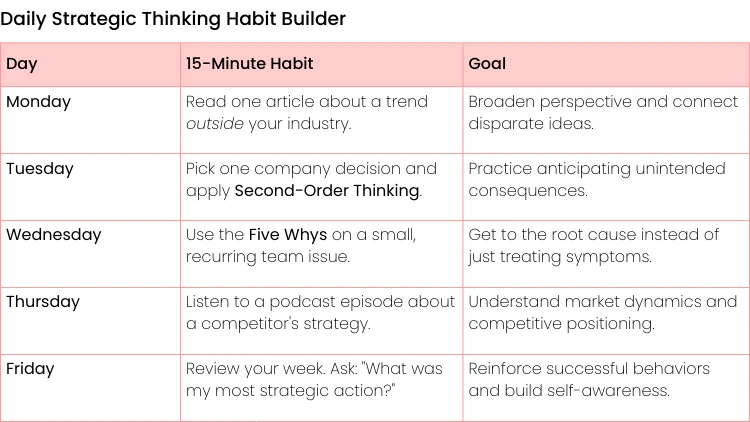
To get started, try this simple weekly plan to build your strategic thinking muscles.
The magic isn't in one single session, but in the cumulative effect of hundreds of them over time. By building a system for strategic thought, you're creating a massive long-term advantage for your career. If you're serious about making these changes last, check out this article on the power of routine.
Avoid These Common Strategic Thinking Mistakes
Developing a strategic mindset is one thing. Actually using it without falling into common traps is another challenge entirely. The path to becoming a true strategic thinker is littered with pitfalls that can easily derail even the most well-intentioned leaders.
One of the sneakiest is getting swallowed by the "operational weeds". It happens to everyone. You get so bogged down in the urgent, day-to-day fires—the packed calendar, the overflowing inbox—that you never carve out the mental space for long-term thinking. Strategy becomes a luxury item on your to-do list, something you'll get to... eventually.
Your Strategy Isn't a Stone Tablet
Another classic blunder is treating your strategy like a rigid, sacred document. A real strategy is a living, breathing guide, not a fixed plan you follow blindly. Sticking to an outdated plan simply because it’s "the plan" is a fast track to irrelevance when the market, as it always does, shifts beneath your feet.
Practical Example: You spent weeks crafting an elaborate, "perfect" launch plan for a new software feature. Then, a month before your launch, a competitor dropped a nearly identical tool. Your boss insisted you stick to the plan. You did, and you got absolutely crushed. The market had moved on, but your "strategy" was stuck in the past.
That painful lesson taught you a strategy's real power is in its adaptability, not its perfection. The actionable insight here is to schedule a "Strategy Review" at least quarterly. This isn't a massive overhaul, but a quick check-in: Are your core assumptions still true? Has anything major changed in the market? This forces you to adapt before it's too late.
The real danger isn't making the wrong decision; it's failing to recognize when a previously right decision has become the wrong one. A flexible approach is your greatest strategic asset.
Escaping the Echo Chamber
Finally, there's the subtle but deadly trap of confirmation bias. This is our natural human tendency to seek out and favor information that confirms what we already believe. It's the absolute enemy of strategic thinking because it locks you in an echo chamber, blinding you to genuine threats and game-changing opportunities.
You have to actively fight this instinct. Force yourself to seek out dissenting opinions and data that challenges your assumptions.
- Assign a devil's advocate: In key meetings, give someone the official role of poking holes in the consensus view. Make it their job to challenge everything.
- Talk to your critics: Don't hide from them. Actively listen to the customers, colleagues, or industry analysts who are most critical of your approach. They see things you don't.
- Hunt for opposing data: Don't just look for charts that prove you're right. Intentionally seek out and dig into the numbers that tell a different, uncomfortable story.
Steering clear of these mistakes isn't about avoiding failure; it's about building the resilience and clarity needed to think strategically for the long haul. This kind of proactive awareness is what separates a good plan from a great strategist.
Common Questions About Strategic Thinking
As you start flexing your strategic muscles, some questions are bound to pop up. That’s a great sign—it means you're really digging in and engaging with the concepts. Let's tackle some of the most common ones from professionals who are on this exact same journey.
How Can I Practice Strategic Thinking in a Junior Role?
You absolutely do not need a corner office to think strategically. The real key is learning to look beyond the immediate checklist of your assigned tasks.
A simple but powerful first step? Just start asking "why" more often. Get curious about the purpose behind your work and how your small piece of the puzzle connects to the team's bigger picture. Another fantastic move is to volunteer for cross-functional projects. This gives you a front-row seat to how different parts of the business actually work together, which is the heart and soul of systems thinking.
- Actionable Insight: See a recurring snag or an inefficient process on your team? Instead of just pointing it out, use a simple framework like the Five Whys to trace it back to its root cause. Then, draft a one-page proposal with a well-reasoned solution and present it to your manager. This demonstrates proactive problem-solving, not just problem-spotting.
- Practical Example: Pay attention in meetings, especially when leaders are wrestling with challenges. If a decision is made to delay a product feature, don't just accept it. Later, ask your manager, "I was curious about the decision to delay Feature X. I'm trying to better understand the strategic trade-offs we have to make. Could you walk me through the thinking?" This is a low-risk, high-reward way to see strategy unfold.
Building these habits early is a massive career accelerator. If you're serious about getting ahead, this guide on how to get promoted offers more tactics that dovetail perfectly with this strategic mindset.
How Long Does It Take to Become a Good Strategic Thinker?
This is a journey, not a destination. Think of it like building muscle at the gym rather than finishing a weekend course. You don't walk out transformed after one session, but with consistent effort over time, the change is undeniable.
Becoming a strategic thinker is about consistent application. You won't wake up one day with the skill magically unlocked. But after a few months of deliberate practice—using the frameworks and daily habits—you'll find yourself spotting connections, anticipating issues, and making better decisions more naturally.
Actionable Insight: Don't try to master everything at once. For the next 30 days, pick just one strategic habit, like Second-Order Thinking. For every significant decision you make, force yourself to write down at least one "and then what?" consequence. After a month, that habit will start to become automatic, and you can add another.
What's the Biggest Hurdle to Thinking Strategically?
Hands down, the biggest trap is letting the urgent completely devour the important. It's so easy to get sucked into the daily whirlwind of operational demands—the endless emails, the back-to-back meetings, the immediate deadlines breathing down your neck. This tactical firefighting leaves zero mental bandwidth for the deep, "big picture" work that strategy demands.
Strategy needs room to breathe. The most effective countermeasure is to become fiercely protective of your calendar.
- Actionable Insight: Block out just 30 minutes, twice a week, on your calendar and label it "Strategic Thinking Time". Be specific. For example, "Tuesday 9:00 AM: Review Competitor X's last product launch" or "Thursday 4:00 PM: Brainstorm risks for Q4 project". Defend this time as if it were a meeting with your CEO. This simple act of carving out and defending that time is often the single change that makes all the difference.
Ready to turn these insights into action and accelerate your career growth? At Uplyrn, we provide the courses, tools, and expert guidance you need to master skills like strategic thinking and stand out in your field. Explore our learning pathways and start building your future today.


Leave your thoughts here...
All Comments
Reply