









How to Develop Analytical Skills and Advance Your Career

To really sharpen your analytical skills, you have to focus on three things: understanding what makes up the skill, practicing it over and over, and then applying what you know to real-world problems. This isn't just about getting good with spreadsheets; it's about mastering how to evaluate information, solve problems creatively, and clearly explain what you've found. This guide provides actionable insights and practical examples to help you build this crucial career asset.
Jump To Section

Earn As You Learn
Earn 25% commission when your network purchase Uplyrn courses or subscribe to our annual membership. It’s the best thing ever. Next to learning,
of course.
Why Analytical Skills Are Your Greatest Career Asset
Let's be honest: in today's job market, having strong analytical skills isn't just a nice-to-have—it’s a flat-out requirement for getting ahead. Companies in every industry imaginable are looking for people who can do more than just follow a to-do list. They need professionals who can look at complex information, spot the patterns that matter, and make smart, data-driven decisions that actually move the business forward.
This isn't just a fleeting trend. For years, analytical thinking has been one of the top skills employers are desperate for. The World Economic Forum’s Future of Jobs Report even predicts it will be the number one core skill in 2025, with a staggering 70% of companies calling it essential. The message couldn't be clearer: investing time in your analytical abilities is a direct investment in your career's future.
Moving Beyond the Buzzword
So, what does it really mean to be "analytical"? It’s not just one thing. It's a mix of several connected skills that all work together. Pinpointing these components is the first real step you can take to get better at them.
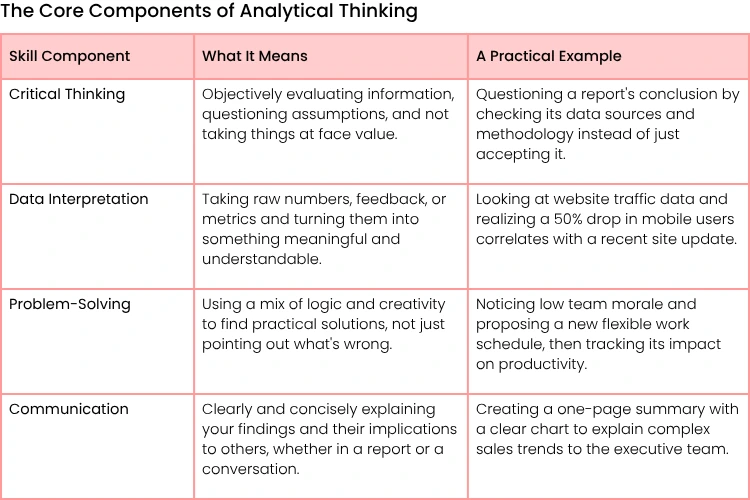
Before we dive deeper, here’s a quick breakdown of what analytical thinking actually involves. Think of these as the pillars holding up the entire skill set.
Getting a handle on these key areas is what separates someone who just processes information from someone who uses it to drive real results. It's the difference between simply completing a task and adding genuine, strategic value to your team.
Here’s a deeper look at each component:
- Critical Thinking: This is all about looking at information from multiple angles and questioning where it came from. It's the foundation of any solid analysis. To go further, check out this guide on how to improve critical thinking.
- Data Interpretation: This skill is about transforming raw data—like monthly sales figures or website traffic reports—into insights that tell a story and can shape strategy.
- Problem-Solving: This isn't just about spotting issues. It's about using logic and a bit of out-of-the-box thinking to come up with effective fixes for tough challenges.
- Communication: Your analysis is only as impactful as your ability to explain it. This means presenting your findings clearly, whether you’re writing a report, giving a presentation, or just talking through it with your team.
Understanding why these skills are so vital is directly tied to the idea of upskilling as a key to advancing your career. It's a constant process of learning and applying new knowledge that keeps you relevant and valuable, no matter how much your industry changes.
How to Conduct a Personal Skills Audit
Before you can build new strengths, you’ve got to get an honest look at where you stand today. Think of a personal skills audit less as a judgment and more as creating a personalized roadmap for your own development.
The whole point is to move from a vague desire to "get better at analysis" to a crystal-clear understanding of your specific starting point. This self-assessment is all about pinpointing your current analytical abilities and figuring out the exact areas that could use some love. It’s the most important first step—because learning is always more effective when it’s targeted.
First, Get Brutally Honest with Yourself
Set aside some real, uninterrupted time to think about recent situations where you had to flex your analytical muscles. This isn't a test; it's a diagnostic. The more honest you are, the more this exercise will actually help you.
Think about a recent project where you hit an unexpected snag or had to make a call with incomplete information. How did you react? That real-world scenario is your first piece of data.
Actionable Insight: A skills audit is like a doctor's diagnosis. You can't prescribe the right treatment without first understanding the condition. Your goal here is to identify the specific "symptoms" of your analytical gaps.
For example, a marketing manager might look back at a campaign that fell flat. Did they immediately jump to blaming the ad creative? Or did they first dig into the click-through rates, audience demographics, and conversion funnels to find the real source of the problem? The answer reveals a ton about their current analytical habits.
A Diagnostic Checklist for Your Analytical Abilities
Use these questions to guide your reflection. Don't just give a "yes" or "no" answer. Try to recall specific instances from your work or even your personal life that prove your point.
- Information Gathering: When you're tackling a new topic, do you seek out multiple sources, or do you tend to stick with the first thing you find? Do you ever stop to question how credible your sources are?
- Problem Deconstruction: When a complex problem lands on your desk, is your first instinct to feel overwhelmed? Or do you naturally start breaking it down into smaller, more manageable pieces?
- Pattern Recognition: Can you connect seemingly unrelated dots? For instance, could you link a dip in customer satisfaction scores last quarter to a new software update that was rolled out around the same time?
- Identifying Assumptions: In a team meeting, are you the person who points out the underlying assumptions behind a proposed strategy? More importantly, do you challenge your own assumptions before making a decision?
- Logical Reasoning: Do your conclusions actually follow from the evidence you have? Or do you sometimes let your personal biases or a gut feeling steer the ship?
Answering these questions gives you a baseline. You might realize you’re a pro at breaking down problems but really struggle to question your own biases. That's a powerful insight that tells you exactly where to focus your energy first.
This process is more important than ever in the current job market. Research keeps showing a major gap between the skills employers want and what candidates bring to the table. For instance, 78% of organizations say they have a hard time finding people with strong analytical skills, while 65% of employers note that related abilities like communication and problem-solving are also in short supply. You can dive deeper into this skills gap article.
By doing this audit, you'll walk away with a clear, actionable list of areas to strengthen. You’ll have turned a general goal into a concrete plan for how to truly develop your analytical skills.
Build Your Analytical Muscle with Practical Exercises
Alright, you’ve taken an honest look at where your skills stand. Now it’s time to get to work. Developing analytical skills is a lot like building muscle—you can't just read about lifting weights and expect to get stronger. You have to show up, do the reps, and be consistent.
The idea is to weave small, deliberate analytical habits into your everyday life. Over time, these exercises will sharpen your mind and train you to see the world through a more critical, insightful lens. We're not talking about huge, time-consuming projects. Even five focused minutes a day can make a massive difference.
Daily Habits for Sharpening Your Mind
Consistency is everything. These quick daily exercises are designed to fit into any schedule and train your brain to think more analytically without it feeling like a chore.
One of the best things you can do is apply the ‘5 Whys’ technique to a news headline or a problem at work. Instead of just accepting a statement at face value, ask "Why?" five times. This simple habit forces you to dig past the surface and uncover the root causes.
Let's try it. Say you see a headline: "Company X's Stock Price Dropped 10% Today."
- Why? They released a disappointing earnings report.
- Why? Their sales were lower than projected.
- Why? A key product launch seriously underperformed.
- Why? The marketing campaign didn't resonate with the target audience.
- Why? Their market research was outdated and missed a new competitor.
See how that works? You just turned a passive piece of information into an active investigation. You're training your brain to look for causality, not just correlation.
Another great daily habit is to practice "debate mapping". The next time you come across a strong opinion—in an article, a podcast, or a meeting—take a second to map out the argument. What’s the main claim? What evidence are they using? What assumptions are they not stating? This helps you deconstruct arguments logically instead of just reacting emotionally.
Weekly Challenges to Deepen Your Analysis
While daily habits build consistency, weekly challenges let you sink your teeth into something more complex. They take a bit more time but offer a much deeper learning experience.
A fantastic weekly challenge is to analyze a personal dataset. You're sitting on more data than you realize.
- Practical Example (Finance): Dig into your monthly spending. Categorize everything in a simple spreadsheet and look for patterns. Are subscriptions costing more than you thought? Can you pinpoint what triggers impulse buys?
- Actionable Insight: Set a rule for yourself, like "If an online purchase is over $50, I will wait 24 hours before buying it."
- Practical Example (Time Management): Track your time for one week. Use an app or just a notebook. At the end of the week, analyze it. Where are your biggest time sinks? How much of your day is spent on high-value versus low-value tasks?
- Actionable Insight: Block off the first 90 minutes of your day for your most important task before checking email.
This process of identifying a weak spot, understanding its impact, and then building a clear roadmap is what turns a vague goal into a concrete action plan.
Tailoring Exercises to Your Profession
The best way to make these skills stick is to apply them directly to your field. Generic puzzles are fine, but solving real-world problems relevant to your career? That's where the magic happens.
- Practical Example (Marketer): Deconstruct a competitor's most successful ad campaign. Don't just stop at "it looks nice". Analyze the audience, the core message, the call-to-action, and the distribution channels. What assumptions did they make? Why did this specific combination work so well?
- Actionable Insight: Create a one-page summary of your findings and present it to your team to inspire your next campaign strategy.
- Practical Example (Project Manager): Pick a recent project that hit a snag. Instead of just noting the delay, map out the entire workflow that led to it. Pinpoint the exact bottleneck. Was it a communication breakdown? A resource shortage? This transforms a past failure into a powerful lesson in systems thinking. For more on this, you might find this guide on how to improve problem-solving skills useful.
- Practical Example (Software Developer): Practice root cause analysis on a recurring bug. Don't just slap a patch on it. Dig into the logs, review the commit history, and talk to the QA team to understand the full sequence of events. The goal isn't just to fix the bug, but to understand the systemic weakness that allowed it to exist in the first place.
Actionable Insight: The goal of these exercises isn't to find the "right" answer. It's to practice the process of breaking down information, identifying patterns, and forming logical conclusions. The process is the skill.
By turning these activities into regular habits, you're actively rewiring your brain. You’ll start approaching everyday situations with a more questioning, structured, and insightful mindset. Before you know it, analysis will go from being a deliberate task to a natural reflex.
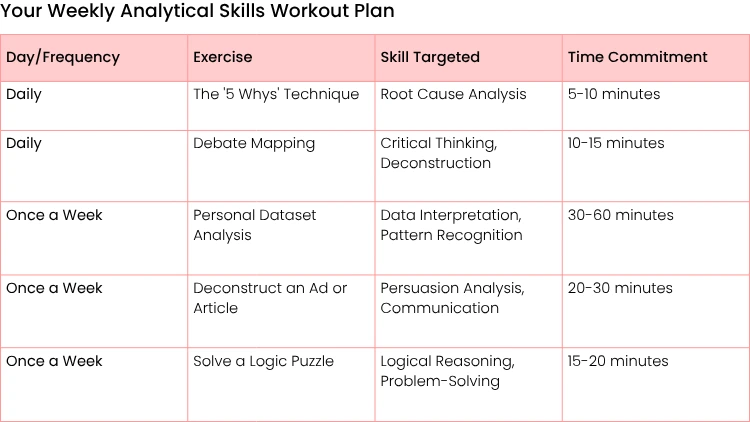
I've put together a sample schedule to help you get started. Think of it as a workout plan for your brain—a structured way to make these exercises a non-negotiable part of your routine.
Don't feel pressured to do everything at once. Pick one or two exercises that feel right for you and build from there. The goal is to create a sustainable habit, not to burn out.
Create Your Structured Learning Path
While daily brain training is great for building mental muscle, a structured learning path is how you really level up your skills. It’s the difference between wandering around the gym and having a dedicated training program. A solid curriculum gives your efforts direction and turns random practice into a focused journey toward your goals.
The secret isn’t finding one perfect resource, but building a personal curriculum that works for you. The best approach is to mix different learning styles—maybe an online course, a couple of foundational books, and a podcast for your commute. This keeps things interesting and helps you build a truly well-rounded analytical mind.
Curate Your Learning Resources
Start by picking a few high-quality resources that directly address the gaps you found during your self-audit. The key is not to get overwhelmed. Just choose one or two from each of these categories and really commit to them.
- Online Courses: Platforms like edX are treasure troves of university-level courses, many of which are free. Look for foundational classes like "Logical and Critical Thinking", "Introduction to Statistics" or "Mindware: Critical Thinking for the Modern World".
- Must-Read Books: To go deeper than a blog post ever could, you need to read the classics. Daniel Kahneman's Thinking, Fast and Slow is essential for understanding the cognitive biases that trip us all up. Another great one is Super Thinking: The Big Book of Mental Models by Gabriel Weinberg and Lauren McCann, which gives you a toolkit of frameworks for making better decisions.
- Podcasts and Lectures: Perfect for learning on the go. "Freakonomics Radio" is brilliant for training your brain to spot the hidden connections between seemingly unrelated things. For a deeper dive into logical reasoning, "Making Sense with Sam Harris" often explores these topics with incredible rigor.
Here’s a look at what you’ll find on a platform like Uplyrn. It’s packed with thousands of expert-led courses designed to help you build real-world skills.
This just shows that no matter what skill you want to build, there's likely a structured path already available to guide you.
A Sample 3-Month Learning Plan
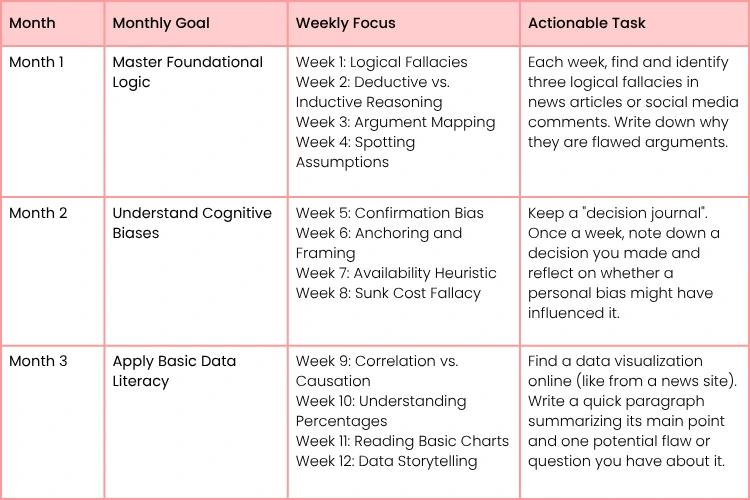
To make this feel less abstract, here’s a sample curriculum you can borrow and adapt. The idea is to set clear monthly goals broken down into specific weekly topics. This creates accountability and lets you see tangible progress along the way.
This kind of structured learning is exactly why companies are so focused on upskilling their teams. According to the World Bank, about 23% of firms globally see a lack of workforce skills as a major barrier to their operations. This points directly to a huge gap in analytical and data-driven thinking. You can discover more insights about global skills development from the World Bank if you want to dig into the data.
Actionable Insight: Don't just be a passive consumer of information. Real learning clicks when you actively engage with new ideas. Every time you learn a new concept, try explaining it to a friend or writing a short summary in your own words. That act of active recall is what makes knowledge stick.
Applying these ideas to specific business scenarios will cement your understanding even further. For instance, many of these principles are at the core of data-heavy fields. If that sounds interesting, you might want to learn more about business intelligence training online.
In the end, think of your learning path as a living document. It’s meant to be tweaked and adjusted as you discover what works for you and what you’re most passionate about. The most important part is simply having a plan that keeps you moving forward.
Apply and Showcase Your Skills in the Real World
Book smarts will only get you so far. The real test—and where you truly start mastering analytical skills—is when you roll up your sleeves and apply what you’ve learned to messy, real-world problems. It's about taking that knowledge and creating something tangible that proves you can deliver real value.
The goal is to stop saying, "I learned about data analysis" and start saying, "I analyzed this dataset and discovered a key insight that could change X". That’s the kind of statement that makes hiring managers sit up and listen. It's about building a portfolio of proof.
Find Your Sandbox: Personal Projects
The best way to get started is to get your hands dirty with data, no strings attached. Think of personal projects as your private playground. Here, you can experiment, make mistakes, and run through the entire analytical process without the pressure of a looming deadline.
Public datasets are a goldmine for this. Websites like Kaggle host thousands of free datasets on just about any topic you can imagine—from Netflix movie ratings to global air pollution trends. This is your chance to pick something you're genuinely curious about, which is the secret ingredient to staying motivated.
Just a quick glance at Kaggle shows you the sheer variety available. You can easily find a project that lines up with your passions.
Diving into these resources lets you pick a project that not only sharpens your skills but actually keeps you hooked from start to finish.
From Analysis to Achievement
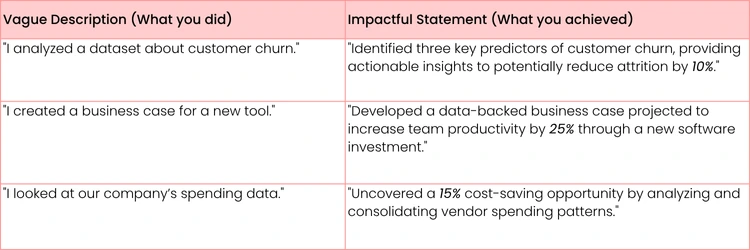
Once you’ve wrapped up a project, the next—and most crucial—step is learning how to talk about it. An incredible analysis is completely wasted if you can't explain why it matters. You need to frame your work around its impact and outcomes.
Forget just listing what you did. Focus on what you achieved. This means translating your technical process into a compelling, results-driven statement that anyone can grasp.
This ability to weave a narrative around data is often called data storytelling. To get a better handle on this, especially for professional settings, learning about data storytelling as a risk analyst can give you some powerful frameworks.
Weave Your Story into Your Career
Okay, now it's time to show off your hard work where it counts: on your resume, in your portfolio, and during interviews. You have to be strategic about integrating your projects to give employers undeniable proof of your analytical capabilities.
- On Your Resume: Don't just throw "Analytical Skills" into a skills section. Create a dedicated "Projects" section or, even better, embed your achievements as bullet points under your work experience. Use those impactful statements you just crafted.
- In Your Portfolio: If it makes sense for your field, build a simple online portfolio. For each project, lay out the problem, your method, the tools you used, and—most importantly—your key findings and the impact.
- During Job Interviews: When the interviewer asks about your analytical skills, don't just say you're a good problem-solver. Tell them a story. Use the STAR method (Situation, Task, Action, Result) to walk them through a project, putting extra emphasis on the "Result".
Actionable Insight: Treat every project like a mini case study. It needs a clear beginning (the problem), a middle (your analysis), and an end (the outcome). This structured storytelling makes your skills feel real and memorable.
Measure Your Progress and Find a Mentor
Building your analytical skills isn't a one-and-done deal; it's a journey. To make sure all your hard work is actually paying off, you need a way to track your growth and someone to help you see the road ahead. This mix of looking inward and getting an outside perspective is what separates casual practice from true mastery.
The best place to start is by looking back. Remember that initial self-audit you did? Go back to it every few months. It's your personal benchmark. Ask yourself: Can you spot patterns now that you missed before? Do you feel more comfortable breaking down a tangled problem? This isn’t about giving yourself a grade. It’s about seeing real, tangible shifts in how you think.
The Power of Objective Feedback
Here’s the thing: you can't see your own blind spots. We're all too close to our own work. That’s why getting feedback from a trusted manager or a sharp colleague is so incredibly valuable.
But don't just ask, "Am I getting better at analysis?" That's too fuzzy to be helpful. Get specific and ask for input on something concrete you just did.
- Practical Example: "When I presented the Q3 sales data, was my main argument easy to follow? Could you tell me one thing that was unclear?"
- Practical Example: "In that last meeting, did you spot any assumptions in my proposal that I might have overlooked? I was worried I was too close to the project."
This kind of targeted question gives you actual data to work with. It helps you zero in on the exact areas that still need a bit of polishing.
Actionable Insight: Getting an outside perspective is like having a mirror for your thought process. It reflects back the gaps and assumptions you're too close to see on your own, accelerating your learning curve significantly.
Finding an Analytical Mentor
Want to fast-track your growth? Learn from someone who's already where you want to be. A mentor with strong analytical skills can offer insights you just can't get from a book or an online course. They can share how they think, walk you through their problem-solving frameworks, and throw personalized challenges your way.
Finding the right person is key, but it doesn't have to be a formal, life-long commitment. You can learn a lot more about making that connection in this guide on how to find a mentor who can genuinely shape your career.
Sometimes, the best first step is the simplest. Just ask a senior colleague you respect for 30 minutes to talk through a specific analytical problem you're stuck on. You’d be surprised how much you can learn from one focused conversation.
Got Questions? Let's Talk.
As you start putting these ideas into practice, you're bound to run into a few questions. I see the same ones pop up all the time, so let's tackle them head-on. Getting these cleared up will help you stay focused and keep the momentum going.
How Long Does This Actually Take?
Everyone wants a timeline, but there's no magic number here. Your progress really depends on where you're starting from and how consistently you put in the work.
That said, if you're dedicated, you should start seeing a real difference in how you think and solve problems within a couple of months. But true mastery? That's a lifelong game. The goal isn't to hit some imaginary finish line; it's to build a habit of steady, incremental progress. Weave these exercises into your daily routine, and you'll find analytical thinking becomes second nature.
Do I Need to Be a Math Whiz to Do This?
Absolutely not. It's a common misconception that "analytical" just means "good with numbers". While quantitative skills are part of the equation, they're just one piece of a much larger puzzle.
Analytical thinking is also about logical reasoning, spotting biases, understanding systems, and communicating complex ideas clearly. You can start by flexing those muscles. Pick apart the argument in an article you're reading. Identify the logical fallacies in a heated online debate. Map out a workflow at your job that seems overly complicated. Some of the sharpest analysts I know came from humanities or arts backgrounds—their strength is seeing the story and the patterns that numbers alone can't reveal.
Actionable Insight: Don't let a fear of numbers hold you back. The most important analytical tool you have is your own curiosity. If you can make a habit of asking "Why?" and challenging what's presented to you, you're already on the right track.
If I Only Do One Thing, What Should It Be?
This is an easy one: cultivate active curiosity.
Get into the habit of questioning everything instead of just accepting information at face value. Whether you're in a meeting, reading a report, or watching the news, don't just passively consume it.
- A Practical Example: Next time your boss mentions a new company initiative, don't just nod along. Ask a thoughtful question like, "What's the primary metric we'll use to measure the success of this initiative?" This simple act shifts you from a passive receiver to an active, analytical participant. It forces clarity and demonstrates your engagement.
This is the core of what it means to be a strong analytical thinker.
Ready to turn these insights into action? At Uplyrn, we provide the courses and mentorship you need to build a powerful analytical skillset and advance your career. Start your learning journey today.


Leave your thoughts here...
All Comments
Reply