









How to Improve Active Listening Skills: An Essential Guide

To truly improve your active listening skills, you need to make a mental shift. It's not just about hearing the words someone says; it's about diving deeper to understand the full message—the intent, the emotion, and the context that isn't being said out loud. This means giving the speaker your complete, undivided attention, really thinking about what they've said, and hitting the pause button on your own judgments. It’s a deliberate choice to absorb, comprehend, and actually retain what you're hearing.
Jump To Section

Earn As You Learn
Earn 25% commission when your network purchase Uplyrn courses or subscribe to our annual membership. It’s the best thing ever. Next to learning,
of course.
Why Active Listening Is Your Most Underrated Career Superpower
We've all been there. You're sitting in a meeting, someone makes a critical point, and it just sails over everyone's heads. The result? Total confusion and hours of rework down the line. This isn't just some minor annoyance; it’s a massive career roadblock. In fact, poor listening is behind more than 70% of workplace errors and misunderstandings. If we move past the generic advice that "listening is important", we can see how this one skill can unlock promotions and cement your reputation as a true leader.
Active listening isn't some fluffy soft skill. It's a strategic tool for navigating tricky projects and getting real results. It changes the game in every single interaction, from a quick team huddle to a high-stakes client negotiation. To really get why active listening is a career superpower, you have to understand the role of Emotional Intelligence (EQ). Think of EQ as the engine driving effective listening; it’s what allows you to pick up on and respond to the unspoken needs of the people around you.
The True Cost of Not Listening
Let’s play out a super common workplace scenario. A manager walks by and tells their team, "I need that quarterly report finalized soon." One employee hears "soon" and figures they have a week, maybe they'll start on Thursday. But another team member, who's practicing active listening, pipes up with a clarifying question: "Just to make sure we're on the same page, are you hoping to review it before the big stakeholder meeting on Wednesday?" The manager confirms, and just like that, a last-minute scramble and a missed deadline have been avoided.
That tiny interaction shows the tangible payoff. Active listening isn't just about being polite; it’s about being efficient, accurate, and building a foundation of trust.
When you listen with intent, you're not just gathering data—you're building psychological safety. People feel valued and are more likely to share critical information, fostering genuine collaboration instead of surface-level agreement.
How This Skill Shapes Your Career
Getting good at active listening has a direct, measurable impact on your professional growth. It’s the bedrock for so many other crucial abilities. You simply can't be a great leader, a sharp negotiator, or a creative problem-solver if you're not an exceptional listener first.
Here’s how it works in the real world:
- Conflict Resolution: Instead of getting defensive when a colleague says, "Your part of the project is holding us up", you listen to understand the real issue underneath. You might ask, "Can you walk me through which specific dependency is causing the bottleneck?" This turns a potential argument into a productive, problem-solving conversation.
- Innovation: You pick up on the subtle frustration in a client's voice when they say, "The reporting feature is fine, I guess." An active listener follows up with, "It sounds like it's not quite what you hoped for. What would an ideal report look like for you?" This is how you uncover unmet needs and spark groundbreaking ideas.
- Leadership: Your team trusts you because they genuinely feel heard. When a direct report expresses burnout, instead of offering a quick solution, you listen fully to their experience. That feeling of being respected boosts morale, increases engagement, and makes people want to follow you.
Ultimately, this guide is packed with actionable strategies you can start using today. As you sharpen this skill, you'll also notice a huge improvement in your ability to connect with others—a key component of communication.

Setting the Stage for Successful Communication
Exceptional listening doesn’t just happen. It starts long before anyone says a word. It’s all about intentionally creating an environment—both in your head and in your physical space—where you can genuinely focus without battling distractions.
Getting this prep work right is the difference between simply hearing sounds and actively understanding the meaning behind them.
Think about this: studies show we spend up to 55% of our day listening, yet our retention rate is often a dismal 25-50%. By properly setting the stage, you can dramatically boost that figure. It’s not just a soft skill, either. When managers are trained in this, their teams report 30% higher satisfaction and see 25% productivity gains. The benefits are real and measurable.
Clear Your Mental Clutter
Before you jump into any important conversation, take a beat to clear your mind. Most of the time, our thoughts are a chaotic jumble of deadlines, personal to-do lists, and leftover stress from the last meeting. Trying to listen through that noise is like trying to hear a whisper in a crowded stadium.
A simple but powerful trick is to set a specific intention for the conversation. This acts like a mental anchor, pulling your focus back whenever it starts to drift.
- Before a client call: "My only job right now is to understand the client's core frustration with the new software update."
- Before a team meeting: "I'm going to listen for new ideas that can help us finally solve that Q3 logistics problem."
- Before a performance review: "My intention is to listen to the feedback with an open mind, without planning my defense while they're talking."
This small mental shift primes your brain to receive information instead of just reacting to it. It’s a foundational piece of the puzzle, tying directly into the core principles of business communication.
Engineer Your Physical Environment
Your physical surroundings can either support your focus or completely sabotage it. Every notification, open tab, or background conversation is a tiny tear in the fabric of your concentration. Taking control of your environment isn't optional; it's essential.
Actionable Tip: Treat your listening environment like a workshop. Just as you’d clear your workbench for a critical project, you need to clear your sensory inputs for an important conversation.
Try this five-minute prep routine before your next call or meeting:
- Silence all notifications. Don't just mute your phone and computer—turn them off completely or activate "Do Not Disturb" mode. The temptation is too great.
- Close every irrelevant browser tab and application. Minimize the digital clutter so your mind has less to wander to.
- If you can, find a quiet space. Move to a room where you're less likely to be interrupted. If working in an open office, book a small focus room.
- Grab a dedicated notepad and pen. This simple physical act signals to your brain that it’s time to lock in and focus.
Of course, developing these skills is just one part of the equation. You also need to know how to measure communication effectiveness to make sure your efforts are actually paying off.
Mastering In-Conversation Listening Techniques
Alright, you've prepped your space and your mind. Now for the main event—the conversation itself. This is where the magic happens, where you shift from just hearing words to actively engaging with the person in front of you.
This isn't about sitting silently and waiting for your turn to talk. It's about deploying a handful of powerful, real-time techniques that build rapport, ensure you're actually understanding what's being said, and unlock much deeper insights. Think of these as your active listening toolkit. They're the practical moves that show someone you're not just present, but truly plugged in.
The goal is to move from passively receiving information to actively co-creating meaning with the other person.
A quick reminder: great listening starts with a conscious decision to prepare, set an intention, and then lock in your focus.
It all comes down to being intentional. When you walk into a conversation having already decided to listen well, you're halfway there.
Paraphrase for Crystal-Clear Clarity
One of the most effective tools you have is paraphrasing. It's simple: you just restate what you heard the speaker say, but in your own words. This small act is a game-changer because it instantly confirms whether you're on the right track or way off base, preventing huge misunderstandings later on.
Here’s what that looks like in the real world:
Imagine a colleague venting, "I'm just swamped. The launch is next week, my slides aren't done, and marketing just sent over a bunch of last-minute changes to the copy."
Instead of a generic "that sucks", try paraphrasing: "So, it sounds like the biggest pressure point right now is juggling the final presentation with these unexpected marketing edits, all under the launch deadline. Is that right?"
See the difference? You've validated their stress and given them a chance to correct you, making sure you're both solving the same problem.
Ask Insightful Open-Ended Questions
Nothing stalls a conversation faster than a series of "yes" or "no" questions. Open-ended questions are your secret weapon for keeping the dialogue flowing. They invite the speaker to elaborate and share more context, often starting with words like "what", "how" or "why".
An open-ended question is an invitation for the other person to share their perspective, not just confirm yours. It shifts the focus from fact-gathering to understanding.
Let's flip some common closed questions:
- Instead of: "Did you finish the project?"
- Try: "What was the most challenging part of finishing that project?"
- Instead of: "Are you happy with the results?"
- Try: "How do you feel about the way the results turned out?"
These kinds of questions open doors instead of closing them.
A lot of the time, our knee-jerk responses are more passive than we realize.
Reflect Emotions to Build Empathy
Sometimes, what's being said is less important than how it's being said. The emotion behind the words is often the real message. When you acknowledge those feelings, you show that you’re listening on a much deeper level. This is how you build trust and psychological safety.
You don't have to be a therapist to pull this off. Simple, observational statements are incredibly powerful.
- Scenario: Your teammate says, "I worked all weekend on this proposal, and the client just rejected it without any real feedback."
- Empathetic Reflection: "Wow, that sounds incredibly frustrating. I can see how disheartening it would be to put in all that effort and get such a vague response."
Notice this response doesn't jump to fixing the problem. It just sits with the emotion for a moment. That simple act of validation is often exactly what the person needs before they can even think about next steps. For a closer look at this concept, check out the 6 principles to follow to be a better listener.
Transforming Passive Hearing into Active Listening
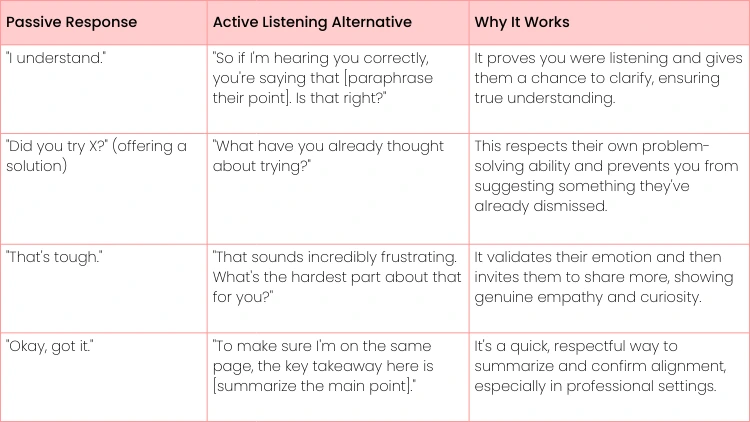
Here’s a quick guide to turning common conversational dead-ends into opportunities for deeper connection.
By consciously choosing these active alternatives, you're not just hearing—you're engaging, validating, and building a much stronger connection.
Turning Words into Action and Building Trust
Listening without any follow-through is just a conversation. Real active listening—the kind that actually builds careers and solidifies professional relationships—is all about connecting words to meaningful action.
This is where trust is truly built.
So many people are great at the in-conversation part, but they drop the ball the second the meeting ends. The follow-up is what separates a polite listener from an effective, accountable partner. When you turn what you heard into tangible next steps, you prove you weren't just hearing, but understanding.
The Power of the 10-Minute Reflection
Honestly, the most important listening you do might just be in the ten minutes after a conversation. Before you dive back into your inbox or jump to the next thing on your to-do list, pause. Take a moment to reflect and lock in what you just learned. This simple habit is a game-changer for preventing key details from slipping away.
We call this the "10-minute reflection". Right after a call or meeting, grab a notebook and just jot down your thoughts. This isn't about creating a perfect transcript; it's about boiling the conversation down to its most critical parts.
Here’s a simple framework to use:
- Key Takeaways: What were the 2-3 most important points or decisions?
- Action Items: What specific tasks did I just commit to? Who owns each task? What are the deadlines?
- Open Questions: What’s still fuzzy? What do I need to get clarification on?
Think of this brief reflection as the bridge between listening and doing. It turns a fleeting conversation into a concrete plan, and it drastically cuts down on misunderstandings—which some studies show are at the root of 40% of workplace issues.
Crafting a Follow-Up That Builds Trust
Once you have your reflection notes, the next step is to close the loop with a quick follow-up. This isn't just about creating a paper trail for CYA purposes. It’s a powerful move that shows you're accountable and helps get everyone on the same page.
A simple, well-crafted follow-up email reinforces your reputation as someone who is proactive and pays attention to the details. It gives everyone a chance to correct any misinterpretations before they morph into real problems.
Here's What That Looks Like in the Real World:
Imagine you just wrapped up a project kickoff meeting. Instead of letting everyone scatter and potentially forget what was said, you send this:
"Hi Team,
Great chat today. Just want to make sure I've got everything straight. Here are my key takeaways and our immediate next steps:
- Main Goal: We're launching the user feedback survey by EOD Friday.
- My Action Item: I'll draft the survey questions and get them over to Sarah for review by noon tomorrow.
- Sarah's Action Item: Sarah will review the draft and provide feedback by EOD tomorrow.
- Open Question: We still need to land on the incentive for completing the survey. Let's try to lock that in on tomorrow's check-in.
Let me know if I missed anything!"
See? This email is more than just a summary; it's proof that you were dialed in. It brings clarity, assigns ownership, and flags potential roadblocks. These kinds of follow-up actions are also a huge part of effectively giving feedback, because they help build a culture where communication is always clear and continuous.
How to Build a Consistent Active Listening Habit
Let's be honest: becoming a great listener doesn't just happen overnight. It's a skill, and like any other, it takes deliberate and consistent practice to get right.
The secret is to start small. You want to build the habit in environments where the stakes are low and the pressure is completely off. This gives you the freedom to try out new techniques, make a few mistakes, and build confidence without putting a major project or relationship on the line.
Think of it like training for a marathon. You don't just show up and run 26 miles on day one. You start with a short jog around the block and build from there.
Start with Low-Stakes Practice
Your first goal is just to get the reps in. You're simply practicing the mechanics of active listening without any fear of failure. These are the perfect opportunities to flex your new skills in a totally safe setting.
- Podcast Summaries: The next time you're listening to a podcast, hit pause after a 10-minute segment. Try to summarize the main arguments out loud, either to yourself or a friend. The point isn't perfect recall; it's to practice pulling out and restating the core ideas.
- Conversations with Friends: When a friend is telling you a story, give yourself a simple mission: ask one insightful, open-ended question that gets them to elaborate. Instead of just nodding along, try something like, "What was going through your mind when that happened?"
Actionable Insight: Set a reminder on your phone for the end of each day with the question: "Did I practice one active listening skill today?" This small prompt keeps the goal top-of-mind.
Move to Medium-Stakes Scenarios
Once you feel comfortable in those casual situations, it's time to bring your skills to work—but in a non-critical context. Internal team meetings are a fantastic training ground for this.
- Practical Example: In your next team huddle, set a small, achievable goal. Maybe you decide you'll paraphrase a colleague's point once during the meeting just to confirm you've understood it. Saying, "So, if I'm hearing you correctly, the main bottleneck is the API integration, not the front-end code. Is that accurate?" does two things: it shows you're engaged and helps clarify the discussion for everyone involved. You’ll find that building these small behaviors is the key, which is covered in this guide on why it's important to develop good habits.
Without active engagement, information fades fast. In a high-stakes meeting, you might recall about 50% of what was said by the end of the day. Within 48 hours, that can drop to just 25%—a common issue for over 70% of employees. You can dig into how quickly we lose information in these workplace listening studies.
Apply Skills in High-Stakes Environments
This is where all that practice pays off—when you need your listening skills the most. We're talking about crucial client negotiations, a big job interview, or your annual performance review. The pressure is on, but you're not starting from scratch. You're prepared.
- Practical Example: During a salary negotiation, the hiring manager says, "This is the top of the budget for this role." Instead of immediately accepting or countering, use reflective listening. You could say, "I hear that the budget is a key constraint here." Then pause. This shows you've understood their position and the silence often encourages them to provide more context, potentially revealing flexibility or other non-monetary benefits. This is when active listening stops being a personal development exercise and becomes a powerful strategic tool that drives real results.
By building up to this point step-by-step, you make active listening a natural, reliable part of your professional toolkit.

Common Questions About Active Listening
Knowing the techniques is one thing, but putting them into practice? That's where things get tricky. It’s easy to read about active listening, but what do you do when you’re facing an awkward silence or someone who just won't stop talking in a meeting?
Let's break down some of the most common hurdles people face. Successfully navigating these moments is what separates someone who knows about active listening from someone who has truly mastered it.
What If I’m Introverted or Shy?
This is a huge one. So many people believe you have to be bubbly and extroverted to be a great listener, but that’s just not the case. In fact, I’d argue that introverts often have a natural advantage here—they're typically more comfortable with silence and are keen observers.
You don't need to be the loudest person in the room to have the most impact. Instead, play to your strengths:
- Use Powerful Non-Verbal Cues: A thoughtful nod, some focused eye contact, or even just leaning in slightly can scream "I'm engaged" louder than a dozen interruptions.
- Aim for One Perfect Question: Forget trying to keep up a constant stream of chatter. Focus your energy on crafting just one insightful, open-ended question. A single, "How did that end up impacting the team's morale?" can be far more powerful than five surface-level comments.
- Actionable Insight: Before your next meeting, write down one potential open-ended question related to the agenda. Having it prepared can give you the confidence to speak up when the time is right.
Being a great listener isn’t about faking a new personality. It’s about using your natural disposition as a strength. Your quiet focus is an asset, not a liability.
Isn't Active Listening Just Being Silent?
Not at all—and this is a critical distinction to make. Silence is simply the absence of noise. Active listening, on the other hand, is a deeply cognitive activity. While you're quiet on the outside, your brain should be firing on all cylinders.
- Practical Example: A colleague is explaining a complex problem. Instead of just waiting for them to finish (passive silence), you are mentally summarizing their points, identifying potential gaps in their logic, and formulating clarifying questions (active listening). You aren’t just waiting for your turn to speak; you're actively processing, summarizing, and empathizing with what the other person is sharing. That mental engagement is what makes your silence so powerful.
How Do I Handle Someone Who Dominates the Conversation?
We've all been there. You're trapped in a one-way conversation with someone who never seems to take a breath, and it feels impossible to get a word in. The trick is learning how to interject politely but firmly.
Your goal isn't to shut them down. It's to gently steer the conversation back to being a two-way street.
- Look for Their Pauses: Wait for that moment when they take a natural (even if tiny) pause for breath. Use that small window to jump in with a summarizing statement. Try something like, "That's a really interesting point about the marketing budget. Just to make sure I'm following, you're suggesting we reallocate the funds from Q3 to Q4?"
- Use the "Bridge" Technique: Acknowledge their point and then use it as a bridge to add your own. For example: "I agree that the timeline is aggressive, and building on that, I think we also need to consider the impact on the design team's workload."
- Actionable Insight: Practice this with a friend. Have them tell you a long story without pausing, and your goal is to find a moment to politely interject with a paraphrase. It feels awkward at first but builds the muscle for real-world situations.
Can I Practice Active Listening Online?
Absolutely. In fact, the digital world can be a fantastic, low-stakes training ground. When you're in a text-based chat or an online forum, you have the luxury of time. You can read a comment, actually think about it without the pressure of an immediate response, and craft a thoughtful, clarifying question.
- Practical Example: On a company Slack channel, a coworker posts a long message about a project issue. Instead of firing back with a quick "Got it", take an extra minute. Reread their message and respond with, "Thanks for the detailed breakdown. To confirm, it sounds like the main blocker is waiting for the client's API keys. Is that correct, or is there another piece I'm missing?" This is an excellent way to build the habit of pausing and processing before you react—a skill that translates directly and powerfully to your real-time, face-to-face conversations.
Ready to turn these skills into a career advantage? At Uplyrn, we offer courses and mentoring designed to help you master communication, leadership, and more. Explore our programs and start your journey today.


Leave your thoughts here...
All Comments
Reply