









How to Improve Interpersonal Skills: Steps to Boost Career

Improving your interpersonal skills isn't about memorizing scripts or faking charisma. It’s a genuine process of sharpening your self-awareness, zeroing in on specific communication techniques like active listening, and then using real-world feedback to get better. Think of it as moving beyond your technical abilities to build authentic, effective connections with the people around you.
Jump To Section

Earn As You Learn
Earn 25% commission when your network purchase Uplyrn courses or subscribe to our annual membership. It’s the best thing ever. Next to learning,
of course.
Why Interpersonal Skills Define Your Career Trajectory
Sure, your technical expertise might get you in the door. But it’s your interpersonal skills that will build a lasting and successful career. The modern workplace is more collaborative and less hierarchical than ever before. Your ability to connect, persuade, and empathize isn't just a "soft skill" anymore—it's a core competency that directly drives results.
- Practical Example: Imagine two software developers are equally brilliant coders. One works in isolation, delivering flawless code but struggling to explain their thought process or gracefully accept feedback during code reviews. The other actively engages with the team in daily stand-ups, seeks clarification on project requirements from the product manager, and jumps in to help colleagues solve tough problems.
Which one do you think gets tapped to lead the next big project? The answer is obvious. The second developer's interpersonal skills make their technical skills more valuable to the team.
The True Impact on Promotions and Leadership
Your ability to manage relationships has a direct and powerful influence on your career path. When it comes time for promotions, managers and executives are always looking for people who can unite teams, navigate difficult conversations, and embody the company’s values.
Strong interpersonal skills are not about being popular; they are about being effective. They allow you to turn conflict into collaboration, inspire action in others, and build the trust necessary for leadership.
This is precisely why skills like social influence and creative problem-solving have become so critical. Research clearly shows that as jobs evolve, the ability to think on your feet and lead others is what sets resilient professionals apart.
- For example, the World Economic Forum’s Future of Jobs Report 2023 ranked leadership and social influence among the fastest-growing skills. It also predicted the demand for creative thinking will surge by 73% by 2027. The data also reveals that organizations focusing on skill-based hiring are 107% more likely to place talent effectively, proving the direct link between people skills and business success. You can explore more data on the future of job skills to see how these trends are reshaping entire industries.
The Core Skills You Need to Master
To really move the needle on your interpersonal abilities, you need to know where to focus your energy. These skills all work together, making you a more well-rounded and influential professional.
Here are the essential pillars to build on:
- Active Listening: This goes way beyond just hearing words. It’s about truly understanding the intent and emotion behind them, which is the foundation of trust and a surefire way to prevent misunderstandings.
- Clear Communication: This is your ability to express ideas concisely and confidently, whether you're firing off a quick email or presenting to the entire team.
- Empathy: Simply put, it's the capacity to understand and share the feelings of another person. It allows you to build genuine rapport and respond in a way that resonates.
- Conflict Resolution: This is the skill of navigating disagreements constructively. Instead of avoiding friction, you learn to find common ground and turn it into a positive outcome.
- Assertiveness: It's about confidently expressing your own needs and opinions while still respecting others. This ensures your voice is heard without coming across as aggressive.
By focusing your practice on these specific areas, you create a powerful foundation for growth. The rest of this guide will give you practical, step-by-step actions to help you develop each one.
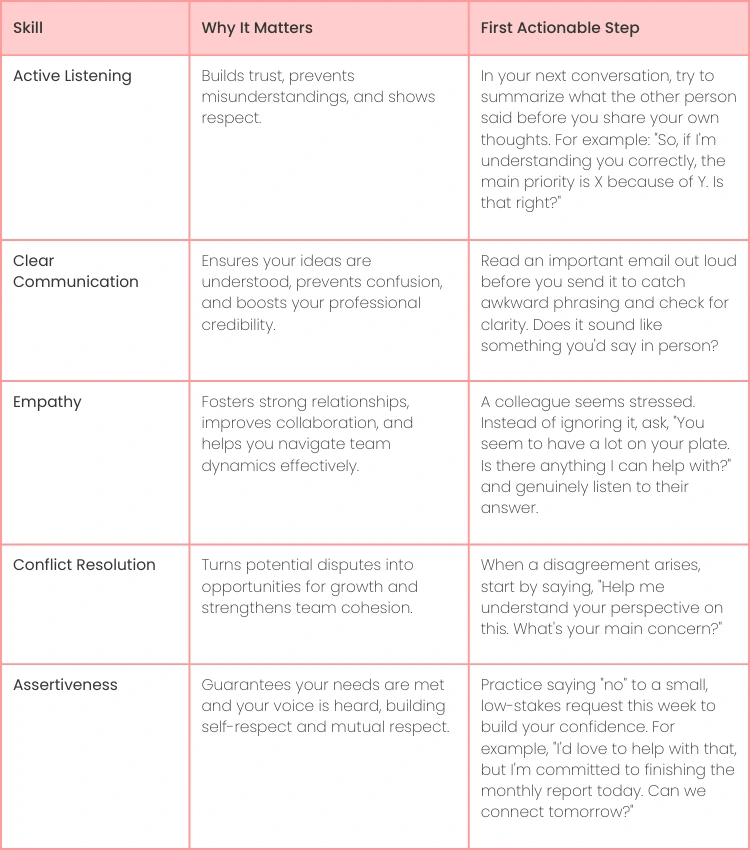
Before we dive into the "how", let's quickly summarize the most important skills for today's workplace.
Core Interpersonal Skills for Professional Success in 2026
The table below breaks down the key skills, why they're non-negotiable in the modern professional world, and the very first step you can take to start improving.
Think of this table as your starting map. As you continue through this guide, you'll find detailed strategies and exercises to master each one of these areas.
Go Beyond Hearing With Active Listening and Empathy
Most of us like to think we're good listeners. But if we're being honest, we're often just hearing—waiting for our turn to talk instead of truly absorbing what the other person is saying. The real starting point for better interpersonal skills is making the jump from passive hearing to active listening.
This isn't just about being polite. It’s a powerful tool for building influence, trust, and deeper connections. When you make people feel genuinely understood, you become the person they seek out for advice and collaboration.
Active listening is more than just processing words; it's about decoding the emotion, intent, and unspoken concerns behind them. It’s the very foundation of empathy.
Master the LEAP Method for Better Conversations
To put active listening into practice, a simple framework called LEAP is incredibly helpful: Listen, Empathize, Ask, and Paraphrase. It’s a four-step process that gives you a concrete action plan for any conversation, especially the high-stakes ones.
Practical Example: You're in a tough meeting with a client who's unhappy with a project's progress. Instead of immediately getting defensive, you can apply LEAP.
- Listen: Let them get it all out. Don't interrupt. Mute your mic on the video call if you have to. Your only job right now is to give them your full attention—not to formulate your rebuttal.
- Empathize: Acknowledge their feelings directly. You could say, "I completely understand why you're frustrated. It sounds like these delays are putting your launch date at risk, which must be incredibly stressful."
- Ask: Now, dig a little deeper with open-ended questions. Something like, "Can you walk me through the specific impacts this is having on your team's workflow?" or "What does the ideal outcome look like from your side?"
- Paraphrase: Finally, summarize their core message to make sure you're on the same page. "So, if I'm hearing you correctly, the main issue is the delayed feature which is a bottleneck for your marketing team, and you need a firm revised timeline by tomorrow. Is that right?"
This approach instantly de-escalates tension and frames you as a partner, not an adversary. If you're looking to dive deeper into this topic, you might be interested in this guide on how to improve active listening skills.
The goal of active listening isn't to win an argument but to fully understand the other person's reality. When people feel truly heard, they become open to finding solutions together.
Cultivate Empathy With Practical Exercises
While listening helps you understand what is said, empathy is about understanding why it's being said. You can absolutely develop this skill with a few targeted exercises. A powerful technique is cognitive empathy—understanding someone's perspective without having to absorb their emotions yourself.
Here are a couple of actionable insights to try:
- Try the 'Five-Minute Silence' Rule: In your next team meeting, make a conscious effort to stay silent for the first five minutes. Just observe. Who is speaking? What's their tone and body language telling you? Is the junior designer hesitant to speak after the senior manager shared a strong opinion? What are the underlying currents of the conversation?
- Practice 'Perspective Journaling': After a tricky interaction with a colleague, take five minutes to write about it from their point of view. For example: "He seemed really dismissive in that meeting. From his perspective, he's under pressure to deliver the project by Friday, and my question probably sounded like a roadblock. He wasn't trying to be rude; he was just stressed." This exercise is like a workout for your empathy muscle, helping you see situations from multiple angles.
Making these small, consistent efforts is the real secret to improving your interpersonal skills and building stronger professional relationships.

Communicating with Clarity and Confidence
Knowing how to improve interpersonal skills goes way beyond just having the right words. It’s often how you say something—your tone, your body language, the very structure of your thoughts—that leaves the biggest impression. Confident communication isn’t about being the loudest person in the room; it’s about delivering your message with clarity and conviction.
- Practical Example: Even small shifts in your non-verbal cues can completely change how people receive your message. Standing with an open, relaxed posture during a presentation naturally projects authority and trust. On the other hand, crossing your arms or hunching over your laptop on a video call can signal defensiveness or a lack of confidence, undermining your point before you've even made it.
Master Your Message Delivery
One of the fastest ways to sound more polished and professional is to cut out filler words. We all do it—the "ums", "uhs", "likes" and "you knows"—but they dilute the power of your message, making you seem hesitant or unprepared.
Start by just noticing when you use them. It’s often when you’re searching for the next thought. The fix is simple but takes some real practice: embrace the pause. A silent moment feels way longer to you than it does to your audience. Taking a deliberate, silent breath is far more powerful than filling the space with an "um".
- Actionable Insight: The Video Feedback exercise is a total game-changer for this. Record yourself on your phone practicing a short pitch or explaining a project ("I'm going to explain our Q3 marketing strategy in under 60 seconds."). When you watch it back, you'll spot nervous habits and filler words you never even knew you had, giving you a clear target for improvement.
Developing this ability is a core part of learning how to improve conversation skills in any setting. Building this foundation helps ensure your messages are actually heard the way you intend them.
Assertiveness Versus Aggression
A huge part of confident communication is assertiveness—the ability to express your needs and opinions clearly while still respecting others. This gets confused with aggression all the time, but they’re worlds apart. Aggression steamrolls others; assertiveness is about being firm, not forceful.
Being able to disagree constructively or set boundaries without causing offense is the mark of a truly skilled communicator. If you want to dive deeper, this guide on how to improve communication skills has more detailed strategies.
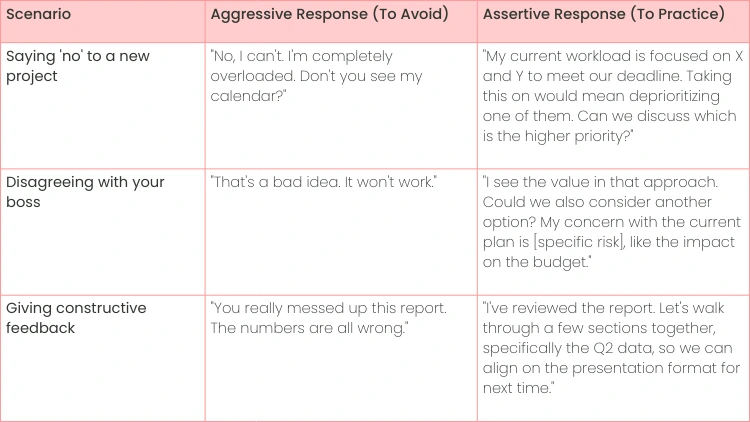
To see this in action, it helps to compare aggressive and assertive responses side-by-side.
Assertive vs. Aggressive Communication
Notice the difference. The assertive responses are collaborative and solution-focused. They state the reality of the situation without placing blame or shutting down the conversation. This is the sweet spot you're aiming for.
Turning Conflict into Collaboration
Workplace conflict isn't just inevitable; it’s a natural byproduct of passionate, driven people working together. The real test of your interpersonal skills is learning to see disagreement not as a fight, but as a chance to build something better.
When you learn to navigate these tough conversations constructively, you can turn friction into innovation. Instead of destructive arguments, you get collaborative problem-solving. This shift is what separates good teams from great ones.
A Framework for Navigating Disagreements
Having a solid framework can be a game-changer. It gives you a roadmap for de-escalating tension and moving from confrontation to cooperation. This isn't about winning an argument; it's about finding a shared path forward.
Here’s a simple, four-part approach I’ve seen work time and time again:
- Define the Real Issue: Get past the surface-level frustration. What's the actual root cause of the problem? Is it a timeline, a budget constraint, or a difference in creative vision?
- Validate Their Perspective: Show the other person you hear them. Acknowledging their viewpoint doesn't mean you agree, but it proves you're listening.
- Co-create Solutions: Frame the issue as a shared challenge. Use "we" language. Brainstorm potential fixes together.
- Agree on the Path Forward: Land on a concrete, actionable plan that both of you can commit to. Define who does what, and by when.
This structured method stops conversations from spiraling into personal attacks and keeps everyone focused on the problem, not the people. If you're serious about mastering this, digging into specific conflict resolution strategies for the workplace will give you an even bigger advantage.
Putting the Framework into Action
Practical Example: Imagine Alex, a marketing manager, needs a critical design asset reviewed by tomorrow, but Ben, the designer, is completely swamped with his own urgent deadline for a product launch.
- The Conflict: Alex feels blocked and ignored. Ben feels pressured and misunderstood. Tensions are high.
Here's how they could use the framework to find a solution:
- Define the Real Issue: This isn't about Ben being unhelpful or Alex being pushy. The real issue is a classic resource crunch—two high-priority tasks are competing for the same person's time.
- Validate the Perspective: Alex could kick things off by saying, “Ben, I get that you’re under a ton of pressure for the product launch, and I know my request is just adding to that.” This simple sentence validates Ben’s reality and immediately lowers his defenses.
- Co-create Solutions: With the tension eased, Alex can shift to problem-solving. “How can we tackle this? What if you reviewed just the logo placement and typography today? I could get feedback from Sarah on the color palette.” This invites Ben to be a partner in the solution.
- Agree on a Path Forward: They might decide that Ben will review the two key design elements by 4 PM, while Alex loops in another colleague for the remainder. Now they have a clear, mutually agreed-upon plan.
Shifting your mindset from "me vs. you" to "us vs. the problem" is the single most powerful change you can make in any disagreement. It reframes the entire dynamic and opens the door to collaboration.
By following this process, Alex and Ben don't just solve the immediate logistical problem—they actually strengthen their working relationship. This proactive, structured approach is a cornerstone of exceptional interpersonal skills.
Right, so you've done the reading and you understand the theories behind good communication. That's a great start, but it's only half the battle. The real magic happens when you start putting those ideas into action.
Think of it like learning to drive. You can read the highway code cover to cover, but you won't actually be a driver until you get behind the wheel. The same goes for interpersonal skills. You need to move from knowing what to do to actually doing it, especially in a safe space before you're in a high-stakes meeting.
This is where most people falter. They have the knowledge but freeze when it comes time to apply it. The good news is that structured, deliberate practice is the perfect bridge to cross that gap.
Using Role-Play to Build Confidence
One of the best ways I’ve seen people prepare for tough conversations is through mentor-led role-playing. It's a game-changer. This is your chance to rehearse tricky scenarios—like asking for a raise, giving difficult feedback, or handling a demanding client—with someone who has been there and done that.
- Practical Example: Imagine you're prepping for a big negotiation. You can have your mentor play the part of a really tough customer who keeps pushing back on price. This lets you practice your assertive communication, test different ways to reframe value, and get immediate, expert feedback on what works and what doesn't, all without any real-world risk.
- Actionable Insight: The secret to genuinely improving your people skills is creating a feedback loop. You practice something (like a negotiation tactic), get feedback ("You conceded too quickly on that point"), tweak your approach ("Next time, I'll respond with a question about their budget"), and try again. That cycle is what turns theory into an instinct.
This hands-on approach is becoming a huge priority, especially for the next generation of professionals. A 2023 report from ADP Research, which surveyed over 34,000 workers, found that 35% of young professionals (18-24) are actively working on their interpersonal relationships. Another 34% are focused on improving their social skills.
It's a global thing, too. In China, 42% of workers said improving these skills was a top goal for the coming years. It just goes to show how universal the need for better human connection is at work.
Pinpointing Blind Spots with Peer Feedback
While a mentor offers that seasoned perspective, don't underestimate the power of peer feedback. Your colleagues can offer a raw, honest look at how you come across—the kind of stuff you’d never see in yourself. This is incredibly useful for improving skills like networking. If you're looking to branch out, this guide on how to network effectively is a great place to start building those connections.
Getting this kind of feedback doesn't have to be awkward. Here are a few simple ways to ask for it:
- Practice a Pitch: Grab a trusted coworker and say, "Can I practice my one-minute project update on you?" Afterwards, ask them straight up: "Was my main point clear? Did I seem confident?"
- Review an Email: Before you hit "send" on that tricky email to a client, have a peer give it a once-over. Ask: "Does this tone sound collaborative or demanding? Is there any way this could be misunderstood?"
- Debrief After a Meeting: Pull a teammate aside after a group discussion and ask, “How did I show up in there? I'm trying to listen more than I talk. Did I succeed?"
This isn't about getting criticized. It’s about gaining a clearer, more objective understanding of the impact you have on others. It's a small step that makes you a far more effective team member and a much stronger candidate for whatever career move you're planning next.

Got Questions About Interpersonal Skills? You're Not Alone.
As you start working on your interpersonal skills, some questions will naturally pop up. Let's tackle some of the most common ones with practical, no-fluff answers to help you succeed.
"How Can I Practice Interpersonal Skills If I'm an Introvert?"
The good news is that being an introvert isn't a barrier to incredible interpersonal skills—it’s just a different way of operating. The key is to play to your strengths and practice in environments where you feel comfortable, not overwhelmed.
- Actionable Insight: Forget the giant, loud networking events for now. Instead, channel your energy into meaningful one-on-one conversations. Your natural tendency to listen deeply is a superpower. For your next team event, set a small, achievable goal: have one meaningful, 10-minute conversation with a colleague from another department. That’s a win. Be strategic with your social battery and invest it in the interactions that truly matter.
The goal here isn't to force yourself to be an extrovert. It's about becoming a skilled communicator. There are introverts who become the best communicators in the room by using structured role-playing with a mentor or a small group of trusted peers. It's a fantastic, low-pressure way to build confidence for those tougher conversations.
"What's the Fastest Way to See Real Improvement?"
Everyone wants to see results quickly. But trying to fix everything at once is a recipe for disaster. You'll just feel overwhelmed and are more likely to quit. The fastest path is actually to narrow your focus and master one thing at a time.
Think of it as a rapid improvement cycle. It’s simple and it works.
- Pick One Thing: Choose a single, highly specific skill. For instance, you could decide, "In my next two team meetings, I will paraphrase what the other person says before I give my own opinion."
- Practice Deliberately: Now, actively hunt for chances to use that one skill. This conscious effort makes every interaction a valuable practice session. For example, when your manager gives you a task, you say, "Just to confirm, you need the report by EOD, focusing on the Q3 numbers. Correct?"
- Ask for Specific Feedback: Right after, pull a trusted colleague aside and ask for their direct input. Something as simple as, "Hey, in that meeting, did it seem like I understood your point before I jumped in with mine?" creates a powerful, immediate learning loop.
This focused cycle gets you visible results far faster than a scattered approach. To really get a handle on the fundamentals, you can dig deeper into what interpersonal communication is and why it matters in this detailed guide.
"Can I Really Improve My Interpersonal Skills on My Own?"
Absolutely. You can definitely start this journey by yourself. Any meaningful change begins with self-awareness, and you can build that independently by reading great books, observing people who communicate well, and simply reflecting on your own conversations after they happen.
However, if you want to accelerate your growth, you need outside feedback. We all have communication blind spots—those little habits and quirks we don't even notice but that heavily influence how others see us.
- Practical Example: You might think you're being efficient by getting straight to the point on a video call, but your team might perceive you as abrupt or dismissive. A mentor, a coach, or even just a brutally honest (but kind!) colleague can give you an objective view you simply can't get on your own. They’ll tell you how your message is actually landing, which is pure gold for refining your approach.
"How Do I Even Measure My Progress with Soft Skills?"
Measuring soft skills can feel a bit like trying to nail Jell-O to a wall. But it becomes much clearer when you stop being vague and start tracking specific, observable actions.
Instead of a fuzzy goal like "be a better listener", make it something you can actually count.
- Actionable Insight: Set a measurable goal like this: "For my next three one-on-one meetings, I will ask one open-ended clarifying question (like 'Can you tell me more about...') and let the other person finish their thought without interrupting." That’s measurable. You either did it or you didn't.
You can also measure the outcomes. Are disagreements getting resolved more quickly? Are your meetings more productive and finishing on time? Are people starting to seek out your opinion more often? These are all concrete signs of progress.
Finally, check in with that trusted colleague again in a few months. Ask them if they’ve noticed a change in how you communicate. Their specific observations will be the clearest proof that your hard work is paying off.
Ready to stop guessing and get expert feedback on your communication style? At Uplyrn, we connect you with experienced mentors who provide personalized guidance to help you master these essential skills. Explore our courses and start building real confidence today.


Leave your thoughts here...
All Comments
Reply