









How to Prepare for Job Interviews and Land the Offer

Preparing for a job interview isn't rocket science, but there's a simple, powerful formula that works every time: strategically research the company and role, prepare compelling stories about your experience, and practice your delivery.
Nailing these three areas will transform you from just another applicant into a standout candidate they can't ignore.
Jump To Section

Earn As You Learn
Earn 25% commission when your network purchase Uplyrn courses or subscribe to our annual membership. It’s the best thing ever. Next to learning,
of course.
Why Interview Preparation Is Non-Negotiable
In today's job market, an interview is more than just a chat. Think of it as a performance where only the best-prepared succeed. The old advice to just "show up and be yourself" doesn't cut it anymore. If you want to land an offer, you need a game plan that starts long before you ever speak to a hiring manager.
Many candidates don't even realize their application has to survive a tough digital gauntlet first. Companies lean heavily on Applicant Tracking Systems (ATS) and other automated tools to filter resumes. This means a human might never even see your application if it isn't optimized to get past the bots.
The Stark Reality of the Numbers
Let's be honest, the odds can look a little daunting. On average, only about 3% of applicants actually make it to the interview stage. It gets even tougher for some corporate roles that pull in 250 applications, with a slim 2% advancing to that first conversation. This is why it's so critical to stand out right from the very beginning.
This reality calls for a serious mindset shift. You're not just applying for a job; you are strategically positioning yourself as the undeniable best choice for the role. Every bit of prep work is another piece of evidence you're building for your case. Getting into this competitive headspace is essential for navigating the modern world of work and building your career.
The goal of preparation isn't to have rehearsed, robotic answers. It's to build the confidence and knowledge needed to have a natural, compelling conversation that showcases your true value.
Adopting a Winning Mindset
Thinking like a top candidate means understanding that preparation is your biggest competitive advantage. It’s all about connecting the dots between your unique skills and the company's specific needs before you even walk through the door (or log onto the video call).
This guide will break down exactly how to do that, turning what feels like a daunting task into a clear, manageable plan.
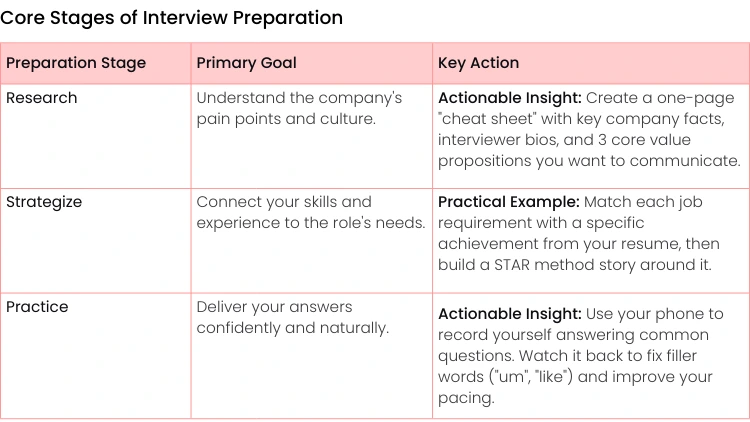
Here’s a quick overview of the key preparation stages we'll cover, designed to give you a clear roadmap for success.
By following these stages, you’ll be ready to handle whatever comes your way. To get an even deeper look at the whole process, this ultimate guide to product manager interview prep is a fantastic resource, with principles that apply across almost any field.
Building Your Pre-Interview Strategy
Winning the interview happens long before you ever walk into the room or join the video call. Let's be honest: the best candidates don't just show up to answer questions. They arrive ready to have a strategic conversation, already armed with a deep understanding of the company's world. This is your chance to shift from being just another applicant to being a potential colleague.
Too many people make the classic mistake of skimming the "About Us" page and calling it a day. If you want to stand out, you have to go deeper. That means breaking down the job description like a puzzle, researching the people you'll be talking to, and getting a real sense of the company's recent wins and current struggles.
Decode the Job Description
Think of the job description as a treasure map. It’s not just a list of tasks; it’s a direct line into the hiring manager’s biggest headaches and top priorities. Your mission is to read between the lines and figure out what problems they're trying to solve.
Actionable Insight: Open a document and create two columns. In the first column, copy and paste every single bullet point from the "Responsibilities" and "Qualifications" sections. In the second column, write a specific, one-sentence example from your career that proves you've done that exact thing.
- Must-Have Skills: These are the non-negotiables. Think proficiency in a specific software, a certain number of years of experience, or a required certification.
- Success Traits: These are the clues about their culture. You'll see words like "self-starter", "highly collaborative" or "adept at handling ambiguity". This tells you what kind of person really thrives on their team.
For every single point on that list, come up with a concrete example from your past. This simple exercise forces you to connect your experience directly to their needs, giving you a library of relevant stories to pull from. It’s a core step that builds on the foundation of your application materials. For more on that, check out this guide on how to write a resume that will actually get a recruiter's attention.
Research Your Interviewers and the Company
Knowing who you're talking to is an absolute game-changer. Head over to LinkedIn and look up your interviewers. Don’t just memorize their job title—that’s amateur hour. Look for common ground: shared connections, the same university, or articles they’ve recently posted or commented on.
Practical Example: You discover your interviewer recently published a LinkedIn post about the challenges of remote team management. You can weave this into your conversation by asking, "I saw your recent post on managing remote teams and it really resonated. How has the team adapted to ensure collaboration stays high while working fully distributed?" This shows you've done your homework and are genuinely interested in their perspective.
It’s a small detail, but it shows genuine curiosity and helps turn a stiff interrogation into a real conversation. And your research shouldn't stop with the people.
First impressions are made in a flash. Research shows that 49% of employers know if a candidate is a good fit within the first five minutes. A staggering 70% point to a lack of preparation as the biggest mistake a candidate can make. This deep dive isn't optional.
Go Beyond the Company Website
To really make an impression, you need to show you understand where the company fits within its industry. This is what separates the good candidates from the great ones.
Here's your intelligence-gathering checklist:
- Recent News & Press Releases: What have they launched lately? Did they just acquire a smaller company or win a big industry award?
- Quarterly Earnings Reports (if they're public): Don't read the whole thing. Just skim the executive summary. What challenges and opportunities are the leaders highlighting to their investors?
- Competitor Analysis: Who are their main rivals? More importantly, what makes this company’s product or service different—and hopefully, better?
- Company Culture: Check out reviews on Glassdoor, but take them with a grain of salt. Look for patterns and recurring themes about the management style, work-life balance, and team dynamics.
This level of preparation is what allows you to answer the classic "Why do you want to work here?" question with substance.
You can go from a weak, forgettable answer to something that makes the interviewer sit up and take notice.
- Before Research: "I'd love to work here because I'm passionate about technology and your company has a great reputation."
- After Research: "I was particularly drawn to your recent launch of Project Nightingale. The way it uses AI to improve customer support efficiency directly aligns with my experience in scaling support teams, and I'm really excited by your commitment to innovation in that specific area."
See the difference? The second answer proves you've done your homework and are already thinking about how you can make an impact.
Answering Interview Questions with Impact
Okay, you’ve done your research and mapped out your strategy. Now comes the moment of truth: answering the actual questions. This is where you need to do more than just list your accomplishments; you have to tell stories that stick.
Many candidates stumble when they get hit with behavioral questions like, "Tell me about a time when..." They end up giving vague, rambling answers that don't land. The key is having a simple framework to turn those anecdotes into tight, powerful narratives that prove your value.
Master the STAR Method for Behavioral Questions
This is exactly what the STAR method was made for. It’s a dead-simple way to structure your answers so you cover all the important points—from the initial context to the final, measurable results. It’s an absolute must-have in your interview prep toolkit.
Here’s how it breaks down:
- S - Situation: Quickly set the scene. Where were you, what was the project? Give just enough context.
- T - Task: What was your specific goal? What were you responsible for achieving?
- A - Action: Describe the exact steps you took. This is your chance to shine and show off your skills, initiative, and problem-solving abilities.
- R - Result: What happened because of your actions? This is crucial: use numbers, percentages, and hard data whenever you can.
Let's see what this looks like in the real world.
Practical Example: Software Engineer
Question: "Tell me about a time you had to resolve a complex technical bug under pressure."
- Situation: "At my last job, we were a week from a major product launch when a critical bug popped up in the payment processing module. It was causing random transaction failures for about 5% of our beta users."
- Task: "As the lead engineer on that module, I had to find the root cause and get a fix deployed without pushing back the launch date."
- Action: "I immediately called a code freeze and pulled two junior devs into a focused debugging session. We worked systematically, testing each piece of the transaction flow and checking recent commits. I eventually traced it to a tricky race condition that only happened under a very specific server load."
- Result: "I developed a patch and had it pushed within six hours. After running it through extensive tests, we confirmed the fix, and the failure rate dropped to zero. We launched on schedule, protecting our projected Q3 revenue."
Practical Example: Project Manager
Question: "Describe a project that was falling behind schedule and how you handled it."
- Situation: "I was managing a client website redesign on a tight, fixed deadline. About halfway through, it became clear the design team was way behind schedule due to some serious scope creep from the client."
- Task: "My responsibility was to get the project back on track without sacrificing quality or, just as importantly, damaging our relationship with the client."
- Action: "The first thing I did was sit down with the client and re-prioritize all the remaining tasks into 'must-haves' for launch and 'nice-to-haves' for later. We agreed to move two of the 'nice-to-have' features into a Phase 2 project. I also started running daily 15-minute stand-ups to keep communication tight and track progress obsessively."
- Result: "Because of that, we launched the core site right on the original deadline. The client loved the transparency and immediately signed on for the Phase 2 project, which actually boosted the total contract value by 20%."
Tackling Tricky Questions with Authenticity
It’s not all about behavioral questions. You'll also get the classics that are designed to test your self-awareness and how you handle a little pressure. The best approach is always honesty, with a positive, forward-looking spin.
"Tell me about yourself."
Resist the urge to just walk through your resume. This is your chance to deliver a quick, compelling "elevator pitch" that connects your past experience to this specific role.
Actionable Insight: Try the "Present-Past-Future" formula.
- Present (1 sentence): "Currently, I'm a Senior Marketing Manager at XYZ Corp, where I lead our demand generation strategy and recently increased MQLs by 30%."
- Past (2 sentences): "Before that, I spent four years at ABC Inc., where I honed my skills in SEO and content marketing. That's where I discovered my passion for using data to drive growth."
- Future (1 sentence): "I'm really excited about this role because it seems like the perfect opportunity to apply my demand generation experience to a new challenge in the B2B SaaS space."
"What is your greatest weakness?"
Please, don't say "I'm a perfectionist". Everyone sees through that. Instead, pick a genuine, minor weakness that you've already taken steps to improve. The goal is to show self-awareness, not a fatal flaw.
Practical Example: "Early in my career, I sometimes struggled with public speaking, especially in large meetings. To address this, I proactively joined Toastmasters a year ago and now I regularly volunteer to present at our department all-hands. While it's still a work in progress, I feel much more confident and have even received positive feedback on my last two presentations."
This kind of answer shows humility and a proactive, problem-solving mindset. If you want to dig deeper into navigating these conversations, checking out some golden tips for answering questions smartly can give you a serious confidence boost.
Mastering Your Delivery Through Practice
You can have the most brilliant, well-researched answers in the world, but if your delivery is shaky, the message gets lost. Confidence isn't something you're born with; it's built through practice. This is where you separate yourself from the pack, turning good answers into a great performance, whether you're in person or on a video call.
Let's be real: hiring processes are getting longer. It now takes an average of 5.5 interviews to land a single job. On top of that, 72% of companies use structured interviews to keep things fair, meaning you'll face similar behavioral questions over and over. Consistent, confident delivery is your ticket to getting through all those rounds.
Run Mock Interviews That Actually Work
Thinking through your answers isn't enough. You have to say them out loud. A mock interview is the single best way to simulate the real thing, forcing you to articulate your thoughts and uncover the gaps in your stories.
- Record Yourself: It feels awkward at first, but using your phone or laptop to record a practice session is invaluable. You'll get undeniable feedback on your pacing, body language, and how many times you say "um" or "like".
- Get a Second Opinion: Ask a mentor, a trusted colleague, or even a friend to play the role of the interviewer. Give them the job description and some common questions so they can give you honest, targeted feedback on where you can improve.
Actionable Insight: Nerves are a top interview killer. Hiring managers say being overly nervous is why 75% of candidates get rejected. The only antidote is repetition. Seriously, aim to rehearse your key stories and answers 10-15 times until they feel like second nature—not like you're reading a script.
For more on this, this guide on how to rehearse and practice to stand out as a master speaker has some great tips.
Prepare Your Own Insightful Questions
Near the end of every interview, you'll hear the inevitable: "So, do you have any questions for us?" Answering "No" is a massive red flag. It signals a lack of genuine interest and curiosity.
This is your chance to turn the tables and interview them. It shows you're not just looking for any job—you're looking for the right one.
Move beyond generic questions. Ask things that prove you've been listening and are already thinking like a member of the team.
Here’s how to level up your questions with practical examples:
- Instead of: "What does a typical day look like?"
- Try: "What is the most immediate challenge or project I would be tackling in the first 30 days if I were to join the team?"
- Instead of: "What are the company's goals?"
- Try: "You mentioned the company is focused on expanding into the European market this year. How will this team's work directly support that initiative?"
- Instead of: "What do you like about working here?"
- Try: "What behaviors do the most successful people on this team consistently demonstrate?"
Thoughtful questions demonstrate that you're engaged, strategic, and already picturing yourself succeeding in the role.
How to Prepare for Different Interview Formats
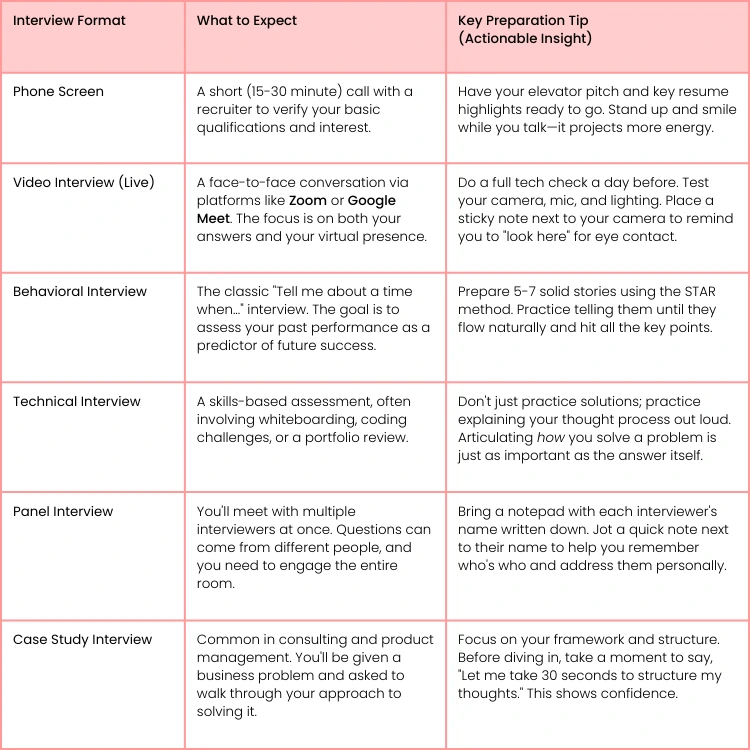
Interviews aren't one-size-fits-all anymore. From quick phone screens to multi-day on-site loops, each format requires a slightly different approach. Knowing what to expect and how to prepare can make all the difference.
Here’s a quick rundown of what you might encounter and how to get ready for each one.
Each format tests different skills, but they all boil down to one thing: showing the interviewer you're the right person for the job. A little targeted prep goes a long way.
Don't Drop the Ball: Post-Interview Follow-Up and Negotiation
Think the interview is over once you hang up the Zoom call or walk out the door? Think again. What you do next is often just as important as the answers you gave. A smart follow-up strategy can be the final push that turns a "maybe" into a "yes".
Too many people fire off a generic "thanks for your time" email and then just sit back and wait. That's a huge missed opportunity. Your follow-up is your last chance to make your case, remind them why you're the perfect fit, and connect one last dot between their problems and your solutions.
Nail the Follow-Up Email
Timing is everything. You need to get that email into their inbox within 24 hours. It has to be quick, professional, and most importantly, personal. Forget the templates—this message needs to reflect the actual conversation you had.
Actionable Insight: Immediately after the interview, spend five minutes writing down the most memorable parts of the conversation. What specific projects were mentioned? What was the interviewer most excited about? Use these notes to personalize your email.
Here is a practical email template you can adapt:
- Subject Line: Thank You - Interview for [Job Title]
- Personalized Intro: "Hi [Interviewer Name], Thank you again for taking the time to speak with me today about the [Job Title] role."
- The Value-Add: "I particularly enjoyed our conversation about [mention a specific topic, e.g., the challenge of scaling your customer support]. It reinforced my enthusiasm for the role, especially since my experience in [mention a relevant skill, e.g., implementing a new ticketing system] led to a 25% improvement in response times at my previous company."
- Enthusiastic Close: "I'm very excited about the possibility of joining your team and am confident I can help you achieve [mention a company goal]. Looking forward to hearing about the next steps."
See how that works? It’s not just "thanks", it’s a tangible reminder of your qualifications and a measurable achievement.
The Art of Talking Money
If your follow-up lands well, an offer is the next step. This is where a lot of people freeze up, but negotiation is a completely normal part of the hiring process. In fact, it's expected. If you just take the first number, you could be leaving serious money on the table.
Actionable Insight: Before an offer even materializes, you should be researching the market rate for your position, experience, and city. Use sites like Glassdoor, Levels.fyi, and the U.S. Bureau of Labor Statistics to arm yourself with data. Create a "target salary" number and a "walk-away" number.
When the salary question inevitably comes up, do your best to avoid naming a number first. Wait until you have a formal offer. You can deflect with something like, "Right now, my main focus is on finding the perfect fit. If we both feel this is a match, I'm confident we can land on a salary that's fair for both of us."
How to Respond to the Offer
Once you have that official offer, the ball is in your court. Thank them genuinely and ask for a day or two to review it. Requesting 24 to 48 hours is perfectly reasonable and gives you time to assess the full package—salary, benefits, bonus, everything—and formulate your counter.
When you do respond, your counteroffer should be rooted in your research and the value you know you'll bring.
Here's a practical, collaborative script to use:
"Thank you so much for the offer. I am very excited about the opportunity to join the team. Based on my research for similar roles in this market, which shows an average salary of [$X], and considering my specific experience with [mention a key skill like 'enterprise software sales'], I was targeting a salary closer to [$Y]. Is there any flexibility to discuss this further?"
This approach is confident but not demanding. It opens a conversation. Negotiation can be tricky, and for a much deeper look, this complete guide on how to negotiate salary is packed with detailed scripts and strategies to help you get paid what you’re worth.

Answering the Tough Questions: Acing the Curveballs
Even the most buttoned-up preparation plan can get rattled by a few tricky questions. Don't worry, it happens to everyone. Let's walk through some of the most common curveballs so you can handle them with confidence and professionalism.
Getting these moments right is less about having a perfect, rehearsed answer and more about showing how you think on your feet. It’s your chance to demonstrate genuine strategic thinking.
How Do I Answer the Salary Expectation Question?
The golden rule is simple: don't be the first to name a number. Your goal is to hold off on the money talk until you have an offer in hand. That’s when you have the most leverage.
When the question comes up, try gracefully redirecting the conversation. Something like this usually works well:
Practical Script: "That's a great question. I'm flexible and open to negotiating once we've determined that I'm the right fit for the role. Right now, I'm most interested in learning more about the opportunity. Could you tell me what the approved salary range is for this position?"
Now, if they gently push back and ask for a number, you need to be ready. This is where your research pays off.
- Offer a Range, Not a Number: Giving a single figure can box you in. Instead, provide a thoughtful range, like "$85,000 to $95,000". This gives you both some wiggle room.
- Justify Your Range: Casually mention that your range is based on market data for similar roles in this area. This shows your expectation is grounded in reality, not just a random number you picked.
This approach proves you’ve done your homework and know your worth, all while keeping the negotiation friendly and professional.
What Is the Best Way to Explain an Employment Gap?
Honesty, brevity, and a positive spin are your best friends here. You want to address the gap head-on, but without sounding defensive or apologetic. The key is to show that you used the time productively.
Practical Example: "After my last role ended, I took a planned six-month break to focus on professional development. During that time, I completed my project management certification and volunteered with a local non-profit to manage their website redesign, which gave me hands-on experience with agile methodologies. I'm now re-energized and excited to apply these new skills here."
Maybe you were traveling, focusing on family, or just recovering from serious burnout. All are perfectly valid.
Your explanation should be a simple, confident statement, not an apology. The goal is to show you are now re-energized, fully committed, and ready to bring your focus back to your career.
When you frame it this way, you control the narrative and show self-awareness—a trait every employer wants to see.
How Should I Handle a Question I Don’t Know the Answer To?
Whatever you do, don't fake it. Authenticity is always more impressive than a made-up answer. Interviewers aren't just testing what you know; they're trying to see how you think and what you do when you hit a wall.
First, just admit you don't know. It’s that simple. Then, immediately pivot to explaining your thought process—how you would figure it out. This is where you can really shine.
Practical Example for a technical question:
"That's a great question. To be honest, I haven't worked with that specific framework before. My approach would be to start with the official documentation to get the fundamentals down. After that, I’d look for established open-source projects that use it to understand best practices in a real-world context, and I'd likely spin up a small personal project to solidify my understanding."
A response like this shows you’re resourceful, methodical, and have a solid process for learning. Those are the skills that really matter, far more than knowing one specific fact off the top of your head.
How Many Questions Should I Prepare to Ask the Interviewer?
Walking into an interview without questions is a major misstep. It signals a lack of interest.
Actionable Insight: A good rule of thumb is to prepare five to seven thoughtful questions. You'll probably only have time to ask three to five, but it’s always good to have backups. Sometimes your best questions get answered naturally during the conversation. Organize them in a notebook under categories like "Team", "Role" and "Culture."
Your questions are your final opportunity to show you're engaged and thinking strategically. Focus on things that reveal what it’s really like to work there.
- On Team Dynamics: "What does a successful first 90 days look like in this role?"
- On Company Challenges: "What are some of the biggest priorities this team is focused on right now?"
- On Growth Opportunities: "What does professional development look like for someone in this position?"
Asking smart questions proves you’re not just looking for any job. It shows you’re picturing yourself on the team and already thinking about how you can make an impact.
At Uplyrn, we believe that mastering skills is the first step toward career success. Our platform connects you with expert-led courses and mentors to help you not only learn the skills but also master the interview process. Explore our courses today and take the next step in your professional journey.


Leave your thoughts here...
All Comments
Reply