









Levels of Management: A Guide to the Management Hierarchy

Every successful organization, from a tiny startup to a global giant, relies on a clear structure to get things done. This structure is built around three primary levels of management: top-level managers who set the grand vision, middle-level managers who turn that vision into actionable plans, and lower-level managers who guide the day-to-day execution. Understanding these levels isn't just theory; it's a practical roadmap for leading teams and growing your career.
Jump To Section

Earn As You Learn
Earn 25% commission when your network purchase Uplyrn courses or subscribe to our annual membership. It’s the best thing ever. Next to learning,
of course.
Understanding the Management Hierarchy
Think of this structure as a pyramid. It’s a time-tested framework that clarifies authority, responsibility, and the flow of information from the top down.
This classic pyramid shape has been the backbone of business for over a century. It's not just some old-school theory, either. As of 2026, this three-tier model still powers a staggering 80% of Fortune 1000 firms. Why? Because it provides a clear chain of command, ensuring that big-picture strategic goals are effectively translated into the concrete tasks that drive results.
The Three Tiers of Authority
At its heart, the management hierarchy is all about organizing roles by their scope of influence and decision-making power. It clearly answers the question of "who does what" from shaping company-wide strategy to managing an individual employee's daily workload.
The core purpose of a management hierarchy is to create a system where strategy is translated into action. Without these defined levels, a company’s vision would remain an idea, lacking the structure needed for implementation.
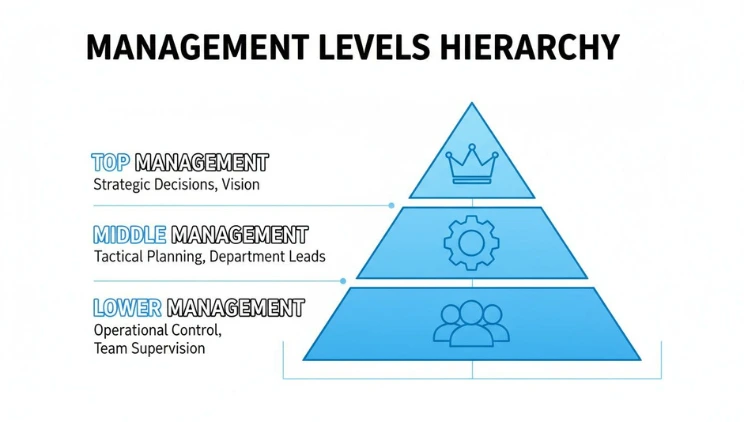
This simple diagram below perfectly illustrates the management pyramid, showing how the top, middle, and lower levels interact.
As you can see, authority and strategic focus are concentrated at the top and then distributed downward. Meanwhile, the number of managers grows at each lower level, forming a broad base for operational execution.
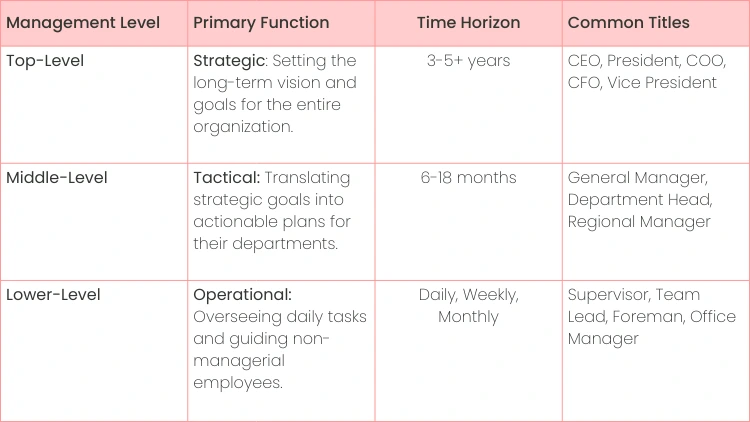
Each tier in this structure comes with its own unique set of duties, which naturally demands a different mix of skills. This relationship between roles and required abilities is what forms a competency framework that guides career progression within a company. This clear separation of duties allows people to specialize and truly excel, whether their job is to steer the ship or to make sure the engines are running flawlessly every single day.
1. Top-Level Managers: The Strategic Architects
Let's start at the very top of the food chain: the C-suite. This is the highest tier in the management hierarchy, and these folks are the big-picture thinkers. Perched at the peak of the organizational pyramid, these are the executives responsible for steering the entire company.
Their world isn't about the nitty-gritty of daily tasks. Instead, they're focused on shaping the future, often looking three to five years down the road. They are the company's strategic architects, defining its mission, vision, and ultimate goals. We're talking about titles like Chief Executive Officer (CEO), Chief Financial Officer (CFO), and President. Their main job is to answer the fundamental question: "Where are we going as a company?"
What Do Top-Level Managers Actually Do?
The decisions made here create ripples across the entire organization, influencing everything from market position to the vibe in the office. These responsibilities are broad and carry some serious weight.
- Setting the Grand Plan: They create the master strategy for the whole organization.
- Practical Example: A retail CEO sees the market shifting and decides the company will pivot from 80% brick-and-mortar sales to 70% e-commerce within five years. That's a top-level strategic decision.
- Managing Outside Relationships: This involves negotiating with major investors, reporting to the board of directors, and engaging with regulatory bodies. They are the public face of the company, and it’s on them to protect its reputation.
- Shaping Company Culture: Top leaders set the tone.
- Practical Example: A CEO who prioritizes innovation and risk-taking will foster a culture where employees feel safe to experiment, whereas a leader focused on efficiency will create a culture centered on process optimization.
- Allocating Major Resources: They have the final say on huge investments. This could mean green-lighting a multi-billion dollar budget for R&D, deciding to enter a new country, or acquiring another company.
A key piece of advice for anyone with C-suite ambitions is to develop a "helicopter view". This is the ability to see the big picture and connect the dots without getting bogged down in the daily grind. Top managers have to anticipate market shifts and spot competitive threats before they become full-blown crises.
The Skills That Make a Strategic Architect
To succeed at this level, your technical skills start to matter less than your ability to think strategically and lead a massive, complex organization. It’s a completely different skill set. For a deeper look into this, check out this guide on what is the strategic planning process.
Here are the must-have skills:
- Visionary Thinking: The ability to see past today’s problems and paint a compelling picture of the future that gets everyone excited.
- Serious Financial Abilities: You have to understand financial statements, investment analysis, and how to allocate capital to make smart, data-driven decisions.
- Decisiveness Under Pressure: The guts to make tough, high-stakes calls, often with incomplete information.
- Inspirational Leadership: The power to motivate thousands of people and unite them behind a shared purpose.
Actionable Insight: If you want to cultivate these skills, start seeking out cross-functional projects that involve long-range planning, budget oversight, or competitive analysis. This experience is vital for building the strategic muscle needed to operate at the top. For instance, volunteer to be on a committee that reviews the company's 3-year plan.
2. Middle Managers: The Tactical Powerhouse
If top-level managers are the architects dreaming up the grand blueprint, who actually gets the building constructed? That falls to the middle managers.
They are the crucial link between the visionary C-suite and the operational frontline. Think of them as the organization's transmission system—they take the broad, long-term strategic goals handed down from above and translate them into real, actionable plans for their departments.
This is the world of tactical execution, where the focus shifts to a shorter timeline, typically from six months to a year and a half. We're talking about roles like General Manager, Department Head, and Regional Director. They are the ones who turn the "what" and "why" from leadership into the "how" and "when" for the teams doing the work.
The Art of Translation and Execution
Middle managers live in a world of specifics. They don’t just get told to "expand into Europe"; they're the ones tasked with drawing the detailed roadmap to make that happen.
Let's look at a practical example:
A software company's leadership sets a strategic goal: "increase market share by 15% in the enterprise segment." The Director of Marketing, a classic middle manager, takes this directive and builds a tactical plan for the next four quarters.
That plan would get very specific, very fast:
- Targeted Campaigns: Launch a new digital advertising push on LinkedIn in Q1, targeting VPs of Operations in the finance sector, followed by a major webinar series in Q2.
- Budget Allocation: Earmark a $250,000 budget for paid ads and get approval to hire two new content creators specializing in B2B case studies.
- Team Objectives: Set clear KPIs for the social media team (e.g., increase engagement by 30%) and the sales development team (e.g., generate 500 new qualified leads per quarter).
- Cross-Departmental Work: Sync up with the product team to ensure marketing messages align with upcoming feature releases and with the sales team to create unified collateral.
This act of translating a high-level goal into measurable, bite-sized actions is the absolute core of what a middle manager does. They are accountable for their department's performance and must constantly have a finger on the pulse, ready to adjust tactics to stay on course. This often means they need to master persuasion and motivation, especially when you have to introduce change to teams.
Middle management is the vital link in the organizational chain. This group often makes up 8-12% of all employees and is directly responsible for the success of nearly 70% of strategy implementation. Yet, the pressure is immense. While training in agile methods can boost team performance by 28%, a staggering 42% of these managers report feeling burnt out from the constant juggling act between upper management and their teams.
Balancing Demands and Driving Performance
A huge slice of a middle manager's job is simply managing relationships—both up and down the chain of command. They have to champion their team's needs to senior leadership while simultaneously ensuring their team meets the expectations set from above. It’s a delicate balance that calls for a unique mix of empathy, sharp communication, and solid project management skills.
Their day-to-day is incredibly diverse and demanding:
- Resource Management: Effectively allocating budgets, people, and technology within their department.
- Performance Monitoring: Tracking team progress against goals and providing constant feedback and coaching.
- Problem Solving: Jumping on departmental roadblocks, whether it's a resource shortage or an interpersonal conflict.
- Interdepartmental Communication: Working with other middle managers to keep the entire organization aligned and moving in the same direction.
Actionable Insight: To improve as a middle manager, practice "managing up". Create a concise weekly or bi-weekly report for your superior that highlights your team's progress, flags potential roadblocks, and proposes solutions. This demonstrates proactive leadership and builds trust.
3. Frontline Managers: The Operational Drivers
While top and middle managers are charting the course and drawing the maps, frontline managers are the ones on the ground, making the journey happen. This is where the rubber meets the road.
Also known as lower-level management, these are your supervisors, team leads, and shift managers. They’re the ones overseeing the day-to-day work, guiding the employees who are actually building the product or delivering the service. Their world is immediate, hands-on, and all about execution.
If a middle manager thinks in terms of months, a frontline manager thinks in hours, days, and weeks. They are the true heartbeat of an organization, directly shaping things like productivity, quality, and even team morale through constant, daily interaction. When problems pop up, they’re the first to see them and the first to act, which makes them absolutely critical for keeping operations running smoothly.
Hands-On Leadership in Action
To really get a feel for their impact, just picture a call center supervisor. Their day isn't about five-year plans; it's about getting results right now and backing up their team in real-time.
A practical example of their day is a whirlwind of activity:
- Creating Daily Schedules: Juggling shifts to cover a sudden spike in call volume due to a product outage, ensuring no agent is overworked.
- Real-Time Coaching: Listening in on a tough call and sending a private chat message to an agent with a specific phrase to de-escalate a frustrated customer.
- Tracking Performance Metrics: Keeping one eye on the live dashboard, noticing that average handle time is creeping up, and quickly huddling with the team to identify the cause.
- Resolving Immediate Problems: Jumping in to fix a CRM glitch that's preventing an agent from logging a ticket or stepping in to mediate a disagreement over break times.
This constant presence is what keeps the engine of the business firing on all cylinders. To dive deeper into the specific responsibilities here, this guide on operational leadership duties offers a much closer look.
Frontline managers directly supervise up to 80% of the workforce. Their effectiveness in coaching, communicating, and motivating has a direct and measurable impact on employee engagement and retention.
Actionable Insights for Excelling on the Frontline
Nailing this role comes down to a specific skill set that’s all about people and process. These managers have to be fantastic communicators, great motivators, and quick problem-solvers. For anyone stepping into their first leadership role, getting a handle on these responsibilities is key. You can find some excellent actionable tips for first-time managers to help you start strong.
Here are a few techniques you'll need to master:
- Effective Time Management: Learn to use a system like the Eisenhower Matrix (Urgent/Important) to prioritize on the fly and handle constant interruptions without losing track of key tasks.
- Practical Coaching: Instead of just saying "do better", use the SBI (Situation-Behavior-Impact) model to give specific, helpful feedback.
- For example: "In the team meeting (Situation), when you presented the data (Behavior), it clearly showed the impact of our work (Impact)."
- Conflict Resolution: Act as a neutral mediator to sort out workplace disagreements. Start by having separate, private conversations with each party to understand their perspective before bringing them together to find a solution.
By getting these areas right, frontline managers do a lot more than just supervise. They build the entire foundation for a productive, positive work environment.
Charting Your Course Through the Management Ranks
Climbing the management ladder isn't a passive waiting game. It's about deliberately building the right skills at the right time. Think of your career like a map—you need to master the terrain you're on before you can successfully navigate the next leg of the journey.
A great way to start, especially if you're stepping into a new leadership role, is by creating a solid 30-60-90 day plan for new managers. This isn't just busywork; it's a strategic tool that forces you to think about how you'll make an impact right out of the gate, setting the tone for your entire tenure.
Your Skill Set Has to Evolve
Here’s a hard truth: the skills that made you a rockstar frontline manager are not the same ones that will get you a seat in the C-suite. As you move up, your focus has to shift. You’ll go from doing the work to delegating it, from technical wizardry to big-picture vision, and from managing tasks to truly leading people.
This is where so many ambitious professionals get stuck. A recent survey highlighted that a staggering 62% of middle managers were held back from promotion simply because they lacked advanced analytics skills. And in today's business world, where 45% of S&P 500 companies have flatter structures, being a master of your specific level—while preparing for the next—is absolutely critical to stay in the game.
The skills you need to focus on will change dramatically as you progress:
- At the Front Line: It’s all about technical expertise—knowing the work inside and out—and having the coaching skills to get the best from each person on your team.
- In the Middle: Your world expands. Success now depends on your interpersonal savvy to manage different teams and personalities, plus sharp project management skills to turn strategy into reality.
- At the Top: Your perspective must be completely strategic. You'll rely on conceptual skills to see the entire board, not just the next move, and the decision-making ability to steer the whole ship.

Essential Skills Across Management Levels
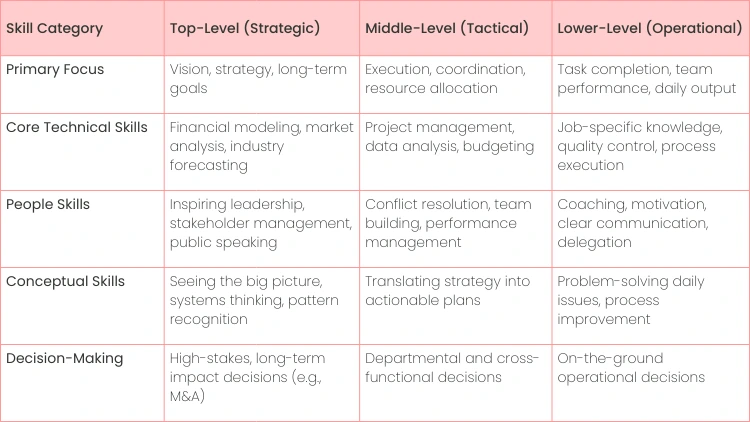
Understanding how these skill requirements shift is key to planning your career trajectory. The table below breaks down the core competencies you'll need to develop at each stage.
As you can see, while some skills are always important, their application and emphasis change drastically. A frontline manager solves today's problems, while a top-level executive is trying to solve problems that don't even exist yet.
How to Proactively Climb the Ladder
If you want to move up, you can't just wait for your boss to send you to a training course. You have to take control of your own development.
The most effective leaders are perpetual students of their craft. They actively seek out challenges that stretch their abilities and force them to think differently, preparing them for the complexities of the next management level.
Actionable Insight: If you're a department head aspiring to a VP role, volunteer for projects that involve M&A due diligence or long-term financial modeling. If you're a team lead aiming for a department head position, put your hand up to lead a cross-functional project that forces you to coordinate with other teams. This is the perfect way to build your influence and demonstrate readiness for the next level.
By charting your own path and intentionally acquiring the skills for the next level, you stop just wishing for a promotion and start building a real career strategy. For more tips on making that jump, don't miss this complete guide on how to get promoted.
How Modern Trends Are Reshaping Management Roles
The classic management pyramid we all know? It’s starting to look a lot less like a pyramid. Big shifts are underway, thanks to the explosion of remote work, the arrival of AI, and a growing taste for flatter, more nimble company structures. These aren't just minor tweaks; they're fundamentally changing what it means to be a manager at every level.
Companies are starting to ditch the old top-down, command-and-control playbook. Instead, they're experimenting with more fluid setups, like agile "squads" or even holacracy, where power is spread out and teams manage themselves. This doesn't mean managers are obsolete—far from it. It just means their job is evolving from a director to an enabler.
The Rise of AI and Human-Centric Leadership
Artificial intelligence has officially entered the chat. AI tools are now taking over many of the routine tasks that used to eat up a manager’s day—things like scheduling, tracking performance data, and even doing the first pass on resumes. This isn't a threat; it's a huge opportunity.
By handing off these administrative chores, AI is freeing up managers to double down on the work that only humans can do.
The future of management is less about being a taskmaster and more about being a coach. As technology handles the 'what', leaders must master the 'who' and 'why'—focusing on mentorship, motivation, and creating a culture of psychological safety.
Future-Proofing Your Management Career
If you want to stay relevant and thrive in this new world, you need to focus on a specific set of future-proof skills. The game is shifting away from just technical oversight and toward emotional and strategic leadership. Here are the skills that matter most now:
- Emotional Intelligence (EQ): This is your ability to read the room, even when the "room" is a Slack channel.
- Actionable Insight: Start practicing active listening in your one-on-ones. Instead of just waiting for your turn to talk, repeat back what you heard ("So, what I'm hearing is...") to ensure understanding and show you're engaged. This builds trust, especially in a remote setting.
- Coaching and Mentorship: The best modern managers don't just hand out orders. They act as coaches. They help their team spot strengths, navigate challenges, and carve out a career path.
- Practical Example: Instead of solving a problem for an employee, ask them, "What are some potential solutions you've considered?" This empowers them and develops their problem-solving skills.
- Digital Fluency: This isn't just about using the latest app. It’s about strategically using tools to improve collaboration and decision-making.
- Practical Example: A manager uses a project management tool not just for tasks, but to create dashboards that give the entire team visibility into progress, fostering transparency and accountability.
By building up these very human skills, you can turn what looks like disruption into a massive career advantage. You'll be ready for what's next, no matter how the world of work evolves.
Frequently Asked Questions About Management Levels
Alright, we've covered the core concepts. But to really bring it all together, let's dig into a few practical questions that always come up when people talk about management hierarchies.
How Many Management Levels Does a Startup Need?
When a company is brand new, it usually has zero formal management levels. The founders wear all the hats—they’re the CEO, the department head, and the team lead all rolled into one.
The first real shift happens when the team grows to about 10-15 people. At this point, it’s just not practical for the founders to manage everyone’s day-to-day work.
- Practical Example: A startup hits 12 employees, and the CTO, who was managing all 8 engineers, can no longer do code reviews and one-on-ones effectively. They promote a senior engineer to be the "Engineering Lead", creating the first frontline management layer.
As the company continues to scale, often hitting the 50-employee mark, middle management starts to take shape. Founders can no longer have their finger on the pulse of every single department. They need to bring in directors who can take the big-picture vision and turn it into tactical, actionable plans.
What Is the Biggest Challenge for Middle Managers?
Without a doubt, the biggest struggle for any middle manager is living in two different worlds at once. They're caught in a constant balancing act, needing to execute the strategic goals passed down from senior leadership while also fiercely protecting and advocating for their own teams.
They are the "translators" of the organization, responsible for turning high-level strategy into concrete action. This requires constantly balancing top-down pressure for results with the bottom-up needs and concerns of their people, a skill that defines their success.
- Practical Example: A Marketing Director gets an ambitious new lead generation target from the C-suite. Their job is to push the team to hit those numbers, but it’s also their job to shield that team from burnout. This means going back to leadership to argue for a bigger ad budget or more headcount to make the goal achievable, rather than just passing the pressure down.
Can You Skip a Management Level When Getting Promoted?
It's technically possible, but it happens very rarely and it's usually not a good idea. Each management level is a training ground for a distinct and absolutely essential set of skills.
- Practical Example: Imagine a star Team Lead who is a technical genius gets promoted directly to a Director role, skipping the middle manager step. They may be brilliant at guiding their old 8-person team but will likely struggle immensely when asked to create a budget for a 50-person department, negotiate resources with other Directors, or translate a vague 5-year strategic goal into a concrete 12-month roadmap. They missed the training ground.
Experience at each stage builds the foundation you need to stand on for the next one. That climb is a necessary part of forging yourself into a truly effective leader.
Ready to build the skills you need for the next step in your management career? Uplyrn offers a complete ecosystem of courses taught by industry experts to help you master everything from operational leadership to strategic planning. Explore our learning paths and start your journey today.


Leave your thoughts here...
All Comments
Reply