









What is Competency Framework? A Practical Guide

A competency framework is essentially the architectural blueprint for your organization’s talent. It’s a detailed plan that defines the specific skills, behaviors, and knowledge your people need to truly excel in any given role. Think of it as translating those lofty company goals into a clear, day-to-day roadmap for what success actually looks like for every single employee.
Jump To Section

Earn As You Learn
Earn 25% commission when your network purchase Uplyrn courses or subscribe to our annual membership. It’s the best thing ever. Next to learning,
of course.
Decoding the Blueprint for Talent and Performance
The easiest way to think about a competency framework is as the official "common language" for performance at your company. Without one, you're left with subjective terms like "good communication" or "strong leadership" which mean different things to different people. A framework strips away all that guesswork.
It creates a structured guide that defines precisely which behaviors and skills add up to a job well done.
So, instead of a fuzzy job description, a role gets defined by concrete competencies. For example, a "Project Manager" isn't just a person who "manages projects". In a framework, they’re defined by competencies like 'Stakeholder Management', 'Risk Assessment' and 'Agile Methodologies'—and each one has specific, observable behaviors tied to it. This kind of clarity is a game-changer for everyone involved.
This structured approach quickly becomes the foundation for almost every part of the employee lifecycle. It helps organizations:
- Hire Smarter: You can map interview questions directly to core competencies. For instance, instead of asking "Are you a team player?", you can ask, "Tell me about a time you had a disagreement with a colleague on a project. How did you handle it, and what was the outcome?" This targets the competency of 'Collaboration' directly.
- Develop Employees Effectively: It shines a spotlight on exact skill gaps, making your training and development efforts far more targeted and impactful. You can dive deeper into this by understanding the modern challenges of upskilling workers.
- Conduct Fairer Performance Reviews: Managers can finally evaluate performance against objective, pre-defined standards. This dramatically reduces bias and helps make feedback much more constructive and actionable. For example, feedback shifts from "You need to be more proactive" to "In Q3, I'd like to see you take the lead on identifying two potential project risks before they escalate, which aligns with our 'Initiative' competency."
From Vague Goals to Tangible Skills
Ultimately, a well-designed framework forges a powerful link between individual effort and the company's biggest strategic goals.
Let’s say a company’s objective is to become more customer-centric. A competency like 'Client Empathy' can be woven into every relevant role, from sales all the way to product development. This simple act ensures that everyone is pulling in the same direction, guided by the same definition of success.
Competency frameworks are also essential for structuring effective learning and development initiatives. They guide the creation of targeted competency-based training programs that build the exact skills needed to hit organizational targets. It’s all about building a workforce that is not just busy, but strategically capable.
The Building Blocks of an Effective Framework
A truly effective competency framework isn’t some monolithic document you create once and forget. It’s a living, breathing structure made of distinct, interconnected parts. Think of it like building with LEGOs—you need different types of bricks, each with a specific purpose, to build something strong that won't fall over.
Each "brick" in your framework represents a different category of skill or behavior that’s essential for someone to succeed at your company. This layered approach means everyone, from a brand-new hire to a seasoned executive, knows exactly what’s expected of them and what their path forward looks like.
This simple pyramid shows how it all fits together: the company's goals set the direction, the framework provides the structure, and individual growth is the ultimate result.
As you can see, everything starts with the big-picture business goals. The framework is built to support those goals, and the foundation of it all is the growth of your people.
The Three Pillars of Competency
Most solid frameworks are built on three fundamental pillars. Each one serves a different purpose, but they all work together to paint a complete picture of what great performance looks like.
- Core Competencies: These are the non-negotiables. Think of them as your company’s cultural DNA—the skills and behaviors that apply to every single employee, no matter their role.
- Practical example: A company that values transparency might have 'Open Communication' as a core competency, expecting everyone from the CEO to an intern to share information freely and honestly.
- Functional Competencies: This is where we get specific. These are the technical, hands-on skills needed to do a particular job well. For a data analyst, it might be SQL Proficiency. For a graphic designer, it’s mastery of the Adobe Creative Suite. These define what it means to be good at the actual job.
- Leadership Competencies: Reserved for anyone who manages or influences others, these skills go beyond day-to-day tasks. They’re all about guiding teams and driving strategy.
- Practical example: A key leadership competency could be 'Talent Development', measured by a manager's ability to create growth plans for their direct reports and track their progress toward promotion.
Bringing Competencies to Life with Proficiency Levels
Just listing out competencies is a good start, but it's only half the battle. To make them truly useful, you need to define proficiency levels. These are basically scales that describe what a competency looks like in action at different stages of someone's development.
A proficiency scale turns a static concept like 'Communication' into a dynamic growth path, showing an employee exactly how to progress from a Novice communicator to an Expert one.
For example, a 'Novice' in 'Project Management' might be able to follow a pre-made plan. An 'Expert' on the other hand, can juggle multiple complex projects at once and even mentor others on how to do it. This kind of clarity is a game-changer for how to identify skill gaps and build development plans that actually work.
By breaking down what "success" looks like into these clear, measurable building blocks, a competency framework stops being a stuffy HR document and becomes a practical, everyday tool for growth.
How to Build Your Competency Framework Step by Step
Building a competency framework from scratch can feel like a massive undertaking. But when you break it down into a clear, manageable process, it’s not so intimidating. Think of yourself as an architect designing a blueprint for talent in your company. The goal is to turn abstract ideas about what "success" looks like into a concrete tool everyone can use to grow.
This step-by-step guide will demystify the process and make it an achievable project for any team.
This isn’t just an HR box-ticking exercise. It's a strategic move that directly links your people's skills to your most important business goals.
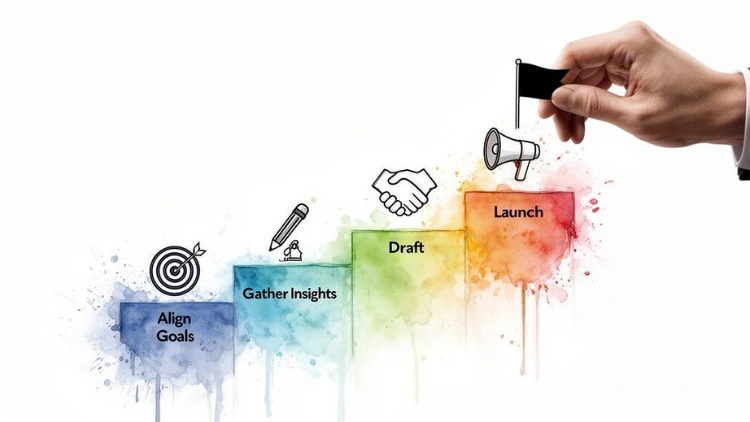
Step 1: Align with Strategic Goals
Before you even think about writing a single competency, you have to start with the "why". What is the business trying to achieve? A framework built without a clear purpose is just another document destined to collect dust on a server somewhere.
- Actionable Insight: Sit down with your leadership team and review the company's 3-year strategic plan. Identify the top three business objectives. If a key goal is to "increase market share through innovation", then your framework absolutely needs competencies like 'Creative Problem-Solving' or 'Calculated Risk-Taking'. This alignment ensures your framework is solving real-world business challenges from day one.
Step 2: Gather Critical Insights
Next, it’s time to figure out what great performance actually looks like in the wild. This means getting out there and gathering information directly from the source—your employees. You're moving from theory to reality here.
Your mission is to pinpoint the specific behaviours that separate your top performers from everyone else. Here’s how you can do that:
- Interview Top Performers: Sit down with your stars and ask them behavioural questions. Something like, "Can you walk me through a time you had to handle a really tough client?" Their stories will reveal the practical skills and actions that lead to their success.
- Conduct Focus Groups: Get managers from different departments in a room to talk about the skills their teams need most, both for today's challenges and for what's coming next.
- Analyze Job Descriptions: Look through existing role descriptions to find common threads and essential technical skills that should be standardized across the board.
This research phase is basically an internal training needs analysis. It gives you a crystal-clear picture of the skills that genuinely drive results. You can learn more about this in this guide on training need analysis and learning development.
Step 3: Draft the Competencies
Once you have all your insights, it's time to start writing. Every competency needs a clear title, a simple definition, and—this is the most important part—behavioural indicators for different levels of proficiency.
A well-written competency describes something you can actually see, not an abstract personality trait. Instead of a vague term like "good communicator", you want something specific, like "Clearly articulates complex ideas to diverse audiences and checks for understanding".
Let’s take a 'Project Management' competency as an example. The proficiency levels might look something like this:
- Level 1 (Foundational): Follows project plans and gets their assigned tasks done on time.
- Level 2 (Intermediate): Manages small projects on their own and can spot potential risks.
- Level 3 (Advanced): Leads complex projects that span multiple teams and mentors junior team members.
Step 4: Validate with Stakeholders
After you’ve got a solid draft, it's absolutely crucial to get feedback. A framework built in a silo is doomed to fail because nobody will feel any ownership of it. Share your draft with managers, department heads, and even a small group of employees.
- Actionable Insight: Create a simple survey using a tool like Google Forms or SurveyMonkey. Send the draft framework to your stakeholders and ask them to rate each competency on a scale of 1-5 for "Relevance" and "Clarity". This gives you quantitative data to guide your revisions and demonstrates that you value their input.
Step 5: Launch and Communicate
You're at the finish line—it's time to launch! A successful rollout is all about having a clear communication plan. You need to explain what the framework is, why it was created, and how it will be woven into performance reviews, career pathing, and training initiatives.
Make sure you train your managers on how to use it effectively in conversations with their teams. This final step is what transforms your framework from a simple document into a living, breathing part of your company culture.
Real-World Examples of Competency Frameworks in Action
Theory is one thing, but seeing a competency framework in action really makes the concept click. Let’s move beyond the abstract ideas and look at two detailed, real-world examples for a couple of very different roles. This will show you exactly how a framework provides a clear path for growth, bridging the gap between a job title and what it truly takes to succeed.
These examples really bring to life how different competencies weave together to define a successful professional.
Customer Support Specialist Framework
For a Customer Support Specialist, the focus shifts dramatically toward people skills and quick, effective problem-solving. Sure, technical knowledge is important, but core competencies like empathy and communication are what separate an average agent from an exceptional one.
The framework for a support role has to find a way to measure the "soft skills" that directly impact customer satisfaction and retention. It turns abstract qualities like 'empathy' into real, observable behaviors.
Let’s break down what this looks like:
- Core Competency: Empathy: At a basic level, this just means actively listening without interrupting. But at an advanced level, it’s about proactively spotting a customer's underlying frustrations and validating their feelings before even offering a solution.
- Practical example: A Level 3 specialist might say, "I can see how frustrating it must be to have this issue disrupt your workflow. Let's solve this together so you can get back on track."
- Functional Competency: Technical Troubleshooting: A rookie can follow a script to solve common problems. An expert, on the other hand, can diagnose brand-new, complex issues and then document that solution for the entire team, making everyone better.
By defining these competencies, a company creates a clear, consistent standard for what excellent service looks like. This approach is absolutely essential for creating effective employee training program examples that develop the specific skills tied directly to customer success.
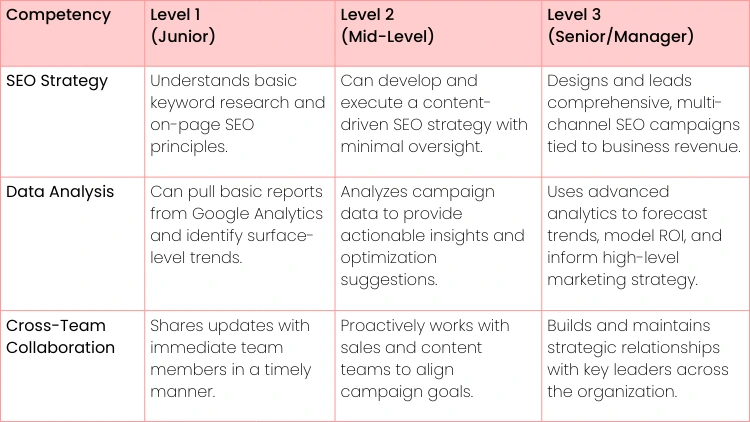
Digital Marketing Manager Framework
A Digital Marketing Manager has to be a jack-of-all-trades, blending sharp technical skills with strategic thinking and a bit of leadership. Their framework needs to reflect this, mapping out not just their marketing expertise but also their ability to guide a team. A well-built plan helps them grow from just doing tasks to actually driving strategy.
Here’s a simplified look at what their key competencies and proficiency levels could look like. This isn't just a list of skills; it's a career roadmap. It shows a marketer exactly what behaviors they need to master to move up from a junior role to a senior leadership position.
The Business Impact of a Well-Designed Framework
Implementing a competency framework isn't just another HR initiative to check off a list. It's a serious strategic investment, and when done right, it pays dividends across the entire business.
By creating a shared, crystal-clear language for what "good" looks like, you fundamentally change how you hire, develop, and manage your most valuable asset—your people. It’s the connective tissue between individual skills and high-level company goals, creating a powerful engine for growth that you can actually measure.
The impact for the organization is often immediate. Hiring decisions start shifting from "gut feelings" to objective, data-backed choices, which leads to better long-term fits. Training dollars are no longer scattered; they become laser-focused on plugging the exact skill gaps holding your teams back. This kind of clarity is also a game-changer for building more equitable and effective performance management best practices.
Fueling Organizational and Individual Success
A well-designed framework completely removes the guesswork from career progression, a major factor in keeping your best people engaged and on board. When employees can see a clear path forward, they're empowered to take control of their own development.
They can proactively spot the skills they need for that next role, turning their personal ambition into a direct win for the company.
A transparent competency framework demystifies career paths. It acts as a GPS for employees, showing them not just where they are, but the exact route they need to take to reach their desired destination within the organization.
This clarity ultimately builds a more adaptable, forward-thinking workforce that’s ready to tackle whatever challenges come next.
The Shift Towards Skills-Based Talent Strategy
The data backs this up. There's a major strategic shift happening, and competency frameworks are right at the center of modern talent strategy.
Recent surveys paint a pretty clear picture:
- 69% of U.S. employers now endorse industry-led frameworks.
- A staggering 73% are using talent analytics to sharpen their hiring processes.
This move is so significant that 34% now prioritize proven competencies over traditional college degrees, and 42% are actively exploring skills-based hiring models.
The takeaway for professionals and the companies training them is simple: aligning learning with these frameworks is no longer a "nice-to-have". It's the key to boosting employability and career mobility in a market where skills have become the new currency.
Turning Your Framework into a Growth Engine with Uplyrn
A competency framework sitting in a shared drive is just a well-organized document. To really get value out of it, you need to turn that map into an active, living growth engine for your team.
This is where a learning platform like Uplyrn comes in. It’s the crucial link that transforms your framework from a static PDF into a dynamic tool for day-to-day development.
It all starts by mapping the competencies you’ve defined directly to real-world learning opportunities. Suddenly, abstract skill requirements are connected to concrete, actionable steps, giving employees a clear path to close their skill gaps.
From Skill Gaps to Learning Paths
Picture this: an employee's development plan shows they need to get better at "Advanced Data Analysis". Instead of just pointing it out and leaving them to search for solutions, a manager can use Uplyrn to build a personalized learning path that perfectly mirrors the framework's proficiency levels.
It could look something like this:
- Foundational Level: Kick things off with an introductory course on "Data Visualization with Power BI".
- Intermediate Level: Level up with a practical, hands-on course like "SQL for Data Analysts".
- Advanced Level: Reach the top with an expert-led course on "Predictive Modeling in Python".
This approach completely removes the guesswork. It gives employees a clear, step-by-step journey for building new skills and empowers them to take real ownership of their professional growth.
By directly linking each competency to a curated set of courses, managers can create personalized development plans that are both meaningful and measurable, turning good intentions into tangible skills.
Bridging the Implementation Gap
A well-integrated system is what makes your competency framework initiative actually stick. While these frameworks are incredibly powerful, their rollout in formal education has been surprisingly slow. One study found that only about 40% of secondary schools in OECD countries systematically use them.
Platforms like Uplyrn help close this gap in the corporate world by embedding skills-focused learning right into an employee's workflow.
When you connect your framework to a learning ecosystem, you create a powerful feedback loop. Managers can assign relevant training, track an employee's progress, and see the direct impact on performance. This ensures your framework doesn't just sit on a shelf—it becomes a living, breathing blueprint for talent development.
Common Questions About Competency Frameworks
Even with the best-laid plans, a few questions always bubble to the surface when you start building a competency framework. Let's get ahead of them and tackle the most common ones right now.
Answering these early on helps everyone feel more confident and keeps the project moving smoothly.
How Long Does It Take to Build a Framework?
This is the classic "how long is a piece of string?" question. The honest answer? It depends.
A nimble startup could probably map out its core framework in a few weeks. But a large, global company with hundreds of distinct roles might spend six months to a year getting it just right, from the initial research all the way to the final sign-off.
The most important thing is not to rush. A framework that’s pushed through too quickly, without real input from your top performers and managers, will just gather dust.
Is This Only for Large Corporations?
Not at all. While big companies often have dedicated HR teams to spearhead these projects, the underlying idea is valuable for businesses of any size.
Even a small company can get a massive amount of clarity by defining the core competencies that truly matter to its culture and the handful of critical skills needed to succeed.
Think about a small design agency, for example. They could build a simple framework around competencies like 'Client Communication' and 'Creative Innovation'. It provides the exact same clarity for hiring, feedback, and growth as a hundred-page corporate document—just on a different scale.
How Often Should a Framework Be Updated?
Your competency framework should be a living, breathing document, not something you carve in stone and forget about.
A good rule of thumb is to plan a review annually, or anytime your business makes a major strategic shift.
- Actionable Insight: Schedule a recurring annual meeting with key department heads specifically to review the competency framework. Before the meeting, ask them to identify one competency that has become more critical in the past year and one that has become less relevant. This focused approach makes the update process efficient and ensures the framework evolves with the business. For example, if your company decides to lean heavily into AI-powered products, you'll need to update it with new competencies like 'Machine Learning Principles' and 'Data Ethics'.
Ready to turn your competency framework into a powerful engine for growth? With Uplyrn, you can map skills to targeted courses, creating clear development paths that empower your team and drive real business results. Discover how Uplyrn can activate your talent strategy today!


Leave your thoughts here...
All Comments
Reply