




Online Courses for Career Change: Your Practical Guide

Online courses can be an incredible tool for changing careers, offering a flexible and direct path to gaining new professional skills. But they work best when they're part of a real strategy—one that starts with what you already bring to the table and targets specific, in-demand jobs. Taking this approach means you're investing your time and money wisely, in learning that actually leads to a new job offer.
Jump To Section

Earn As You Learn
Earn 25% commission when your network purchase Uplyrn courses or subscribe to our annual membership. It’s the best thing ever. Next to learning,
of course.
Build Your Foundation for a Successful Career Shift
Thinking about a career change can feel huge, even a little scary. But a successful switch starts with a solid foundation, not a blind leap of faith. Before you even type "online courses" into a search bar, the most important work happens right where you are: looking inward to take stock of the valuable assets you already have.
This isn't about fluffy advice like "follow your passion". It’s about a practical, strategic audit of your professional self.
This first phase will guide every decision you make from here on out, making sure the online courses for career change you pick are deliberate investments, not just hopeful guesses. The goal is to draw a clear map from where you are today to where you want to be tomorrow.
Start with What You Already Have
Every job you've ever had—no matter the industry—has given you transferable skills. These are the core abilities you can apply across different roles and sectors. The trick is to identify them, reframe them for the career you want, and see how they give you a running start.
For example, think about these real-world scenarios:
- A retail manager isn't just managing a store; they have deep experience in inventory control, team leadership, and customer conflict resolution. Those are gold for a role in operations or project management.
- A teacher is a master of curriculum development, public speaking, and communicating with stakeholders. That experience translates perfectly to corporate training or instructional design.
- A sales professional has honed their skills in client relationship management and persuasive communication, both of which are highly sought after in account management or product marketing roles.
A huge mistake people make is thinking they have to start from square one. Your past experience isn't a setback; it's your unique advantage. When you map your existing skills to the needs of a new field, you build a bridge that makes your career change feel logical and compelling to a future employer.
To get a better handle on this, it's worth digging into the career changer's dilemma, which offers great strategies for finding your next role without starting from scratch.
Research with a Purpose
Once you have a clear inventory of your skills, your research becomes focused and way more effective. Instead of aimless searches like "best jobs for career changers", you can start looking for roles where your existing strengths create a natural fit. This simple shift moves you from being a passive job seeker to an active career strategist.
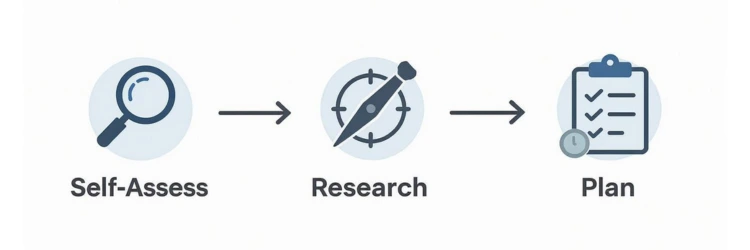
The process below breaks this foundational work into three simple, actionable stages.
This visual roadmap drives home the point: a successful career shift is built on a sequence of self-assessment, targeted research, and deliberate planning—all before you start learning anything new.
This kind of foundational work is backed by what's happening globally in online education. Many people are using specialized online programs to make moves into new fields without having to start over completely. Learners often report major career benefits, like getting a promotion or landing a new job, after finishing professional certificates.
This self-directed learning is powerful, but it needs a structured approach to work. You can find more tips on how to learn effectively in the flow of work.
How to Choose Courses That Employers Actually Value
With a sea of online courses out there, picking the right one can feel impossible. The trick isn't just to find a course; it's to find one that teaches skills employers are actively paying for. You have to learn to see past the flashy marketing and figure out if a program has real substance.
Your goal is to walk away with skills you can prove, not just a PDF certificate. An employer isn't going to be wowed by a course title. They want to see what you can actually do. That’s why how you evaluate your options is so important.
Differentiating Credentials That Count
Not all online credentials are created equal. Knowing the difference helps you match a program to your specific goals and the time you're willing to commit.
- University-Branded Certificates: These are fantastic for building credibility and foundational knowledge.
- Practical example: A certificate in "Foundations of Project Management" from a university partner on edX can give a former administrative assistant the formal language and frameworks to pivot into a project coordinator role.
- Intensive Bootcamps: Think of these as fast-tracked, immersive programs designed to get you job-ready in a specific, high-demand role like a developer or UX designer. Their real value is in the project-based curriculum and direct career support.
- Practical example: A 12-week coding bootcamp where you build and deploy three full-stack web applications is designed to make you hirable immediately.
- Specialized Micro-Credentials: These are short, laser-focused programs that teach one specific skill, like mastering Google Ads or learning a particular programming framework. They're perfect for plugging a very specific gap on your resume.
- Practical example: A marketer with strong content skills could take a 4-week "Google Analytics 4" micro-credential to add a quantitative, in-demand skill to their profile.
People are re-skilling in huge numbers. Post-pandemic, applications for some work-based training programs shot up by 58%. It's clear that professionals are taking their development into their own hands, and employers are taking notice of these alternative credentials.
The Litmus Test: Theory vs. Application
This is it. This is the single most important question you need to ask when looking at online courses for a career change: Does it teach you theory, or does it force you to apply it? A hiring manager will always, always choose the candidate who has built something over the one who has only read about it.
The ultimate goal of any course you take is to produce tangible proof of your skills. If a course curriculum doesn't end with a project you can proudly add to a portfolio, it’s probably not the right one for your career transition.
Put yourself in the hiring manager’s shoes. Who sounds more impressive?
- Candidate A: "I completed an 'Introduction to UX Design' course online".
- Candidate B: "I completed a UX Design Specialization where I designed, prototyped, and user-tested a mobile app concept for a local coffee shop".
Candidate B gets the interview every single time. They didn't just learn—they did. As you weigh your options, first identify the essential skills employers actually value and then hunt down the courses that make you practice them through hands-on work.
Your Course Evaluation Checklist
Before you pull out your credit card, run every potential course through this checklist. It’s designed to help you see beyond the sales page and focus on what will actually help you land a job.
- Check the Final Project: Is there a mandatory capstone or final project? Does it mirror a task you’d actually do in your target role? If you're learning to code, you need to ship a project. For a closer look at this, this guide on how to learn coding fast and get hired is a great resource.
- Investigate the Instructors: Who’s teaching? Are they career academics, or are they industry pros with recent, relevant experience?
- Actionable insight: Search the instructor's name on LinkedIn. If their current job title is "Senior Product Manager at Spotify", they'll likely teach practical, modern skills. If their last relevant role was 10 years ago, the curriculum might be outdated.
- Do a Curriculum Reality Check: Grab three real job descriptions for the role you want. Now, compare the skills and tools they list to the course syllabus. If you don't see at least an 80% overlap, that course might not be specific enough to make you a truly competitive applicant.

Turn Your Course Certificate Into a Job Offer
Finishing an online course is a huge win—definitely something to be proud of. But it's really the starting line, not the finish line. A certificate proves you've learned something new. Now you have to prove you can do something with that knowledge.
This is where the real work begins. It's time to translate all that theory into tangible proof that convinces a hiring manager you’re the right person for the job. You'll need to build a portfolio that does the talking for you.
From Theory to Tangible Projects
Let's be clear: a portfolio is just a collection of your work that shows off your skills. For anyone changing careers, this isn't optional. It’s the single most powerful tool you have to overcome a lack of direct, on-the-job experience.
The key is to create projects that look like the real-world tasks you'd be doing in your target role. Don't wait around for someone to give you an assignment. Get proactive and create your own opportunities to put those new skills to the test.
Practical Project Ideas to Get You Started
- For Aspiring Data Analysts: Grab a compelling public dataset from a site like Kaggle or Data.gov. Clean it up, find some interesting trends, and then build a visualization dashboard in Tableau or Power BI to show what you found.
- For Future Digital Marketers: Find a small local business or a nonprofit that could use some help online. Offer to develop a basic content strategy for them, run a small, targeted social media campaign, and use Google Analytics to track and report on the results.
- For Aspiring UX/UI Designers: Pick a popular app you use every day and find a problem with its user experience. Go through the whole design process—create user personas, map out user flows, wireframe a better solution, and build a clickable prototype in Figma or Adobe XD.
- For Budding Software Developers: Build a simple web app that solves a personal problem. It could be a budget tracker, a workout log, or a tool to organize your favorite recipes. The complexity doesn't matter as much as showing you can build, debug, and deploy something that actually works.
Showcasing Your Work Where It Counts
Once you’ve got a few solid projects under your belt, you have to display them where people will see them. Think of your resume and LinkedIn profile as your marketing brochures, and your portfolio projects are the star products.
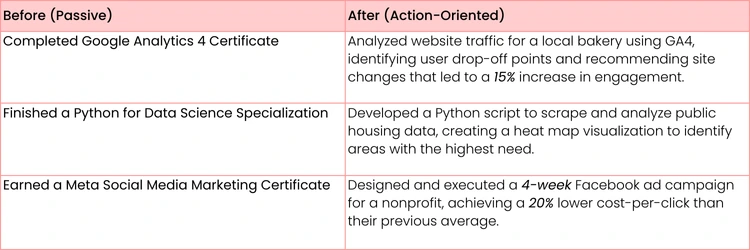
It’s not enough to just list the certificate you earned. You have to translate that learning into an accomplishment that shows real impact.
The best way to stand out is to quantify your results. Don't just say you "managed a social media campaign". Instead, say you "grew an Instagram account's engagement by 25% over three months by implementing a new content strategy". Numbers grab attention and prove your value.
This shift in how you frame your experience separates passive learners from proactive job candidates. And companies are catching on. According to a recent analysis, 73% of companies plan to increase their online learning budgets, showing just how much they value practical, skill-based education. Platforms that focus on skills-based learning are perfect for career changers because they provide the exact kind of portfolio-ready work employers are looking for.
Translating Projects Onto Your Resume
Your resume is prime real estate, so don't waste any of it. Instead of generic course descriptions, create a dedicated "Projects" section to highlight your hands-on work.
The image below shows how you can reframe a certificate into a resume bullet point that packs a punch. This approach connects what you learned directly to a business outcome, which is exactly what hiring managers want. For more tips on this, take a look at this guide on how to write a resume that will actually get a recruiter's attention.
By building and showcasing your projects effectively, you’re no longer just a candidate with a certificate. You're a problem-solver with proven skills.
Build Your Network While Still Learning
Your online course isn’t just a classroom; it’s your first door into a new professional world. We’ve seen so many career changers make the mistake of learning in a bubble, only to realize they have zero industry connections when it's time to job hunt. Don't let that be you.
The smartest thing you can do is start building your network the same day you start your course. This isn't about awkwardly hitting people up for jobs. It's about building real relationships, getting priceless advice, and becoming a familiar face in your new field long before you even think about applying for a role.
Engage Where the Experts Are
Your new professional community is already out there online; you just need to jump in. Course forums and industry-specific groups are absolute goldmines for connections and learning, but only if you approach them the right way.
The goal is to be an active, helpful participant. Don't just ask questions—answer them when you can. Share cool articles you find. Offer thoughtful feedback on another student’s project. This simple strategy gets you noticed by instructors and TAs, who are often well-connected professionals themselves.
Beyond your course, you need to find the virtual water coolers for your new field:
- Slack and Discord Communities: Search for groups dedicated to your new career (think "UX/UI Designers" or "Data Science Hangout"). These are amazing places to get advice on tools, find people to collaborate with, and even hear about jobs that aren't posted anywhere else.
- LinkedIn Groups: Join groups centered around your target industry or role. Jumping into discussions here boosts your visibility and shows that you're serious about your craft.
Master the Art of the Informational Interview
One of the most powerful—and underused—networking tools is the informational interview. It’s a quick, 20-minute chat where you’re not asking for a job, you’re asking for advice. You’d be surprised how generous people are with their time when the pressure is off.
Your goal for an informational interview is simple: get one piece of advice and one new contact. Approaching it this way makes the conversation feel authentic, not transactional. It shows you respect their time, which dramatically increases your chances of getting a "yes".
When you reach out on LinkedIn, keep your message short, professional, and clear. Here’s a template we’ve seen work time and time again:
Subject: Aspiring [Your New Role] Seeking Advice
"Hi [Name], I found your profile and was really impressed by your work on [Specific Project or at Company]. I'm currently taking online courses for a career change into [Your New Field] from [Your Old Field] and would love to ask you a few questions about your journey. Would you be open to a quick 20-minute chat sometime? I'm keen to learn from your experience."
This approach proves you've done your homework and value their expertise. For a deeper dive, check out this complete guide on how to network effectively for more strategies.
Get Hands-On Experience Immediately
The absolute fastest way to build your network and your portfolio is to start doing the work, even on a small scale. Getting practical experience while you're still learning validates your new skills and gives you tangible results to talk about.
Look for chances to apply your knowledge right away:
- Volunteer for a Nonprofit: Many charities operate on a shoestring budget and would be thrilled to get help with digital marketing, a website refresh, or data analysis.
- Offer Freelance Services: Hop on platforms like Upwork or Fiverr to find small, manageable projects. A single successful gig gives you a client testimonial, a portfolio piece, and a professional reference.
- Seek Micro-Internships: These are short-term, paid projects that let you contribute to a real company. They're a fantastic way to get a foot in the door.
Let's say you're learning digital marketing. You could offer to run a small Google Ads campaign for a local animal shelter. In just a few weeks, you've gained practical campaign management experience, have hard numbers for your portfolio, and earned a glowing reference. That’s a powerful trifecta that can seriously accelerate your career change.
All your hard work—completing courses, building a portfolio, and connecting with people in your new field—has led you to this moment. It's time to turn that preparation into a job offer. But let's be real: the job search looks a little different when you're switching careers. You can't just follow the same old playbook.
Your job is to be the narrator of your own career story. Your resume, cover letter, and interview answers need to work together, painting a clear picture of why this change isn't just a random jump, but a deliberate, powerful next step.
Reframe Your Resume to Lead With Strength
If you’re changing careers, the standard chronological resume is your worst enemy. It makes recruiters sift through years of experience that seems irrelevant before they find the gold: your new, hard-won skills. We need to flip that script.
The fix? Lead with a powerful Summary of Qualifications or Professional Profile right at the top. Think of this section, placed just below your name and contact info, as your personal highlight reel.
Forget the outdated "Objective" statement. Use this prime real estate to show off your most relevant new skills, key projects, and the specific value you bring to this new field. It should be a punchy, 3-4 bullet summary that immediately tells the recruiter, "Yes, this person is qualified for this job."
Let's see it in action:
- Weak Opening: "Seeking a challenging role in digital marketing to utilize my skills." (Generic, passive, and tells them nothing.)
- Strong Opening: "Certified Digital Marketing Professional with demonstrated expertise in SEO, PPC campaign management, and Google Analytics. Proven ability to drive user engagement, evidenced by a project that increased website traffic by 15% for a local business. Eager to apply data-driven marketing strategies to boost brand visibility and ROI."
See the difference? This approach grabs their attention and establishes your credibility before they even glance at your previous job titles.
Write a Cover Letter That Tells Your Story
Your cover letter is where you get to connect the dots. Don't be shy about your career change—own it. A great cover letter for a career changer weaves a narrative that makes your transition feel intentional, logical, and incredibly valuable to the employer.
Here’s a simple framework to build your story:
- The Hook: Kick things off with genuine enthusiasm for their company and this specific role.
- Example: "I've been following Acme Corp's innovative approach to sustainable packaging for months, and I was thrilled to see the opening for a Junior Marketing Coordinator."
- The Bridge: Briefly explain your transition. "After a successful career in [Old Field], I found a real passion for [New Field]. I committed myself to mastering the core skills through [mention your online course or key project]."
- The Proof: Directly connect your new skills to what they're asking for in the job description. "My recent project building [mention project] gave me hands-on experience with [Skill 1] and [Tool 2], both of which I see are key requirements for this position."
- The Unique Value: Show them how your old career gives you an edge. "My background in [Old Field] really sharpened my ability to [mention a transferable skill like client management or strategic planning], and I'm confident that brings a unique and valuable perspective to your team."
This isn't just a cover letter; it's a story of deliberate growth, and you're the hero.
Answering the Toughest Interview Questions
The interview is where your story truly comes to life. As a career changer, you can bet you’ll get a few specific questions. Nailing your answers with confidence and authenticity is crucial. Let’s tackle the two big ones.
Question 1: "Why Are You Changing Careers?"
This question is a gift. It's an open invitation to share your compelling story. Your answer should always be positive and forward-looking. Focus on the pull of the new field, not the push from your old one.
- Bad Answer: "I was bored and burned out in my old job. I just needed a change."
- Good Answer: "While I gained a lot of valuable experience in [Old Field], I found myself increasingly drawn to the problem-solving and creative challenges in [New Field]. I started taking online courses for a career change to explore that interest, and I quickly realized my analytical skills were a perfect match. I'm genuinely excited to apply my abilities to a role where I can build [mention a specific outcome, like 'more intuitive user experiences']."
Question 2: "How Will Your Past Experience Help You Here?"
This is your chance to shine and showcase your unique value. The key is to draw a direct line from your transferable skills to the needs of the new role.
- Real-World Scenario: A former teacher interviewing for a corporate trainer position.
- Answer: "As a teacher, my entire job was to break down complex subjects into lessons that were easy to understand and to manage a room full of diverse learners. That experience is directly applicable to corporate training. I know how to develop engaging curriculum, adapt my communication style for different audiences, and make sure new information actually sticks."
By mastering these parts of your job search, you're no longer just a "career changer". You're a strategic, motivated, and uniquely qualified candidate who brings a whole lot more to the table than just a certificate.

Common Questions About Changing Careers with Online Courses
So, you're thinking about making a big career move using online courses. It’s a huge step, and it’s totally normal to have a ton of questions swirling around. Let's tackle some of the most common ones we hear from people just like you.
Think of this as your practical FAQ, designed to give you some clarity and confidence as you get started.
How Long Does a Career Change Take?
This is the big one, isn't it? The honest answer is: it depends. Your timeline for using online courses for a career change hinges on where you're headed and how much time you can realistically carve out each week.
For roles in fields like digital marketing or UI/UX design, you could be job-ready in about 6 to 12 months. That usually means buckling down for 10-15 hours a week to get through a solid bootcamp or a few professional certificates.
If you're aiming for something more technical—say, software development or data science—you should probably plan for a longer runway. Think more in the range of 12 to 18 months. That extra time isn't just for learning; it's for building the kind of complex, impressive projects that make hiring managers sit up and take notice.
Are Online Course Certificates Respected?
Yes, but there's a huge "but" here. The certificate itself isn't the prize. The skills and projects it represents are what really matter to employers.
Think of it this way: a certificate from a well-known platform gets your foot in the door. It shows you’re serious and have foundational knowledge. But your portfolio is what will carry you across the finish line. It's the proof that you can actually do the work.
When a hiring manager is looking at two candidates, they aren't just comparing certificates. They're comparing portfolios. The person who can show them a working web app or a live data dashboard they built from scratch will win every time.
We dive even deeper into this topic in this guide on how to change careers successfully.
How Do I Choose the Best Course?
Don't just jump into the first course that looks good. Start by playing detective. Pull up a handful of job descriptions for the role you want and find the top 3-5 core skills that show up again and again. That's your shopping list.
With that list in hand, here’s how to find the right program:
- Look for Projects, Not Just Quizzes: Find courses that make you build something real, like a final capstone project. This is the fastest way to get those crucial portfolio pieces.
- Vet Your Instructor: Hop on LinkedIn and check out the instructor's background. Are they a career academic, or are they actually working in the field? For a career switch, learning from someone who lives and breathes this stuff every day is a game-changer.
- Find the Real Reviews: Don't just rely on the shiny testimonials on the course website. Dig into Reddit threads and industry forums to get the unfiltered, honest opinions of other people who've been in your shoes.
Can I Get a Job Without a Degree in the New Field?
Absolutely. This is especially true in tech and digital industries where skills-based hiring is the new norm. Most companies are far more interested in what you can do than what your diploma says.
Your portfolio, your performance in a technical interview, and your ability to talk intelligently about the projects you've built are what will land you the job. Plus, don't discount your old career! When you frame it correctly, all that experience in things like communication, project management, or client relations becomes a huge asset that makes you stand out from the crowd.
Ready to stop thinking and start doing? At Uplyrn, we've got the courses, expert mentors, and job opportunities to help you make your career change a reality. Check out our programs and let's start building your future today.


Leave your thoughts here...
All Comments
Reply