









Finding the Best Online Job Training Programs That Work

Online job training programs are all about getting you the specific, in-demand skills that employers are looking for right now. Forget the long-winded theory you might remember from traditional schooling. These programs are a direct bridge from where you are to where you want to be in your career.
Jump To Section

Earn As You Learn
Earn 25% commission when your network purchase Uplyrn courses or subscribe to our annual membership. It’s the best thing ever. Next to learning,
of course.
What Are Online Job Training Programs
Think of these programs less like a university degree and more like a specialized career launchpad. Instead of spending years covering a wide range of subjects, you're zeroing in on the exact skills needed for a specific job. Whether you're trying to climb the ladder in your current field or pivot to a completely new one, these programs are built for tangible results.
A marketing professional, for example, might take a deep dive into a digital advertising program to master Google Ads and Meta campaigns. The actionable insight here is to find a program that mirrors the exact tasks in your target job description. Or, a retail worker could complete a cybersecurity bootcamp and step into a high-demand tech career. It's all about cutting through the noise and getting straight to the expertise you need.
A Modern Path to Career Growth
It's no secret that people are hungry for this kind of flexible, skill-focused learning. The global online education market is expected to hit a staggering US$221.71 billion by 2026. This isn't just a niche trend; it's a massive shift driven by professionals and companies who need efficient ways to stay competitive. It’s clear that both individuals and their employers see huge value in this kind of targeted training.
This move toward continuous learning is completely changing how we build our careers.
The core idea is simple but powerful: invest a few months in focused learning to unlock years of career advancement. These programs are about gaining momentum and achieving your goals much faster than traditional routes allow.
The Focus on Practical Application
What really makes these programs different is the heavy emphasis on doing, not just knowing. You're moving from being a passive student to an active builder. For anyone looking to upskill, understanding the practical side of training employees online helps to see why this model is so effective.
Here’s what that hands-on focus actually looks like in practice:
- Project-Based Learning: You don't just read about coding; you build a real, functioning app.
- For example, a data science student might analyze a real-world dataset from a company to predict customer churn, a project they can feature on their resume.
- Industry-Standard Tools: You get your hands dirty with the same software and platforms professionals use every single day, from Salesforce to the Adobe Creative Suite.
- Real-World Scenarios: The entire curriculum is designed around solving the kind of problems you’ll actually face on the job. No hypotheticals here.
This hands-on approach means you graduate with more than just a certificate. You leave with a portfolio of real work and the confidence to start contributing from day one. To get a better feel for how this all comes together, check out this guide on the digital era of courses, learning, and teaching. This is exactly why platforms like Uplyrn exist—to create that direct path from learning a new skill to landing a better job.
What Kinds of Online Job Training Programs Are Out There?
Stepping into the world of online job training can feel a little overwhelming at first. With so many options, each promising to be the next big step in your career, how do you know which one is right? Let's cut through the noise and break down the four main types you’ll run into.
Before we dive in, it helps to understand what these programs are ultimately designed to do.
At the end of the day, every program is built to help you either upskill (get better at what you already do) or reskill (learn something completely new).
Bootcamps: The Fast Track to a New Career
Think of a bootcamp as a career pressure cooker. These are intense, short-term programs—usually lasting 3-6 months—designed to get you job-ready in a specific field, fast. The focus is almost always on hands-on, project-based learning, especially in tech.
- Here's a practical example: A graphic designer wants to pivot into tech. They enroll in a full-stack web development bootcamp and spend the next 12 weeks building actual websites and applications. When they graduate, they don’t just have a certificate; they have a portfolio of real work to show employers and the practical skills to land a junior developer job.
Certificate Programs: The Credibility Builder
Certificate programs are all about earning a credential that your industry recognizes and respects. They tend to be more comprehensive than bootcamps, often spanning several months to a year, and are perfect for digging deep into a specialized area.
- A practical example is a human resources generalist who wants to specialize in compensation and benefits. They might enroll in a year-long HR Management Certificate program to gain the deep knowledge needed for that senior role. The big win here is credibility. For fields like project management or data science, having a formal certificate proves to employers that you’ve met a high standard of knowledge.
Micro-credentials: The Quick Skill Upgrade
Micro-credentials are laser-focused on a single, in-demand skill. Instead of tackling an entire discipline, you might take a short course on a specific software like Excel, a coding language like Python, or a particular digital marketing tactic. They are fast, affordable, and incredibly flexible.
Think of a micro-credential as adding a specialized tool to your professional toolkit. It’s a quick, targeted upgrade that can make you more valuable in your current role almost overnight.
A marketing manager, for instance, might earn a micro-credential in Google Analytics to get a better handle on campaign data.
- Actionable insight: Search for job postings for your next desired role and identify any specific software skills mentioned. A micro-credential can be a fast way to fill that gap.
Employer-Sponsored Training: Learning on the Company's Dime
Just like it sounds, this is training that your employer pays for. Companies use these programs to close skill gaps on their teams, groom employees for promotions, and boost overall performance. It’s a smart move—organizations that invest in targeted employee training see 21% higher profitability.
- Here's an actionable insight: If your company offers professional development funds or tuition reimbursement, don't let it go to waste! Find an online program that aligns with both your career goals and your company's needs, then put together a simple proposal for your manager explaining how your new skills will directly benefit the team. For example, explain how a Project Management certificate will help you deliver projects on time and under budget.
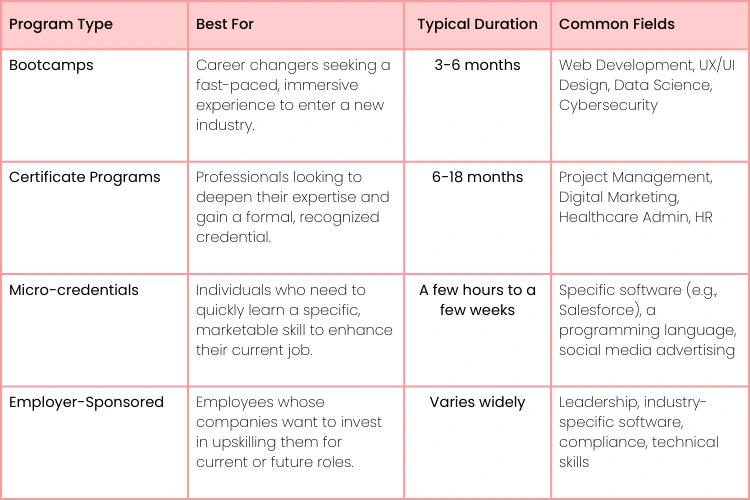
To make things even clearer, let's compare these formats side-by-side.
Comparing Online Job Training Program Formats
This table gives you a quick rundown of the most common online training formats, helping you see at a glance which one might be the best fit for your goals and lifestyle.
Each of these paths offers a unique way to level up your career. The key is to pick the one that aligns with how you learn, what you want to achieve, and how much time you can realistically commit.
How to Choose a Program That Delivers Real Results
Let's be honest: not all online job training programs are created equal. With so many options out there, it’s easy to get lost in glossy marketing. The real goal is to find a program that’s more than just a content library—it needs to be a true partner in your success.
This means you need to do a little digging. A thoughtful evaluation of a few key factors will tell you everything you need to know about a program's ability to impact your learning and, more importantly, your career prospects.
Evaluate the Curriculum for Real-World Relevance
First things first: the curriculum. A great program teaches what companies are hiring for right now. If the course material feels generic or outdated, that’s a huge red flag.
- Here’s an actionable insight: Open a job board and pull up five to ten listings for roles you’d love to have. Copy and paste the "Required Skills" into a word cloud generator. The biggest words are the skills you need to prioritize.
Now, hold that list up against the program's syllabus.
- Does it explicitly teach the software employers are actually demanding?
- Are the projects you'll build similar to what you'd do on the job?
- Is the focus clearly on practical application over pure theory?
If a program’s content doesn't line up with what the job market wants, it's just not the right investment for your time and money.
Assess the Expertise of the Instructors
Who’s teaching the course is just as important as what’s being taught. The best instructors aren't just academics; they're often current practitioners who live and breathe their field. They bring priceless, on-the-ground experience into the virtual classroom.
- Actionable Insight: Look up potential instructors on LinkedIn. Do they have recent, relevant work experience at reputable companies? This simple check tells you if you're learning from someone who is actively shaping their industry.
An instructor who works in the field can give you insights into current trends, common challenges, and the unwritten rules of their profession—stuff you’ll never find in a textbook. It's also worth choosing a program that actively uses proven tips for student engagement in online learning, because staying motivated and involved is a massive part of getting results.
Prioritize Robust Job Placement Support
Learning new skills is only half the journey. The ultimate goal is turning those skills into a new job, and that's where dedicated job placement support becomes a game-changer. Companies get this, which is why 62% of firms use these kinds of programs to fill crucial knowledge gaps.
A program’s commitment to your career success says a lot about its quality. When you're weighing your options, get specific about their career services:
- Dedicated Coaching: Do they offer one-on-one sessions for resume building and interview prep?
- Practical example: Ask if they provide mock technical interviews for developer roles or portfolio reviews for design roles.
- Employer Networks: Do they have established relationships with hiring partners that they can connect you with?
- Portfolio Reviews: Will an expert help you polish your projects to actually impress hiring managers?
Think of this support system as the bridge between finishing your coursework and confidently walking into your new role.

Real Stories of Career Transformation
Theory and criteria are important, but nothing brings the power of online job training programs to life like seeing them in action. Let's look at how real people used targeted learning to completely pivot their professional lives. These stories show the tangible results that a focused, practical education can deliver.
These pathways prove that with the right program, a major career shift is more attainable than you might think.
From Hospitality Manager to UX Designer
Meet Alex. For nearly a decade, he was a manager in the hospitality industry. While he loved working with people, he felt like his career had hit a ceiling and he was ready for a new challenge. The creative problem-solving he saw happening in the tech world really caught his eye.
Alex decided to take the leap and enrolled in a six-month, part-time UX/UI design bootcamp. The program's hands-on, project-based structure was exactly what he needed. He walked away with a portfolio of real work, including a mobile app prototype and a full website redesign, giving him something concrete to show employers. He got comfortable with essential tools like Figma and Adobe XD—the exact skills hiring managers were looking for.
Just two months after graduating, Alex landed a role as a UX Designer at a growing tech startup. He says the program's dedicated career coaching was a game-changer, helping him frame his management experience as a design asset by emphasizing his deep skills in empathy and understanding user feedback.
Leveling Up from Coordinator to Strategist
Ben was a marketing coordinator who felt stuck. He was good at handling the day-to-day tasks, but he had his sights set on a more strategic role. He noticed that all the senior positions required deep expertise in analytics and paid advertising, two areas where he had little experience.
Instead of a full career change, Ben opted for an eight-month Digital Marketing Certificate program focused on data analytics and campaign optimization. The flexible, online coursework allowed him to keep his full-time job while he learned.
The Outcome: Armed with new skills in Google Analytics and advanced SEO, Ben put together a data-driven proposal to completely overhaul his company's ad spend. His initiative and newfound expertise got him promoted to Senior Digital Strategist, and it came with a significant pay raise.
Breaking into a High-Demand Field
Chloe, a recent liberal arts grad, faced a familiar problem: she had a degree she loved but no clear, high-paying career path. The stability and growth of the cybersecurity field intrigued her, but she had absolutely zero technical background. It felt like a world away.
She chose a cybersecurity certificate program designed specifically for beginners. The curriculum started with the absolute basics and gradually built up to complex topics like network security and ethical hacking. The program's strong alumni network and job placement support were huge selling points for her.
After finishing her training and earning her CompTIA Security+ certification, Chloe secured a position as a cybersecurity analyst at a financial services firm. Her story is a perfect example of how reskilling can open doors to industries that once seemed out of reach. If a path like Chloe's sounds appealing, this article on using online courses for a career change offers even more guidance.
These transformations happen when a structured learning path is combined with great support, creating a direct line from education to employment.

Got Questions About Online Job Training?
Stepping into the world of online job training can feel like a big move. It’s a major investment of your time and money, so it’s only natural to have a few questions before you jump in.
We’ve rounded up some of the most common things people ask to help you feel confident and clear about your next step.
Are Online Job Training Certificates Actually Valued by Employers?
Yes, absolutely—as long as they come from a reputable program. Today’s employers, especially in fast-moving fields like tech and digital marketing, see a good certificate as direct proof that you have job-ready skills. It shows you’ve got current, practical knowledge you can put to work on day one.
- A practical example: a certificate in something like AWS Cloud Practitioner or Salesforce Administration tells a hiring manager you can handle specific, in-demand tasks. More than that, these credentials signal that you're proactive and committed to staying current, which are huge green flags for any company.
How Can I Possibly Balance a Training Program with a Full-Time Job?
This is exactly what online programs are designed for. Their biggest superpower is flexibility. The trick isn't to magically find more hours in the day but to be intentional with the time you already have.
Most people who succeed create a sustainable routine instead of trying to cram everything into one weekend.
- Here's an actionable insight: use a technique like "time blocking" to schedule 1-2 hour study sessions into your week. Treating this time like a non-negotiable appointment makes you far more likely to stick with it.
- Look for self-paced or part-time formats that offer evening or weekend classes.
- Block out learning time in your calendar, just like you would for a work meeting or a doctor's appointment.
- Talk to your support system. Let your family and friends know what you’re doing so they can cheer you on and help you stay on track.
Even a consistent 4-5 hours per week can lead to huge progress and skill growth without burning you out.
The goal isn't to find more time but to be intentional with the time you have. A structured schedule is the most powerful tool for balancing work, life, and your career development.
What Is the Difference Between Upskilling and Reskilling?
While they sound almost the same, these two ideas point to very different career goals. Figuring out which one you’re doing will help you pick the right kind of online job training program.
Upskilling is all about getting better at the job you already have by adding new, more advanced skills.
- A practical example is a content writer who learns SEO to make their articles rank higher and drive more traffic. They aren't changing jobs, but they are becoming more valuable in their current one.
Reskilling, on the other hand, is about learning a completely new set of skills to pivot into a different role or even a new industry. Think of an administrative assistant who takes a coding bootcamp to become a web developer. Both are fantastic ways to grow your career.
How Important Is Job Placement Support?
It’s everything—if your main goal is to land a new job. Learning in-demand skills is the first critical step, but a program with solid job placement support is the bridge that gets you from education to employment.
Think of it this way: the skills get you qualified, but the support gets you hired. This support often includes game-changing services like resume building, portfolio reviews, interview coaching, and—most importantly—access to a network of companies that are actively hiring.
- A practical example of this support in action is a program connecting you directly with a recruiter at a partner company for an interview you might not have secured otherwise. This kind of system dramatically boosts your odds of landing a role you love soon after finishing your program.
Ready to find an online job training program that connects learning directly to your career goals? At Uplyrn, we provide expert-led courses, dedicated mentorship, and real job opportunities to make sure you don’t just learn—you succeed. Explore our programs today.


Leave your thoughts here...
All Comments
Reply