









How to Grow With Professional Development Training Programs

Professional development training programs are more than just a line item in your budget; they're a strategic investment in the very people who drive your company forward. Think of them as structured initiatives designed to improve employee skills, knowledge, and competencies. The goal is simple: fuel individual career growth, which in turn powers your overall business success.
Jump To Section

Earn As You Learn
Earn 25% commission when your network purchase Uplyrn courses or subscribe to our annual membership. It’s the best thing ever. Next to learning,
of course.
Why Invest in Professional Development Training Programs
In a crowded market, treating employee training as just another expense is a shortsighted move. It’s far better to view it as a high-performance upgrade for your entire organization. It’s the engine that powers innovation, deepens employee loyalty, and builds a team that’s ready for whatever challenges come next.
The global workplace training market has exploded to a whopping $401 billion, which tells you just how seriously companies are taking skills development. And the numbers back it up: companies with solid training programs report a staggering 218% higher income per employee compared to those without. That’s a direct line to your bottom line. You can explore more about why training is so important right here.
Fostering Innovation and Adaptability
Stagnant skills lead to a stagnant business. It's that simple. When your people learn new techniques and see different ways of working, they bring fresh eyes to old problems. This culture of learning is what keeps you ahead of market shifts and new technology.
- A practical example is training your marketing team on the latest AI-powered data analytics tools. They won't just improve campaign performance; they’ll start spotting emerging consumer trends your competitors are missing. That’s how you get a first-mover advantage.
- Actionable Insight: Dedicate one hour every Friday for "Future-Forward Friday" where teams can explore new tools or trends relevant to their roles, fostering a continuous learning mindset.
An investment in knowledge pays the best interest. When you empower your team to grow, you're directly investing in your company's capacity to adapt and innovate.
Boosting Employee Retention and Engagement
Today's top talent isn't just looking for a paycheck—they're looking for a career path. One of the biggest reasons people quit is a lack of growth opportunities. When you offer robust professional development training programs, you send a powerful message: we're invested in your future with us.
This investment creates a win-win situation:
- For employees: They gain valuable skills that boost their careers, leading to higher job satisfaction and morale.
- For the organization: You build a loyal, motivated team and slash the high costs that come with recruiting and turnover.
Actionable Insight: Implement individual development plans (IDPs) during annual reviews. Work with each employee to map out their career goals and identify specific training programs that will help them get there. This makes development personal and directly tied to retention.
The long-term upside goes way beyond just learning a new skill. It taps into the broader lifelong learning benefits that create a more engaged and forward-thinking team.

The Building Blocks of High-Impact Training
Truly effective professional development training programs aren’t just thrown together. They’re meticulously designed. Think of it like building a custom home—you wouldn’t just start laying bricks without a solid foundation and a detailed blueprint. It's the same with high-impact training; it needs a strategic framework to deliver real, lasting results.
The whole process starts not with picking content, but with asking the right questions. What specific challenges are we trying to solve here? Who really needs this training, and why? Skipping this discovery phase is like handing someone a map without asking where they want to go. You get a lot of activity, but no meaningful progress.
Pinpointing Needs with Precision
The first critical building block is a thorough needs analysis. This is your diagnostic phase. It’s where you uncover the specific skill or knowledge gaps that are holding your team—and your business—back. Without it, you’re just guessing, and you risk pouring time and money into training that’s completely off the mark.
A practical way to do this is to dig into your performance data.
- For example, if your sales team’s closing ratio has dipped by 15% over the last two quarters, that’s a clear signal. You might have a gap in negotiation skills or up-to-date product knowledge. This data-driven approach transforms training from a shot in the dark to a targeted solution.
- Actionable Insight: Use a simple survey tool to ask managers, "What is the number one skill that, if improved, would have the biggest impact on your team's performance?" This quickly highlights high-priority training needs.
If you’re looking to get this right, this guide on performing a training needs analysis breaks down the entire process.
Setting Crystal-Clear Learning Objectives
Once you know what the problem is, you have to define why you're solving it. This is where learning objectives come in. They are clear, measurable statements that spell out exactly what people should be able to do after the training. Vague goals like “improve communication skills” are basically useless.
Instead, a strong objective sounds like this: “By the end of this workshop, customer service reps will be able to de-escalate customer complaints using the three-step XYZ method, reducing average call resolution times by 10%.” This sets a razor-sharp target for both the learner and the organization.
A well-designed training program is a direct response to a well-defined problem. Clear objectives are the bridge between the current skill gap and the desired business outcome.
Choosing Engaging Delivery Formats
Finally, how you deliver the training matters just as much as what you teach. The delivery format is the engine of engagement and knowledge retention. A dry, lecture-style webinar on a creative topic is doomed from the start, while an interactive, hands-on session could be a game-changer.
The key is to match the format to the objective and the audience. A one-size-fits-all approach just doesn't work.
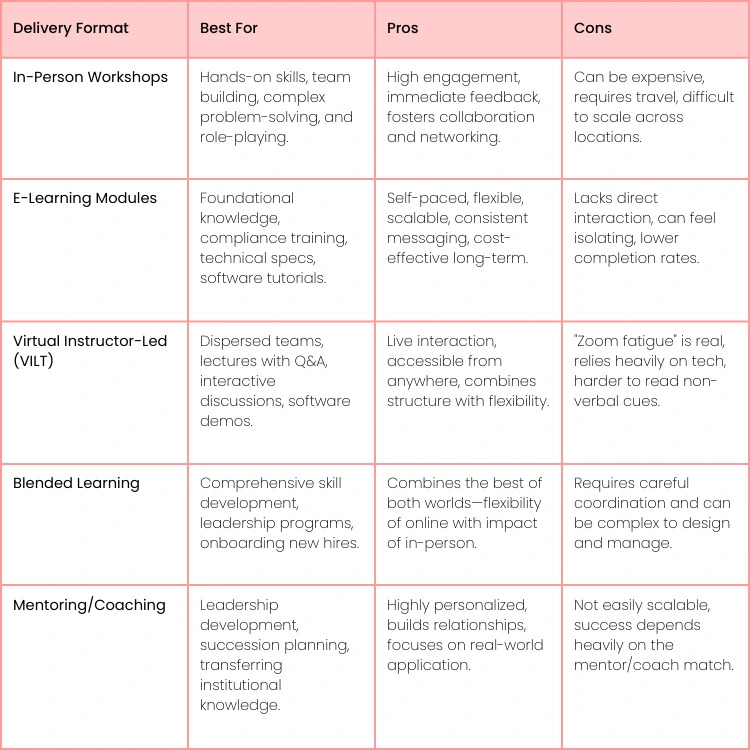
Comparing Training Delivery Formats
To help you decide, here’s a quick breakdown of common delivery methods, highlighting where they shine and where they fall short.
Choosing the right tool for the job is essential. For instance, teaching new managers how to give effective feedback is far better suited for a role-playing workshop than a passive e-learning module. This simple choice can be the difference between training that sticks and training that gets forgotten the next day.
Exploring Key Types of Development Programs
Not all professional development is created equal, nor should it be. Think of a company’s training portfolio like a well-balanced diet; you need a mix of different nutrients to build a strong, healthy, and adaptable organization. If you only focus on one area, you're leaving your team exposed and vulnerable to skill gaps elsewhere.
A truly effective strategy doesn't just offer random workshops. Instead, it categorizes training to solve specific business problems and build clear career pathways. This is how you develop a versatile workforce that’s ready for anything, whether it's mastering new software or leading a global team.
Let's break down the essential types of programs that should form the foundation of any solid development plan.
Technical and Hard Skills Training
This is the bread and butter of corporate training. It's focused on giving employees the specific, measurable abilities they need to get their jobs done well. It’s all about becoming proficient with the tools of the trade—be it software, machinery, or complex methodologies. A slip in technical skill has an immediate and direct impact on productivity and quality.
- For instance, your marketing team might need to get up to speed on a new CRM platform to improve how they track leads. Or, a software company could run a coding bootcamp to get their developers fluent in a new programming language.
- Actionable Insight: Don't wait for performance to tank. Proactively survey your teams quarterly to find out where technical skills are starting to fall behind new tools or industry standards. It’s much better to stay ahead of the curve than to constantly play catch-up.
Building a technically proficient team is simply non-negotiable. It's the operational bedrock that allows higher-level, strategic work to even happen. Without it, even the best ideas fall apart during execution.
Leadership and Management Development
Here’s a classic, costly mistake: promoting a top performer into a management role without any leadership training. The skills that make someone a fantastic individual contributor—like being a brilliant coder or a star salesperson—are worlds away from what's needed to lead, motivate, and mentor a team.
Leadership development programs are designed specifically to build these crucial management muscles.
- A practical example for New Managers: A workshop on emotional intelligence can be a game-changer, teaching them how to give constructive feedback and navigate tricky team dynamics.
- A practical example for Senior Leaders: An executive coaching program can help them sharpen their strategic thinking and fine-tune their decision-making instincts.
These programs are vital for building a strong leadership pipeline. They ensure you can promote talent from within and maintain a consistent, positive culture as you grow.
- Actionable Insight: Create a "New Manager Starter Kit" that includes mandatory training on delegation, feedback, and performance management, to be completed within their first 90 days in the new role.
Soft Skills Enhancement
Soft skills are often the most overlooked yet most critical ingredient for success. These are the interpersonal skills that allow people to work together effectively and harmoniously. Think communication, collaboration, creative problem-solving, and adaptability.
It's not just a hunch; a recent study found that a staggering 92% of recruiters believe soft skills matter just as much, if not more, than hard skills.
- A practical example? Offering a workshop on persuasive communication for your sales team. Or maybe conflict resolution training for your project managers. These skills are portable across any role and are the very glue that holds high-performing teams together.
- Actionable Insight: Host a monthly "Lunch and Learn" where different team members present on a soft skill they excel at, like time management or effective meeting facilitation. This encourages peer-to-peer learning and costs nothing.
How to Design a Program That Delivers Results
So, how do you build or pick a program that actually moves the needle? It starts with a clear strategy, not a course catalog. The biggest mistake organizations make is training for the sake of training. Instead, the goal should be to solve a specific, measurable business problem.
This all begins with a thorough skills gap analysis. It’s not just a buzzword; it's a practical audit of where your team is versus where it needs to be to win. Sometimes the gap is obvious—like when you’re rolling out new project management software. Other times, it's more subtle and requires digging into performance metrics, team feedback, and future business goals.
A Practical Framework For Success
A well-designed plan is what separates a training expense from a strategic investment. The most effective professional development training programs are built on a solid foundation of data and clear expectations.
Think about it: with 52% of workers needing to learn new skills in the next year, shooting in the dark is not an option. The data is clear—properly trained teams can deliver a 17% productivity boost and a 21% increase in profitability. It’s no surprise that 74% of top firms make skills gap assessments a priority before launching any new initiative.
For individuals looking to level up their own careers, the logic is the same, just a bit more personal:
- Self-Assess Your Ambitions: Where do you really want to be in five years? Get specific about your long-term career goals.
- Identify In-Demand Skills: Scour job descriptions for the roles you want. What skills, software, or certifications keep popping up? That's your roadmap.
- Find Credible Courses: Look for programs with solid testimonials, hands-on projects, and learning outcomes that directly map to the skills you identified.
Test Before You Invest
Before you go all-in on a full-scale rollout, launch a small pilot program with a control group. This is the single best way to test a program’s effectiveness, gather honest feedback, and make critical adjustments without blowing your budget.
Using this structured approach, both companies and individuals can make smarter choices. It turns training from a hopeful expense into a strategic investment that drives real, measurable growth.
Ready to start building out the actual content? Check out this in-depth guide on how to create training materials that engage and educate.
Measuring the ROI of Your Training Initiatives
It feels good to invest in your people through professional development training programs. But how can you prove it's money well spent?
Measuring the return on investment (ROI) is what separates a training budget that's just an "expense" from one that's a powerful growth engine for the business. It’s all about moving past vanity metrics like course completion rates and drawing a clear line from learning to tangible business results.
To get there, you need a simple framework that tracks the impact on multiple levels. This isn't about getting lost in complex financial models; it's about observing real-world change. You can start with direct feedback, but the real proof is seeing new skills being used on the job—and watching key business metrics climb as a result.
From Feedback to Financials
The path to calculating a solid ROI starts with gathering immediate reactions, but it has to move quickly toward more substantial proof. An effective way to do this is with a multi-level evaluation that builds on itself, painting a full picture of the training’s impact.
The ultimate goal is to draw a straight line from a training workshop to a positive number on a financial report. This is how you demonstrate that investing in your people is the most profitable investment a company can make.
A practical approach involves looking at a few key data points:
- Level 1 - Reaction: Right after the training, use simple surveys. Ask participants how relevant the content was and how effective the instructor was.
- Level 2 - Learning: A few weeks later, check if the knowledge stuck. Pre- and post-training quizzes are great for this. Did they actually retain the key information?
- Level 3 - Behavior: This is where you start to see the value.
- Actionable Insight: Ask managers to observe and note one instance where an employee used a new skill from the training within the first 30 days. This makes tracking behavior changes tangible.
- Level 4 - Results: Finally, connect these behavioral shifts to actual business KPIs. For instance, after a sales negotiation workshop, did the team’s average deal size increase by 5%?
To really dig into the impact and measure your ROI, using a dedicated employee training tracking software can be a game-changer.
Connecting Training to Business Goals
Let’s walk through a concrete example. Imagine a software company spends $10,000 on advanced troubleshooting training for its customer support team.
To figure out the ROI, they track a few specific metrics over the next quarter:
- Ticket Resolution Time: The average time to close a support ticket drops from 8 hours to 6 hours.
- Customer Satisfaction (CSAT): Scores tied to support interactions jump from 85% to 92%.
- Ticket Escalations: The number of tickets kicked up to senior engineers decreases by 30%, freeing up valuable engineering time.
By calculating the dollar value of the saved time and the positive financial impact of higher customer retention, the company can pinpoint the actual gain from the training.
This transforms the internal conversation from "training is important" to "this specific training generated a 300% ROI." For a deeper dive, check out this guide on how to measure training effectiveness.

Successful Training Programs in Action
Theory and frameworks are all well and good, but let's be honest—seeing professional development training programs actually work in the real world is what truly shows their power. It's one thing to talk strategy, but it’s another thing entirely to see how the right training can solve real business problems and kickstart serious growth. These stories connect the dots between investing in your people and seeing incredible results.
- A practical example: a growing tech firm needs to bake AI into its next product to stay ahead of the curve, but they don't have the talent in-house. Instead of getting into a costly and time-consuming hiring war, they launched a targeted upskilling program. They took their existing software engineers and trained them in machine learning and data science.
What happened? Within a year, this newly skilled team built a game-changing AI feature that became their product's main selling point. The result was a massive 25% increase in market share.
From Soft Skills to Hard Numbers
Now, let's pivot to another practical example: a service-based company that was struggling with sinking customer satisfaction scores. They dug in and realized the problem wasn't a lack of technical know-how; it was a gap in communication and empathy. So, they rolled out a company-wide soft skills program for their client-facing teams, focusing on active listening, conflict resolution, and emotional intelligence.
The impact was immediate and easy to measure:
- Customer satisfaction scores shot up by over 40% in just six months.
- Employee confidence went through the roof, creating a much more positive and collaborative vibe at work.
- Client retention rates climbed, giving a direct boost to the company's bottom line.
These examples really drive home how different kinds of training can lead to specific, valuable wins. You can dive into more real-world employee training program examples in this detailed guide.
The most successful training initiatives are those laser-focused on solving a specific business challenge, whether that's a technical skill gap or an interpersonal communication breakdown.
Leadership development, especially, has become a huge priority. The global market for corporate leadership training is set to grow by a staggering $31.40 billion in the next five years, mostly because companies need leaders who can steer the ship through major AI disruptions. In fact, a remarkable 55% of organizations are now making AI-related skills a top priority in their leadership programs. You can find more fascinating numbers behind this trend in these leadership training statistics here.
Common Questions About Professional Development Programs
When you start digging into professional development, a few questions always seem to pop up. Let's tackle some of the most common ones to give you a clearer picture for your team or your own career.
How Often Should Employees Get Training?
The most effective training isn't a one-and-done event; it’s a continuous rhythm. The best approach mixes smaller, regular learning moments—think monthly workshops or quick weekly modules—with a more significant, intensive program maybe once a year. This keeps everyone's skills sharp and up-to-date.
For individuals, a good rule of thumb is to focus on learning one major new skill or deeply refining an existing one each year. If you're in marketing, for example, you might dedicate one year to mastering video editing and the next to advanced SEO.
- Actionable Insight: Create a shared "learning calendar" for the year, plotting out small- and large-scale training opportunities so employees can plan ahead and see the company's commitment to their growth.
The most impactful professional development is woven right into the work week. Think of it less like a once-a-year bootcamp and more like consistent exercise for your professional skills.
What's The Difference Between Upskilling And Reskilling?
It’s a common point of confusion, but the distinction is pretty simple.
Upskilling is all about sharpening an employee’s existing abilities so they can get even better at their current job. A perfect example is a graphic designer learning new animation software to level up their design projects. It’s about building on what they already do well.
Reskilling, on the other hand, is about training an employee for a totally new role within the company. Imagine an administrative assistant learning data analysis to move into a junior business analyst position. Both are crucial for growing your own talent and staying flexible as the market changes.
Are Professional Development Programs Affordable For Small Businesses?
Absolutely. You don't need a massive budget to create high-impact training. Cost-effective online learning platforms, for instance, offer huge course libraries for a low monthly fee, giving you a ton of value.
But that's not the only way. Here are a few other practical strategies:
- In-house mentorship programs: Pairing senior team members with junior staff costs nothing but time and is a fantastic way to build up internal knowledge.
- Peer-to-peer skill sharing: Try hosting "lunch and learns" where one team member teaches a skill they're great at to everyone else.
- Laser-focused training: Instead of trying to do everything, concentrate on one high-value area, like customer service, where you can see a direct and immediate return.
Actionable Insight: Start with the lowest-hanging fruit. Identify one common challenge across multiple teams (e.g., managing overflowing inboxes) and find a single, low-cost online course to solve it. This provides a quick win and builds momentum for future training investments.
Ready to build a culture of continuous learning and empower your team for whatever comes next? At Uplyrn, we provide a dynamic ecosystem of courses and expert-led mentoring designed to scale with your goals. Explore how our platform can transform your approach to professional development today.


Leave your thoughts here...
All Comments
Reply