









Top 10 Essential Skills for Professional Development in 2026

In a world of constant change, professional stagnation is the biggest career risk you can take. The key to not just surviving but thriving is a commitment to continuous growth through targeted professional development. This guide moves beyond generic advice to provide a detailed roadmap of the ten most critical skills for professional development today. We will break down why each skill matters, providing practical examples and actionable insights you can implement immediately.
This isn't just a theoretical list; it's a practical toolkit designed for immediate application. You'll learn not only what skills are essential but also how to build them, where to apply them, and how to measure your progress. We will explore competencies ranging from leadership and strategic thinking to digital literacy and emotional intelligence, ensuring you have a well-rounded foundation for advancement.
Whether you're aiming for a promotion, pivoting to a new industry, or future-proofing your career, mastering these competencies will provide the leverage you need. Consider this your blueprint for building a resilient and successful career path. Let's explore the skills that will define professional success, with a focus on how structured learning can accelerate your journey.
Jump To Section

Earn As You Learn
Earn 25% commission when your network purchase Uplyrn courses or subscribe to our annual membership. It’s the best thing ever. Next to learning,
of course.
1. Communication Skills
Effective communication is the cornerstone of professional success, encompassing your ability to clearly articulate ideas, listen with intent, and tailor your message for different audiences. It's one of the most critical skills for professional development because it directly impacts collaboration, client relationships, and leadership effectiveness. Strong communicators prevent misunderstandings, build trust, and drive projects forward with precision.
- Practical Example: A project manager sends a weekly update email. Instead of a long paragraph, they use bullet points for key milestones, bold text for action items, and a clear subject line like "Project Phoenix: Weekly Update & Actions for 10/21". This clarity ensures everyone knows their responsibilities, reducing back-and-forth questions. For career advancement, it's vital to continuously learn how to improve communication skills in the workplace to foster better collaboration and understanding.
How to Build This Skill
- Practice Active Listening: In your next team meeting, instead of formulating your response while someone is talking, try summarizing their point back to them ("So, if I understand correctly, you're saying…") before you share your own thoughts. This confirms understanding and shows you're engaged.
- Seek Constructive Feedback: Send a draft of an important email to a trusted colleague and ask, "Is the key message clear in the first three sentences?" Use their feedback to refine your writing.
- Use Storytelling: When presenting quarterly results, don't just show a chart of rising sales. Start with a story about a specific customer's success that illustrates the impact behind the numbers.
- Join a Public Speaking Group: Organizations like Toastmasters provide a safe environment to practice public speaking and receive peer feedback. For more structured guidance, Uplyrn offers courses to help you master the art of public speaking.

2. Critical Thinking and Problem-Solving
Critical thinking is the ability to analyze information objectively, question assumptions, and evaluate evidence to form a reasoned judgment. It is one of the most vital skills for professional development because it enables you to navigate complex challenges and drive innovation. This skill goes hand-in-hand with problem-solving, which applies this analytical mindset to identify root causes, generate creative solutions, and implement effective strategies to overcome obstacles.
- Practical Example: A marketing team notices a drop in website conversions. Instead of immediately launching a new ad campaign (addressing the symptom), a critical thinker analyzes the data. They discover the drop correlates with a recent website update that slowed down page load times on mobile. The real solution isn't more ads; it's optimizing the site's mobile performance. Professionals looking to refine their approach can learn to use creative problem-solving methods to tackle challenges from new angles.
How to Build This Skill
- Use Structured Frameworks: When faced with a recurring issue like missed deadlines, apply the Five Whys technique. Ask "Why did we miss the deadline?" and continue asking "why" for each answer to uncover the root cause, which might be an inefficient review process rather than individual performance.
- Challenge Your Assumptions: Before launching a new product feature based on a team's belief that "customers will love it", create a simple survey or conduct five customer interviews to gather actual evidence.
- Gather Diverse Perspectives: If you're solving a logistics problem, don't just talk to other managers. Involve a warehouse worker, a delivery driver, and a customer service rep to get a 360-degree view of the issue.
- Practice Mind Mapping: When planning a project, use a mind map to visually brainstorm all potential risks, dependencies, and stakeholders. This helps you see connections you might otherwise miss.

3. Leadership and Management
Leadership and management are two sides of the same coin, essential for guiding teams and driving organizational success. Leadership is about inspiring a shared vision and motivating people, while management focuses on organizing resources and executing plans efficiently. Developing these skills for professional development is crucial, as they enable you to move from individual contributor to a role that amplifies the impact of an entire team.
- Practical Example: A manager notices their team is burning out. Instead of just demanding they meet deadlines (management), a leader holds a team meeting to discuss workload, reprioritizes tasks based on impact, and champions the need for an additional hire to senior management. They manage the work while leading the people. For those looking to grow, it's beneficial to explore effective strategies for performance management to better support and guide their teams.
How to Build This Skill
- Mentor a Junior Colleague: Offer to help a new hire navigate their first 90 days. Schedule a 30-minute check-in each week to answer questions and offer guidance. This provides a practical way to exercise leadership muscles in a low-stakes environment.
- Study Different Leadership Models: Read a book like Simon Sinek's "Start With Why" and then, in your next team meeting, try to frame a new project by explaining the "why" behind it before discussing the "what" and "how".
- Seek Leadership Opportunities: Volunteer to lead the planning for the next team offsite or be the point person for a small-scale internal project. This gives you a safe space to practice decision-making and delegation.
- Develop Emotional Intelligence (EQ): Before giving critical feedback, take a moment to consider the team member's current workload and mindset. Frame your feedback constructively, focusing on the action and its impact, not the person.
4. Digital Literacy and Technical Skills
Digital literacy is the ability to effectively use technology, understand digital concepts, and navigate online environments safely. In a tech-driven world, this skill set is no longer optional; it’s a core competency. Developing these skills for professional development ensures you can adapt to new tools, analyze data, and contribute to an increasingly automated workplace, making you a more valuable and resilient employee.
- Practical Example: An HR professional, instead of manually tracking employee leave requests in a spreadsheet, learns to use a tool like BambooHR. This automates the process, reduces errors, and frees up their time to focus on more strategic initiatives like employee engagement and development. Learning these tools is fundamental to understanding what data science and analytics can bring to your organization.
How to Build This Skill
- Start with Role-Relevant Tools: If you're in marketing, don't try to learn Python and SQL at the same time. Start by mastering Google Analytics or a social media scheduling tool like Buffer.
- Practice with Hands-On Projects: After watching a tutorial on advanced Excel functions, create a dashboard using your department's actual monthly data. This moves your learning from theory to practical application.
- Obtain Relevant Certifications: If your company uses Microsoft 365, completing a certification for a tool like Power BI not only validates your skill but also makes you the go-to expert on your team.
- Follow Tech Communities and Blogs: Set up a Google Alert for "new features in Asana" or your project management tool of choice. This ensures you're always aware of new updates that can improve your workflow.
5. Emotional Intelligence (EQ)
Emotional intelligence (EQ) is the ability to recognize, understand, and manage your own emotions, as well as perceive and influence the emotions of others. It stands out as one of the most vital skills for professional development because it governs how we navigate social complexities and make personal decisions. Professionals with high EQ build stronger relationships, resolve conflicts effectively, and lead with empathy, making them more resilient and successful leaders.
- Practical Example: A team member gives a presentation that doesn't go well. A manager with low EQ might say, "That was a mess." A manager with high EQ will approach them privately and say, "That looked like a tough crowd. Let's talk about what worked and what we can refine for next time." The latter approach builds trust and encourages growth. Developing this attribute is key to navigating workplace dynamics and can significantly improve emotional resilience and overcome adversity.
How to Build This Skill
- Practice Self-Awareness: At the end of each day, take two minutes to identify one moment you felt frustrated or stressed. Write down what triggered it. Recognizing your triggers is the first step to managing your reactions.
- Develop Empathy: In your next one-on-one, focus on asking open-ended questions like, "How are you feeling about your current workload?" and listen without immediately trying to solve the problem.
- Improve Self-Regulation: When you receive a frustrating email, use the "draft" technique. Write your immediate, emotional response in a draft, but don't send it. Wait an hour, then come back and rewrite it from a more calm and logical perspective.
- Seek Feedback on Your Impact: Ask a trusted colleague, "During that tense project meeting, how did my communication come across to you?" Use this feedback to understand how your emotional state affects others.

6. Adaptability and Learning Agility
Adaptability is the ability to adjust to new conditions, while learning agility is the capacity to quickly acquire and apply new knowledge in a rapidly changing environment. Together, these are crucial skills for professional development, determining how well you can pivot, upskill, and maintain relevance. In a world where industries can be disrupted overnight, professionals who embrace change are the ones who thrive and lead.
- Practical Example: A company introduces a new CRM system. An adaptable employee doesn't just complain about the old system; they sign up for the first training session, create a "cheat sheet" of shortcuts for the team, and volunteer to be a "super user" who helps colleagues navigate the transition. They see the change as an opportunity to grow their expertise.
How to Build This Skill
- Embrace a Growth Mindset: When a project fails, instead of saying "This didn't work", reframe it as "Here's what we learned from this attempt". This actionable step turns a setback into a learning opportunity.
- Seek Opportunities Outside Your Comfort Zone: If you're a writer, volunteer to help the design team with a project that requires basic graphic design skills. This forces you to learn a new tool and a different way of thinking.
- Stay Informed About Industry Trends: Dedicate 30 minutes every Friday to read one article or listen to a podcast about the future of your industry. This keeps you proactive rather than reactive to change.
- Build a Diverse Skill Set: If you're a software developer, take a short online course on project management. Understanding the principles of how your work is managed makes you a more effective and versatile team member.
7. Time Management and Productivity
Effective time management is the art of strategically planning and controlling how you spend your time on specific activities to work smarter, not harder. This skill is crucial for professional development because it enables you to meet deadlines consistently, reduce stress, and maintain a high quality of work. Professionals who master productivity can better balance their workload, seize new opportunities, and achieve a healthier work-life integration, making it a foundational skill for career growth.
- Practical Example: A designer has three projects with competing deadlines. Instead of randomly switching between them, they use the Eisenhower Matrix. They identify that finishing the logo for a major client launch is "Urgent and Important" while brainstorming ideas for a future internal project is "Important, Not Urgent". This allows them to focus their energy where it matters most.
How to Build This Skill
- Implement Time-Blocking: At the end of each day, look at your to-do list for tomorrow and block out 90 minutes of "focus time" in your calendar to work on your single most important task. Protect this time from meetings.
- Use Productivity Tools: Use a tool like Asana or Todoist to set up a recurring task every Friday to "Plan next week's priorities". This builds a consistent habit of proactive planning.
- Practice Saying "No": When asked to join a meeting, you can politely respond, "To make sure I can add value, could you please send me the agenda beforehand?" This helps you decline meetings that aren't a good use of your time.
- Track Your Time: Use a simple tool like Toggl for three days to track how you spend your time. You might be surprised to find that "quick" email checks are eating up two hours of your day, prompting you to batch them instead.

8. Collaboration and Teamwork
Collaboration skills are your ability to work effectively with others toward shared objectives, respecting diverse perspectives and leveraging collective intelligence. In today's interconnected workplace, teamwork is one of the most vital skills for professional development, enabling professionals to build consensus, resolve conflicts constructively, and create synergy that exceeds individual contributions. Strong collaborators drive innovation and are essential in both in-office and remote environments.
- Practical Example: A product development team needs to decide on a new feature. Instead of the loudest voice winning, they use a structured brainstorming session where everyone writes down their ideas silently first. They then discuss each idea on its merits, which ensures that introverted but insightful team members contribute equally, leading to a better final decision.
How to Build This Skill
- Establish Clear Roles and Responsibilities: At the start of a project, create a simple RACI chart (Responsible, Accountable, Consulted, Informed) in a shared document so everyone knows exactly what is expected of them.
- Master Collaborative Tools: Instead of emailing document versions back and forth, become an expert in using the real-time collaboration and commenting features of Google Docs or Miro. Proactively teach a teammate one new feature.
- Practice Constructive Conflict Resolution: When a disagreement arises, frame your perspective using "I" statements, such as "I am concerned that this timeline is too aggressive" instead of "Your timeline is unrealistic". This focuses the conversation on the issue, not the person.
- Celebrate Team Achievements: When a project is completed, send a team-wide email specifically calling out one key contribution from each person. This acknowledges individual effort while reinforcing a collective win.
9. Strategic Thinking and Business Acumen
Strategic thinking is the ability to see the bigger picture, connecting market trends, competitive landscapes, and internal capabilities to guide long-term organizational success. Paired with business acumen, which is the keen understanding of how a business operates and makes money, these skills for professional development transform you from a tactical doer into a strategic leader. Professionals with this skill set make decisions that create sustainable value, anticipating future challenges and opportunities.
- Practical Example: A social media manager is asked to increase followers. Instead of just posting more frequently (a tactic), a strategic thinker asks, "What is the business goal? Are we trying to increase brand awareness among a new demographic or drive leads for a specific product?" They then propose a targeted content strategy aligned with that goal, measuring success in leads generated, not just vanity metrics.
How to Build This Skill
- Study Financial Statements: Read your company's latest quarterly earnings report. You don't need to be a finance expert, but try to identify the main sources of revenue and the biggest costs.
- Learn Key Business Metrics: Ask your manager, "What are the two or three key performance indicators (KPIs) our team is most responsible for?" Then, actively track how your daily work contributes to those metrics.
- Analyze Business Case Studies: Read an article about why a company like Blockbuster failed. Analyze the strategic missteps they made in the face of market changes, and think about how your own company is adapting to trends.
- Network with Senior Leaders: In your next conversation with a department head, ask, "What do you see as the biggest challenge or opportunity for our business in the next year?" Their answers will give you a high-level, strategic perspective.
10. Continuous Learning and Self-Development
Continuous learning is the proactive commitment to acquiring new knowledge and skills throughout your life. It's one of the most vital skills for professional development in a world where industries and technologies evolve at breakneck speed. This mindset ensures your expertise remains relevant, opens doors to new opportunities, and fuels personal and career growth. Embracing self-development means you are the architect of your own advancement.
- Practical Example: A graphic designer notices that AI-powered design tools are becoming more popular. Instead of seeing this as a threat, they dedicate two hours a week to mastering a new AI tool. They then create a presentation for their team on how they can use it to speed up their workflow, turning a potential disruption into a competitive advantage.
How to Build This Skill
- Set Deliberate Learning Goals: Instead of a vague goal like "learn about AI", set a specific goal: "Complete a 3-hour introductory course on AI for marketers by the end of the month". To effectively chart your professional growth, consider utilizing a structured approach like this practical development planning template to map out your objectives.
- Allocate Dedicated Time: Treat learning like a meeting. Block out "Learning Hour" in your calendar every Wednesday morning from 9-10 AM and commit to it.
- Apply Knowledge Immediately: After you learn a new Excel formula, find a way to use it in one of your work spreadsheets that same day. This immediate application solidifies the knowledge.
- Teach Others: After attending a webinar, volunteer to share the three key takeaways with your team in the next meeting. Explaining a concept to others is one of the most effective ways to ensure you've truly understood it.
From Knowledge to Action: Your Next Step in Professional Growth
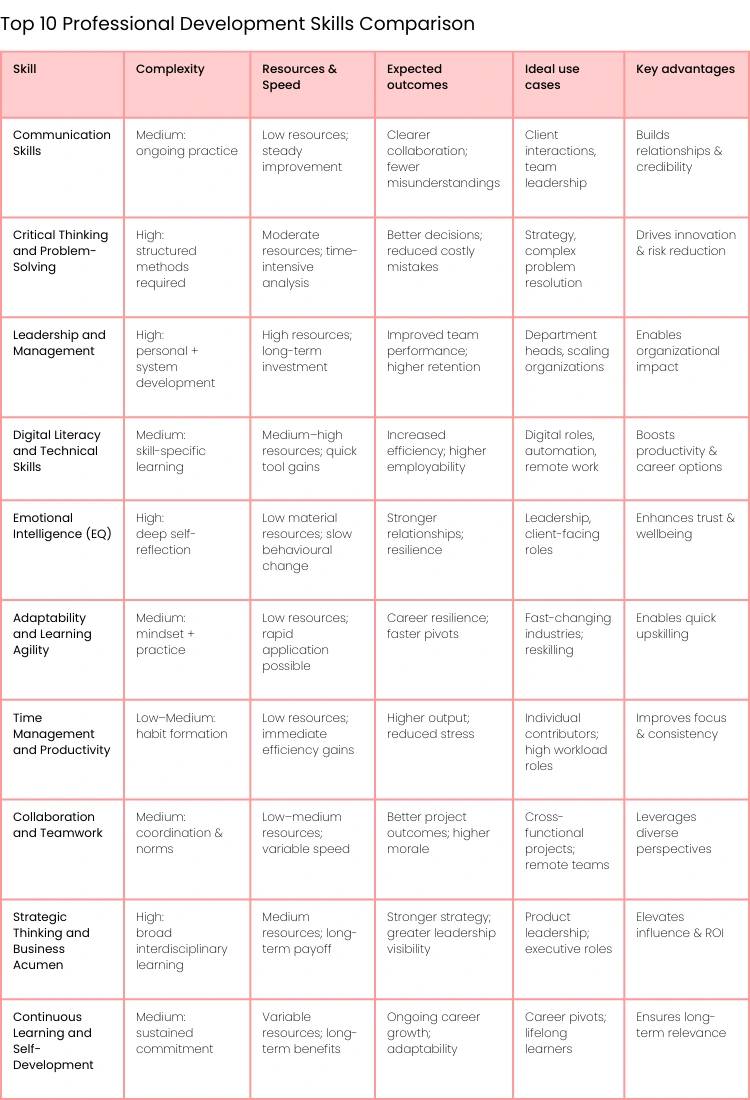
Navigating the modern professional landscape requires more than just a resume; it demands a dynamic and evolving skill set. Throughout this guide, we've explored the ten foundational pillars of career success, from the nuanced art of Communication and the analytical power of Critical Thinking to the forward-looking vision of Strategic Thinking and the collaborative spirit of Teamwork. Each skill serves not as an isolated attribute but as an interconnected part of a holistic professional identity.
The journey from identifying these skills to mastering them is where true transformation occurs. It's the difference between knowing that leadership is important and confidently guiding a team through a complex project. It's understanding that digital literacy is key versus skillfully leveraging new software to drive efficiency and innovation. The actionable insights and practical examples provided for each skill are your roadmap to bridge this gap between theory and application.
Synthesizing Your Learning into a Personal Plan
The most crucial takeaway is that developing these skills is an active, not a passive process. Merely acknowledging their importance is not enough. The key to unlocking your potential lies in creating a deliberate and personalized development plan.
Here’s how to start today:
- Conduct a Self-Assessment: Review the ten skills we've discussed. Which two or three represent your biggest opportunity for growth right now? Perhaps improving your Time Management could have an immediate impact on your daily productivity, or developing your Emotional Intelligence could strengthen vital client relationships. Be honest and specific.
- Set SMART Goals: For each chosen skill, define what success looks like. Instead of a vague goal like "get better at communication", aim for something specific and measurable: "Present my team's weekly progress in the Monday meeting for the next two months, actively soliciting feedback from my manager to improve clarity and confidence."
- Commit to Action: Use the strategies outlined in this article. If you're focusing on Adaptability, volunteer for a project that uses a new methodology. If Continuous Learning is your goal, block out two hours on your calendar each week dedicated solely to an online course or industry reading.
The Long-Term Impact of Skill Development
Mastering these skills for professional development is an investment that pays lifelong dividends. It builds career resilience, enabling you to pivot and thrive amidst industry shifts and technological advancements. It enhances your value to any organization, positioning you not just as an employee but as a strategic asset who can solve problems, lead initiatives, and drive results. This commitment to growth is what separates stagnant careers from those marked by continuous advancement and fulfillment. Your professional future isn't a matter of chance; it's a direct result of the skills you intentionally build today.
Ready to turn your professional development plan into reality? Uplyrn offers a comprehensive library of courses, taught by industry experts, designed to help you master these essential skills. Explore our learning paths and start building a more powerful professional future today.


Leave your thoughts here...
All Comments
Reply