









What is Organizational Behavior Management?

Organizational Behavior Management (OBM) is, at its heart, the science of making work better. It’s a systematic way to figure out why people do what they do in the workplace and then use that knowledge to boost performance. Forget guesswork or hoping for the best—OBM uses data-driven strategies to make real, measurable improvements in everything from safety and quality to overall efficiency.
Think of it as a diagnostic system for your company's most valuable asset: its people.
Jump To Section

Earn As You Learn
Earn 25% commission when your network purchase Uplyrn courses or subscribe to our annual membership. It’s the best thing ever. Next to learning,
of course.
Defining Organizational Behavior Management
Instead of asking a vague question like, "Why is my team underperforming?", a manager using OBM digs deeper. They ask, "What specific, observable behaviors are leading to this outcome, and what in the environment is either helping or hurting those behaviors?"
This simple shift from chasing opinions to analyzing facts is the core of OBM. It's a practical science focused on pinpointing the critical actions that drive success and then finding ways to encourage them, day in and day out.
This isn't some new management fad. OBM actually got its start back in the 1960s, growing out of B.F. Skinner's groundbreaking work in behavioral science. By the 1970s, pioneers were already applying these principles to solve real-world business challenges. Decades of solid research have backed it up, with some studies showing OBM interventions can boost productivity in targeted areas by as much as 84%.
The ABC Model: A Simple Framework for Behavior
The bedrock of OBM is a simple yet powerful tool called the ABC Model. It stands for Antecedent-Behavior-Consequence, giving us a clear lens to analyze any performance issue.
- Antecedent: This is the trigger. It’s what happens right before a behavior. This could be a manager's request, a pop-up notification on a screen, or a checklist sitting on a desk.
- Practical example: A reminder notification on a sales associate's screen (antecedent) prompts them to update their customer relationship management (CRM) software.
- Behavior: This is the specific, observable action an employee takes. "Completing a safety checklist" is a behavior you can see and measure. "Being more careful" is not.
- Practical example: The sales associate logs the details of their recent client call in the CRM (behavior).
- Consequence: This is what happens immediately after the behavior. It can be positive (a quick "thank you" from a supervisor), negative (a reprimand), or even neutral (getting no feedback at all).
- Practical example: Their manager sends a quick chat message saying, "Thanks for keeping the CRM updated—it helps the whole team stay on track!" (consequence).
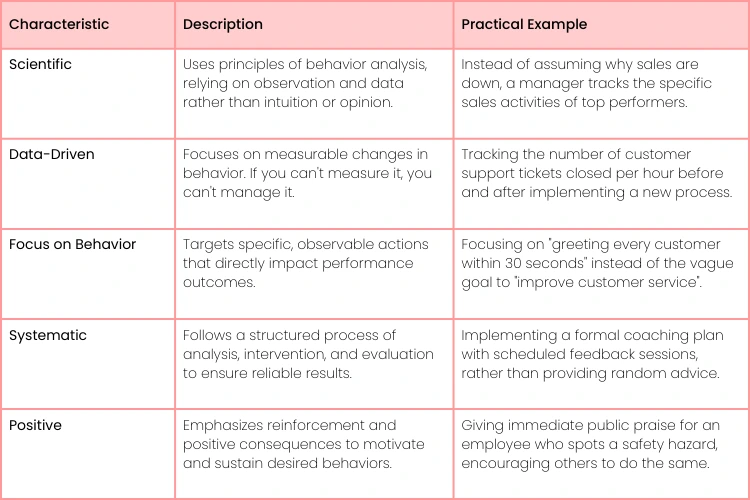
OBM At A Glance: Key Characteristics
To make this even clearer, let's break down the core components of OBM into a simple table. This gives you a quick snapshot of what makes this approach so effective.
Ultimately, these characteristics work together to create a system that not only identifies performance gaps but gives you a clear, repeatable process for closing them.
- Actionable Insight: The most powerful lever in this entire model is the consequence. A positive, immediate consequence is far more likely to make a desired behavior happen again. Think about it: a manager saying, "Great job submitting that report ahead of schedule!" right after it happens is infinitely more effective than a generic compliment in a performance review weeks later.
The Core Principles Driving Real Results
Organizational Behavior Management (OBM) isn’t about motivational posters or vague corporate theories. It’s a hands-on science built on a few core principles that deliver concrete, measurable results. Think of it as a practical roadmap for analyzing and improving performance in any role, from the factory floor to the C-suite.
This approach shifts the focus from fuzzy goals like "be more productive" to specific, actionable steps that create lasting change. Understanding OBM through these principles gives you a powerful toolkit. It’s not about controlling people; it's about creating an environment where the most effective behaviors are naturally encouraged and reinforced.
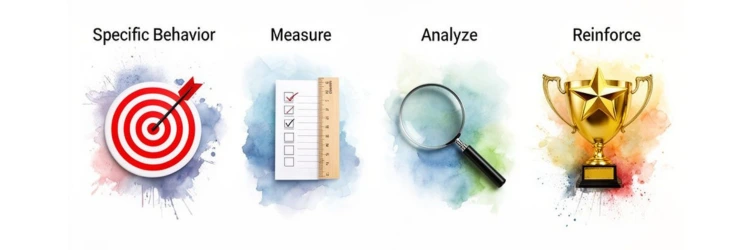
Pinpoint and Measure Specific Behaviors
The first step is moving from ambiguity to absolute clarity. Instead of aiming for broad outcomes like “better customer service”, OBM forces you to pinpoint the exact behaviors that lead to that result. And this is where using performance assessments becomes crucial for accurately measuring behavior and its real impact.
Here's a real-world example: Don't just say "improve safety". Instead, pinpoint a behavior: "Drivers must complete a 10-point vehicle safety check before every trip". See the difference? That action is observable, you can measure it, and it's directly tied to the outcome you want.
Once you’ve pinpointed a behavior, you have to measure it. This gives you a baseline—a clear starting point to track progress against. Measurement is what turns guesswork into hard data, showing you exactly how often the desired behavior is happening before you make any changes.
Analyze and Intervene Systematically
With a specific, measured behavior in hand, the next step is to figure out what’s influencing it. This is done using the ABC Model (Antecedent-Behavior-Consequence) we touched on earlier. It’s a simple but powerful way to diagnose why a certain behavior is—or isn't—happening.
You just have to ask a couple of key questions:
- Is the antecedent clear? Does the employee know exactly when and how to perform the action?
- Is the consequence reinforcing? What happens immediately after the behavior? Is there positive feedback, or just silence?
This analysis is the foundation for your intervention. The goal is to tweak the antecedents and consequences to make the desired behavior the most logical and rewarding choice. When done right, this helps build the prominence of psychological safety, creating an environment where employees feel secure enough to perform at their best.
Finally, the intervention itself involves making structured changes to the environment. This isn't a one-and-done fix but a continuous cycle of implementation and evaluation.
- Provide immediate feedback: Let people know on the spot when they’re performing the behavior correctly.
- Use positive reinforcement: Offer genuine praise, recognition, or other rewards to strengthen that behavior.
- Evaluate results: Keep measuring the behavior to see if your intervention is actually working, and be ready to make adjustments as needed.
This systematic process ensures that improvements aren't just a fluke. They are the direct result of carefully planned and executed strategies.

Practical OBM Methods You Can Use Today
Knowing the principles of Organizational Behavior Management is one thing, but actually putting them into practice is where the magic happens. The good news is that OBM isn't just theory; it's a practical toolkit filled with proven methods you can start using to improve performance right away.
These aren't complicated, abstract ideas. They’re straightforward techniques that move you beyond just hoping for better outcomes and give you a structured way to figure out what’s really going on and how to fix it.
Diagnose Gaps with Performance and Systems Analysis
Before you jump in to fix a problem, you have to know what the real problem is. A Performance and Systems Analysis is the diagnostic tool for the job. It helps you answer one critical question: is this a skill issue or a process issue?
Too often, managers default to thinking underperformance is about an employee's lack of skill or motivation. OBM flips that script and encourages you to look at the system first. Are the tools clunky? Is the workflow confusing? Is there a bottleneck completely outside the employee's control?
- Practical Example: A team is consistently missing deadlines. Instead of blaming them for poor time management, a performance analysis reveals the project management software they use is slow and frequently crashes, adding hours of wasted time each week. The problem isn't the people; it's the system.
Running this analysis first can save you from wasting a ton of time and money on training when the real culprit is a broken process.
Implement Task Clarification and Goal Setting
Ambiguity is the enemy of high performance. Task Clarification is all about making sure every single person on your team knows exactly what's expected of them. This isn't just about the "what"—it's also about defining the "how" and "why" behind their most important duties.
This goes hand-in-hand with effective Goal Setting. Vague goals like "increase sales" just don't cut it. OBM pushes for specific, measurable targets, like "make 10 follow-up calls to new leads each day". That kind of clarity gives employees a direct path to follow and a clear benchmark for success.
- Actionable Insight: Create a "definition of done" checklist for key recurring tasks. For example, a marketing team's "definition of done" for a blog post might include: spell-checked, SEO-optimized, peer-reviewed, and scheduled in the content calendar. This removes all guesswork and ensures consistent quality.
Apply Strategic Feedback and Reinforcement
This is where OBM really shines. The engine that drives all behavioral change is the strategic use of feedback and reinforcement. The key is to make feedback immediate, specific, and focused on the behavior—not the person.
Reinforcement is any consequence that makes a desired behavior more likely to happen again. It's not always about money, either. It can take many forms:
- Social Reinforcement: A simple "great job on that report" or public recognition in a team meeting.
- Tangible Reinforcement: Small rewards, bonuses, or other perks tied directly to specific achievements.
- Activity-Based Reinforcement: Offering a preferred task as a reward for completing a less desirable one.
For example, a logistics company struggling with accuracy put up a simple public recognition board. Each time a packer completed a shift with zero shipping errors, their name went on the board. This tiny act of social reinforcement led to a 40% reduction in shipping errors within three months. It's a powerful reminder of how small, consistent positive reinforcement can create massive change. If you want to dive deeper, this article on giving feedback is a great place to start.
How OBM Solves Real-World Business Problems
Theory is great, but seeing Organizational Behavior Management in action is where its real power shines. OBM works because it cuts through the noise of abstract goals and gets right down to the specific, observable behaviors that actually drive business results. It’s about scientifically analyzing and improving what people do, day in and day out, to solve stubborn and expensive problems.
This hands-on approach provides a clear framework for achieving genuine business process optimization, making sure every part of the company is pulling in the same direction. Let's look at a few real-world scenarios to see how OBM turns complex challenges into measurable wins.
Improving Safety and Quality in Healthcare
Imagine a hospital struggling with a high rate of hospital-acquired infections (HAIs). It’s a huge patient safety risk. The goal was obvious—fewer infections—but just telling staff to "be more careful" wasn't moving the needle.
- The Problem: Too many clinical staff members were forgetting to wash their hands.
- The OBM Intervention: Instead of a generic reminder, an OBM practitioner pinpointed the one critical behavior: using hand sanitizer every single time they entered or left a patient's room. They then set up a system for immediate, positive feedback. Team leaders gave on-the-spot praise for doing it right, and weekly team performance charts were posted for everyone to see.
- The Result: This simple, consistent feedback loop worked wonders. Hand-washing rates soared, leading to a massive 60% reduction in certain HAIs within just six months. This directly improved patient outcomes and saved the hospital a fortune.
Actionable Insight: The secret sauce wasn't punishment; it was consistent, positive reinforcement. By making the right behavior visible and celebrating it, the hospital built a powerful new cultural habit around safety.
Boosting Performance in Customer Service
Here’s another one: a big customer service center was plagued by low first-call resolution (FCR) rates. Customers were getting frustrated, calling back multiple times, and driving up operational costs.
- The Problem: Agents weren't successfully getting to the root of a customer's issue on the first try.
- The OBM Intervention: The company studied its top-performing agents to see exactly what they were doing differently. They found a pattern. The best agents consistently followed a three-step script: paraphrase the customer's issue, confirm their understanding, and clearly state the next step. This became the new standard, and a coaching program was built around mastering these three behaviors.
- The Result: In a single quarter, this targeted coaching pushed the center's FCR rate up by 25%. Not only that, but overall customer satisfaction scores jumped by 15%.
These examples show how OBM provides a practical blueprint for getting things done. It’s also incredibly powerful for keeping your best people. For instance, a major European telecom giant used an OBM program that turned feedback and reinforcement into a game. The initiative slashed voluntary turnover from 18% to just 9% in two years, saving the company an estimated €15 million.
For more strategies on keeping your team intact, check out this guide on how to reduce employee turnover.
Navigating The Benefits And Challenges Of OBM
So, you're thinking about bringing Organizational Behavior Management into your workplace. That's a great move. But like any powerful strategy, it’s not magic—it's a discipline. Adopting OBM can deliver some incredible results, but it’s smart to go in with your eyes open, ready to navigate a few common hurdles along the way.
The upside of OBM goes way beyond just squeezing a little more productivity out of your teams. We're talking about direct, measurable improvements in the things that really matter: safety, quality, and morale. And because OBM is all about data, you aren't just guessing. You can actually see the needle moving on your performance dashboards.
Understanding The Potential Payoffs
The real genius of OBM is its ability to create positive, lasting changes in behavior that spread throughout the entire organization. When people know exactly what's expected of them and get consistent, positive reinforcement for doing great work, powerful things start to happen.
Here are a few of the biggest wins you can expect:
- Enhanced Safety: You can dramatically cut down on workplace accidents by pinpointing and reinforcing safe behaviors. Imagine a manufacturing plant rewarding teams for perfect PPE usage—that simple act can directly lead to fewer injuries.
- Improved Quality: By breaking down quality control into specific, repeatable actions and offering immediate feedback, companies can slash errors and defects.
- Increased Employee Engagement: When the work environment is predictable and supportive—thanks to clear goals and positive reinforcement—people are happier. This leads to better job satisfaction and lower turnover. It’s that simple.
Overcoming Common Implementation Hurdles
Of course, rolling out an OBM program isn't always a walk in the park. The science itself is solid, but applying it to a complex system of human beings can get tricky.
The first, and often biggest, hurdle is getting leadership on board. Managers who are used to doing things the old way might be a bit skeptical of a behavior-based approach.
- Actionable Insight: Don't try to boil the ocean. Start with a small pilot project that targets a single, high-impact behavior in one department. Nothing convinces a skeptical leader like a clear, data-backed return on investment from a successful pilot. For example, focus only on improving the on-time delivery rate for one product line before trying to overhaul the entire logistics department.
Another common challenge is creating reinforcement systems that actually feel fair and motivating to everyone. If you're not careful, you can accidentally spark unhealthy competition between team members instead of fostering teamwork. The goal is always to build programs that encourage everyone to work together toward shared goals.
It's no surprise that the fusion of OBM with modern analytics has kicked off a market boom. The global Behavior Analytics sector hit $4.13 billion in 2024 and is on track to reach an incredible $16.68 billion by 2030. This explosive growth shows just how much value companies are placing on understanding and shaping behavior.
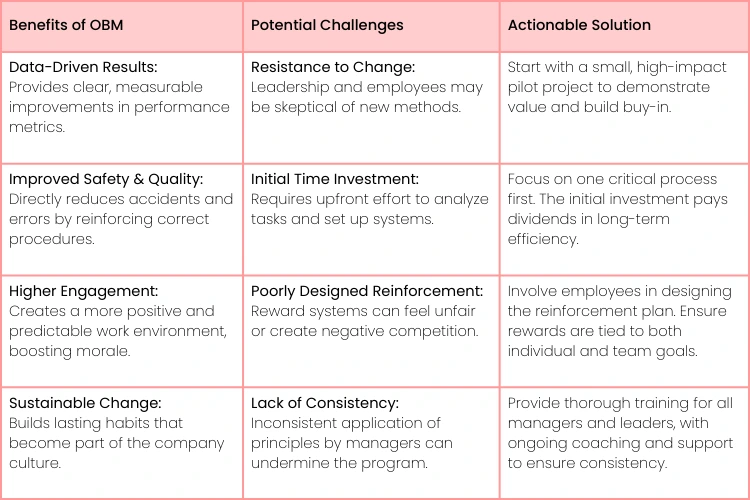
OBM Implementation Pros and Cons
To give you a clearer picture, let's break down the good, the challenging, and the solutions for implementing OBM.
Ultimately, the challenges of implementing OBM are entirely manageable with thoughtful planning and a commitment to the process. By anticipating these hurdles and having a plan to address them, you can unlock the significant, long-term benefits that OBM has to offer.
Getting Your Feet Wet With OBM
You don't need to orchestrate a massive, top-down corporate revolution to start applying Organizational Behavior Management. The truth is, you can start turning this knowledge into real action right now. The key is to start small by focusing on a single, high-impact behavior within your team. This approach makes the process feel manageable and, more importantly, shows results fast.
Take a second to think about a nagging, common challenge your team faces. Is it constantly missed deadlines? Maybe it's recurring safety oversights or spotty customer follow-up. Instead of trying to boil the ocean and fix the entire problem at once, pinpoint one crucial behavior that would make the biggest difference.
Practical First Steps
Seriously, don't try to change everything at once. Pick one specific, measurable behavior that you can directly tie to a key business outcome.
- Here’s an example: A sales team is terrible at keeping the CRM updated. The single, high-impact behavior you want to target is: "Enter all call notes into the CRM immediately after each client conversation."
Once you've zeroed in on your target behavior, just measure how often it's currently happening. This gives you a baseline—a starting point to see if your efforts are actually working. A great first move is often to run a proper training need analysis for learning and development to figure out if a simple skills gap is part of the problem.
Foundational Resources for Going Deeper
As you get started, diving into some foundational resources will give you much deeper insights and practical advice. These aren't just dry textbooks; they help connect the dots between the science and the real world, packed with frameworks and stories that make OBM click.
- Actionable Insight: If you ask anyone in the field where to start, they'll likely point you to Aubrey Daniels' classic book, Performance Management. It’s legendary for a reason—it breaks down the science of human behavior into simple, actionable strategies that any manager can use to boost performance with positive reinforcement.
Beyond books, getting plugged into professional communities is a game-changer. Groups like the OBM Network are fantastic places to learn from seasoned pros, talk through your own challenges, and keep up with what's working today. These resources are the perfect launchpad for anyone ready to truly master what organizational behavior management is all about.
Got Questions About OBM?
Even when the core ideas of OBM click, a few practical questions almost always pop up. Let's tackle some of the most common ones we hear from leaders trying to bridge the gap between theory and real-world application.
How Is OBM Different From Traditional HR?
This is a great question. While both OBM and HR want to make the workplace better, they come at it from completely different angles.
Think of traditional HR as working with a wide-angle lens. They focus on big-picture, system-wide programs like annual performance reviews, engagement surveys, or rolling out new benefits. These are absolutely essential for a healthy organization, but they often move slowly and the impact can be hard to pin down to specific results.
OBM, on the other hand, uses a microscope. It’s a surgical, data-first approach that asks, "What specific, observable behavior is driving this business problem?" Instead of waiting for an annual review, OBM uses immediate feedback and reinforcement to shape those key behaviors day by day. It’s less about yearly cycles and more about creating constant, measurable improvement.
Can OBM Really Be Applied To Knowledge Work?
Absolutely. It’s a common myth that OBM only works for clear-cut, physical tasks you'd see in manufacturing or safety protocols. The truth is, its principles are just as powerful for complex knowledge work. The trick is to stop focusing on vague outcomes and start identifying the specific behaviors that create those outcomes.
Take a software developer, for instance. A goal like "write better code" is fuzzy and hard to act on. But we can break it down into concrete, observable actions that directly lead to better code.
- Submitting code with zero failed unit tests.
- Completing peer code reviews within 24 hours of a request.
- Documenting new features using a specific, agreed-upon template.
See the difference? These are tangible behaviors you can track, measure, and—most importantly—reinforce. This is how you apply behavioral science to even the most creative and complex roles.
How Can I Start a Small OBM Pilot Project?
Jumping into a massive, company-wide OBM initiative is a recipe for disaster. The smartest path forward is to start small, prove the concept, and build momentum. Getting a quick win is the best way to earn buy-in from your team and leadership.
Here’s a simple, three-step game plan to get your first pilot off the ground:
- Select One Metric: Don't try to boil the ocean. Pick a single, frustrating problem that everyone agrees on. Maybe it's the number of missed deadlines on a key project or the high rate of errors in client-facing reports.
- Pinpoint One Behavior: Ask your team: "What is the one single action that, if we all did it consistently, would make the biggest dent in this problem?" Isolate that critical behavior.
- Practical Example: To reduce report errors, the pinpointed behavior might be "Having a second team member review the report against a 5-point quality checklist before sending."
- Reinforce Immediately: Figure out a dead-simple way to track that behavior and provide immediate, positive feedback every single time it happens. This could be a shout-out in Slack, a checkmark on a public whiteboard, or a simple "great job on this" from a manager.
This lean approach lets you test the waters, collect real performance data, and show tangible results without a huge investment of time or resources.
Ready to build a high-performance team culture based on proven science? At Uplyrn, we provide the skills and expert-led guidance to turn behavioral insights into powerful leadership strategies. Start your journey with us and learn to drive real, measurable results.


Leave your thoughts here...
All Comments
Reply