









What is Peer to Peer Learning and How Does It Work

Peer-to-peer learning is simply about people sharing what they know directly with each other. It’s a collaborative model where everyone gets to be both the student and the teacher, ditching the old-school, top-down lecture format.
Jump To Section

Earn As You Learn
Earn 25% commission when your network purchase Uplyrn courses or subscribe to our annual membership. It’s the best thing ever. Next to learning,
of course.
Learning From Each Other: A Quick Intro
Picture this: a seasoned developer and a junior marketer grab a coffee. The developer walks the marketer through a few basic Python scripts to automate boring reports. In return, the marketer shows the developer how to spin up a quick social media ad campaign to test a new product idea.
That’s peer-to-peer learning in a nutshell. It's a living, breathing exchange of useful knowledge between equals.
This whole approach flips the traditional classroom on its head. Instead of one expert talking at a room full of people, learning becomes a dynamic conversation. The idea is brilliant in its simplicity: sometimes the best person to explain a tricky concept is someone who’s just a few steps ahead of you.
The Modern Alternative to Traditional Education
This model really shines in fast-paced fields where skills go out of date almost as soon as you learn them. It makes learning a continuous part of the daily grind, not a one-off event you have to schedule. To get a better handle on this, it helps to look at what peer-to-peer learning really involves.
The real goal here is to get people to stop being passive sponges for information. Peer learning is all about active problem-solving, asking questions, and getting your hands dirty—all things you need for deep, lasting skill development.
Let’s break down how this actually stacks up against the way most of us were taught. When you understand how the brain learns, it becomes clear why learning from each other is so effective.
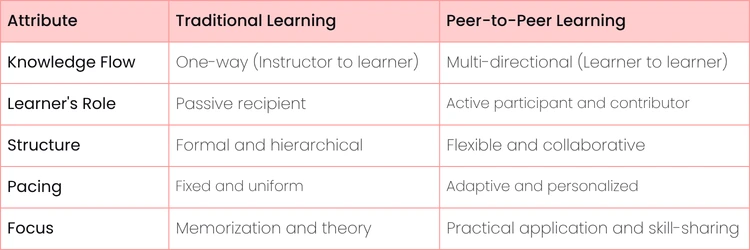
Peer Learning vs. Traditional Learning at a Glance
This table lays out the fundamental differences between the old-school, hierarchical way of learning and the more collaborative peer-to-peer model.
As you can see, the contrast is stark. Peer learning is built for agility and real-world application, making it a powerful tool for today’s challenges.
Why Peer Learning Is Gaining Momentum
The move towards peer-to-peer learning isn't just another corporate fad. It’s a direct answer to the real pressures of today's workplace.
Companies are struggling with skills that become outdated almost overnight. They're also trying to keep their teams feeling connected, especially when everyone's working from different places. Peer learning steps in as a practical, human solution to both problems.
- Actionable Insight: Instead of waiting for a formal training course to learn a new software feature, an employee can ask a colleague for a quick 15-minute screen-share tutorial. This is learning that happens on the job, right when it's needed, solving problems instantly. It’s a fast-moving approach for a world that can't afford to wait.
Closing Skills Gaps and Fostering Connection
The skills that matter most today—like great communication, collaboration, and creative thinking—aren't things you can master from a lecture. You learn them by doing, by interacting with others.
When team members teach each other, they're not just passing along facts. They're building relationships and, in the process, getting a much deeper understanding of the material themselves. That social connection is a huge motivator.
This is especially true for remote teams that miss out on those spontaneous "water cooler" chats. A structured peer learning program creates a space for those connections to happen on purpose, fighting off isolation and building a learning culture where everyone feels like their knowledge matters.
Peer learning turns your workplace into a living library of skills. It’s a recognition that the most valuable expertise is often already sitting inside your team, just waiting to be shared.
The Tangible Business Impact
This isn't just a nice idea; there's serious money behind it. The global market for social learning platforms was valued at a massive USD 1.8 billion back in 2022. It's now expected to skyrocket with a compound annual growth rate of 18.5% through 2030.
On top of that, 80% of organizations are planning to spend more on their learning tech, with a big chunk of that going to systems that support peer learning. The numbers don't lie: businesses are betting big on collaborative learning to get real results.
This investment pays off in ways that directly impact the bottom line.
- Knowledge That Actually Sticks: We remember far more of what we learn when we talk about it and use it right away. In fact, trying to teach something to a coworker is one of the best ways to truly master it yourself.
- A More Engaged Team: When people feel empowered to share what they know and learn from their colleagues, they feel more connected to their work and the company. It gives them a real sense of purpose.
- Scalable Skill-Building: Peer learning lets expertise spread naturally through a company without needing a huge training department or budget. It’s how you get smart, fast. This is where platforms like Uplyrn become so important, making it easy to build these connections across the entire organization.

Practical Models of Peer Learning in Action
So, what does peer-to-peer learning actually look like on the ground? It's easy to talk about the theory, but seeing it in practice is where things get interesting. These aren't rigid, academic frameworks but flexible blueprints you can adapt for just about any team or goal.
The real magic happens when you match the right model to the skill you're trying to build or the problem you need to crack. Let's break down a few common ways this plays out.
Peer Coaching
Think of this as a focused, one-on-one partnership designed to sharpen a specific skill. It goes way beyond just giving a bit of advice; it’s about structured practice, observation, and real, honest feedback.
- Practical Example: Let's say you have a sales team. Alex is a natural, always crushing targets with a killer pitch. Meanwhile, Ben is struggling to get deals over the line. In a peer coaching setup, Alex would actually sit in on Ben's calls, give specific pointers on his technique ("Try asking an open-ended question right after they mention budget"), and then they'd role-play different customer scenarios until Ben feels that spark of confidence.
This isn't generic training. It's personalized guidance from a colleague who’s in the trenches and gets the exact challenges Ben is facing every single day.
Collaborative Projects
This model is all about learning by doing—together. You throw a group of peers into a project with a shared goal, forcing them to pool their talents and figure things out as a unit.
- Practical Example: Imagine a group of designers teaming up to create a full brand identity for a fictional company. The graphic artist, the UX guru, and the copywriter all have to bring their A-game. As they work, they’re not just building a cool portfolio piece; they’re learning to juggle deadlines, blend different creative visions, and handle constructive criticism ("I love the color palette, but does this font really work for our target audience?"). For more ideas on how this works, checking out these Collaborative Learning Examples can show you just how powerful this approach is.
Collaborative projects transform individual knowledge into collective achievement. Everyone learns from each other's strengths and weaknesses, filling in skill gaps in real time.
This is a prime example of action-based learning, the future of skills development because it’s a perfect mirror of how real work gets done in today's world.
Knowledge-Sharing Circles
You might know these as "communities of practice". Basically, they're informal groups where people in the same role or with a shared passion get together to talk shop, troubleshoot problems, and trade insights.
- Practical Example: A company’s software developers could start a monthly "Code Jam" circle. In each meeting, one developer walks the group through a tricky problem they recently solved, sharing their code and explaining their thought process. The rest of the team then jumps in, discussing different ways to tackle it, new tools they’ve found, and best practices. A simple Slack channel can keep the conversation going between meetings, creating a live hub for problem-solving.
It’s a simple concept, but it builds a powerful, supportive network that raises the skill level of the entire department over time.

How Peer Learning Drives Workplace Performance
In the corporate world, learning isn't just a perk for personal growth—it's a core strategy for keeping the business sharp and competitive. This is where peer-to-peer learning shines, transforming from a nice-to-have idea into a serious engine for company performance.
Think of it as a direct answer to the biggest headaches modern companies face, from employees checking out mentally to massive skill gaps that are holding teams back.
When you give employees the power to learn from each other, you’re doing more than just trimming the training budget. You're actually building a more resilient, quick-to-adapt, and tight-knit workforce from the inside out.
Overcoming Modern Workplace Challenges
Let's be honest, today's workplace is facing some tough problems. The good news is that peer-to-peer learning is tackling these issues head-on.
Consider this: global employee engagement dropped to a concerning 21% in 2024, which translates to an eye-watering $438 billion in lost productivity. Yet, companies that truly nail peer-to-peer learning are 1.8 times more likely to see strong financial results.
With more than half of all leaders losing sleep over talent shortages and only 32% feeling confident about their team's skills for the future, collaborative learning is the most practical way to scale up. You can dig into more stats about peer learning's business impact.
This approach creates a culture where knowledge isn't siloed; it flows freely. This directly patches up skill gaps while giving team morale a much-needed boost.
Actionable Ways to Implement Peer Learning
Bringing this idea to life doesn't mean you have to tear down your entire training department. You can start with a few simple, focused initiatives that create value right away.
- Launch Peer Mentoring for New Hires: Nothing helps a new person feel at home faster. Pair them with a seasoned team member who can show them the ropes for their first 90 days.
- Actionable Insight: Create a simple "New Hire Checklist" for the mentor, with topics like "Navigating the project management software" and "Who to contact in each department" to give the mentorship a clear, helpful structure.
- Structure "Lunch and Learn" Sessions: Set aside one lunch hour a week for an employee to share what they know. This could be a marketer breaking down the basics of SEO or a developer walking through a neat coding shortcut. It's casual, effective, and builds community.
- Create Skill-Sharing Circles: Get employees with similar jobs or interests together regularly. For example, a group of project managers could meet to swap stories about what’s working, troubleshoot common problems, and share successful strategies.
By making knowledge sharing a part of the daily routine, you embed continuous improvement into your company culture. It shows that you trust your team's internal expertise.
Linking Peer Learning to Productivity
The return on this investment is incredibly clear. When employees learn directly from their colleagues, the information is instantly relevant to their day-to-day tasks. That means they can put it to use immediately.
This kind of practical, just-in-time learning closes the gap between knowing something and actually doing it, which leads to a direct jump in performance.
What’s more, a culture of peer support naturally leads to better problem-solving. Instead of getting stuck on a problem for hours, an employee knows exactly which colleague to ping for help. Roadblocks quickly turn into valuable learning moments.
Looking for more ways to get your team firing on all cylinders? You might find some great ideas in this guide on how to increase employee productivity.
At the end of the day, a team that learns together works smarter, solves problems faster, and is far more engaged. That’s a clear recipe for a stronger bottom line.
Launching Your Own Peer Learning Program
Alright, you understand the "what" and "why" of peer learning. Now for the fun part: the "how". Moving from theory to a real, live program can feel like a huge step, but it’s more about smart, simple planning than a massive budget.
The secret? Start small. You don’t need fancy software or a new department. All it takes is a clear goal and a handful of motivated people who are ready to share what they know.
Step 1: Start With a Crystal-Clear Goal
Before you start pairing people up, you need to know exactly what you're trying to accomplish. A fuzzy goal like "improve skills" is a recipe for a program that fizzles out fast. You have to get specific.
Are you trying to help your junior sales reps nail their cold-calling scripts? Or maybe you want your design team to get up to speed on a new prototyping tool?
Every great peer learning initiative is built on a specific, measurable goal. This clarity is what helps you find the right people, design the right activities, and actually see if it’s working.
- Actionable Insight: Frame your goal with a clear outcome. Instead of "Improve marketing skills", try "Over the next six weeks, our three junior marketers will learn basic SEO keyword research from a senior specialist, so they can create optimized blog outlines on their own." Now that's a goal everyone can work toward.
Step 2: Find the Perfect Peer Pairings
Once your objective is clear, finding the right people becomes a whole lot easier. This isn't about randomly matching colleagues. It's a strategic partnership—connecting someone who has a specific skill with someone who needs it.
Think about who holds the knowledge and who’s hungry to learn. It could be a seasoned pro mentoring a new hire, or even two people at the same level who can trade complementary skills.
Here’s how to make great matches:
- Run a Small Pilot: Don't try to roll this out to the entire company on day one. Pick a small, enthusiastic group of four to six people and focus on just one skill. This makes it manageable and helps you work out the kinks.
- Think About Chemistry: Whenever you can, try to pair people with compatible communication styles. Someone who asks a ton of questions will thrive with a patient, methodical teacher.
Step 3: Give It Just Enough Structure
Without a little bit of structure, even the most well-intentioned program can drift. Your job is to provide a simple framework that guides people without getting in their way. This means setting clear expectations for how often they meet, for how long, and what they should be doing.
- Practical Example: For your pilot program, you might suggest a one-hour meeting each week for six weeks. To keep things productive, give them a shared Google Doc with a simple agenda: "Goal for this week", "What I learned" and "What I'm stuck on". This keeps the conversation focused and constructive.
You can get more great ideas for building educational frameworks in this guide on how to create training materials.
Step 4: Get Ahead of Common Problems
Finally, be ready for a couple of common hurdles that can slow things down: losing momentum and a lack of accountability.
- Actionable Insight: To keep the energy high, those brief check-ins every couple of weeks are crucial. Just a quick "How's it going?" can make all the difference. For accountability, ask each pair to set one small, concrete goal for every session they have. This tiny step transforms a casual chat into a powerful, goal-driven learning experience.
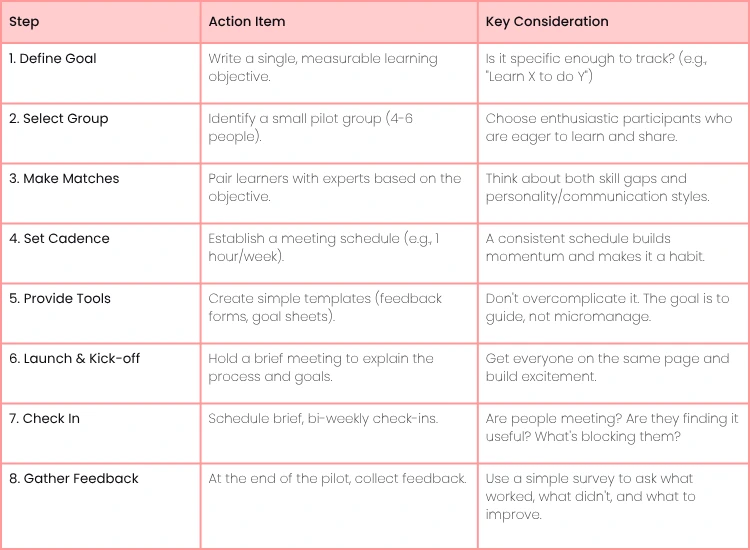
Your Peer Learning Implementation Checklist
To pull it all together, here's a simple checklist to walk you through the process. Use this as your roadmap to get from idea to a fully functioning peer learning program.
This checklist isn't meant to be rigid, but it provides a solid foundation. The most important thing is to just get started.
Common Questions About Peer to Peer Learning
Even with a clear plan in hand, you probably still have some questions about what peer-to-peer learning looks like in the real world. That’s perfectly normal.
Let's clear up a few of the most common questions people have when they first start exploring this way of learning.
How is this Different from Group Work?
While they might look similar on the surface, peer learning and traditional group work are driven by entirely different goals.
- Practical Example: In a group project, five students might write one research paper together, each contributing a section to get a good grade. In a peer learning scenario, those five students would review and critique each other's individual papers with the explicit goal of making everyone a better writer. The focus shifts from the collective output to individual improvement.
Does Peer Learning Work Online?
Absolutely. In many ways, online tools make peer learning even more powerful and accessible.
- Practical Example: A team of remote designers can use a tool like Figma to work on the same file in real-time, leaving comments and suggestions directly on the design. This creates a dynamic feedback loop that's often more efficient than an in-person meeting.
The goal isn't just to work together; it's to foster an environment where every participant actively contributes to the growth of their peers. This is what separates simple collaboration from true peer-to-peer development.
Is It Suitable for Every Subject?
Peer learning is incredibly versatile and works across almost any field you can think of. Whether you’re trying to master a programming language, analyze a tricky business case, or get feedback on a creative project, the model holds up.
The trick is to match the method to the subject matter.
- For technical skills: Peer code reviews are a classic example. Two developers review each other's work to catch bugs and share better coding practices.
- For soft skills: Role-playing difficult conversations is a great peer-to-peer exercise. Two team members can practice giving constructive feedback to each other in a safe, supportive setting.
By tailoring the activity to the skill you want to build, you can make this approach a success for just about anything.
Ready to stop learning in a silo and start growing with a community of driven peers? At Uplyrn, we provide the tools and expert-led environment to turn your skills into real-world success. Explore how Uplyrn can help you achieve your career goals.


Leave your thoughts here...
All Comments
Reply