









What is Performance Coaching? Time to Boost Your Potential

Performance coaching is a partnership, pure and simple. It’s a forward-looking process designed to close the gap between your current performance and your untapped potential.
This isn't about someone telling you what to do. Quite the opposite. It’s about empowering you to find your own solutions and unlock real, measurable improvement in your career or a specific skill you're trying to master.
Jump To Section

Earn As You Learn
Earn 25% commission when your network purchase Uplyrn courses or subscribe to our annual membership. It’s the best thing ever. Next to learning,
of course.
Unlocking Your Potential With Performance Coaching
Think of it like having a personal trainer, but for your professional life. That trainer won't do the push-ups for you, but they will give you the strategy, sharpen your technique, and provide the accountability you need to hit goals that once felt completely out of reach. That’s the essence of performance coaching. It's a collaborative journey focused squarely on your future growth.
A great performance coach moves way beyond just giving advice. They use powerful questions and truly listen, helping you pinpoint specific challenges, hone the skills you already have, and build concrete, actionable plans to get you where you want to go.
The Core Goal: Closing the Performance Gap
At its heart, performance coaching is all about bridging the space between where you are and where you could be. It’s a process laser-focused on helping people and teams achieve peak performance.
A coach helps you see your own blind spots—those little habits or assumptions you didn’t even know were holding you back. By doing this, they help you discover solutions you might have otherwise overlooked. The entire focus is on building your self-sufficiency for long-term development.
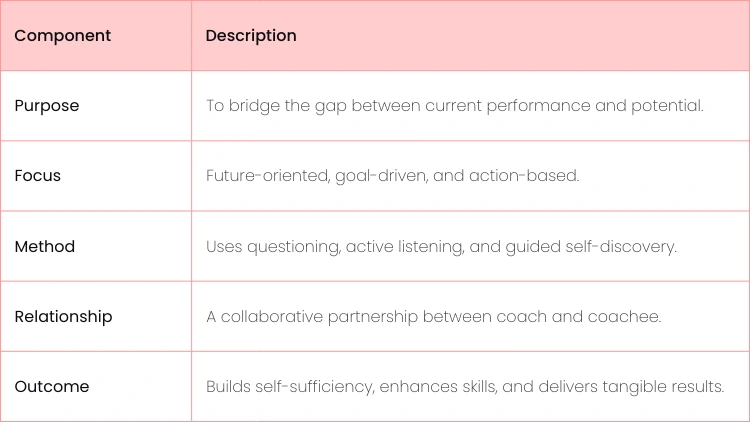
To put it all in one place, here’s a quick summary of what performance coaching is all about.
Performance Coaching At A Glance
The table below shows how each piece of the puzzle fits together to create a powerful engine for professional growth. It’s not a quick fix, but a structured process for sustainable improvement.
- Actionable Insight: The coaching relationship is a co-creative partnership. Your coach acts as a facilitator, but you are the one driving the change. To make this work, come to each session prepared with one success and one challenge from the previous week. This ownership is what makes the results stick.
Here are a couple of practical examples:
- For a Sales Professional: Instead of just grilling them on low sales numbers, a coach might ask, "What part of your sales process feels most draining, and what part energizes you?" This can uncover a hidden roadblock, like a dislike for cold calling, which can then be addressed with new strategies.
- For a New Manager: A coach won't just say, "You need to delegate more." They'll ask, "What's one task you could hand off this week that would free up two hours for more strategic work?" This frames delegation as a benefit and prompts a small, manageable first step.
Ultimately, performance coaching is about building capability, not creating dependency. It’s a structured path toward genuine self-improvement and results you can actually see and measure.
The Core Principles That Drive Real Results
So, what makes performance coaching actually work? It’s not magic, and it’s certainly not guesswork. The whole approach is built on a solid foundation of proven principles that move away from simply telling you what to do. Instead, it’s about empowering you to find your own path forward.
This shift is crucial. It ensures the growth you experience is real, sustainable, and something you truly own because you discovered it yourself. The process isn't random, either. It’s a structured partnership where coaches use specific techniques to help you uncover insights and build momentum, all within a relationship built on trust and a shared commitment to your goals.
The Power Of Insightful Questions
At the heart of performance coaching lies the art of asking powerful, open-ended questions. Instead of dishing out answers, a great coach asks questions that gently challenge your assumptions and help you see your situation from a new angle. This simple shift is what makes coaching so different from other types of guidance.
Here’s a practical example. Imagine a project manager is consistently missing deadlines.
- A traditional manager might say: "You need to manage your time better and hit your deadlines." (This is a command).
- A performance coach would ask: "Walk me through your process for the last project. At what point did you feel the timeline begin to slip?" (This is an exploration).
See the difference? The coaching question puts you in the driver’s seat. It prompts genuine self-reflection and nudges you to find the root cause of the problem, not just patch up the symptoms. This leads to solutions that you create yourself, making you far more invested in seeing them through.
Goal Setting and Co-Creative Partnership
Another pillar of great coaching is setting goals together. A coach will work with you to define what success actually looks like in clear, measurable terms. They often use frameworks like SMART goals (Specific, Measurable, Achievable, Relevant, Time-bound) to turn vague hopes into a concrete plan of action.
- Actionable Insight: A coach's role is to hold up a mirror, not to provide a map. They help you see what’s already there, enabling you to find your own direction with greater clarity and confidence. Try this yourself: At the end of each day, ask "What was my biggest win today, and what did it teach me?" This builds reflective practice.
This co-creative process creates a powerful sense of ownership. When you're part of designing the solution from the ground up, you're naturally more committed to the outcome. This ties directly into developing a mindset where challenges become opportunities for growth—a concept you can dive deeper into in this guide on the growth mindset vs. a fixed mindset.
The demand for this kind of personalized, results-focused support is skyrocketing. The global coaching industry hit a massive $5.34 billion in 2025 and is on track to reach $5.8 billion by 2026. What’s more, the number of active coaches around the world has jumped by 62% since 2019.
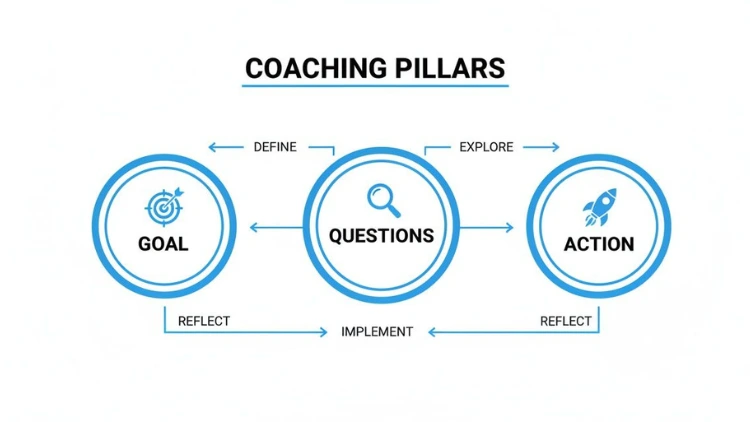
This simple but powerful flow is the heart of performance coaching. It’s a forward-moving process. You start with a clear Goal, explore new possibilities through powerful Questions, and ultimately commit to concrete Action.
Coaching vs. Mentoring vs. Training
People often toss around the terms ‘coaching', ‘mentoring’ and ‘training’ as if they’re the same thing. They’re not. While all three are valuable for growth, they each play a very different role. Knowing the difference is crucial for choosing the right support for your goals.
Think of it this way: Training teaches you "how" to do something. Mentoring is about a seasoned pro sharing "what I did" to succeed. But coaching? Coaching is all about asking "what could you do?"
A Practical Scenario
Let's make these differences real. Picture a newly promoted manager named Sarah. She’s brilliant at her job, but she's struggling to delegate and feels completely swamped.
Here’s how each approach would tackle her problem:
- Training: Sarah would be sent to a workshop on "Delegation Essentials". She’d learn a step-by-step process for assigning tasks and monitoring progress. The focus is on learning a specific, standardized skill. It's a one-size-fits-all solution.
- Mentoring: A senior director might take Sarah under their wing. They’d share personal stories, saying something like, "I remember feeling that way. I used to color-code my tasks to decide what to delegate. Here's what worked for me..." The goal here is to offer wisdom and guidance based on their own successful path.
- Performance Coaching: A performance coach takes a completely different angle. They won’t offer a pre-made solution. Instead, they guide Sarah to find her own answers through powerful questions:
- "What's your biggest fear when it comes to delegating an important task?"
- "If you were to hand off just one small, low-risk item this week, what could that be?"
- "What does 'good enough' look like for that delegated task?"
This approach empowers Sarah to uncover her own mental blocks and build her own solutions, one small step at a time. It’s not about getting an answer; it’s about developing the ability to find answers for yourself.
- Actionable Insight: The magic of performance coaching isn't in giving answers, but in asking the right questions. This shifts the coachee from being a passive student to an active problem-solver.
- Actionable tip for managers: Instead of giving a solution to a team member's problem, ask "What have you already tried?" followed by "What's one more thing you could try?" This builds long-term capability.
For a deeper dive into these unique development paths, check out this detailed guide on coaching vs. mentoring and which is best for your career.
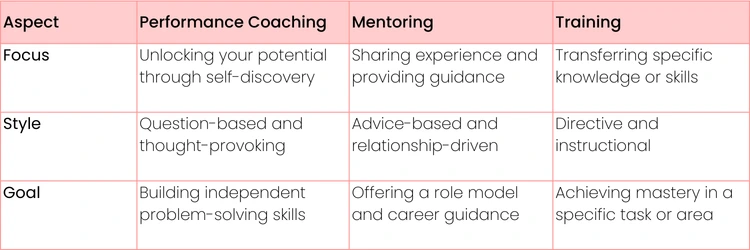
Comparing the Three Approaches
To make it even clearer, here’s a simple table breaking down how these powerful development tools stack up against each other.
Each method has its time and place. Training is perfect for learning a hard skill, and mentoring is invaluable for career navigation. But when it comes to unlocking your own potential and overcoming complex challenges, coaching stands in a class of its own.
Real-World Examples Of Performance Coaching In Action
Theory is one thing, but seeing performance coaching work in the real world is where its value truly shines. It’s easy to talk about goals and potential, but how does a structured conversation actually translate into promotions and increased revenue?
Let's dive into two detailed stories that show what performance coaching looks like in practice.
These aren't just hypotheticals. They highlight the journey from identifying a challenge to achieving measurable success, showing how a coach acts as a catalyst to unlock potential that was there all along.
From Developer To Leader
Meet Alex, a brilliant software developer. His technical skills were off the charts, but he was hitting a wall. While he was a master at his craft, he struggled with strategic communication and just didn't have the leadership presence to move into a team lead role.
In meetings, Alex would get bogged down in technical jargon, losing the attention of non-technical stakeholders who needed to understand the big picture. The challenge was clear: Alex had to evolve from a great individual contributor into an influential leader.
A performance coach came in and immediately got to work, helping Alex first define what "leadership presence" even meant for him and his role. They used a couple of key techniques:
- Role-Playing: They ran through mock presentations, with the coach acting as a non-technical stakeholder. This gave Alex a safe space to practice explaining complex ideas simply and get immediate, honest feedback like, "When you said 'API latency', I got lost. How can you explain the customer impact instead?"
- Goal-Setting: They set one small, achievable goal for each team meeting. A practical example was: "Start your update with the business outcome first, then provide one technical detail if asked." Tiny habits, big results.
Over three months, something clicked. Alex’s confidence soared. He learned to read the room and tailor his message, started contributing to high-level strategic discussions, and was ultimately promoted to Team Lead. His journey is a perfect example of how coaching builds a bridge to fill specific skill gaps.
Key Takeaway: Performance coaching isn't about a personality transplant. It’s about building a bridge between your current abilities and your future goals by developing specific, targeted skills.
Revitalizing A Slumping Sales Team
Next up, a regional sales team that was in a serious slump. They had talented people, but their monthly numbers were consistently missing the mark and morale was at rock bottom. The sales manager was out of ideas, having already tried new incentive programs with little to no effect.
The problem wasn't a lack of effort—it was a breakdown in their process and a total lack of collaboration.
A performance coach was brought in to work with the team, both as a group and one-on-one. The first thing the coach did was facilitate a session where the team mapped out their entire sales process, from the first cold call to the final signature.
Using guided questions like, "Where in this process do leads most often go cold?" the coach helped them spot bottlenecks they were too close to see. They discovered their follow-up process was inconsistent, and worse, team members were hoarding leads instead of collaborating on tough accounts.
The coach then worked with them to redesign their sales process and implement a new "deal huddle" where they shared insights on stalled leads. The change was almost immediate. Within a single quarter, the team’s performance skyrocketed. They hit a 20% increase in revenue, and because they were working together, their job satisfaction went through the roof.
This kind of return is more common than you'd think. Studies often show that executive coaching can yield an average ROI of 5-7 times the initial investment, and consistent sales coaching is known to significantly boost team performance.
These examples prove that whether you're an individual looking to climb the ladder or a manager trying to lift your team, coaching provides a clear path forward. And for those in leadership roles, it’s a good moment to ask yourself: you're a manager, but are you a coach? Learning to apply these techniques yourself might just be the key to unlocking your team’s hidden potential.

How To Find The Right Performance Coach For You
So, you're ready to find a performance coach. This is probably the single most important decision you'll make in this entire process. A great coach can genuinely unlock potential you didn't even know you had, while a poor match can lead to nothing but frustration and wasted time.
Finding the right person means looking beyond a polished resume. You need to dig into their experience, their specific coaching style, and most importantly, their credentials.
A great place to start is by verifying their qualifications. Look for certifications from respected bodies like the International Coaching Federation (ICF). Think of this as a baseline for quality—it shows the coach has committed to rigorous training standards and ethical practices.
Key Criteria For Your Search
Once you've confirmed their credentials, it's time to get more specific. You're looking for someone who not only understands the world you work in but whose approach actually clicks with your personality. Are you someone who thrives with direct, structured guidance? Or do you prefer a more exploratory, open-ended conversation?
Here are a few things to keep on your checklist:
- Industry Relevance: Does this coach have real-world experience in your field or with the specific challenges you’re up against? A former sales leader coaching a new sales manager is a practical example of a good fit.
- Proven Track Record: Can they point to testimonials or case studies from past clients? Real success stories speak volumes.
- Coaching Philosophy: Ask them to describe their approach. A good coach has a clear, well-defined method for helping clients get from A to B.
- Chemistry and Trust: This is a big one. During your first chat, do you feel a genuine connection? Do you feel safe enough to be vulnerable? Trust your gut.
Getting a peek behind the curtain gives you a much better sense of the standards and methods that top-tier professionals use in their own practice.
Questions To Ask A Potential Coach
Think of the initial consultation call as your chance to interview them—not the other way around. Don't hold back. Asking sharp, insightful questions is the best way to see if they’re the real deal.
- Actionable Insight: The best way to evaluate a coach is to "test drive" their coaching style. During the initial call, present a small, real-world challenge you're facing. Ask, "How would you approach helping me with this?" Their response will tell you everything about their expertise and whether their style is right for you.
Here’s a quick list of powerful questions to have ready for your call:
- How do you actually measure progress and success with your clients?
- Can you walk me through a time when a client hit a major setback and how you worked through it together?
- What's your typical coaching process or framework look like?
- What do you expect from me as a client to make our work successful?
Getting Started With Performance Coaching
So, you understand what performance coaching is. Now comes the exciting part: actually doing something about it. Whether you're an individual gunning for that next promotion or a manager looking to elevate your team's game, every great journey begins with a clear, well-defined starting point.
For individuals, the very first move is a bit of honest self-reflection. Before a coach can help you, you need to get a handle on what you truly want to achieve. This groundwork is crucial; it ensures your future coaching sessions are built on solid, tangible outcomes.
Self-Reflection for Individuals
Grab a notebook and really think about these questions. Your honest answers are the raw material for building your coaching goals.
- What specific skill, if I got 10% better at it, would make the biggest difference in my career right now? Get specific. Don't just say "better communication". A practical answer is "delivering presentations to leadership with more confidence and less jargon."
- What does success look like in six months? Paint a vivid picture. Is it landing a promotion? Leading a key project? A practical example: "I will have successfully led one cross-functional project from start to finish."
- What's the one obstacle that always seems to get in my way? Dig deep to find the root cause. A practical example: "I avoid asking for help because I'm afraid it makes me look incompetent."
Jotting down these answers gives you a powerful head start for a conversation with any potential coach. It shows you've done your homework and are genuinely ready to build a plan. For more on this critical first step, this guide on how to set SMART goals is a fantastic resource.
- Actionable Insight: When making the case for coaching to your manager, frame it as a smart investment, not just an expense. Focus on outcomes you can measure. For example: "With coaching, I aim to improve my project delivery time by 15%, which will directly impact our team's Q3 goals."
If you're a manager, kicking off a coaching program means you need to build a clear business case. Start small. A pilot program with one team facing a specific challenge is the perfect way to go. This approach lets you demonstrate a clear return on investment, which builds momentum for a broader rollout later. Your path to peak performance starts with these simple, practical steps.
Have Some Questions About Performance Coaching?
You're not alone. When you’re first exploring this world, a few common questions always seem to pop up. Let’s tackle them head-on so you can get a clear picture of what this is all about.
How Long Does a Typical Coaching Engagement Last?
This is probably the number one question. While there’s no one-size-fits-all answer, most performance coaching partnerships run for about three to six months, typically with sessions every other week. But here’s the most important thing to remember: it’s a goal-driven process, not a time-driven one.
The timeline is completely flexible and built around what you want to achieve.
- For example, a sales pro who wants to improve their closing technique might engage a coach for a focused three-month plan. In contrast, a new manager developing strategic thinking skills may need a six-month engagement to allow time for practice and feedback. The coaching ends when the goal is met, not just when the calendar says so.
- Actionable Insight: The length of the coaching is all about the complexity of your goals. The focus is always on hitting a specific, measurable target. Before starting, agree with your coach on what "done" looks like. This ensures your investment is directly tied to the results you get.
Is Performance Coaching Just for Executives?
Absolutely not. This is one of the biggest myths out there. While you’ll definitely find performance coaches in the C-suite, the benefits are for everyone, at every level of a company.
Performance coaching is for anyone who is ready to get better at what they do. Here are some practical examples:
- A new graduate can use it to build confidence and navigate their first corporate role.
- An experienced software engineer can work with a coach to sharpen the leadership skills needed for a promotion to team lead.
- A team leader can learn how to deliver constructive feedback more effectively to motivate their direct reports.
The only real requirement is the desire to grow and a commitment to doing the work.
What Is the Difference Between Performance and Life Coaching?
This is a great question, and it's easy to get them mixed up. While they use some similar tools, their focus is fundamentally different. Performance coaching is laser-focused on professional or skill-based goals within a specific arena—like your job, a sport, or even academics. It's all about becoming more effective in a particular domain.
Life coaching, in contrast, pulls the camera way back for a wide-angle view of your life. A life coach might work with you on everything from your personal relationships and overall well-being to your general sense of fulfillment.
Here’s a practical way to think about it:
- A performance coach helps you master your presentation skills for a big product launch.
- A life coach helps you figure out if the career that requires those presentations is truly making you happy.
Ready to stop wondering and start doing? With a network of vetted experts and a focus on practical skills, Uplyrn is your first step toward achieving your professional goals. Get started today!


Leave your thoughts here...
All Comments
Reply