









What is Professional Certification: How to Boost Your Career
So, what exactly is a professional certification?
Think of it as a formal endorsement of your expertise in a very specific field. It's a credential awarded by an independent, professional organization—not the place you took a course—that confirms you’ve met a rigorous, industry-wide standard of knowledge and skill. It’s far more than just a piece of paper saying you finished a class; it’s verified proof that you can actually do the job.
This official recognition tells employers, clients, and colleagues that your skills are not just claimed, but proven, current, and credible.
Jump To Section

Earn As You Learn
Earn 25% commission when your network purchase Uplyrn courses or subscribe to our annual membership. It’s the best thing ever. Next to learning,
of course.
What a Professional Certification Really Means
A good way to look at it is like a passport for your career. While a university degree gives you a broad foundation of knowledge—the equivalent of citizenship in a general field—a certification is the visa that gets you into a specialized territory. It’s the difference between saying you’re good at managing projects and holding a Project Management Professional (PMP)® certification, which proves you can lead complex projects according to globally recognized best practices.
That distinction is a game-changer in today's job market. As industries evolve at lightning speed, employers are leaning heavily on certifications to quickly identify candidates who are truly qualified. This is a huge part of the shift toward skills-based hiring, where what you can do often speaks louder than where you went to college.
The Growing Demand for Verified Skills
This need for proven skills has ignited a massive industry. The global market for professional certifications is absolutely booming and is on track to hit an incredible $16.8 billion by 2032. This explosion isn't just a trend; it's a direct response to employers desperately needing tangible proof of a candidate’s competence in a sea of applicants.
A professional certification serves as an impartial, third-party endorsement of an individual's professional knowledge and experience. It's a powerful tool for building trust and credibility with employers, clients, and colleagues.
Actionable Insights from Real-World Examples
Let's ground this in a few practical scenarios to see the real impact:
- IT Security: A job applicant with a CompTIA Security+ certification has proven they have hands-on skills to spot and stop security threats. This immediately puts them ahead of someone who has only taken a few online courses on the topic.
- Actionable Insight: If you're applying for IT roles, scan the job descriptions for desired certifications. Earning one, like Security+, can be the key to getting past automated applicant tracking systems and landing an interview.
- Finance: When a financial advisor holds the Certified Financial Planner (CFP) designation, they are legally bound to a fiduciary standard. This gives clients peace of mind, knowing the advice they receive is required to be in their best interest.
- Actionable Insight: For client-facing roles, a certification isn't just for your employer—it's a trust signal for your customers. Mentioning your CFP status in your professional bio can directly increase client confidence and acquisition.
- Mortgage Lending: In some fields, a credential isn't just an advantage—it's a requirement. A perfect example is understanding What is an MLO License, which is mandatory for anyone originating mortgage loans and ensures they meet essential legal and ethical standards.
In every one of these cases, the certification acts as a standardized benchmark of excellence, giving the person who holds it a clear and undeniable edge.
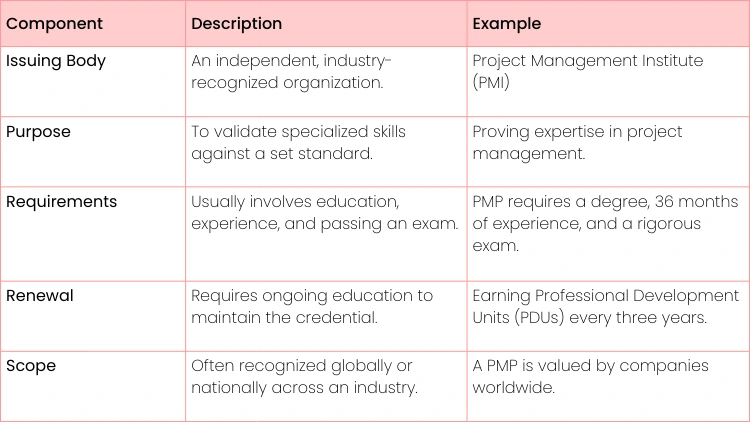
To give you a quick, digestible overview, here’s a breakdown of what a certification typically involves.
Professional Certification At a Glance
This table shows how certifications are designed to be a reliable and consistent measure of professional ability, no matter where you are in the world.
Navigating the World of Professional Credentials
Once you start looking into leveling up your career, you’ll run into a whole jumble of terms: 'certification', 'certificate', 'license'. They sound almost the same, but they mean very different things.
Mixing them up can be a frustrating and expensive mistake. The first step to making a smart investment in your future is getting a crystal-clear understanding of what each one actually does for you.
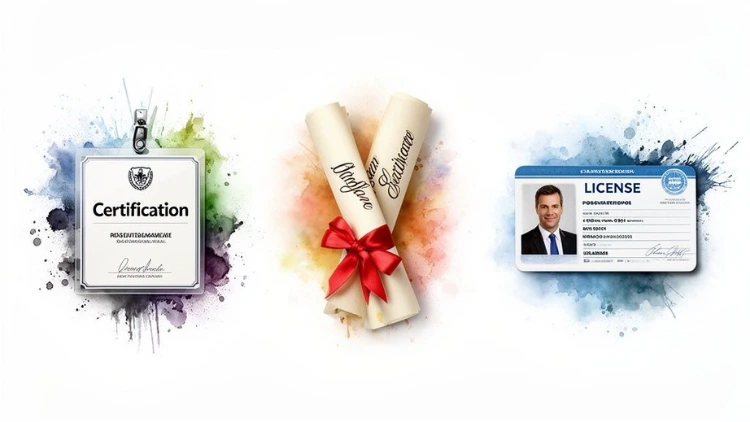
Think of it like this: a certificate is like a receipt for learning. It proves you showed up and completed a specific course, getting exposed to new information. A professional certification, on the other hand, is like passing the bar exam for your industry. It's a tough, independent stamp of approval that you don't just know the material—you can do the job to a high industry standard.
Practical Examples in the Real World
Let’s ground these ideas in a couple of real-world career paths. It makes the differences pop.
Say you’re aiming to climb the ladder in project management.
- Certificate: You might grab a "Certificate of Completion in Agile Methodologies" from an online platform after a 10-hour course. This shows you've learned about Agile.
- Certification: Then you decide to go for the gold standard: the Project Management Professional (PMP)® certification. This isn't a weekend course. It demands thousands of hours of real-world experience and passing a notoriously difficult exam, proving you can actually lead projects effectively. Check out what goes into a Project Management Professional course to see the level of commitment required.
A certificate proves you attended the class. A certification proves you mastered the material.
Here’s another one. An accountant might have a Bachelor's degree in accounting (the broad knowledge base), but they absolutely need a Certified Public Accountant (CPA) license (the legal permission slip) to practice publicly. Later, they might earn a Certified Fraud Examiner (CFE) certification (the specialized skill) to pivot into forensic accounting.
Each credential is a different tool for a different job, building a powerful, strategic career.
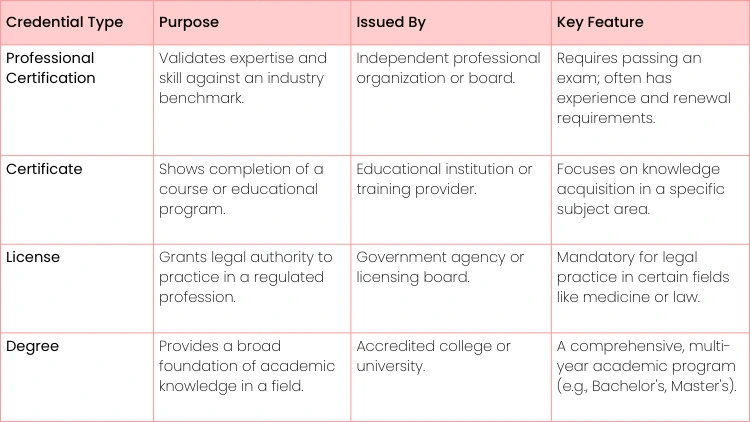
Certification vs Certificate vs License vs Degree
Let’s cut through the noise and lay it all out. When you see these credentials floating around, it's easy to get them confused. This simple breakdown shows exactly what each one is for, who hands it out, and what makes it unique.
As you can see, they all have their place. But a professional certification and a license are the two that are specifically designed to formally vouch for your ability to perform in a certain role.
So, What's a Certification Really Worth to Your Career?
Earning a professional certification is more than just adding another line to your resume. Think of it as a strategic career move, a catalyst that translates directly into better pay, stronger credibility, and doors opening to opportunities that were previously locked.
Imagine walking into an interview. Instead of having to prove your skills from scratch, your expertise is already validated by a respected industry authority. This gives you a massive head start, letting you skip the "prove it" phase and build immediate trust with hiring managers. It's a clear signal that you're serious about your field and have mastered its standards.
Boost Your Paycheck and Climb the Ladder
Let's talk about one of the biggest motivators: money. Getting certified has a direct impact on your earning potential. Certified professionals are seen as more valuable assets, which gives you serious leverage when it's time to negotiate your salary. For example, it's widely known that someone with a Project Management Professional (PMP)® certification often earns a significantly higher salary than their non-certified colleagues in the same job.
This increased value also helps you move up internally. When a promotion is on the table, having that certification can be the single thing that sets you apart from everyone else. It shows you have initiative and are committed to getting better at what you do—exactly the qualities leaders are looking for. Want to know more? We break down how to position yourself for that next step in this guide on how to get promoted and move up the career ladder.
A professional certification isn't just a piece of paper; it's an investment in your personal brand. It builds a foundation of trust and competence that opens doors to senior roles, leadership positions, and specialized projects.
Gain Instant Credibility and Confidence
The shift toward skills-based credentials is undeniable. A recent global survey found that a staggering 67% of professionals now hold at least one skills credential. That number climbs even higher to 72% among Gen Z. In fields like IT (86%) and technology (83%), it’s clear that certifications have become the gold standard for proving what you know. This isn't just about looking good on paper; it translates into real confidence and growth, with 81% of certified pros reporting benefits like a pay raise or greater professional assurance within a year. You can dive deeper into these global credentialing trends from PSI.
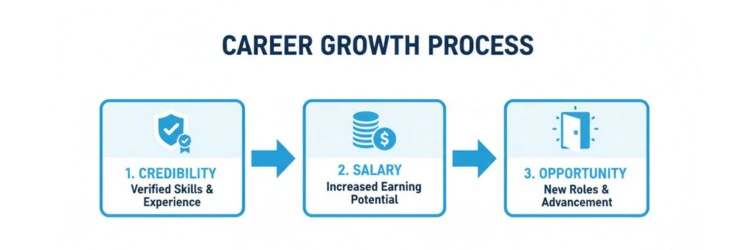
When you boil it down, a professional certification gives you three core advantages that build on each other over time:
- Instant Credibility: It’s third-party proof of your skills, immediately building trust with employers, clients, and colleagues.
- Actionable Insight: Add your certification acronym (e.g., PMP, CISSP) directly after your name on your LinkedIn profile and resume to immediately signal your expertise to recruiters.
- Expanded Opportunities: Many companies specifically look for certified candidates for senior or specialized roles, giving you access to a much wider pool of jobs.
- Demonstrated Commitment: It shows you’re proactive about your own development, signaling that you’re a motivated and valuable person to have on any team.
Your Actionable Guide to Getting Certified
Taking the plunge and deciding to get professionally certified can feel like a massive project, but it’s really just a series of manageable steps. Think of this as your road map—a practical guide to turn that ambition into a real credential you can put on your resume.
Like any big journey, this one starts with a bit of planning and research to make sure you're heading in the right direction. Your first job is to pinpoint the certification that truly fits. Don't just go for the most popular acronym you see. Instead, find the one that plugs directly into your career goals and what your industry is demanding right now.
- Actionable Insight: Go to a major job board like LinkedIn or Indeed and search for your dream job title. Note which certifications are mentioned most frequently in the "required" or "preferred" qualifications. This is your market-driven guide to choosing the most valuable credential.
Meeting the Prerequisites
Once you've zeroed in on the perfect certification, it's time to dig into the eligibility requirements. Most credible certifications aren't a free-for-all; you can't just sign up and take the test. They need proof that you have a certain level of education and, more importantly, real-world experience.
- For example, to become a Certified Brain Injury Specialist (CBIS), you need to show you have 500 hours of direct, hands-on experience working with individuals who have brain injuries. Similarly, the gold-standard Project Management Professional (PMP)® certification requires a minimum of 36 months leading projects if you have a four-year degree.
This is where you need to be meticulous about documenting your work history. A great way to start is to first identify your current skill gaps to see exactly what experience you already have and what you still need to gain.
Preparing for Success
With your eligibility confirmed, the real work begins: preparing for the exam. This is where your dedication will shine. It's not just about hitting the books; you need to understand the most effective study techniques to make sure all that complex information actually sticks.
Create a study schedule that you can actually stick to. Mix it up with official study guides, online courses, and plenty of practice exams. Remember, consistency is your best friend here—steady progress will always beat last-minute cramming.
The Final Steps: Registration and Renewal
When you feel ready, the next step is registering for the exam. This usually involves submitting an application with all your documented experience and paying the exam fee to the certifying organization. Then, after all that hard work, you pass the exam. But you’re not quite done.
Most professional certifications require ongoing education to remain active. This ensures your skills stay current with industry trends and technological advancements, reinforcing the credential's value over time.
This isn't just a box-ticking exercise. The renewal process, which often requires earning continuing education units (CEUs) or Professional Development Units (PDUs), represents a commitment to lifelong learning. It’s what keeps you sharp and proves you’re still at the top of your game, long after you’ve framed that initial certificate.
This process—proving your expertise through certification—is what directly fuels your career growth. As the infographic shows, it’s a clear path from establishing credibility to unlocking a bigger salary and better job opportunities.
Finding the Right Certification for Your Industry
Okay, let's move from the abstract to the concrete. To really get a feel for what a professional certification can do, it helps to look at some of the heavy hitters across different industries. Seeing them in action is the best way to connect the dots between the idea of getting certified and landing a better job.
This isn’t some small trend, either. It's a full-blown global movement. Enrollments in Professional Certificates have shot up by 32% worldwide, which tells you there’s massive demand for credentials that hiring managers actually recognize.
The growth is off the charts in booming fields like cybersecurity (+11%) and Generative AI (+195%), where professionals are scrambling to prove they have the latest job-ready skills. You can dig into more of the numbers in this report on global skill trends and their impact on professional learning.
Technology and Cybersecurity Certifications
In the tech world, things move fast. Certifications act like a universal language for your skills, giving employers a clear, standardized way to see that you can handle specific platforms, tools, and security protocols.
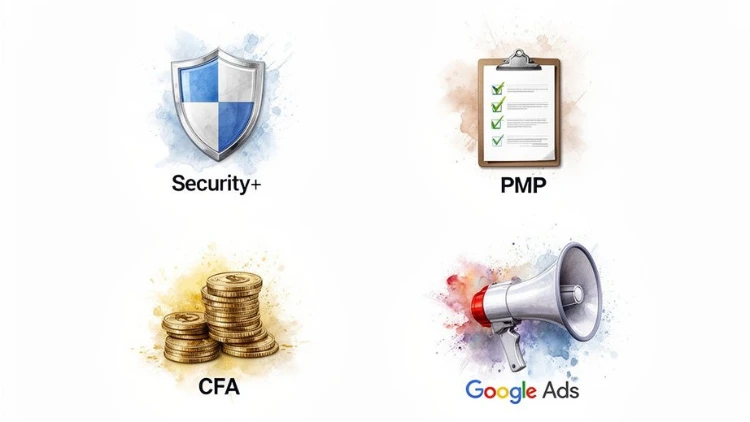
- CompTIA Security+: Think of this as the essential starting point for any cybersecurity career. It confirms you’ve mastered the core knowledge every security role needs, from managing threats to understanding cryptography.
- Practical Example: A recent college graduate with a computer science degree can earn the Security+ to immediately qualify for entry-level security analyst roles that would otherwise require several years of on-the-job experience.
- Certified Information Systems Security Professional (CISSP): This one’s for the seasoned pros—the managers, executives, and senior practitioners. The CISSP is a globally recognized seal of excellence. Earning it tells the world you have what it takes to design, build, and run a top-tier cybersecurity program.
Project Management Credentials
For anyone managing projects, a certification is your proof that you can get things done on time and under budget using methods the whole world agrees on. You’ll often see these listed as a requirement for leadership roles.
- Project Management Professional (PMP)®: The PMP is, without a doubt, the gold standard in project management. It verifies your experience and skill in leading projects from start to finish. It's one of the most respected and requested credentials out there.
- Certified Associate in Project Management (CAPM)®: Just getting started in project management? The CAPM is your perfect entry point. It demonstrates that you have a solid handle on the fundamental knowledge, terms, and processes needed for effective project management.
Choosing the right certification is like picking the right key for a specific lock. The PMP opens doors to senior project leadership roles, while the Security+ unlocks entry-level cybersecurity positions.
Finance and Digital Marketing Examples
It’s not just tech and project management. Other fields depend just as much on certifications to verify specialized skills and earn a client's trust.
Take finance, for instance. The Chartered Financial Analyst (CFA) designation is one of the most respected credentials you can earn. It screams mastery of investment analysis and portfolio management.
Over in digital marketing, a Google Ads Certification is a practical, hands-on credential that shows you know your way around Google's advertising platform. It’s a direct signal to employers that you can manage an ad budget effectively and, most importantly, deliver results.
- Practical Example: A marketing coordinator can complete the free Google Ads certification and immediately start applying for PPC (Pay-Per-Click) Specialist roles, often with a significant salary increase.
Accelerate Your Path to Certification with Uplyrn
Gearing up for a certification exam is a major commitment, but it’s not a journey you have to take on your own. Think of a dedicated learning partner as your co-pilot, turning what could be a stressful solo mission into a structured, supported, and confident path to success. That’s exactly where a platform like Uplyrn comes in. We’re the launchpad you need, providing the laser-focused resources and expert guidance to get you across the finish line.
Our entire learning ecosystem is built to mirror the real-world demands of top certification exams in business and technology. Forget about spending countless hours trying to piece together study materials from all over the internet. With Uplyrn, you get a single, curated curriculum designed from the ground up to build the specific skills you'll be tested on. This targeted approach doesn't just save you time—it makes sure every minute you spend studying is a minute spent on what actually matters.
Beyond Just Passing the Exam
Learning directly from people who have been there and done that gives you a massive advantage. Our instructors don't just teach theory; they bring their real-world experience into every single lesson, offering practical insights you'll never find in a textbook. Paired with interactive course material and the flexibility to learn on your own schedule, you can master even the most complex topics in a way that truly fits your life.
This kind of structured learning is critical, but what happens after you ace the exam? A certification's true value comes to life when it actually helps you grow your career. That's why we also offer job opportunities, creating a clear and direct path from earning that new credential to landing a better role. We help you turn that piece of paper into a genuine career catalyst.
Uplyrn bridges the gap between learning and earning. Our goal is to provide not just the knowledge to get certified, but the support and connections to translate that certification into tangible career advancement.
Got Questions? We’ve Got Answers.
Alright, so the benefits are clear, but you’ve probably got some practical questions buzzing around your head. That's a good thing. It means you're serious.
Let's break down some of the most common questions people ask when they're on the verge of choosing a certification. Getting these details straight is the key to moving forward with confidence.
How Much Is This Going to Cost Me?
The price tag on certifications can swing wildly, depending on the field you're in and how prestigious the credential is. The exam fee itself is the first thing to budget for, and that can be anything from $200 to over $1,000. For a real-world comparison, the Certified Brain Injury Specialist (CBIS) exam runs about $325, while sitting for the Project Management Professional (PMP)® exam will set you back more than $500.
But don't stop there. You need to account for the other costs that creep in:
- Study Materials: Think official guidebooks, practice exams, and online courses. These can easily add another few hundred dollars to your total.
- Training Courses: While often optional, a good prep course is highly recommended. These can range from $500 to $3,000.
- Renewal Fees: Staying certified isn't a one-and-done deal. Most require an annual or bi-annual fee, usually somewhere between $50 and $250, to keep your status active.
How Long Does It Take to Get Certified?
Just like the cost, the timeline is all over the map. Some certifications are relatively quick wins. For example, you can become a Certified Kinesio Taping Practitioner (CKTP) after a 20-hour training course. Quick and effective.
Others are a serious marathon, not a sprint. To even be eligible to take the exam for a Certified Hand Therapist (CHT), you need to clock 4,000 hours of direct, hands-on experience first. That’s why you have to read the fine print on prerequisites to build a timeline that actually makes sense for you.
It helps to think of the time and cost as a direct investment in your future. The upfront spend often pays for itself with the very first salary bump or the new job it helps you land.
Do Employers Really Respect Online Certifications?
Yes, without a doubt. In the modern workplace, where you learned is far less important than what you learned and who says you learned it. What employers truly care about is the credibility of the organization that issued your certification, not whether your study sessions were in a classroom or on your couch.
An online certification from a globally recognized authority like CompTIA, PMI, or Google carries the exact same weight as one earned in person. The only thing that matters is that the credential itself is a respected benchmark in your industry.
Do Professional Certifications Expire?
They do, and that's actually one of their biggest strengths. Most certifications need to be renewed every two to five years. This isn't just a money grab; it’s a quality control measure.
The renewal process usually involves paying a fee and proving you’ve kept your skills sharp by earning continuing education units (CEUs) or professional development units (PDUs). This system ensures that a certified professional isn't just someone who passed a test once—they're someone who is actively staying on top of their game. It’s what keeps the credential valuable for years to come.
Ready to turn your professional goals into reality? At Uplyrn, we provide the expert-led courses and job opportunities you need to not just get certified, but to truly advance your career. Explore our programs and start your journey today.


Leave your thoughts here...
All Comments
Reply