









A Guide to the Competency Based Training Approach

Competency-based training is all about mastering specific, real-world skills—not just logging hours in a classroom. It’s a fundamental shift in thinking, where the real measure of success isn't time spent learning, but skills you can actually prove. This approach makes sure people can truly do what they were trained for, and it's quickly becoming the new standard for building a capable workforce.
Jump To Section

Earn As You Learn
Earn 25% commission when your network purchase Uplyrn courses or subscribe to our annual membership. It’s the best thing ever. Next to learning,
of course.
What Is the Competency Based Training Approach?
Think about learning to fly a drone for a moment.
In a traditional, time-based class, you’d probably sit through eight hours of lectures, pass a written exam, and walk out with a certificate—even if you can’t actually pilot the drone without crashing it into a tree. The focus is on attendance and theory.
Now, imagine a competency-based training approach. Instead of a lecture, you’re given a series of practical missions. First, you have to master taking off and hovering steadily. Once you can do that consistently, you move on to navigating a tricky obstacle course. Finally, you have to land it safely, every single time. You only advance when you've mastered the current skill, getting personalized coaching along the way. Your certificate isn't based on how many hours you sat in a chair; it's proof that you have flawless control of the drone.
That’s the core idea of competency-based training (CBT). It puts what people can do ahead of how long they’ve studied. This philosophy is picking up serious momentum as more and more companies realize they don't just need employees with credentials—they need employees with capabilities.
From Theory to Tangible Skills
This method turns learning from an abstract idea into a practical, hands-on process. You can forget about those generic, one-size-fits-all training modules. CBT is built around specific, measurable skills that are tied directly to how well someone does their job.
A few things make it stand out:
- Mastery Over Seat Time: Learners move forward only when they can prove they can apply a skill, not just because the course schedule says it's time.
- Flexible Pacing: People who catch on fast can power through the material, while others can take the extra time they need to really nail a concept without feeling rushed or left behind.
- Clear, Measurable Outcomes: Everyone involved knows exactly what "good" looks like for every single competency. There's no guesswork.
This focus on provable ability is why the global market for competency-based education, which was valued at $6.2 billion in 2024, is expected to explode to $19.7 billion by 2033. Organizations are putting their money into training that actually delivers results they can see.
An Actionable Example in Sales
Let's look at a sales team. Instead of sending everyone to a generic "Sales 101" workshop, a competency-based program would break the sales role down into its core skills: "Prospecting", "Objection Handling" and "Closing".
A new hire wouldn't just listen to a lecture on handling objections. They’d jump into role-playing scenarios, practicing how to navigate the most common pushback from customers until they can do it smoothly and successfully every time. Only after mastering that skill would they move on to the next one, like mastering the closing process.
- Actionable Insight: Implement this by recording these role-play sessions. Use the recordings to provide specific feedback, like, "You successfully used the 'feel, felt, found' technique, but let's work on your tone when addressing pricing concerns." This makes feedback tangible and targeted.
This way, every single person on the team is genuinely ready for real-world customer conversations. It’s a practical approach that directly supports effective skills-based hiring and development.
The Core Principles of Competency Based Training
To really get why the competency based training approach works so well, you have to understand what it’s built on. Unlike old-school models that just measure time spent in a chair, CBT is built on three core pillars that put provable skill front and center.
These principles work together, creating a learning experience that's far more efficient, relevant, and frankly, more motivating for everyone involved. It all boils down to clear goals, flexible timing, and assessments that actually mean something.
Start With Clear, Measurable Outcomes
Everything in a competency based program starts with the finish line. Before a single module is built, the specific skills or competencies a person needs to master are defined with total clarity. There’s no guessing what "done" looks like.
For instance, a customer service rep's training isn't a vague "communications skills" workshop. Instead, the competencies are things like, "De-escalate an angry customer call in under two minutes" or "Accurately process a refund request with 99% accuracy". These are concrete, observable behaviors that tie directly back to performance on the job.
- Actionable Insight: To define these outcomes, interview your top-performing customer service reps. Ask them: "Walk me through the exact steps you take when a customer is upset." Their answers will give you the practical, real-world actions to build your competencies around.
If you want to dig deeper into structuring these kinds of outcomes, you can explore the different facets that corporate training must include to make them effective.
Give People the Flexibility to Learn at Their Own Pace
This is where CBT really shines. Because mastery is the only thing that matters, the time it takes to get there is flexible. Learners aren't dragged along by a fixed calendar or pushed ahead before they’ve truly grasped a concept.
Think about a newly promoted project manager. She might already be a wizard with budgeting from a previous role. A CBT program lets her test out of that module in minutes, freeing her up to spend quality time on a skill she actually needs, like navigating an advanced risk assessment simulation. It respects what she already knows and gets her up to speed faster.
- Practical Example: A software company could offer a pre-assessment for its "Secure Coding Practices" module. Experienced developers who pass can skip it entirely, while junior developers who struggle are automatically directed to foundational lessons on SQL injection prevention before moving on.
Assess Skills in a Real-World Context
Forget bubble sheets and multiple-choice quizzes. In CBT, the goal is to confirm that someone can actually do the thing in a situation that looks and feels like their real job. This means assessments are almost always performance-based.
True competency isn't about knowing the answer; it's about being able to perform the task. Assessments have to bridge the gap from theory to action.
This could look like:
- Simulations: A software developer is given a buggy piece of code and told to find and fix the error.
- Role-Playing: A sales trainee has to navigate a tough negotiation with a "client" played by a senior team member.
- Portfolio Reviews: A graphic designer submits a collection of work that proves they've mastered specific design principles.
This focus on practical demonstration is the ultimate proof. When the training is done, you know the employee is ready to hit the ground running.
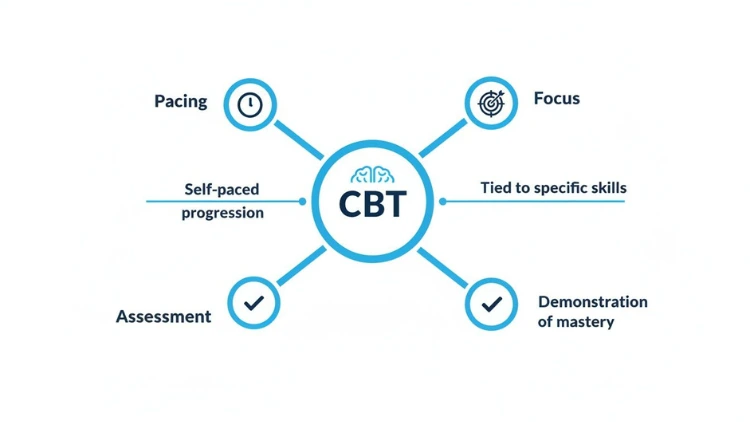
As you can see, the whole system is interconnected. A sharp focus on specific goals allows for adaptable pacing, which is then verified through practical, real-world evaluation to achieve true mastery.
Why Top Businesses Are Adopting This Approach
Making the switch to a competency-based training approach isn't just about keeping up with the latest L&D trends. It’s a strategic move that delivers real, measurable results. Companies are ditching traditional training models because they've realized that investing in provable skills directly impacts the bottom line, turning the training budget from a cost center into a powerful engine for growth.
This shift is backed by some pretty compelling data. Employers who invest in these programs are seeing huge wins, with 77% reporting enhanced productivity and 70% noting improved competitiveness. These aren't just small tweaks; they're significant gains.
Driving Tangible Performance Gains
A competency-based model gets right to the point. It zeroes in on the exact skills that actually move the needle on job performance. By targeting the specific abilities an employee needs to excel, organizations stop wasting time and money on generic or redundant training.
This focus accelerates an employee's journey from novice to fully productive team member.
- Practical Example: A manufacturing company identified "Machine Calibration" as a critical competency for reducing defects. They developed a hands-on training module where technicians practiced on a simulator. After the program, the company saw a 25% reduction in product defects and a 15% decrease in machine downtime, directly tying the training to operational efficiency.
Boosting Employee Retention and Engagement
Let's face it: your best people want to grow. When they can see a clear path to mastering new skills that will advance their careers, they're not just more engaged—they're far more likely to stick around. The flexibility and personal focus of this model send a clear message that the company is invested in their individual success.
A competency-based framework turns professional development into a collaborative journey, not a top-down mandate. It empowers employees by giving them real ownership over their career progression, and that's a powerful tool for retention.
- Actionable Insight: Create visual "competency maps" for different roles. This allows an employee to see which skills they've mastered and which ones they need for the next promotion. This visual roadmap makes career progression transparent and motivating. Many organizations adopt this model as a core part of their talent strategy, especially when they need to figure out how to upskill employees for the challenges ahead.
Calculating a Clear Return on Investment
Perhaps the strongest argument for this approach is its transparent ROI. Because competencies are tied directly to specific business outcomes, leaders can draw a straight line from the training investment to improvements in key performance indicators (KPIs).
You can finally answer the question, "What did we get for our training budget?"
- For a sales team: Track the increase in close rates after a training program focused on the "Objection Handling" competency.
- For a support team: Measure the drop in call escalation rates after mastering the "First-Call Resolution" competency.
- For a logistics team: Calculate cost savings from fewer shipping errors after completing a competency in "Inventory Accuracy".
This data-driven validation makes justifying the training spend to executives a whole lot easier. To dive deeper into building a skilled and agile team, check out this guide on the three pillars to modernizing workforce development.
Building Blocks of a Successful CBT Program
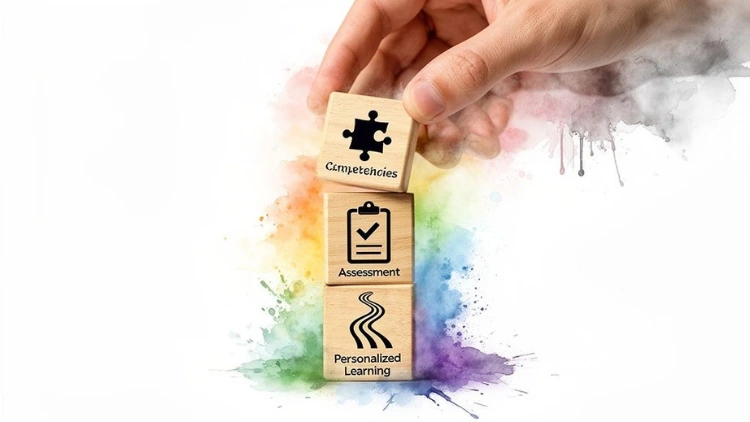
Making the switch to a competency-based training approach takes more than just a new outlook; it requires a solid architectural plan. A truly effective program is built on three core components that work in tandem to create a powerful learning ecosystem: clearly defined competencies, robust assessment methods, and personalized learning pathways.
Think of these as the foundation, walls, and roof of your training structure. If one is weak or missing, the entire system is at risk of collapse.
Clearly Defined Skill Competencies
The bedrock of any CBT program is a crystal-clear competency framework. This goes way beyond a simple list of job duties. It's a detailed breakdown of the specific knowledge, skills, and behaviors an employee needs to truly excel in their role.
For example, a software developer’s competencies might look like this:
- Code Debugging: The ability to systematically hunt down and resolve errors in a complex codebase.
- API Integration: The skill of connecting different software systems so they communicate seamlessly.
- Agile Methodology: The behavior of collaborating effectively within a fast-paced, iterative development cycle.
Each competency has to be something you can see and measure. This crucial first step means taking a deep dive into what your high-performers are actually doing on the job, a process that is essential for correctly identifying your team's most critical skill gaps.
A well-defined competency acts as a North Star for both the learner and the organization. It removes ambiguity and ensures everyone is working toward the same measurable standard of excellence.
Robust and Realistic Assessment Methods
Once your competencies are set in stone, the next block to add is assessment. But we’re not talking about your standard multiple-choice quiz here. In a competency-based world, assessments must mirror real job tasks to prove genuine mastery.
This means shifting from theory to practical application. A customer service trainee shouldn't just answer questions about empathy; they should successfully resolve a complex, simulated client issue. Likewise, a project manager would demonstrate their "Risk Management" competency by creating a detailed risk mitigation plan for a realistic project scenario.
- Practical Example: For a marketing manager's "Campaign Analysis" competency, the assessment could be providing them with a real (anonymized) campaign dataset and asking them to prepare a slide deck that identifies three key insights and recommends two specific actions for the next campaign.
Personalized Learning Paths
The final building block is creating personalized learning paths. Since CBT recognizes that everyone starts from a different place, a one-size-fits-all curriculum is completely counterproductive.
These paths offer a flexible menu of resources—from micro-learning modules and simulations to mentorship and on-the-job projects. This allows individuals to focus only on the competencies they need to develop, saving time and boosting engagement. To explore this topic further, discover how to identify skill gaps in your team.
How to Implement Competency-Based Training
Making the switch to a competency-based training model can seem daunting, but it’s a lot more manageable when you break it down. This isn't about tearing down your L&D department and starting from scratch overnight. Think of it as a methodical process that starts with your core business goals and ends with a truly effective, scalable training program.
And the need has never been greater. The global workforce is facing a massive skills gap. Projections show that over 1 billion people worldwide will need reskilling by 2030, and 58% of today's employees already require new skills just to keep up. This is a huge challenge, but one that CBT is perfectly suited to solve.
Step 1: Define Critical Competencies
Before you can build anything, you have to know what skills actually move the needle. Ditch the generic job descriptions and focus on identifying the specific behaviors and abilities that separate your top performers from everyone else.
The best way to do this? Go straight to the source.
Sit down with your star employees and their managers. Ask them real-world questions:
- "When you're dealing with a tough client or a complex project, what's your go-to move?"
- "What specific knowledge helps you get things done faster or better than your peers?"
- "What's the one skill that makes the biggest difference in your success each day?"
Actionable Insight: Use the answers to these questions to build a "competency dictionary" for each role. For example, if a top salesperson says, "I always research a prospect's company and find a personal connection before I call", the competency is "Pre-Call Research" not just "Prospecting".
This isn’t just an HR exercise. It’s an investigation to uncover the practical, on-the-ground competencies that directly fuel your business goals.
Step 2: Develop Realistic Assessment Tools
Once you've mapped out your core competencies, the next puzzle piece is figuring out how to measure them. Forget about traditional multiple-choice quizzes; they just test memory, not ability. Your assessments need to be a mirror of the actual work environment to prove genuine mastery.
For example, if you're assessing a "Client Negotiation" skill for your sales team, have the learner role-play a negotiation with a senior manager. If you want to measure a graphic designer's grasp of "Visual Hierarchy", give them a cluttered webpage and task them with redesigning it for better user flow. These performance-based challenges offer undeniable proof of skill.
Remember, the goal of assessment in CBT isn’t about assigning a grade. It’s about validating that a learner can confidently and consistently perform a critical task when it matters most.
Step 3: Design Flexible Learning Pathways
Now that you know what to teach and how to measure it, you can start building the learning journey itself. The key is to avoid a one-size-fits-all curriculum.
Instead, create flexible pathways that mix and match different resources. Think on-demand video modules, hands-on projects, realistic simulations, and valuable mentorship opportunities. This approach lets learners zero in on the specific skills they lack, respecting the knowledge they already have and saving everyone a ton of time.
- Practical Example: For a "Data Analysis" competency, a learning path could include an intro video on pivot tables, a link to an interactive data set to practice on, and an optional 30-minute mentoring session with a senior analyst for learners who get stuck.
Step 4: Launch a Pilot Program
Whatever you do, don't try to roll out your shiny new program to the entire organization all at once. Start small. Pick a single team or department for a pilot program.
This controlled launch is your chance to gather honest feedback, iron out any wrinkles in the process, and—most importantly—build a success story. A solid win from the pilot group will generate the buy-in you need from other leaders to expand.
- Actionable Insight: Choose a pilot group where a specific skill gap is causing a visible business problem (e.g., the customer support team with low satisfaction scores). A clear "before and after" makes for a powerful case study.
Step 5: Measure, Iterate, and Scale
A great CBT program is never really "finished". It’s a living, breathing system that needs continuous attention to stay effective. Use the data and feedback from your pilot to refine your competencies, tweak your assessments, and improve your learning materials.
Once you’ve got a proven model that delivers results, you can confidently start scaling the program across the rest of the organization. For a deeper dive into tracking your progress, check out this guide on how to measure training effectiveness.

Got Questions About CBT?
Jumping into a competency-based training model is a big move, and it’s natural to have questions. It’s one thing to understand the theory, but another thing entirely to picture how it works on the ground, day-to-day. That's perfectly normal.
Let's tackle some of the most common questions we hear from organizations. The goal here is to clear up any lingering doubts so you can feel confident moving forward.
Can This Approach Really Work for Creative or Soft-Skill Roles?
Absolutely. It’s easy to picture how CBT applies to a coder or a machine operator—the skills are concrete. But what about a leader, a communicator, or a designer? It’s just as effective, you just have to get specific.
The key is to translate abstract concepts into observable behaviors. Instead of a vague competency like "Good Communicato", you break it down into things you can actually see someone do.
- Active Listening: Can they accurately summarize a colleague's point of view in a team meeting?
- Clarity: Can they explain a complex project update to a non-technical stakeholder without resorting to jargon?
- Conflict Resolution: Can they successfully mediate a disagreement between two team members using a structured approach?
For a graphic designer, you wouldn't just assess "Creativity". Instead, you might measure their ability to produce three distinct logo concepts for a new brand that all adhere to the creative brief. It takes the abstract and makes it tangible.
How Do You Actually Measure Mastery?
Mastery in a CBT world isn't about getting a 95% on a multiple-choice test. It’s about being able to perform a skill consistently and confidently, especially when things don't go perfectly to plan.
You need a mix of assessment methods to get the full picture.
Mastery isn't about memorizing the recipe; it's about being able to cook a great meal, even if the power flickers or you’re missing an ingredient. It’s about reliably producing the desired outcome in a real-world context.
A powerful tool for this is a "mastery rubric". For a skill like "Project Management", the rubric wouldn't be a simple pass/fail. It would lay out clear performance levels:
- Novice: Can create a basic project timeline with some help.
- Competent: Can independently manage a small-scale project, keeping it on time and on budget.
- Master: Can successfully lead a complex, multi-department project, proactively spotting and mitigating risks before they become problems.
This gives everyone—learners and managers alike—a crystal-clear standard for what "good" looks like at every stage.
What Are the Biggest Hurdles to Implementation?
Let's be real: switching to a competency-based approach is a significant change, and it comes with a few predictable bumps in the road. The most common challenges are getting buy-in from leadership, the initial time commitment to build out the competency frameworks, and training managers to be coaches instead of just supervisors.
But you can get ahead of these with a smart strategy.
- Getting Leadership On Board: Don't try to boil the ocean. Start with a pilot program in one department. A small-scale win provides the hard data and success stories you need to convince skeptical leaders of the ROI.
- Managing the Time Investment: You don't need to build frameworks for every single role overnight. Focus on the most critical roles first—the ones that have the biggest impact on your bottom line—and expand from there.
- Turning Managers into Coaches: Your managers are on the front lines, and their role is changing. Give them the tools they need to succeed, like coaching guides, simple checklists, and training on how to deliver effective, performance-based feedback.
By planning for these challenges from the start, you can smooth out the implementation process and set your organization up for a massive win.
Ready to build a workforce with proven, real-world skills? Discover how Uplyrn's skills ecosystem can empower your learners and transform your organization's capabilities.


Leave your thoughts here...
All Comments
Reply