









Computer Programming Certificates for Career Growth

Feeling stuck in your career? Or maybe you're trying to figure out how to break into the tech industry for the first time. It can be overwhelming. But there's a direct, focused path to getting the skills employers are desperately looking for: computer programming certificates.
Think of them as a powerful tool for fast-tracking your career, offering a practical, streamlined alternative to long and costly degree programs.
Jump To Section

Earn As You Learn
Earn 25% commission when your network purchase Uplyrn courses or subscribe to our annual membership. It’s the best thing ever. Next to learning,
of course.
Why Programming Certificates are a Career Accelerator
Let's paint a picture. Imagine a marketing professional who feels like their career has hit a ceiling. They see high-paying data analytics jobs popping up everywhere, but they don't have the Python and SQL skills listed in the job descriptions.
Instead of going back to school for a four-year degree, they enroll in a Python for Data Science certificate program and finish it in six months. Suddenly, that certificate isn't just a piece of paper—it’s a key that unlocks a career pivot that seemed impossible just a short time ago. This is the real power of a good certificate.
This story gets to the heart of why certificates matter so much today. They are tangible proof of specialized, job-ready abilities. In the current job market, this has become a huge deal as more and more companies embrace a new way of hiring. The industry is shifting fast toward what's known as skills-based hiring. To get a better handle on this trend, you can check out this guide on what is skills-based hiring.
From Optional to Essential
Not too long ago, a certificate was a "nice-to-have" on a resume. Now? It’s often a must-have. The perception has completely flipped. Employers need to know for a fact that a new hire can jump in and contribute from day one without a long ramp-up period.
The IT education and certification sector is experiencing unprecedented growth, with industry certifications now becoming mandatory requirements rather than optional credentials in the job market.
This shift means that skills you can prove are your most valuable career asset. For example, having a "Certified Kubernetes Administrator" certificate doesn't just suggest you know your way around Kubernetes; it proves you’ve passed a tough, performance-based exam that tests real-world skills.
The Practical Path to Advancement
Certificates clear a direct and efficient path to career growth because they focus on practical application, not just broad, abstract theory. This hands-on approach lets you:
- Gain Specific Skills Quickly: You can master a specific programming language, cloud platform, or development tool in a matter of months, not years. An aspiring cloud engineer, for instance, could earn an AWS Certified Solutions Architect credential to get a serious leg up on the competition.
- Validate Your Expertise: A certificate from a respected provider is like a third-party endorsement. It gives hiring managers the confidence they need to move you to the top of the "yes" pile.
- Unlock New Opportunities: Earning a certificate in a hot field like cybersecurity or machine learning can open doors to specialized roles and a much bigger paycheck.
The market has definitely taken notice. A recent analysis from the Linux Foundation found that employers are now actively looking for vendor-neutral, industry-validated certifications. They see them as concrete proof of what a candidate can actually do.
Ultimately, a well-chosen computer programming certificate is a strategic investment in yourself. It provides a direct line from where you are now to where you want to be in your career.
Understanding the Different Types of Certificates
When you start looking into programming certificates, you'll quickly realize not all of them are created equal. They're designed for different goals, timelines, and budgets, falling into a few main categories. Figuring out these types is the very first step toward making a smart career move.
It’s a bit like choosing a vehicle: you wouldn't take a sports car off-roading, and you definitely wouldn't enter a race with a moving truck. Each certificate path offers its own unique value, so let’s break them down to see which one is heading in your direction.
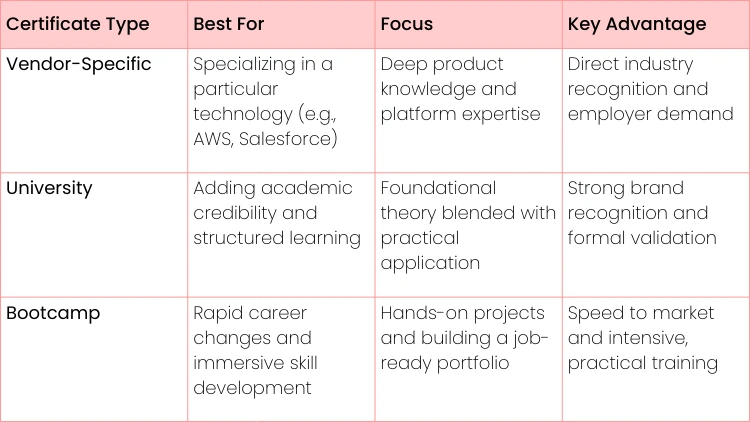
Vendor-Specific Certificates
These certificates come directly from the tech giants that build the tools everyone uses. We're talking about heavy hitters like the AWS Certified Solutions Architect, Google Cloud Professional Cloud Developer, or Microsoft Certified Azure Developer Associate.
Think of these as your official driver's license for a specific, high-demand technology. If a company runs its entire operation on Amazon Web Services, having that AWS cert isn't just a nice-to-have—it’s solid proof you can handle their most critical systems. It tells them you learned the platform straight from the source.
For instance, imagine a company needs a cloud engineer to manage their AWS-based e-commerce platform. One applicant says they have "experience with cloud computing" but the other holds an AWS Certified Solutions Architect – Associate certificate. That second candidate instantly proves they have a tested, verified skill set, making them a much safer bet for the hiring manager.
For many roles deeply embedded in a specific tech stack, these certifications are practically a requirement. To see how this applies to systems administration, check out this deep dive on how to get the RHCSA certification, a top-tier credential in the world of Linux.
University and College Certificates
University certificates offer a powerful mix of academic credibility and real-world skills, all backed by the name of a respected institution. Programs like a "Python for Data Science" certificate from a university extension school provide a structured curriculum that balances theory with hands-on projects.
This path is perfect for anyone who values a more formal learning environment and the weight a university brand can add to their resume. This is especially true if you're making a career change from a completely non-technical field. Most programs start with a solid introduction to programming, making sure you have the fundamentals down pat.
University certificates act as a bridge, connecting foundational academic principles with the specific, in-demand skills required by the modern workforce. They signal to employers that you possess both theoretical knowledge and practical competence.
- Actionable Insight: Keep an eye out for university programs created in partnership with industry leaders. For example, a "Certificate in Project Management" from a university that partners with the Project Management Institute (PMI) ensures the curriculum is aligned with the PMP exam, giving you both academic validation and a direct path to a top industry credential.
Bootcamp Certificates
Programming bootcamps are exactly what they sound like: intense, accelerated training programs designed to make you job-ready in a shockingly short amount of time. They are the specialists of career-changing, focusing on immersive, project-based learning. A full-stack web development bootcamp might take you through HTML, CSS, JavaScript, React, and Node.js in just 12-16 weeks.
Bootcamps are all about speed and practicality. You won't get bogged down in abstract computer science theory. Instead, you'll be building real applications from day one, which gives you a portfolio of projects to show off to potential employers—a massive advantage in any job hunt.
Here’s a quick look at how the three main types stack up.
Ultimately, the right choice comes down to your personal and professional goals. A developer who wants to become an AWS guru needs a vendor certificate. But for someone with zero tech background who wants their first developer job, a bootcamp might be the fastest way to get there
The Real-World Value of a Programming Certificate
So, what's a programming certificate really worth? Beyond just another line on your resume, a well-chosen certificate delivers tangible, real-world value. It can be the exact catalyst you need to propel your career forward—unlocking promotions, bigger paychecks, and a path into those high-demand fields that once seemed out of reach.
This isn't just about collecting badges. It’s about gaining validated expertise that translates directly into professional momentum. When employers see a reputable credential, they see proof that you have the specific skills to solve their problems. That makes you a much less risky and far more attractive candidate.
From Generalist to Specialist: A Case Study
Let's look at a real-world scenario. Meet Alex, an IT support technician with three years under their belt. Alex is good at their job but feels like their career has hit a plateau, and their salary has stagnated. They’ve noticed a huge spike in demand for cybersecurity roles, both within their own company and across the tech industry.
Seeing an opportunity, Alex decides to dedicate six months to earning a Certified Information Systems Security Professional (CISSP) certificate. This isn't just a simple online course; it's a rigorous validation of their ability to design, implement, and manage a top-tier cybersecurity program.
Armed with the CISSP, Alex gives their resume and professional profiles a major refresh. Suddenly, recruiters who had previously glossed over their general IT background now see a certified security specialist. It took just two months for Alex to land a Security Analyst role at a new company, along with a 25% salary increase. This is a perfect example of how a strategic certificate can turn a career aspiration into a reality.
Making Your Certificate Work for You
Earning the certificate is only half the job. To really cash in on its value, you need to show it off where it counts. That means making it a prominent feature on your professional profiles where recruiters and hiring managers are actively looking.
Here are a few practical ways to highlight your new credential:
- On Your Resume: Create a dedicated "Certifications" section and place it right near the top, just under your professional summary. You should also add the acronym after your name in the header (e.g., "Alex Doe, CISSP").
- On Your LinkedIn Profile: This is a big one. Add your certificate to the "Licenses & Certifications" section. Recruiters constantly use filters to search for candidates with specific credentials. Make sure you fill out the issuing organization and credential ID so it shows up in their searches.
- In Your Elevator Pitch: When you're networking or in an interview, casually mention your certification. It’s powerful proof of your commitment. For example, "I recently solidified my cloud infrastructure skills by earning my AWS Certified Solutions Architect credential."
By effectively showcasing your computer programming certificates, you turn them from passive documents into active tools for your job search. For more tips on navigating the hiring process, feel free to explore this guide on how to get a software engineering job.
A Balanced View: The Potential Downsides
While certificates offer a ton of upside, it's smart to look at the investment from all angles. Pursuing a certificate requires a serious commitment of both time and money, and it’s not without potential risks.
A programming certificate is an investment, and like any investment, it comes with potential risks. The key is to choose one with a high probability of delivering a strong return by aligning it with current and future market demand.
Before you jump in, think about these factors:
- Cost: Programs can run anywhere from a few hundred to several thousand dollars.
- Time Commitment: You'll need to set aside consistent, dedicated study hours every week for several weeks or even months.
- Risk of Obsolescence: Tech moves fast. A certificate in an aging technology might lose its shine quickly. It's crucial to pick credentials that are not only in high demand now but are also regularly updated.
By carefully weighing the pros and cons, you can make an informed decision and pick a computer programming certificate that truly acts as a springboard for your career.
How to Choose the Right Programming Certificate
Trying to pick a programming certificate can feel like you're staring at a map with a thousand different roads. With so many options out there, choosing the right one is critical to making sure your investment of time and money actually gets you where you want to go. The secret isn't finding the one "best" certificate—it's about finding the one that’s best for you.
The whole process has to start with some honest self-reflection. Before you even glance at a single program, you need to get crystal clear on your starting point and your destination. This clarity will be your compass, guiding you through the noise and helping you filter out the options that don't make sense.
Define Your Career Goal
First, you have to ask yourself the big question: What do I really want to achieve? Your answer will instantly cut down your list of options. Are you trying to climb the ladder at your current job, make a complete career switch, or break into a specialized, higher-paying role?
- For a promotion: Look for certificates that build on what you already know. If you're a junior developer, earning an advanced certificate in a framework your company already uses, like React or Angular, could be your direct path to a senior position.
- For a career change: You’ll want to focus on foundational, in-demand skills. A bootcamp certificate in full-stack web development or a university certificate in data analytics will give you that broad, job-ready knowledge needed to get your foot in the door.
- For a specialization: Target those niche, high-value credentials. If you have your sights set on cloud computing, a vendor-specific certificate like the AWS Certified Solutions Architect is practically a requirement.
Your specific goals can steer you toward the right kind of certificate, whether you're aiming for a promotion, a new gig, or a salary bump.
The main takeaway here is that different goals demand different credentials. That’s why figuring out your goal is the most important first step you can take.
Research the Job Market
Once you have a goal in mind, it's time to do a little recon. This is where you put on your detective hat and get a real, data-backed look at what employers are actually looking for.
- Actionable Insight: Hop on LinkedIn or another job board and search for your dream job title. Pull up 10-15 job descriptions and start making a list of the certificates, programming languages, and tools that keep popping up.
This simple exercise is incredibly powerful. For example, if you start searching for "Data Analyst" roles, you'll see a clear pattern emerge: employers are consistently asking for skills in SQL, Python, and Tableau. This tells you exactly which technologies to focus on and confirms that a certificate covering them gives you the best shot at landing interviews.
It turns your search from a wild guess into a strategic mission. It also helps you identify specific skill gaps you need to close.
Evaluate the Certificate Provider
Let's be real: not all certificate programs are created equal. The name on the certificate can be just as important as the skills it represents. A credential from a respected institution carries a lot more weight with hiring managers.
Here’s a quick checklist you can use to vet any program you're considering:
- Industry Recognition: Is the provider a known and respected name in tech? Certificates from major players like Google, Microsoft, and AWS, or from accredited universities, are always a safe bet.
- Hands-On Projects: Does the program make you build things? A portfolio of real-world projects is what will get you hired. Employers want to see what you can do, not just what you've memorized.
- Instructor Expertise: Who’s actually teaching the material? Look for instructors with years of in-the-trenches industry experience. Their practical insights are worth their weight in gold compared to purely academic knowledge.
- Career Support: Do they help you after you finish? Things like job placement assistance, resume workshops, and interview coaching can make a huge difference in turning those new skills into a new job.
By working through these steps—defining your goal, researching what employers want, and carefully vetting the provider—you can confidently pick a programming certificate that’s a perfect match for your career path.
How to Turn Your Certificate Into a Bigger Paycheck
Getting that programming certificate is a huge accomplishment. But let's be honest—the real prize is turning that piece of paper into a fatter paycheck. Think of your new certificate as more than just proof you've learned something; it's a powerful bargaining chip that can directly boost your salary.
The secret is to aim for skills that are in white-hot demand and then learn how to talk about their value with confidence. Not all certifications are created equal in the eyes of an employer, and some are tied to specific, high-stakes business needs where companies will happily pay a premium for proven expertise. That's where you'll find the biggest salary bumps.
Pinpointing High-Value Specializations
In some corners of the tech world, there are major talent shortages. Companies are practically falling over each other to find qualified people, which makes your certificate incredibly valuable.
Industry data consistently shows that specialized credentials in programming and IT are commanding top-tier salaries. Certificates like the Google Cloud Platform (GCP) Certified Professional Cloud Architect, AWS Certified Solutions Architect—Associate, Certified Information Security Manager (CISM), and Certified Information Systems Security Professional (CISSP) are some of the heaviest hitters.
Just look at cybersecurity—it's a field with 4.7 million professionals, yet there's still a massive talent gap of 3.4 million jobs. That's pure supply and demand working in your favor.
So, why do these specific certificates pay so well? It all comes down to business impact.
- Cloud Architecture (AWS, GCP): A certified cloud architect is the person designing the very foundation of a modern company's tech infrastructure. Their work has a direct line to performance, security, and how much the company spends. A poorly designed cloud setup can cost millions, so businesses are willing to pay top dollar for someone who knows how to do it right.
- Cybersecurity (CISM, CISSP): A CISM-certified professional isn't just a technical whiz; they're a manager responsible for a company's entire information security strategy. They are on the front lines, fighting off costly data breaches and cyberattacks that could cripple a business financially and ruin its reputation. Their expertise is basically a high-stakes insurance policy.
How to Talk About Your Value in an Interview
Holding the certificate is half the battle; the other half is articulating its value when it's time to talk money. This is your chance to connect your shiny new skills directly to the employer's wallet. You need to shift the conversation from, "I earned this certificate" to "Here's how this certificate will make or save your company money".
When negotiating, frame your certification not as a personal win, but as a direct solution to the company's biggest headaches. You're not just another candidate—you're a strategic asset.
Here’s how to do it: Before your interview, do some digging into the company's recent challenges or projects. If you notice they just moved their services to Amazon Web Services (AWS), you can say, "I saw you've migrated to AWS. My AWS Certified Solutions Architect training was heavily focused on optimizing cloud spending, and I’m confident I can help ensure your infrastructure is as cost-effective as possible."
That one sentence changes everything. You're no longer just asking for more money; you're showing them the return on their investment in you. To really sharpen those skills, check out this guide on how to negotiate your salary.
Finally, don't keep your new credential a secret! Make sure you know how to add certifications to LinkedIn so it's front and center on your profile. A well-presented certificate acts like a 24/7 billboard, advertising your high-value skills to every recruiter who stops by.
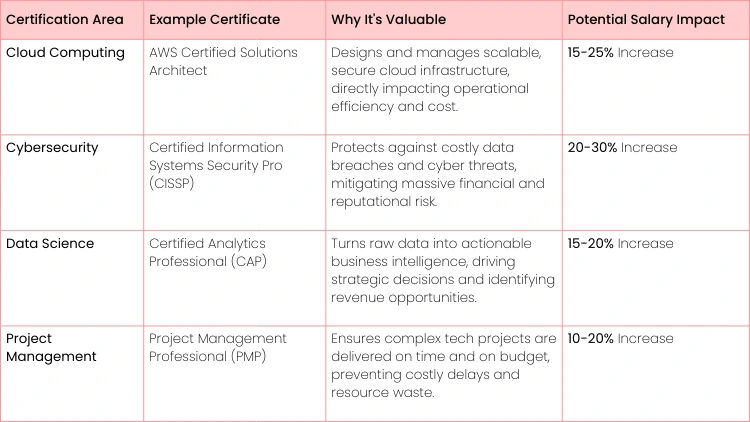
Below is a look at some certifications that are known to pack a financial punch.
High-Impact Programming Certifications and Earning Potential
This table highlights some top-tier certification areas and illustrates why they are so valuable to employers, often resulting in a significant salary increase for qualified professionals.
As you can see, the certifications with the biggest earning potential are those tied directly to a company's bottom line—either by saving money, making money, or protecting it.
Frequently Asked Questions About Programming Certificates
It's completely normal to have a ton of questions when you start looking into programming certificates. Let's tackle some of the most common ones so you can figure out your next steps with confidence.
Are Certificates Better Than a Computer Science Degree?
This is a classic question, but it's not really about one being "better". They just have different jobs to do. A four-year computer science degree is all about building a deep, theoretical understanding of computing. Think of it as the perfect foundation for roles in academic research or designing incredibly complex algorithms from scratch.
A certificate, on the other hand, is hyper-focused. It's designed to get you job-ready for a specific role, like a Python developer or a cloud engineer, and do it quickly. Certificates are faster, much more affordable, and give you a direct route into a new job or career change.
You could say a degree is the entire toolbox, while a certificate is the specialized power tool you need for a particular task.
Do I Need Programming Experience to Start a Certificate Program?
Not at all! A huge number of certificate programs are built from the ground up specifically for beginners. Bootcamps and many university extension courses, for example, often start with the absolute basics, assuming you’ve never written a line of code in your life.
- Actionable Insight: Look for programs that include a "pre-work" module. For example, a web development bootcamp might send you a 20-hour self-paced course on HTML and CSS basics to complete before the official start date. This ensures everyone begins with the same foundational knowledge, making the main program much more effective for beginners.
How Long Do Programming Certificates Stay Relevant?
That’s a smart question, especially since tech moves at lightning speed. The honest answer is: it depends on the technology. A certificate in a fundamental, bedrock skill like Python or SQL will stay valuable for years to come.
But for platform-specific tech like AWS or Google Cloud, you'll need to treat learning as an ongoing process. Those companies are constantly updating their services and, by extension, their certifications. The best approach is to plan on renewing or upgrading your certification every 2-3 years. This keeps your skills sharp and proves to employers that you're current.
Do Employers Actually Value Computer Programming Certificates?
Yes, absolutely. In today's hiring market, where practical skills are king, a good certificate is seen as hard evidence that you can do the job. It cuts through the noise.
A recent study from CompTIA found that a whopping 91% of hiring managers see IT certifications as a reliable sign that a new hire will be successful. For many roles, especially in hot fields like cloud computing and cybersecurity, having specific certificates isn't just a "nice-to-have"—it's a requirement to even get an interview.
Ready to find the right program to launch or advance your career? At Uplyrn, we offer a wide range of expert-led courses designed to give you the job-ready skills you need. Explore our courses today and let us help you achieve your goals.


Leave your thoughts here...
All Comments
Reply