









RHCSA Certification: Achieve It With This Study Plan

If you’ve spent any time in the Linux world, you’ve probably heard of the Red Hat Certified System Administrator (RHCSA) certification. But what is it, exactly? Think of it as the ultimate hands-on driving test for Linux admins. It’s a performance-based exam that proves you have the real-world skills to manage Red Hat Enterprise Linux environments, not just the ability to memorize answers for a test.
Jump To Section

Earn As You Learn
Earn 25% commission when your network purchase Uplyrn courses or subscribe to our annual membership. It’s the best thing ever. Next to learning,
of course.
What is the RHCSA Certification and Why It Matters
For anyone serious about a career in Linux system administration, cloud, or DevOps, the RHCSA is a game-changer. Unlike so many other certifications that rely on multiple-choice questions, this one throws you into a live system and asks you to perform actual tasks.
This hands-on approach is precisely why employers trust it so much. It’s tangible proof that you can configure, manage, and troubleshoot systems under pressure—the stuff you’ll actually be doing on the job. Earning this certification sends a clear signal to hiring managers that you've got the foundational skills needed to support enterprise-level infrastructure.
If you want to get a better handle on the operating system that powers this whole thing, check out this complete guide to Red Hat Linux. It’s a great primer.
The Exam Structure Explained
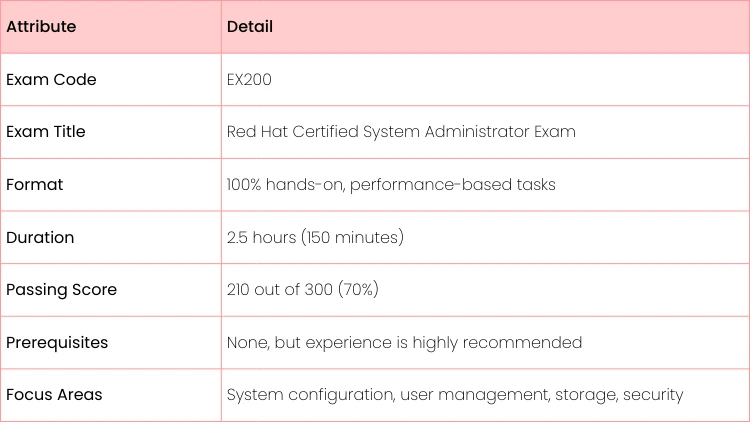
To become a Red Hat Certified System Administrator, you need to pass the EX200 exam. It’s a 2.5-hour (150-minute) test where you'll be given somewhere between 10 to 20 practical tasks to complete. You’ll be working in a real-time environment, doing things like managing users, configuring system services, and securing storage.
To pass, you need a score of at least 210 out of 300 points, which comes out to about 70%. You can learn more about how Red Hat exam benchmarks are viewed across the industry, but the key takeaway is that they are highly respected.
The RHCSA is designed to test your ability to solve problems, not just your memory of commands. The exam environment forces you to apply your knowledge practically, which is exactly what you'll do on the job.
RHCSA Certification at a Glance
To give you a quick snapshot, here are the essential details for the RHCSA certification exam. Getting familiar with these core components is the perfect first step in mapping out your study plan.
This table should give you a clear, high-level view of what to expect. Now, you can start digging into the specifics of how to prepare for each part of the exam.
Cracking the Code: A Guide to the RHCSA Exam Objectives
Let's get one thing straight: the RHCSA exam isn’t about memorizing a list of commands. It's a hands-on, practical test designed to see if you can actually do the job of a Linux system administrator. To pass, you need to understand the why behind every task, not just the how.
Instead of just dumping the official objectives on you, we're going to break them down into practical skill groups. Think of these as the core duties you'd handle in a real-world sysadmin role. This approach helps connect the dots between the concepts and what you'll actually be doing on the exam and on the job.
Core System Management
This is your bread and butter. These objectives cover the day-to-day work of keeping a Red Hat Enterprise Linux system humming along, from running basic commands to juggling processes. You're the one in charge of keeping the lights on.
A huge part of this is managing software. The exam goes beyond simply knowing how to install a package. You need to get comfortable with package groups and, more importantly, module streams.
- Practical Example: Picture this: a developer comes to you needing an older, specific version of Python for a legacy app. You can't just dnf install python and call it a day—that might break other things. Your job is to use module streams to enable and install that exact version. You'd start by listing available streams with dnf module list python39, enable the one you need with dnf module enable python39:3.9, and then install it with dnf install python39. This shows you can manage a system's software lifecycle.
Storage Configuration and Management
Every server needs storage, and managing it correctly is non-negotiable. This section of the RHCSA exam is where you'll move past simple partitions and into the flexible, powerful world of Logical Volume Management (LVM).
You'll need to prove you can create, resize, and manage logical volumes, file systems, and even swap space to meet a specific set of requirements.
The real challenge here isn't just following steps. It's understanding why you'd choose one storage configuration over another. A web server has wildly different storage needs than a database server, and a good admin knows how to handle both.
Actionable Insight: A classic exam task involves extending a logical volume that's running out of space. Here’s how it usually plays out:
- The Problem: A database server is flashing red alerts—the /data partition is almost full.
- Your Task: Add a new physical disk ( /dev/sdb ) to the server and use its space to expand the logical volume, all without losing a single byte of data.
- The Practical Steps: You'll need to initialize the new disk as a physical volume with pvcreate /dev/sdb, add it to the correct volume group (e.g., datavg) with vgextend datavg /dev/sdb, and then extend the logical volume itself with lvextend -l +100%FREE /dev/datavg/datavol. The final, crucial step is resizing the filesystem (xfs_growfs /data or resize2fs /dev/datavg/datavol) to actually use the new space.
User and Security Administration
A system is only as secure as its access controls. This group of objectives is all about managing who can log in and what they're allowed to do once they're there. You'll be creating users and groups, tweaking file permissions, and setting up basic firewall rules. In short, you have to prove you can lock down a server based on a given security policy.
This means you need to be fluent with commands like useradd, usermod, and chmod. But it also means getting your head around more advanced topics like access control lists (ACLs) and SELinux contexts.
- Practical Example: An exam task might require you to create a collaborative directory at /srv/projectfiles for a group called developers. Any member of this group must be able to create and edit files inside, and new files should automatically inherit the developers group ownership. To do this, you would use mkdir /srv/projectfiles, set the group ownership with chgrp developers /srv/projectfiles, and then apply the setgid bit with chmod g+s /srv/projectfiles. This last step is the key to ensuring proper collaboration and shows a deeper understanding of permissions.
Your Actionable RHCSA Study Roadmap
Let's be real: you can't just memorize commands and hope to pass the RHCSA. This is a practical exam, and it demands a hands-on, structured approach that builds real muscle memory. A solid roadmap is what turns that long list of exam objectives into a manageable, week-by-week journey, making sure you hit every topic without getting completely overwhelmed.
The secret is balancing theory with intensive lab time.
A 12-week study plan is a pretty standard and effective timeframe. It gives you enough breathing room to absorb complex topics and—more importantly—apply them in a lab until they're second nature. The real goal here is to make your command-line work so automatic that you free up precious mental energy during the exam to focus on solving the problems, not just typing commands.
You can't just jump into the tricky stuff. Mastering the foundational skills first is absolutely essential before you even think about tackling more complex storage and security configurations.
Setting Up Your Home Lab
Reading about commands is one thing; using them is another. You need a hands-on lab environment where you can practice, break things, and—most importantly—learn how to fix them. We can't stress this enough: your home lab is non-negotiable for building the practical skills this exam demands.
The good news? It's easy to set one up for free. All you need is virtualization software like VirtualBox or KVM to spin up at least two Red Hat Enterprise Linux (RHEL) virtual machines. A free Red Hat Developer subscription will give you access to the RHEL images you'll need to get started.
Actionable Insight: Make your lab simulate the exam. Create a "control node" VM and a "target node" VM. This allows you to practice tasks like remote command execution with SSH and setting up network services between two distinct systems, which is a common exam scenario. For example, try to:
- Configure the control node as a central software repository.
- Use your target node to practice mounting network file systems (NFS) from the control node.
- Practice resetting the root password on the target node from the virtual console.
The single most important part of your preparation is time spent in the terminal. Your goal is to get so comfortable in your lab that the exam environment feels familiar.
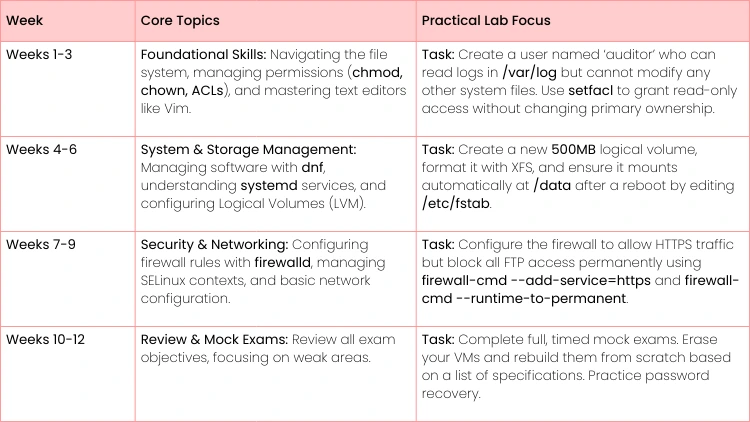
A Sample 12-Week RHCSA Study Plan
Think of this roadmap as a flexible template. You’ll want to adjust it based on your own experience and pace. If you're looking for ways to make your study sessions more efficient, check out this guide on how to improve study habits.
Here is a sample 12-week plan designed to systematically cover all the core RHCSA objectives, ensuring you blend theory with essential hands-on practice every step of the way.
By following a structured plan like this, you'll methodically build the skills and confidence needed to walk into the exam ready for whatever Red Hat throws at you. The final two weeks are crucial—don't skip the full mock exams
Mastering the Exam with Practice Tests and Resources
Let's be honest: passing the RHCSA exam isn't just about what you know. It’s about how you perform when the clock is ticking. You can have all the theoretical knowledge in the world, but if you can't apply it quickly and accurately under pressure, you're going to struggle.
This is where a solid mock exam strategy comes in. The idea is to simulate the real, time-crunched environment you'll face on exam day. You're not just studying; you're training for a performance.
- Actionable Insight: Set up a clean virtual machine, give yourself a strict time limit—maybe 90 minutes for a half-exam to start—and work through a set of practice tasks without peeking at notes or guides. This process does way more than just test your knowledge; it builds crucial exam stamina and reveals your true weak points.
After each session, the real work begins. Reset that virtual machine and do it all over again. Repetition is what turns complex command sequences into muscle memory, freeing up your brain to focus on the real problem-solving during the actual test.
The Power of the Task Triage Technique
Time management can single-handedly make or break your exam attempt. One of the best strategies we’ve seen people use to get a handle on this is the Task Triage Technique. It’s a dead-simple, three-step method to maximize your score before the timer runs out.
Here’s the game plan:
- Quick Scan (The First 5 minutes): As soon as your exam starts, resist the urge to jump into the first question. Instead, take five minutes to read through all the tasks. Get a feel for what’s ahead and mentally tag each one as easy, medium, or hard.
- Tackle the Low-Hanging Fruit: Now, go after the easy stuff. These are your quick wins—creating a user, setting basic file permissions, or starting a simple service. Nailing these right away gets points on the board and builds a ton of confidence.
- Circle Back to the Big Challenges: With some points secured and your momentum up, you can now turn your attention to the tougher, multi-step problems. Think complex LVM configurations or troubleshooting a service that just won't start.
This approach is all about efficiency. It prevents you from getting bogged down on a hard problem early on and running out of time for easier tasks you could have breezed through. It's about grabbing every possible point you can.
Choosing Your Study Resources
While hands-on practice is king, you'll want to back it up with high-quality resources to fill in any knowledge gaps. The official Red Hat documentation is your best friend here, especially since it’s the one resource you can actually use during the exam. Seriously, get comfortable navigating it now; it’s a skill in itself.
If you’re looking for a more structured learning path, exploring some of the best operating systems online courses can provide a solid foundation and guide you through the core concepts methodically.
Ultimately, your RHCSA Certification prep should be a mix of guided learning and relentless practice. Use the resources to understand the "why" but make sure you spend most of your time in the command line practicing the "how". That’s what gets you across the finish line.
Sidestepping Common RHCSA Exam Pitfalls
It's a tough pill to swallow, but plenty of sharp, knowledgeable candidates walk away from the RHCSA exam without a pass. It usually isn’t because they didn't know the material; it’s because they stumbled over simple, avoidable mistakes under the pressure of the clock.
Knowing what these common tripwires are is half the battle. If you can spot them coming, you can walk right around them and make sure all that study time pays off.
The Traps That Catch So Many Test-Takers
One of the most frequent errors is just plain poor time management. It's so easy to get bogged down on one tricky task early in the exam, burning through precious minutes that you desperately need for other, sometimes easier, questions later on.
Another surprisingly common mistake? Misreading the question. The pressure is on, so your brain can easily skip a critical detail—like a specific partition size of 512MiB (not 512MB), a unique file permission, or the name of a user group.
- Practical Example: The instructions say "ensure the web server is running" but you only use systemctl start httpd. You've made a mistake. The real task is "ensure the web server is running and will start on boot" which requires the systemctl enable httpd command. That one word makes all the difference. Always read each task completely.
The Single Biggest Exam Killer: Forgetting Persistence
If there's one mistake that will absolutely torpedo your chances, it's this: forgetting to make your configurations persistent. The exam isn't just a test to see if you can start a service. It’s testing if that service will still be running after the system reboots.
The graders will restart your machine. If your beautifully configured service or perfectly mounted filesystem vanishes into thin air after that reboot, you get a big, fat zero for that entire task.
Before you even think about moving on from a question, ask yourself one simple thing: "Will this survive a reboot?" That single thought can honestly be the difference between a pass and a fail on the RHCSA.
This applies to everything—from enabling services ( systemctl enable ) and firewall rules ( --permanent ) to mounting storage with /etc/fstab. It's a cornerstone of real-world system administration, and you can bet it's weighted heavily on the exam.
Your Game Plan for Avoiding These Mistakes
To make sure your configurations stick and you don't get tripped up, you need to build the right habits directly into your practice sessions. Make these second nature.
- Make Services Stick: Any time you use systemctl start, your very next command should be systemctl enable. Think of them as a pair.
- Practical Habit: Type systemctl enable --now <service> to start and enable a service with one command.
- Master Your Mounts: Be meticulous with your /etc/fstab file. A single typo in that file can prevent the entire system from booting correctly.
- Actionable Insight: After editing /etc/fstab, always run mount -a to test your entries before rebooting. This command will report any errors immediately.
- The Ultimate Test: If you have some time left at the end, do what the graders will do: reboot. It's the only way to be 100% sure that all your hard work is persistent and will be graded correctly.
Finally, don't underestimate the role of exam anxiety in causing these simple errors. Keeping a clear head is a skill in itself. For more on that, check out this guide on how to power up during exam season and stay focused.
Turning Your RHCSA into a Career Opportunity
Let's be clear: getting your RHCSA isn't just about passing an exam. It’s a strategic career move, a key that unlocks doors to roles where practical, real-world Linux skills aren't just a nice-to-have—they're a requirement.
Once you have that certification, you're no longer just another IT enthusiast. You're a validated Red Hat System Administrator, ready to step confidently into high-demand jobs. We're talking about roles like:
- Linux System Administrator: The most direct path. You'll be managing, configuring, and keeping the Linux servers that power businesses running smoothly.
- Cloud Engineer: Linux is the absolute backbone of the cloud. Your RHCSA skills make you a perfect fit for building and maintaining infrastructure on platforms like AWS or Azure.
- DevOps Specialist: Modern software development runs on automation. The RHCSA gives you the core operating system knowledge needed to build and manage those crucial CI/CD pipelines.
The Financial Return on Your Investment
The time and money you put into the RHCSA pay off, and you'll see it in your paycheck. Earning the RHCSA certification can give your salary a serious boost, with certified pros often pulling in between $60,000 and $120,000 a year.
The average salary tends to hover right around $90,000, and in major tech hubs, it’s not uncommon for certified Linux admins to earn 20-30% more than their non-certified colleagues. It's a tangible return on your hard work.
- Actionable Insight: When you update your resume, don't just list "RHCSA Certified". Instead, add a project or skills section that quantifies your abilities. For example: "Managed storage using LVM to dynamically resize partitions, improving server uptime by 15%". Check out this guide on how to write a resume that gets a recruiter's attention for more tips, then browse relevant job listings to see these skills in action.
What Comes After the RHCSA
The RHCSA is a fantastic achievement, but it's just the beginning. Think of it as the foundation you'll build the rest of your career on.
Think of the RHCSA as mastering the fundamentals of a single server. The logical next step is to learn how to manage an entire fleet of them efficiently.
This is exactly where the Red Hat Certified Engineer (RHCE) comes into play. The RHCE exam is all about automation at scale, focusing heavily on Ansible. Making the jump from RHCSA to RHCE is how you go from being a skilled administrator to an invaluable automation expert, which opens up even more opportunities and career growth.

Got Questions About the RHCSA?
Jumping into a major certification like the RHCSA can bring up a lot of questions. Getting the logistics sorted out from the get-go makes the whole process feel a lot less intimidating. Let's tackle some of the most common things people ask.
Are There Any Prerequisites for the Exam?
Officially, no. You can book the RHCSA exam without any prior certifications.
That said, Red Hat strongly recommends you come in with some solid experience under your belt. This means you should have either gone through their foundational system administration courses or, more importantly, have real-world experience managing Linux systems day-to-day. You don't want to walk into this exam cold.
What Is the Official Exam Retake Policy?
It happens. Sometimes you don't pass on the first try, and that's okay. The good news is, you absolutely can retake the exam.
Keep in mind that Red Hat's policies can get updated, but the standard procedure is that you'll need to purchase a new exam attempt to get another shot at it.
How Long Is the RHCSA Certification Valid?
Your RHCSA certification stays active for three years from the day you earn it.
To keep your certified status, you have two main options: you can either pass the latest version of the RHCSA exam again, or you can level up by earning a more advanced Red Hat certification, like the RHCE.
Ready to turn your Linux skills into a certified career advantage? Uplyrn offers expert-led courses to guide you from study plan to your first day on the job. Start your journey with us today!


Leave your thoughts here...
All Comments
Reply