









Your Guide to Data Analyst Training in a Data-Driven World

At its core, data analyst training is all about learning how to find the story hidden inside numbers. It’s the process of mastering the technical skills and analytical thinking required to take raw data and turn it into clear, actionable insights that help a business make smarter decisions.
This means getting comfortable with essential tools like SQL, Excel, and data visualization platforms like Tableau, transforming you from someone who just looks at data to someone who truly understands it. For example, instead of just reporting that sales are down, you'll be able to pinpoint that sales are down specifically for mobile users in the Midwest after 3 PM, giving the marketing team a concrete problem to solve.
Jump To Section

Earn As You Learn
Earn 25% commission when your network purchase Uplyrn courses or subscribe to our annual membership. It’s the best thing ever. Next to learning,
of course.
Why Data Analyst Training Matters More Than Ever
Think of any modern business as a massive ship navigating a vast, unpredictable ocean. That ship is constantly generating information—its speed, the weather, engine performance, fuel levels. Without an expert on board to interpret all that information, the captain is sailing blind.
A data analyst is that expert navigator. They take all those raw numbers and turn them into a reliable map, guiding the ship safely and efficiently to its destination. An actionable insight here would be telling the captain, "Based on the last three voyages under similar weather conditions, reducing speed by 2 knots will extend our fuel range by 15%, ensuring we reach port without an extra stop."
Today, companies of every size are drowning in data. From customer clicks and supply chain logistics to social media engagement, every action creates a data point. The real challenge isn't collecting it; it's making sense of it. This is where a trained data analyst becomes the most valuable person in the room. They are the translators who turn complex datasets into compelling stories that drive strategy forward.
The Soaring Demand for Data Skills
The urgent need for skilled analysts has blown the doors wide open for aspiring professionals. This isn't just a "tech company" thing anymore. Industries like healthcare, finance, retail, and manufacturing all lean heavily on data to make crucial decisions. This has created incredible career stability and a clear path for growth for anyone with the right training.
The numbers from the U.S. Bureau of Labor Statistics speak for themselves.
This isn't just a trend; it's a fundamental shift. The demand for data analysts is set to grow by an astounding 35% between 2022 and 2032. That translates to almost 60,000 new jobs opening up each year in the U.S. alone.
Why the boom? Because it delivers real results. Companies that master data-driven decision-making can boost their revenue by up to 20%, making a skilled analyst one of the best investments they can make.
A great data analyst doesn't just report what happened; they explain why it happened. They're the ones who can discover that a 15% drop in sales is tied to a clunky checkout page or prove that a specific marketing campaign delivered a 300% return on investment.
Bridging the Modern Skills Gap
This explosive demand has created a major problem: a skills gap. Countless professionals have deep industry knowledge but lack the specific data skills needed to stay relevant and move up.
This is exactly where targeted data analyst training comes in. It offers a direct pathway to gaining the competencies that employers are desperately looking for. To get a better handle on this issue, it's worth reading about the growing skills gap and why nearly half of workers need upgrading. The best training programs are built to close this gap, focusing on practical, hands-on projects that get you ready for the real-world challenges you'll face on day one.

What It Really Takes to Be a Data Analyst
Becoming a great data analyst isn't just about learning one specific program or skill. It's about building a well-rounded toolbox that combines technical prowess with sharp, analytical thinking and the ability to tell a compelling story.
Think of yourself as a modern-day detective. You need the right tools to gather evidence (your technical skills), the sharp mind to piece together the clues (your analytical skills), and the persuasive ability to present your case to an audience (your communication skills).
These three pillars are the foundation of turning raw, messy data into actionable business strategies. Any good training program will be built around helping you master them.
Getting Your Hands on the Data: Technical Skills
First things first, you need to be able to access and manage the data. This is where your technical skills come in. Without a solid technical foundation, even the most brilliant insights will stay locked away inside a database.
The two non-negotiables for any aspiring analyst are SQL and a programming language like Python.
- SQL (Structured Query Language) is the universal language of databases. Imagine a colossal warehouse packed with millions of customer records. SQL is how you ask the manager to pull very specific items, like, "Show me every customer from New York who bought something in the last 30 days."
- Python is like your Swiss Army knife for everything else. Once SQL fetches the data, you can use Python to automatically clean it, sort it, and run complex statistical models. It's the difference between sorting a thousand spreadsheets by hand and writing a simple script that does the job perfectly in seconds. Want a head start? Here's a great guide on how to learn Python programming.
Thinking Like an Analyst: The Analytical Mindset
Once you have the data in front of you, the real work begins. Analytical thinking is all about moving beyond what the numbers say to understanding why they're saying it. This is where your curiosity, critical thinking, and problem-solving abilities shine.
A key part of this is getting comfortable with statistical concepts. Understanding something like hypothesis testing allows you to move from simply guessing to proving your theories with actual mathematical rigor.
- Here’s a real-world example: An online store sees a sudden 25% nosedive in sales. A junior analyst might just report the drop. But a sharp analyst asks why. Did it happen right after a website update? Is it only happening on mobile? Is one product to blame? This line of questioning leads them to find a hidden bug in the mobile checkout, saving the company from losing even more money.
Top-tier training programs know this and build their curriculum around these job-ready skills. The Google Data Analytics Professional Certificate, for example, has enrolled over 1 million people, teaching them SQL, Tableau, and R—with 75% of grads reporting a positive career outcome. IBM’s program drills down on Python and data wrangling, reflecting what employers are looking for right now.
Turning Numbers into Narratives: The Art of Storytelling
Finally, all your hard work is for nothing if you can't explain your findings to someone who isn't a data expert. The best data analysts are storytellers. They can take complex data and weave it into a clear, understandable narrative that decision-makers can act on.
This is where data visualization tools like Tableau or Power BI are indispensable. They let you turn dense spreadsheets into beautiful, interactive charts and dashboards that make the story pop.
Let's say a marketing team asks which of their recent campaigns was the most successful.
- Poor Communication: You email them a spreadsheet full of raw numbers for clicks, conversions, and costs. It's confusing and doesn't lead to a clear decision.
- Effective Communication: You build a simple Tableau dashboard. It visually compares each campaign's return on investment and customer acquisition cost. The team can see in an instant that Campaign B, despite having fewer clicks, brought in much more valuable customers. Now they know exactly where to put their budget next quarter.
Choosing Your Ideal Data Analyst Training Path
Deciding where to start your journey into data analytics can feel like you're staring at a map with a dozen different routes to the same destination. Which one is right for you? It really boils down to your personal situation—your budget, how much time you can commit, and what your career and life look like right now.
There’s no magic "best" option. The right path is the one that fits you.
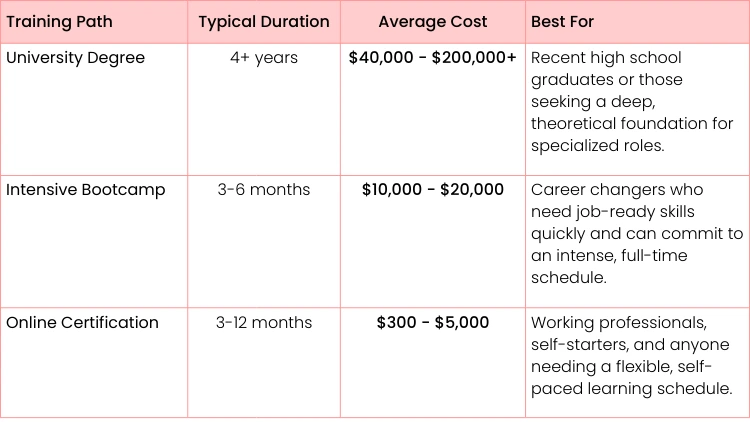
The three main roads you can take are a traditional university degree, an intensive bootcamp, or a flexible online certification. Each has a completely different feel and is built for a different type of learner. Let's break down the pros and cons of each so you can make a choice you feel good about.
The University Degree: A Four-Year Foundation
A four-year degree in something like statistics, computer science, or business analytics lays the deepest theoretical groundwork. This path is a fantastic choice for recent high school graduates or anyone who wants a thorough, academic understanding of data from the ground up and has the time and money to invest.
Think of it less as immediate job training and more as building a solid, long-term conceptual framework. It's an excellent route if you're aiming for highly specialized or research-focused roles later in your career.
The Bootcamp: The Fast Track for Career Changers
Data analytics bootcamps are built for one thing: speed. These are intense, immersive programs that cram everything you need to know into just a few months, focusing laser-like on the practical, job-ready skills employers are looking for today. They're perfect for career changers who need to pivot quickly and effectively.
The whole experience is project-based. You’ll be hands-on from day one, tackling real-world problems and building a portfolio that will actually get you noticed. It’s a high-intensity, high-reward option, but you have to be ready to commit to a demanding schedule.
Online Certifications: Learning On Your Terms
Online certifications offer the ultimate flexibility, making them the most popular choice for professionals who want to add new skills without quitting their day job. These programs let you learn at your own pace, fitting lessons in whenever you can—evenings, weekends, or even on your lunch break.
While you're in the driver's seat, the best programs aren't just a collection of videos. They provide a structured curriculum, a community to lean on, and access to mentors who can help you when you get stuck. This path is ideal for self-starters who need to juggle learning with life. It's also a great way to specialize, like taking a deep dive into a single tool or industry. If you're curious how data can shape business strategy, this guide on business intelligence training online is a great next step.
So, how long does it actually take? You could become a certified data analyst in as little as four months with a dedicated bootcamp. On the other end, a university degree takes about four years. Online options split the difference; Google's popular certificate can be finished in about six months by studying just 10 hours a week. In fact, 75% of its graduates report a positive career outcome. This flexibility is key, as a whopping 80% of these students are learning while holding down a job.
This decision tree gives you a great visual for what skills to focus on based on where you want to go.
The big takeaway here is that your learning path should be a direct reflection of your career goals, whether that’s automating reports with Python or telling compelling stories with data visualization.
Data Analyst Training Pathways At a Glance
To make the decision even clearer, here's a quick comparison of the three main training paths. This should help you quickly see which one aligns best with your goals, budget, and timeline.
Ultimately, comparing them side-by-side highlights that there's a viable option for nearly every situation. The "best" one is simply the one that makes the most sense for you right now.
No matter which path you choose, the most important factor is consistency. Committing even a few focused hours each week will build momentum and steadily move you closer to your goal of becoming a skilled data analyst.
How to Select the Best Training Program for You
Picking a data analyst training program is a huge decision. It’s easy to get overwhelmed by endless lists of tools and topics, but the best programs aren’t just about what they teach. They’re about how they prepare you for the reality of the job market.
Looking past the syllabus is the single most important thing you can do. Sure, knowing SQL and Python is non-negotiable, but what really gets a hiring manager's attention is seeing how you’ve used those skills to solve actual business problems. That's where the real value lies.
To make sure you're investing wisely in your career, you need to dig deeper and evaluate programs on three critical elements that make or break your job search: project-based learning, genuine mentorship, and real-world career services.
Look for a Strong Project Portfolio
A certificate is nice to have, but a portfolio of projects is what gets you interviews. Plain and simple. It's your proof that you can actually do the work. It’s the difference between saying "I know SQL" and showing an interactive dashboard you built that pulls insights from messy sales data.
When you're checking out a program, ask these questions:
- Do you build projects from the ground up? You need to work with messy, realistic datasets—not just sterile, pre-packaged examples. This is where you learn data cleaning, a skill that often eats up 60-80% of an analyst's time on the job.
- Are the projects varied? A great portfolio shows your range. You should have projects that cover data visualization, complex database queries, and maybe even a little predictive modeling.
- Can you explain what your projects accomplished? It’s not enough to build something; you have to be able to talk about the business question you answered, the steps you took, and the impact of your findings.
Think about it this way: Two candidates apply for a job. Candidate A has "SQL" listed as a skill on their resume. Candidate B includes a link to their GitHub, which features a project where they used SQL to analyze e-commerce transactions and identify the most profitable customer groups. Who do you think gets the call?
Evaluate the Mentorship and Support System
Trying to learn data analysis all on your own is a tough road. You will get stuck. A query will break, a statistical concept will feel impossible to grasp, and that’s where mentorship makes all the difference. A good mentor doesn’t just give you the answer; they provide guidance, share their industry perspective, and offer encouragement when you feel like giving up.
A solid support system is a huge sign of a quality program. Look for ones that offer:
- One-on-one access to industry experts. Can you actually book time with a mentor who is a working data professional?
- An active community. Is there a Slack channel or forum where you can ask questions and work through problems with other students?
- Regular feedback and code reviews. Will an expert look at your work and give you direct, constructive criticism to help you get better?
This kind of structure keeps you from feeling like you're on an island and helps you build the confidence to tackle tough technical challenges.
Prioritize Career Services and Job Support
At the end of the day, the goal is to land a great job. The best programs get this and build career support right into the curriculum from day one. This is so much more than just handing you a certificate and wishing you luck.
Actionable career support should be a deal-breaker. Look for programs that provide hands-on help with:
- Resume and LinkedIn Optimization: Crafting a resume that can get past automated filters and actually grab a recruiter’s attention.
- Portfolio Reviews: Getting expert feedback on how to present your projects in a way that tells a compelling story.
- Interview Preparation: Doing mock technical and behavioral interviews so you’re not caught off guard and can answer questions with confidence.
- Networking Opportunities: Getting connected with alumni and hiring partners who are active in the industry.
Making the right choice means looking at the entire package. A program that invests in projects, mentorship, and career support is a program that's truly invested in you.
So, What Happens After the Training Wraps Up?
Finishing your data analyst training is a huge accomplishment, but it’s really just the starting line. The skills you’ve painstakingly built are now your entry pass into a field full of opportunities, letting you jump into roles where you can start making a real difference almost immediately. The payoff for your training isn't just a piece of paper; it's a clear path forward in your career.
Right out of the gate, most new analysts land in foundational roles that are the backbone of any data-savvy company. These jobs are designed to throw you into the deep end with real-world data problems, helping you build confidence and setting you up for bigger things down the road.
What Your First Job Might Look Like
Your first role is all about putting your new skills to the test to solve actual business problems. The two most common starting points are the Data Analyst and the Junior Business Intelligence (BI) Analyst. They might sound like the same thing, but they have some subtle differences.
- Data Analyst: You’ll be the person people turn to for on-the-fly answers. One day you might be digging into a database with SQL to figure out why customer cancellations spiked last quarter. The next, you could be using Python to wrangle a messy dataset for the marketing team's next big campaign.
- Junior BI Analyst: This position is often more focused on building and maintaining the tools that help others make sense of data. You’ll likely spend your time creating and updating dashboards in tools like Tableau or Power BI that track key performance indicators (KPIs) for departments like sales or operations.
In either job, you’re doing the vital work of translating raw numbers into a story people can understand. The trick is to show off not just your technical skills, but also your ability to explain what the data is actually saying.
Mapping Out Your Career Growth
One of the best parts about a career in data analytics is the clear runway for growth. You won't be stuck in an entry-level job forever. As you gain experience, your career can climb toward more senior and strategic roles where you have a much bigger say.
A typical data analyst career path isn't just about getting faster at the same tasks. It’s about expanding your influence—moving from someone who answers questions to someone who asks the right questions that shape the entire business strategy.
After you've spent a few years honing your craft, you can step up to a Senior Data Analyst role. Here, you'll be handed more complex projects, start mentoring junior analysts, and take the lead on important business initiatives. From there, your path can branch out even more:
- Data Scientist: If you find you love the statistical and programming side of things, moving into data science to build predictive models is a very common and rewarding next step.
- BI Developer: Love the visualization and dashboard-building part of the job? You can specialize in creating highly sophisticated BI systems.
- Analytics Manager: For those who discover they have a knack for leadership, moving into management lets you guide a whole team of analysts and set the data strategy for your department.
Salary Potential and Financial Rewards
The financial payoff from your data analyst training is pretty impressive, and it gets better with experience. While paychecks can vary based on where you live and the industry you're in, the earning potential is strong just about everywhere.
In the U.S., entry-level data analysts can generally expect to start somewhere between $65,000 and $85,000. Once you have a few years under your belt and move into a mid-level position, that number often jumps into the $90,000-$115,000 range. Senior analysts, managers, and those with specialized skills can easily command salaries north of $130,000.
Of course, landing these roles depends heavily on how well you present yourself on paper. For some hands-on tips, this guide on how to write a resume that will actually get a recruiter's attention is a fantastic resource. This vision of growth and reward is what your hard work is all about—turning your training into a career that’s both fulfilling and financially secure.
Your Action Plan to Become a Data Analyst
Knowing what to do is one thing; actually doing it is what gets you the job. It's time to take all that ambition and channel it into a concrete, step-by-step plan. Think of this as your launch sequence, guiding you from an interested beginner to a confident, job-ready professional.
Follow these steps to build momentum and keep yourself on the right track.
1. Assess Your Starting Point
Before you can map out a route, you need to know your exact location. Take an honest look at the skills you already have. Are you a wizard in Excel with a natural feel for numbers? That’s a fantastic start. Maybe you've dabbled in some basic coding? Even better.
- Actionable Insight: Create a simple two-column list: "Skills I Have" and "Skills I Need". Under "Skills I Need", list the top 3-5 technologies you see in job descriptions that interest you (e.g., SQL, Tableau, Python). This gives you an immediate, personalized curriculum to focus on.
2. Define Your Learning Strategy
With a clear picture of your starting point, you can now pick the training style that fits your life. A working professional juggling a full-time job might do best with a flexible online course. On the other hand, someone looking to switch careers quickly might prefer the intensity and structure of a full-blown bootcamp.
Your choice here really sets the tone and timeline for the entire journey.
3. Focus on Building, Not Just Watching
Let’s be honest: you can't learn to swim by watching videos of Michael Phelps. The same goes for data analysis. Commit to a project-based learning approach from day one.
Get your hands dirty. Set up a portfolio on a platform like GitHub and start filling it. A perfect first project is to find a public dataset about something you love—video games, coffee, movie ratings, anything—and try to analyze and visualize it. For example, analyze a dataset of coffee shop reviews to identify the most common words associated with high and low ratings. This is a real-world task that builds multiple skills at once.
4. Network Before You Need It
Don't wait until you have a polished resume to start making connections. The best time to build your network was yesterday; the second-best time is now.
Join data communities on LinkedIn, find a few virtual meetups, and start interacting with posts from people in the field. An actionable step is to find three data analysts on LinkedIn whose careers you admire, follow them, and leave a thoughtful comment on their next post. This builds visibility and starts conversations.
5. Prepare for the Job Hunt
The final phase is all about packaging your newfound skills into a story that gets you hired. This means crafting a resume that highlights your projects, tuning up your LinkedIn profile, and practicing your interview skills.
To bring it all together, check out this fantastic step-by-step guide on how to become a data analyst. It’s packed with practical advice to turn your data analyst training into a successful job offer.

Got Questions About Data Analyst Training?
If you're thinking about a career in data analysis, you probably have a lot of questions. That’s a good thing—it means you're already thinking like an analyst! Let's clear up some of the most common questions we hear from people just starting out.
Do I Really Need a Math or CS Degree?
This is probably the biggest misconception out there, and it stops a lot of talented people from even trying. The short answer? No. While a degree in a field like math, statistics, or computer science can be a nice bonus, it's definitely not a must-have anymore.
What hiring managers really care about today is what you can do. A solid portfolio that shows you can wrangle data with SQL, build models in Python, and create compelling visualizations will always speak louder than a specific degree on your resume. Your ability to solve real problems and explain your findings is the skill that gets you hired.
Python or R? Which Language Should I Learn First?
This is a classic crossroads for anyone starting their data analyst training. You'll hear strong arguments for both Python and R, and honestly, you can't go wrong with either. They're both powerhouses for statistical analysis, but they come from different places and have different strengths.
- Python: Think of Python as the versatile multi-tool. It's famous for its clean, easy-to-read syntax, which makes it a fantastic first language. Beyond data, it's used for everything from building websites to automating tasks, so you're learning a skill that opens a lot of doors.
- R: This language was built by statisticians, for statisticians. It's a beast when it comes to hardcore statistical modeling and academic work. The learning curve can be a bit steeper, but for deep, specialized statistical tasks, it's tough to beat.
For most people breaking into the field, Python is the way to go. It’s just more approachable. You can pick up the fundamentals of programming more easily, and libraries like Pandas and Matplotlib give you everything you need to handle the day-to-day tasks of a data analyst.
How Do I Get Experience if I Don't Have a Data Job?
The old "you need experience to get a job, but a job to get experience" paradox. The key is to stop waiting for permission and start creating your own experience through personal projects. This is, without a doubt, the best way to show employers you have what it takes.
A great portfolio isn’t just a collection of code. It’s a story about your curiosity, your problem-solving process, and your passion for finding answers in the data.
Don't overthink it. Find a public dataset on a site like Kaggle or data.gov that genuinely interests you—it could be anything from NBA stats to Netflix movie ratings. Then, document your entire journey on a platform like GitHub. Show how you cleaned the data, what questions you asked, and how you visualized your findings. Another great option is to contribute to open-source projects; it’s a fantastic way to get real-world, collaborative experience.
Is It Worth It to Switch Careers Into Data Analysis?
One hundred percent, yes. The return on your investment in quality data analyst training is huge, not just in salary potential but in long-term career growth. But it’s about more than just the money.
Your past experience is not something you leave behind; it's your secret weapon. If you come from marketing, you already have the domain knowledge to analyze campaign effectiveness. If you worked in customer service, you have a deep, intuitive understanding of user behavior. This unique background helps you ask smarter questions and see things in the data that someone fresh out of college might completely miss. That’s why career changers are often some of the most valuable hires.
Ready to turn these answers into your new career? At Uplyrn, we provide the expert-led courses, mentorship, and career opportunities you need to launch your data analysis career with confidence. Start your journey with Uplyrn today!


Leave your thoughts here...
All Comments
Reply