









A Manager's Guide on How to Give Constructive Feedback

Giving constructive feedback is all about building people up, not tearing them down. It’s one of the most powerful skills you can have as a leader—it turns raw potential into real performance by focusing on specific behaviors and their impact, creating a clear path for growth instead of just pointing out flaws.
Jump To Section

Earn As You Learn
Earn 25% commission when your network purchase Uplyrn courses or subscribe to our annual membership. It’s the best thing ever. Next to learning,
of course.
Why Constructive Feedback Is Your Most Powerful Growth Tool
A lot of leaders shy away from tough conversations because they're worried about demotivating their team. In reality, the opposite is true. Thoughtful, well-delivered feedback is the cornerstone of a healthy work environment. It builds trust and shows your people that you're genuinely invested in their development.
At its core, constructive feedback is a powerful way to improve workplace communication, leading to stronger teams and better results. When you get it right, it doesn't feel like criticism at all. It feels like coaching.
The Real Impact of Honest Feedback
Avoiding these conversations only creates uncertainty and allows minor issues to snowball into major problems. A culture where feedback is rare usually suffers from a few common ailments:
- Stagnant Performance: How can people improve if they don't know what to improve? They’ll just keep repeating the same mistakes.
- For example, a junior designer who isn't told their color choices are clashing with brand guidelines will continue making the same error, impacting multiple projects.
- Reduced Engagement: A lack of feedback often gets misinterpreted as indifference. When people feel like you don't care, their motivation plummets.
- Actionable Insight: Make a point to give at least one piece of specific, positive feedback to each team member weekly to show you're paying attention to their efforts.
- Lower Trust: Sidestepping honest dialogue chips away at the psychological safety that high-performing teams need to thrive.
The modern workforce isn't afraid of feedback; they actively want it. In fact, a staggering 92% of employees believe that even negative feedback, when delivered appropriately, is effective at boosting their performance.
Ultimately, great feedback is an essential part of a strong performance management system. By mastering how to give constructive feedback, you’re not just having a conversation; you're building a resilient, growth-oriented team that’s ready to take on any challenge. You can learn more about this in this guide to performance management best practices.

Preparing for a Successful Feedback Conversation
The best feedback conversations are often won long before you ever sit down to have them. If you rush into this kind of dialogue unprepared, it’s easy for the other person to feel attacked, which quickly turns a potential growth moment into a defensive standoff.
The whole game changes when you shift your mindset from judgment to observation and support. Your goal here is to help, not to criticize. Before you even think about scheduling a meeting, get crystal clear on your own intentions. Are you actually trying to solve a problem and help them grow, or are you just blowing off steam? Your underlying motive is going to set the tone for the entire interaction.
Define Your Purpose and Collect Your Facts
The bedrock of good feedback is specificity. Dropping vague comments like, "You need to be more proactive" is just confusing—and honestly, impossible to act on. You have to gather concrete, observable examples of the behavior you want to talk about.
- Focus on Behavior, Not Personality: There's a world of difference between "You're unreliable" and "When the report was due on Friday and it arrived on Monday, it caused a delay for the client." One is an attack; the other is a fact.
- Practical Example: Instead of saying, "You're not a team player", say, "In yesterday's team meeting, I noticed you didn't contribute to the brainstorming session for the Q3 project."
- Document the Impact: Don't stop at the behavior; connect it to the consequences. Explain how their actions affected the team, the project, or the business. This isn’t about blame; it’s about helping them see the bigger picture they're a part of.
- Actionable Insight: Before the conversation, write down the specific impact. For example: "Because the weekly sales data was submitted late, the finance team couldn't complete their forecast on time."
Your job is to describe what you saw and its effect, not to guess their intentions. When you stick to the facts, you strip personal bias out of the equation.
Since giving feedback can sometimes get tricky, it’s smart to brush up on how to handle difficult conversations. Part of this prep work is also about logistics. Choose the right time and place—a private setting where you won’t be interrupted is non-negotiable if you want to create a sense of psychological safety.
And remember, feedback is a two-way street. A huge part of your preparation is simply being ready to listen. Taking some time to explore how to be a better listener will equip you to hear their side of the story with an open mind.
Using Proven Frameworks to Structure Your Feedback
Once you've done the prep work—you know your intention and have specific examples ready—it’s time to think about how you'll actually deliver the message. Just winging it is a recipe for a rambling, confusing, or emotionally charged conversation. It rarely ends well.
This is where feedback frameworks come in. Think of them as guardrails for your conversation. They take the guesswork out of the equation and help you deliver feedback that's clear, objective, and genuinely helpful. By focusing on behavior and impact instead of personality, you keep the conversation productive and lower the chances of a defensive reaction.
The SBI Model: Situation-Behavior-Impact
If you're looking for something straightforward and powerful, my go-to is often the SBI (Situation-Behavior-Impact) model. It's brilliant in its simplicity and forces you to be incredibly specific, which makes it much harder for the other person to feel personally attacked.
Here’s the breakdown:
- Situation: First, ground the feedback in a specific time and place. "When and where did this happen?"
- Behavior: Next, describe only the observable actions. What did the person actually say or do? Stick to the facts.
- Impact: Finally, explain the result. How did that behavior affect you, the team, the project, or the client?
Let's say you need to address someone who constantly interrupts in meetings. A vague comment like, "You dominate meetings" will just put them on the defensive.
Instead, try SBI:
"During this morning's project kickoff meeting (Situation), you spoke over a few team members while they were sharing their ideas (Behavior). The impact was that we missed out on their perspectives, and I felt the energy in the room drop."
See the difference? It's objective, focused on a single event, and much easier for the person to hear and understand.
The DESC Model for Clearer Requests
Sometimes, you don't just need to point something out; you need to ask for a specific change. That’s when the DESC (Describe-Express-Specify-Consequences) model really shines. It builds on the SBI concept but adds a clear call to action.
It works like this:
- Describe: Objectively state the situation and the behavior you observed.
- Express: Share how you felt about it, always using "I" statements to own your feelings.
- Specify: Be direct and clear about the change you need to see.
- Consequences: Outline the positive results that will happen if the change is made. This isn't a threat—it's about showing the shared benefit.
Here's DESC in action for a missed deadline:
"I wanted to chat about the project report that was due yesterday (Describe). I felt pretty concerned when the deadline passed because it puts our client timeline at risk (Express). Going forward, I need you to give me a heads-up at least 24 hours in advance if you think you might miss a deadline (Specify). That way, we can work together to adjust the plan and manage the client's expectations without any last-minute surprises (Consequences)."
This approach not only addresses the issue but also sets a new, collaborative expectation.
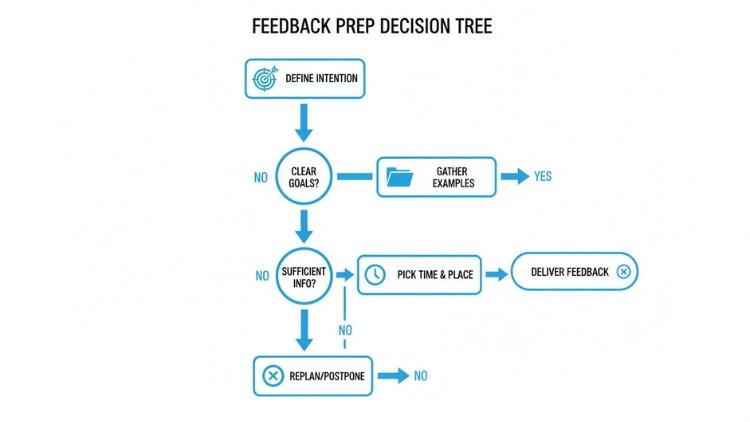
The flowchart below is a great visual for this whole preparation process, from clarifying your goal to picking the right moment to talk.
It’s a good reminder that thoughtful preparation is what sets the stage for a supportive and successful conversation.
Choosing the Right Feedback Framework
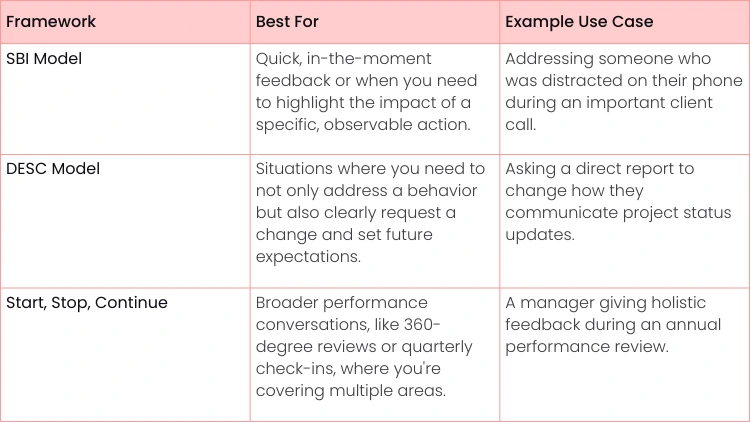
So, which one should you use? It really depends on the situation. One isn't inherently better than the other; they're just different tools for different jobs.
Ultimately, the best framework is the one that feels most natural to you and fits the specific conversation you need to have. The goal is clarity, not rigidity.
How to Navigate the Conversation with Confidence
You’ve done your prep work and have a framework in mind. Now it's time for the actual conversation. How you kick things off really sets the stage for everything that follows, so your first goal is to create a sense of partnership, not confrontation.
Start by stating your positive intent right away. You could say something like, "Thanks for making time to chat. I wanted to talk about the project presentation so we can figure out how to make the next one even stronger." This simple opener immediately frames the discussion around growth and collaboration, not blame.
An approach like this helps lower their defenses right from the get-go. After you've shared your observations using a model like SBI, the most important thing you can do is to stop talking and start listening. Ask open-ended questions that invite their perspective, like, "What was your take on how that meeting went?" or "How did you feel about that part of the project?"
Handling Reactions with Empathy
No matter how carefully you deliver the feedback, people’s reactions can be unpredictable. You might get silence, denial, or even tears. Your job isn't to win an argument; it's to manage the conversation with empathy and guide it toward a productive outcome.
- If they get defensive: Should they disagree or deny what you're saying, don't get drawn into a debate. Instead, try something like, "I understand you see it differently. Can you walk me through your perspective?" This validates their viewpoint while keeping the door open for discussion.
- If you get silence: A long pause can mean a lot of things—they could be processing, feeling overwhelmed, or just shutting down. Gently nudge them to share what's on their mind: "I know I've shared a lot here. What's going through your head right now?"
- If they get emotional: When emotions run high, give them a moment. Acknowledge how they're feeling without backing away from the feedback itself. You could say, "I can see this is difficult to hear, and I really appreciate you listening."
Actionable Insight: Role-play the conversation with a trusted peer beforehand. Practice your opening line and how you might respond to potential reactions. This simple exercise can dramatically increase your confidence and clarity.
The impact of getting this right is huge. In fact, 80% of employees who received meaningful feedback in the past week were fully engaged. As you can see, regular, well-handled discussions directly fuel motivation and performance. This makes learning how to give constructive feedback a non-negotiable skill for any effective leader.
Turning Feedback into Collaborative Action Steps
Let's be honest: a feedback conversation without a clear plan for what's next is just a critique. And that's not the goal. The entire point of constructive feedback is to spark positive change, not just rehash the past. It’s all about shifting the conversation from "what happened" to "what can we do now?"
Once you've shared your observations and, just as importantly, they've shared their side, the conversation needs to pivot. Your job now is to co-create a simple, forward-looking plan. This shouldn't feel like you're handing down a prescription; it should feel like a partnership. When people have a hand in building the solution, they own it.
From Discussion to Action
So, how do you make that transition smoothly? It's all in the questions you ask. Instead of dictating what they should do, you can guide them to their own solutions. This is where you put on your coaching hat.
Try asking things like:
- "What are your initial thoughts on how to approach this differently next time?" This immediately puts the ball in their court and invites them to problem-solve.
- "What support do you need from me to make that happen?" This one is huge. It shows you're not just an evaluator but a genuine resource committed to their growth.
- "What’s one small step you feel confident taking this week?" This is my personal favorite. It breaks down what might feel like a huge challenge into a manageable first step, which makes getting started far less intimidating.
Actionable Insight: End every feedback conversation by scheduling a brief follow-up meeting. Put it on the calendar right then and there. A practical example would be: "Let's check in for 15 minutes next Tuesday to see how the new reporting approach is feeling." This creates accountability and shows you're committed to their progress.
And this approach gets real results. Strengths-based feedback has been shown to boost team productivity by 12.5%. Even better, employees who receive it are 8.9% more profitable for their companies. Setting clear, collaborative goals is the perfect way to put this into practice. For more on this, check out this guide on how to start co-creating team working agreements.

Common Questions About Giving Feedback
Even the best frameworks can feel a little flimsy when you're facing a genuinely tricky feedback situation. Let's be honest, it's these unique challenges that really test our skills as leaders. Here are a few of the most common curveballs I've seen managers face, and how to handle them.
What If They're Not My Direct Report?
One of the most frequent questions is about giving feedback to a senior colleague, a peer, or someone on another team. The dynamic is different, so your approach has to be, too. This isn't the time for a directive; it's a time for collaboration.
Your best bet is to frame your feedback as a simple observation tied to a goal you both share.
For instance, you could try something like, "I noticed in the client pitch that we seemed to lose some momentum when we switched from the demo to the Q&A. I was thinking about how we could make that transition feel a bit smoother next time. Are you open to spitballing an idea?"
You're positioning yourself as a helpful partner, not a critic.
How Do I Address Sensitive Topics?
Then there's the really tough stuff: delivering feedback on sensitive personal issues, like body odor or unprofessional attire. There's no way around it—it's awkward. The key here is 100% discretion, privacy, and empathy. This conversation must happen in private, and your tone has to be gentle and supportive.
Start by making it clear your intention is to help, not to cause embarrassment. You might say, "This is a bit awkward to bring up, and please know I'm saying this because I want to be supportive. I've noticed [observation], and I just wanted to mention it privately in case you weren't aware."
- Practical Example: For attire, be specific and professional. Instead of "Your clothes are unprofessional", try: "Our client-facing dress code requires closed-toe shoes. I noticed you were wearing sandals in today's client meeting and wanted to give you a quiet heads-up for next time." This is factual, non-judgmental, and provides a clear, actionable path forward.
It’s just as important to know what not to say. Making assumptions or using loaded language will shatter trust in a heartbeat. For a deeper dive, this guide on stupid things not to say to your team has more real-world examples of what to avoid.
Ultimately, navigating these conversations comes down to good preparation, a clear and helpful intention, and a genuine desire to see the other person grow.
At Uplyrn, we believe that strong communication skills are the foundation of great leadership. Explore our courses to build the confidence you need to lead your team to success.


Leave your thoughts here...
All Comments
Reply