









How to Overcome Self Doubt and Build Real Confidence

To kick self-doubt to the curb, you need a game plan. It’s all about spotting the root causes, calling out those negative thoughts, and then building up your confidence with small, steady wins. It really starts with figuring out why you feel so shaky and then gathering cold, hard proof that your doubts are usually just noise.
Jump To Section

Earn As You Learn
Earn 25% commission when your network purchase Uplyrn courses or subscribe to our annual membership. It’s the best thing ever. Next to learning,
of course.
Understanding Why Self Doubt Holds You Back
Self-doubt is that sneaky voice that stops you from going for a promotion, pitching a wild idea, or even just speaking up in a team meeting. It’s that constant, nagging question: "What if I’m not actually good enough?"
This isn't just a minor pest; it's a huge roadblock to your growth, both personally and professionally.
For most of us, this doubt sprouts from a few familiar places. Past failures can leave a nasty scar, making you gun-shy about taking another risk. Then there's the endless parade of curated success stories on social media, which makes your own messy journey feel totally inadequate.
Where Does Self Doubt Come From?
This feeling is usually a cocktail of old experiences and ingrained thought patterns. Pinpointing these origins is the first real step to taking back control.
- Past Experiences: That one sharp comment from a manager or a project that went south can easily become the story you tell yourself about your capabilities. Your brain, trying to be helpful, remembers that sting and steers you away from anything that feels similar.
- Social Comparison: You watch a colleague nail a presentation and instantly, your own skills feel second-rate. It's a classic trap—measuring your raw, behind-the-scenes footage against someone else's highlight reel.
- Imposter Syndrome: This is that deep, persistent feeling that you’re a total fraud just waiting to be exposed, no matter how much you've accomplished. You chalk up your wins to luck or good timing, never your own talent and effort.
Self-doubt is like a brake you press without realizing it. It stops you from accelerating toward your goals by convincing you that you don't have enough fuel to make the journey. The first step is to recognize your foot is on the brake.
The Real-World Impact of Doubt
In a professional setting, this inner battle has very real consequences. For example, persistent work-related pessimism can slash productivity by over 60%. It can also increase the risk of depression by a staggering 128%, making it a serious career obstacle.
But this isn't just a 9-to-5 problem. A student might dodge a tough but rewarding course because they're afraid of messing up their GPA. A freelance artist might sit paralyzed in front of a blank canvas, terrified their next piece won’t be as good as their last. These aren't signs of weakness; they're just part of being human.
A common side effect of chronic self-doubt is a desperate need for outside approval. You might find yourself fishing for compliments or reassurance before you can trust your own gut. A big part of this journey is understanding why seeking validation can be crippling.
- Practical Example: Imagine you've just been asked to lead a project. Self-doubt whispers, "You're not experienced enough." As a result, you downplay your abilities in the kickoff meeting, creating a hesitant first impression with your team.
- Actionable Insight: The next time you feel doubt before a task, ask yourself: "What is one small action I can take to prove this doubt wrong?" For the project lead, this could be creating a detailed 30-day plan to show you're organized and in control.

Rewiring Your Inner Monologue
That little voice in your head? It can be your harshest critic or your strongest ally. Getting a handle on self-doubt really boils down to managing this internal conversation. Using a few practical cognitive techniques, you can start catching that negative self-talk before it sends you spiralling.
First, you have to become a detective of your own thoughts. It's about learning to spot your specific "doubt triggers"—those people, situations, or even feelings that always seem to activate your inner critic. This could be anything, from a vague email from your boss to a looming project deadline.
Just noticing these triggers as they happen is a game-changer. It creates a crucial pause, giving you a chance to interrupt the automatic negative response and choose a different path.
From Critic to Coach
Once you’ve caught a negative thought in the act, your next move is to challenge it. Negative self-talk loves to deal in assumptions and drama, not facts. The goal here is to question those assumptions and swap them for a more realistic point of view.
A thought like, "I'm going to fail this presentation" is a total dead end. It offers zero solutions and just cranks up your anxiety. A simple reframe can turn that paralyzing statement into a question that actually sparks action.
Try asking yourself something different:
- "What is one small step I can take right now to feel more prepared?"
- "Which part of this presentation do I actually feel pretty good about?"
- "If my friend felt this way, what would I tell them?"
This shift pulls you out of a passive, victim mindset and makes you an active problem-solver. It’s not about pretending the challenge isn't real; it's about channelling your mental energy toward a solution. You can dig deeper into this process and learn how to make your mind your best friend.
Your inner critic thrives on vague, sweeping judgments. To disarm it, you must demand specifics and evidence. The moment you ask "Is that really true?" you begin to take back control.
Putting It Into Practice with a Thought Log
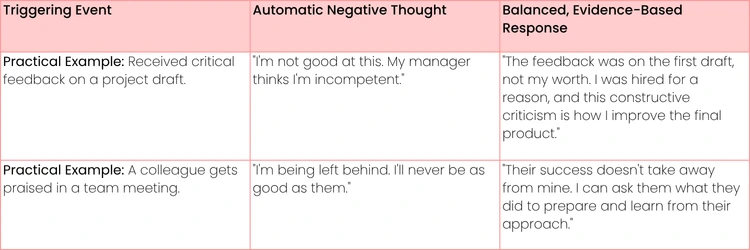
A seriously powerful, hands-on tool for this is a Thought Re-evaluation Log. It sounds a bit clinical, but it's a simple and incredibly effective way to see your self-doubting patterns on paper and start dismantling them.
- Actionable Insight: Create a simple three-column table in a notebook or a digital document to track your thoughts. This makes the process tangible and easier to follow.
Doing this consistently builds a powerful habit. You're training your brain to stop taking every negative thought as gospel and to start cross-examining it with cold, hard evidence.
Building Confidence Through Actionable Habits
Confidence isn't a personality trait you're born with. It’s a skill you build, one small, deliberate action at a time. While challenging your inner critic is important, true self-assurance comes from collecting real-world proof that your doubts are just plain wrong.
This is where you stop trying to think your way into better habits and start acting your way into a better mindset. When you consistently take small steps, you create a powerful feedback loop. You do something, you see you can do it, and that competence slowly but surely silences your self-doubt.
Test Your Doubts with Behavioral Experiments
A brilliant way to get started is by running "behavioral experiments"—tiny, low-risk tests designed to poke holes in a specific doubting belief. You're not trying to become a superstar overnight; you're just gathering a little data.
Think of yourself as a scientist and your self-doubt as a testable hypothesis. For example, if your hypothesis is "I am bad at public speaking", you can design an experiment to test it.
- The Doubt: "I'm terrible at networking. I always get awkward and say the wrong thing."
- Practical Example: At your next virtual conference, aim to ask just one person a single question in the public chat. That’s it. The goal isn't to become a master networker; it's just to see if you can complete that one simple action.
- The Doubt: "I'm not creative enough to add anything valuable to brainstorming sessions."
- Practical Example: Before your next team meeting, brainstorm one single idea related to the topic. It doesn't have to be perfect. Your only job is to write it down and share it if a comfortable moment arises.
Actionable Insight: Start with the smallest possible experiment. The goal is to guarantee a win. If asking a question feels too big, start by simply posting a "thumbs up" emoji in response to someone else's comment.
Use Guided Journaling to Document Your Capabilities
While experiments create new proof, journaling helps you see the proof you’ve been ignoring all along. Self-doubt has a nasty habit of making us magnify our failures and completely forget our successes. A targeted journaling practice can flip that script.
Instead of just writing whatever comes to mind, use specific prompts that force your brain to focus on competence and ability.
Your brain is wired to remember threats and failures far more vividly than successes. Actively logging your wins forces you to pay attention to the evidence your self-doubt wants you to ignore.
This isn't just about making yourself feel good. It's about building a case file against your inner critic. Boosting your self-esteem has real-world benefits, too. For instance, high self-esteem workers can achieve up to 20-30% higher productivity levels. You can read more about this connection in a 2022 study on worker psychology.
Actionable Insight: Spend just five minutes each evening answering one of these prompts. Set a reminder on your phone so it becomes a non-negotiable part of your wind-down routine.
- What’s one thing I did today that proves I am capable?
- Describe a challenge I handled better than I thought I would.
- What is a specific skill I used today that I'm proud of?
If you find that self-doubt is seriously holding you back, exploring professional support like self-esteem and confidence therapy can offer strategies designed just for you. For many people, mixing these self-directed habits with expert guidance is the fastest path forward. Ultimately, building these habits is a crucial part of learning how to develop a growth mindset.
Integrating Resilience Into Your Daily Routine
Building real, lasting confidence isn't about some grand, one-time transformation. It's about the small, powerful habits you weave into your day-to-day life that build a buffer against self-doubt.
Think of these not as chores, but as small, consistent deposits into your confidence account. By making them a regular part of your routine, you're building the muscle needed to quiet that negative inner voice before it even gets a chance to get loud.
Create Your Personal Win File
One of the simplest, most powerful things you can do is start a ‘Win File’—some people call it a ‘Brag Document’. This is just a dedicated spot, maybe a folder on your desktop or a simple notebook, where you collect hard evidence of your wins.
It’s your personal archive of competence. Every time you get a nice email from a client, solve a problem that had you stumped, or hit a target, you document it.
- Practical Example (Positive Emails): Create an email folder called "Wins". When praise from your boss or a happy customer comes in, immediately move it to that folder.
- Practical Example (Accomplishments): Keep a running note on your phone. When you finish a tough project or finally master a new software feature, add a bullet point with the date and the achievement.
- Practical Example (Metrics): Did you help improve a key number at work? Track any data that proves your positive impact in a spreadsheet.
Actionable Insight: Before you start a task you feel nervous about, spend two minutes reviewing your Win File. This is an instant shot of confidence, priming your brain with solid proof that you are good enough, which completely disarms that "what if I fail?" narrative.
Your memory is a terrible record-keeper—it loves to focus on the negative. A Win File isn't about ego. It's about creating a factual, objective record you can turn to when your feelings of doubt just don't line up with reality.
Connect Physical Wellbeing to Mental Fortitude
You can't separate your mind from your body. It's just not possible. When you let your physical health slide, you’re draining the very resources you need to push back against self-doubt. Taking care of yourself is step zero.
The data backs this up. High levels of workplace stress are tied to 35-61% drops in productivity and can absolutely tank work satisfaction by as much as 61%. You can dig into the research on professional wellbeing yourself to see how much of a difference targeted wellness strategies can make.
Focus on these three fundamentals:
- Quality Sleep: You need 7-9 hours. This isn't negotiable. It's how your brain processes stress and keeps your emotions in check.
- Nutritious Food: Good fuel means clear, confident thinking. It's that simple.
- Regular Exercise: You don't have to run a marathon. Even a quick walk gets the endorphins flowing, cuts down stress hormones, and lifts your mood.
Actionable Insight: Link one of these physical habits to an existing part of your routine. For example, commit to a 15-minute walk immediately after you finish lunch each day. This "habit stacking" makes it much easier to stick with.
When you nail these habits, you’re doing more than just getting healthier. You’re sharpening the most important tool you have for beating self-doubt. This is a huge piece of the puzzle when you're learning how to develop emotional resilience and overcome adversity.
Your Toolkit for High-Pressure Moments
Self-doubt has the worst timing. It loves to show up right before a huge presentation, a make-or-break interview, or one of those conversations you’ve been dreading. In moments like these, you don't have the luxury of deep reflection or journaling. You need a first-aid kit for your mind.
Think of these as your go-to emergency tools. They're designed to be used on the spot to manage the intense physical and mental symptoms of doubt, letting you walk into that room with your head held high.
Use Tactical Breathing to Calm Your Nervous System
When that wave of panic hits, your body’s alarm system goes haywire. Your heart starts pounding, your breath gets short and choppy, and your thoughts begin to spiral. The fastest way to pull the emergency brake is to take conscious control of your breathing. A great method for this is called tactical breathing, sometimes known as box breathing.
- Practical Example: You’re in the waiting room, five minutes from being called in for a job interview, and that all-too-familiar sense of dread starts to creep in. Your hands feel clammy and your heart is racing.
Actionable Insight: Discreetly use this technique to get centered. No one even has to know you're doing it.
- Inhale slowly through your nose for a count of four.
- Hold your breath for a count of four.
- Exhale slowly through your mouth for a count of four.
- Hold your breath out for a count of four.
Just a minute or two of this cycle is often enough. This simple, rhythmic pattern sends a powerful signal to your brain that everything is okay, which helps slow your heart rate and quiet the mental noise. It’s an incredibly effective way to manage self-doubt when the pressure is on.
Anchor Yourself with a 3-Minute Mindfulness Exercise
Self-doubt is a master of time travel. It drags you into nightmarish future scenarios or forces you to relive your greatest flops from the past. A quick mindfulness exercise is your ticket back to the only place you have any real power: right here, right now. And don’t worry, this isn’t about trying to empty your mind—it’s about anchoring it.
Actionable Insight: Find a quiet corner before a big meeting, even if it's a bathroom stall, and set a timer for just three minutes. Close your eyes and bring all of your attention to what your senses are picking up.
- What do you hear? Listen for the sounds around you without labeling them.
- Practical Example: Focus on the hum of an air conditioner, distant chatter, or the sound of your own breathing.
- What do you feel? Notice the physical sensations.
- Practical Example: The feeling of your feet flat on the floor, the chair underneath you, the texture of your shirt against your skin.
- What do you smell? Try to pick out any scents in the air.
- Practical Example: The faint smell of coffee or disinfectant in the office.
When your mind is spinning out of control with "what-ifs", grounding yourself in the physical world is the quickest way to stop the spiral. Doubt lives in the past and future; confidence acts in the present.
This exercise pulls you out of your anxious head and back into your body, acting as an immediate circuit breaker. It’s the difference between walking into a high-stakes meeting feeling frazzled and walking in feeling centered and ready.
The real takeaway here is that one small, deliberate action—like noting a small win or thinking of something you're grateful for—is enough to break the negative feedback loop that doubt thrives on.
Frequently Asked Questions About Overcoming Self Doubt
As you start working on how to overcome self-doubt, you’re bound to have some questions. The path is rarely a straight line, and it's totally normal to wonder about how long it takes, whether setbacks are normal, and how to make sense of what you're feeling. Let's tackle some of the most common questions that come up.
How Long Does It Take To Overcome Self Doubt
This is the big one, isn't it? The honest answer is that this is a gradual process, not a switch you can flip overnight. There's no magical finish line. A better way to think about it is like building a new muscle at the gym—it takes consistent work over time.
- Practical Example: In the first few weeks, you might only catch a negative thought after it has already made you feel bad. This is a win! After a month, you might start catching it in the moment. After three months, you might pre-emptively remind yourself of your strengths before a stressful situation.
- Actionable Insight: Focus on consistency, not speed. A small, daily action like writing down one win is more powerful than a one-time, three-hour "confidence bootcamp".
The key to overcoming self-doubt isn't speed; it's consistency. Small, daily actions compound over time to create profound and lasting confidence.
And remember, progress isn't linear. You’re going to have days where that old doubt creeps back in. That doesn't mean you're failing—it just means you're human.
Can Self Doubt Ever Be a Good Thing
Surprisingly, yes. In small, manageable doses, a little bit of doubt can actually be a good thing. It’s that little nudge that keeps your feet on the ground and pushes you to be more prepared. It’s what makes you double-check your report before a huge deadline or run through your presentation one last time.
- Practical Example: A software developer feeling a flicker of doubt before deploying new code might be motivated to write one more automated test. This doubt directly improves the quality of their work.
- Actionable Insight: When you feel a pang of doubt, ask: "Is this doubt pushing me to prepare better, or is it just telling me to quit?" If it’s the former, use that energy to take one final preparatory step.
The trouble starts when self-doubt becomes chronic and paralyzing. Healthy doubt asks, "Am I prepared for this?" Destructive doubt screams, "I'm not good enough, and I never will be."
What's the Difference Between Self Doubt and Imposter Syndrome
These two feel very similar and often show up together, but they're not the same thing. Knowing the difference helps you use the right tools to fight back.
- Self-Doubt is usually situational and specific. It's that feeling of uncertainty about your skills for a particular task.
- Practical Example: You might doubt your ability to lead a brand-new project because you've never used that specific project management software before.
- Imposter Syndrome is a much deeper, more pervasive feeling. It’s that nagging, internalized fear that you’re a complete "fraud" and you’re about to be exposed, no matter how much success you've had.
- Practical Example: Even after successfully leading five projects, you still feel like your new promotion was a fluke and that you're one mistake away from everyone discovering you're incompetent.
Actionable Insight: If your doubt is specific to a task (self-doubt), focus on building skills in that area. If your doubt is a general feeling of being a "fraud" (imposter syndrome), focus on collecting evidence of your past successes in your Win File.
At Uplyrn, we believe that building unshakeable confidence is a skill you can learn. Explore our courses and connect with expert mentors to unlock your full potential and achieve your career goals. Start your learning journey with Uplyrn today!


Leave your thoughts here...
All Comments
Reply