









How to Switch Careers at 40: A Practical Roadmap to Success

Considering a career switch at 40? It’s a common thought, and one that often mixes the excitement of a fresh start with the anxiety of stepping into the unknown. But let’s be clear: this isn’t about starting from scratch. A career change at this point in your life is about taking two decades of hard-won experience and aiming it toward something more fulfilling.
It’s about building on your foundation, not demolishing it.
Jump To Section

Earn As You Learn
Earn 25% commission when your network purchase Uplyrn courses or subscribe to our annual membership. It’s the best thing ever. Next to learning,
of course.
Why a Career Change at 40 Is a Powerful Move
If you’re having that nagging thought that you’re “too late” to make a real change, it’s time to toss that idea out the window. The old-school belief in a single, straight-line career path is long gone. The truth is, your 40s are a strategic sweet spot for a professional pivot. You bring a depth of real-world knowledge that younger candidates simply haven’t had the time to acquire.
You’re also in good company. Research shows the average age for a significant career change is 39 years old. A switch at 40 isn’t just normal; it’s practically right on schedule.
The data backs this up, too. An encouraging 82% of career changers over the age of 45 successfully make the transition. Many even report a significant pay bump. This isn't a fluke; it's a trend. You can see more compelling stats on career changes.
Your Experience Is Your Edge: Why Age 40 Is Prime for a Pivot
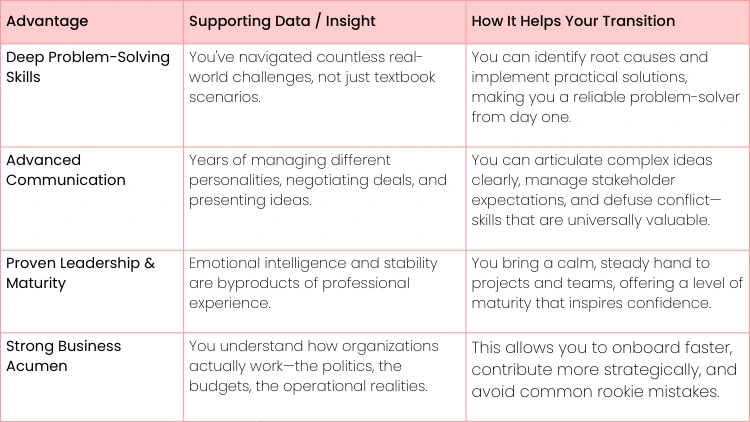
The most powerful tool in your career change toolkit is the wisdom you’ve already gathered. The skills you've spent the last 20 years sharpening aren’t just lines on a resume; they're proven, high-value abilities that employers in any field are desperate for.
This table doesn't just list skills; it highlights your competitive advantage. You're not starting over; you're redeploying a battle-tested skill set into a new arena.
A career change at 40 isn't a crisis. It's a calculated move toward greater personal and professional alignment. You’re not just looking for another job—you’re designing the next chapter of your working life.
When you get right down to it, your age and experience give you a powerful edge. You have a proven work ethic, you know how businesses operate, and you have a much clearer idea of what you want (and don’t want). That combination makes you an incredibly compelling candidate for companies looking for capable, motivated, and reliable professionals.
Crafting Your Personal Career Change Blueprint
A successful career change at 40 doesn’t start by frantically scrolling through job boards. It starts with some honest self-reflection. Before you even peek at what’s out there, you need to look inward. This blueprint is your personal guide to figuring out what you really want and what you already bring to the table.
This initial planning is all about turning vague daydreams into a solid framework. Think of it as drawing the map before you start the journey. It ensures you’re not just running away from a job you dislike, but intentionally moving toward a future you’ve designed for yourself.
Your existing experience, when paired with the right new skills, leads directly to success in a new field. Your current experience is the foundation you build on, not something you throw away.
Map Your Transferable Skills
After two decades in the workforce, you've picked up a ton of skills that are valuable far beyond your current job title. The trick is to reframe them. Your expertise isn't just "managing a team"—it's leadership, mentorship, and talent development.
To get started mapping your skills, try this quick exercise:
- List Your Wins: Jot down 5-10 big achievements from your past roles. What projects still make you proud?
- Practical Example: You successfully managed a trade show booth that generated 50 new leads.
- Find the Core Skills: For each achievement, what skills did you actually use? Did you analyze data, negotiate contracts, or manage a tight budget?
- Practical Example: For the trade show, you used project management, budget tracking, vendor negotiation, and public speaking.
- Translate for a New Audience: Now, rephrase those skills using broader, industry-neutral language. For instance, "Wrote monthly reports" becomes "data analysis and performance reporting".
- Actionable Insight: The trade show experience becomes "Strategic Event Planning & Lead Generation".
This exercise helps you view your professional history as a versatile portfolio, not just a rigid timeline. A project manager, for example, might realize their knack for "managing timelines" is actually "strategic operations planning" in the language of a tech startup.
Define Your Motivations and Non-Negotiables
Knowing what you can do is only half the puzzle. You also need to be brutally honest about what you want to do and what you need from a job to feel fulfilled. Sure, a higher salary is a common goal, but what about work-life balance, creative freedom, or being part of a team you genuinely like?
Your non-negotiables are the guardrails for your job search. They keep you from chasing an opportunity that looks great on paper but will make you miserable in reality.
Use these prompts to dig into your real motivators:
- What parts of your past jobs gave you a real sense of energy?
- Actionable Insight: Was it mentoring junior colleagues? That points toward roles in training, management, or even corporate L&D (Learning & Development).
- What kind of environment helps you do your best work—collaborative or independent?
- What are your absolute must-haves for salary, benefits, and flexibility?
- Practical Example: "I need a remote or hybrid role at least three days a week to manage family commitments" or "I cannot take a role that pays less than $85,000 annually."
- What kind of impact do you want to make with your work?
This reflection is a critical piece of building a solid plan. For a more structured approach, this guide on creating a personal development plan is a great next step. And if you're really struggling to find clarity, professional career coaching can offer an outside perspective to help you get unstuck.
By defining your terms upfront, you give yourself the power to confidently evaluate—and walk away from—potential career paths, making sure your next move is the right one.
Choosing High-Growth Fields and Reskilling Strategically
Now that you've done the internal work, it's time to match your goals with what's happening in the real world. A smart career change at 40 isn't about chasing the latest shiny object. It’s about finding a high-growth field where your years of experience are a huge advantage, not a liability.
The good news? You can forget the idea of going back for a four-year degree. Modern reskilling is fast, focused, and built for people just like you. The goal is to find industries with real demand where a targeted certification can get your foot in the door.
The job market is constantly changing, and the skills employers want are changing with it. The smartest career changers are targeting booming sectors like tech and healthcare, which are set for massive job growth. For example, roles like software developer are growing at almost double the average rate, and cybersecurity pros are pulling in salaries between $109,000 and $162,000.
With an estimated 39% of core skills expected to change by 2030, getting ahead of the curve is everything. Those who reskill strategically can land a new role up to 40% faster. You can dig into more stats about the shifting job market.
Find Your Pivot Point In Growing Industries
Think about it: two decades in the professional world have given you a powerful toolkit of transferable skills. Project management, client relationships, strategic planning—these are worth their weight in gold. The trick is to pair these core strengths with a new, in-demand technical skill.
Here are a few high-growth areas to get you thinking about where you might fit:
- Cybersecurity: Have a background in compliance, risk management, or even just detailed analytical work? You already have the right mindset. This industry is projected to grow like crazy, and a role like Security Analyst is a very achievable entry point.
- Healthcare Administration: As our population ages, the demand for well-run healthcare facilities is skyrocketing. If you’ve got experience in operations, HR, or finance, you’re well-equipped to manage a clinic or a hospital department.
- Green Energy Project Management: The world is shifting to sustainable energy, creating a massive need for people who can manage complex renewable energy projects. Your background in logistics, construction management, or even large-scale event planning could be a perfect match.
Real-World Example: Sarah was a retail store manager for 15 years and felt completely stuck. She was a pro at inventory, scheduling, and managing suppliers. Instead of looking for another retail job, she got a six-month certification in Supply Chain Management. Now, she's a logistics coordinator for a major e-commerce company—a field expecting 118,700 new jobs by 2034.
Create an Efficient Reskilling Roadmap
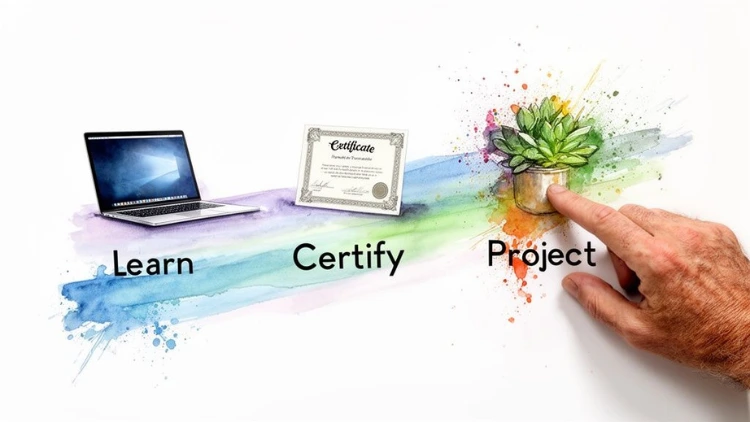
Changing careers at 40 demands a plan that's both fast and effective. The goal isn't to spend years in a classroom; it's to become job-ready in months. This means focusing on certifications and hands-on projects that prove to employers you can do the work.
Let's use cybersecurity as an example. It's a field where your analytical mind can shine. Here's a quick roadmap to pivot:
- Build the Foundation: Start by tackling the CompTIA Security+ certification. With focused study, you can prep and pass the exam in just 3-4 months. This certification is the industry standard and tells employers you know the fundamentals.
- Get Hands-On: At the same time, start building a portfolio of practical projects. Set up a simple home lab to practice skills like network analysis and threat detection.
- Specialize Later: Once you land that first role, you can think about more advanced certifications in areas like cloud security or ethical hacking to really fast-track your career growth.
This approach is all about building momentum. By focusing on targeted, industry-recognized credentials, you create a solid bridge from your past experience to your future career. A great way to begin is by exploring some online courses for a career change that are built around this exact model.
Gaining Experience and Telling Your New Career Story
So you’ve picked your new field and mapped out your learning plan. Now comes the part that trips up so many career changers: getting past the "no direct experience" roadblock.
How do you convince a hiring manager you can do the job when your resume says you’ve been doing something completely different for 20 years? Simple. You go out and create the experience yourself.
This is a make-or-break phase of your career change. It’s all about building a solid bridge from your old career to your new one. The best part? You don't have to quit your current job to get started. You can begin building that bridge right now.
Get Your Hands Dirty (Strategically)
Knowing the theory from courses is a fantastic first step, but it’s the practical application that truly makes you a credible candidate. The goal is to hunt down opportunities—no matter how small—to put your new skills to work in a real-world setting.
You just have to get a little creative. These opportunities are often much closer than you think.
- Volunteer Your New Skills: Offer to manage the social media for a local animal shelter to build your digital marketing portfolio. Or maybe you can volunteer to handle the books for a small nonprofit to get some practical bookkeeping experience. These roles give you tangible results to showcase.
- Take on Freelance Projects: Sites like Upwork or Fiverr are great for finding small, paid projects. A budding UX designer could snag a simple website redesign gig for a local business to prove their skills with a real client.
- Launch a "Passion Project": This is where you create something from scratch. An aspiring content writer could start their own blog on a topic they genuinely love, which demonstrates writing, SEO, and content management skills all at once. An IT pro moving into data could create a public dashboard analyzing sports stats.
These projects do more than just build skills—they build proof. They give you specific achievements to talk about in interviews and highlight on your resume.
Craft Your New Professional Story
Once you start racking up some new experience, it’s time to rewrite your professional narrative. Your LinkedIn, resume, and elevator pitch need to tell a clear, consistent story about your future, not just your past. This isn't about hiding your history; it's about reframing it.
Your career pivot isn't a random leap of faith—it's a calculated evolution. You need to connect the dots for recruiters, showing them how your past experiences logically led you to this new path and make you a uniquely qualified candidate.
Start with a complete overhaul of your LinkedIn profile. It's often the very first place a recruiter will look you up.
Your LinkedIn Transformation Checklist:
- Rewrite Your Headline: Your headline should shout your future ambition, not whisper your past title. Instead of "Customer Service Manager at XYZ Corp", try "Aspiring UX Designer | Passionate about Creating User-Centered Solutions".
- Revamp Your "About" Section: This is your personal storytelling space. Write in the first person and explain your "why". Draw a clear line connecting your old skills to your new goals.
- Showcase New Projects: Add a "Projects" section to your profile. This is where you detail your volunteer work or freelance gigs. Explain the problem, the actions you took, and the results you achieved. Don't forget to include links to your work!
For example, a former customer service manager pivoting to User Experience (UX) can frame their old job as "optimizing user satisfaction through empathetic problem-solving and feedback analysis". That language instantly aligns their background with the core principles of UX. This is a critical part of the art of telling your professional story, which you can dive into deeper in this detailed guide.

Mastering the Modern Job Search and Interview
Job searching at 40 isn't like it was in your 20s. It's a whole new ballgame. The good news? You’re not starting from scratch. You’re bringing years of real-world wisdom to the table. The trick is to stop thinking like a junior applicant and start acting like the seasoned professional you are—someone who offers strategic solutions, not just fills a seat.
This means your resume and interview style need a serious refresh. That old chronological resume that got you your last few jobs? It’s probably holding you back now. It’s time to switch to a hybrid resume format.
This approach is a game-changer. It puts your most valuable skills and recent wins right at the top, immediately grabbing a recruiter's attention. Your work history still matters, of course, but it comes second, acting as the proof behind the skills you've just highlighted.
Reframe Your Value Proposition
Your resume should be less of a historical document and more of a marketing brochure for your future. You have to sell your unique value, and that means speaking the language of the role you want.
Let's say a hospitality manager is making a move into a client success role. A simple list of old duties won't cut it. Instead, they need to translate that experience.
Imagine a "Key Accomplishments" section that reads like this:
- Drove a 30% increase in guest retention through proactive service programs.
- Led and mentored a team of 25, boosting performance metrics by 15%.
- Resolved over 500 complex client issues, achieving a 98% satisfaction rating.
See the difference? This reframes hospitality experience using the vocabulary of client success: retention, team management, and problem-solving. It proves your value before the hiring manager even gets to your past job titles. Once your new resume is ready for action, you can start to find jobs that align with your new career path.
Don’t let age be a barrier. In fact, 82% of career changers over 45 successfully land new roles, and 50% of them even report a significant pay increase. The process typically takes 6 to 12 months, but that timeline can shrink by 40% for those who arm themselves with targeted certifications.
Master Your Interview Narrative
For any career changer, this is the question that makes your palms sweat: "So, why the big change?" Nailing your answer here is non-negotiable.
Whatever you do, don't frame your career change as an escape from something you hated. Position it as a strategic evolution—a natural next step fueled by your experience and a newly discovered passion.
You need a powerful, concise story that bridges your past with your future. For example, a sales expert pivoting to digital marketing could say:
"Throughout my sales career, what really energized me was digging into customer behavior to figure out what made them tick. I realized my true passion wasn't just closing the deal, but the strategy behind reaching and persuading customers at scale. That's what led me to get certified in digital marketing—I want to apply my deep understanding of customer psychology to build powerful online campaigns."
This story works because it's authentic and forward-thinking. It directly connects old skills to new ambitions, showing that your career change is a calculated move, not a whim. For more strategies on telling your story, this guide on how to prepare for job interviews is packed with tips.
Got Questions?
Of all the concerns that come up when you're thinking about a career change at 40, a few big questions seem to pop up again and again. You’ve spent decades building a life and a professional reputation, so it’s completely normal to feel a bit anxious about stepping into something new.
Let's cut through the noise and tackle those common worries head-on.
Will I Have to Take a Major Pay Cut?
Not necessarily, and definitely not always. While some pivots might involve a sideways step at first, a surprising 50% of career changers over 45 actually end up earning more.
The secret is to be strategic. You need to target a high-growth field where your two decades of professional experience—all that time spent managing people, communicating complex ideas, and solving real-world problems—is seen as a massive asset, not a liability.
- Practical Example: A mid-level manager with strong budgeting and team leadership skills pivoting into a tech project management role can often command a higher starting salary than a younger applicant with only technical skills. Why? Because they can point to a proven track record of delivering projects on time and on budget. Bolstering that experience with an Agile or PMP certification strengthens the case, making a pay cut far less likely.
How Long Does This Realistically Take?
For a focused career change at this stage, you're typically looking at a timeline of 6 to 18 months. This isn't a hard-and-fast rule, but it generally breaks down into a few key phases.
- Discovery & Planning (2-3 months): This is where you do your soul-searching, research new fields, and map out a realistic plan.
- Targeted Reskilling (3-9 months): You're not going back to a four-year degree. This is about focused learning through certifications or bootcamps.
- Actionable Insight: Choose a certification that includes a final project, which gives you immediate portfolio-worthy material.
- Job Hunting (3-6 months): Time to activate your network, polish your brand, and start interviewing.
The whole process is much quicker than starting from zero because you aren't. You're building on a solid professional foundation. We’ve seen people who stick to a structured plan land a great new role in well under a year.
Am I Too Old to Get Into Tech?
Absolutely not. In fact, many tech companies are actively looking for mature professionals. They bring stability, emotional intelligence, and battle-tested problem-solving skills that you just don't get straight out of college. The industry isn't just about 22-year-old coders in hoodies; it needs seasoned leaders to guide projects and teams.
A lot of people don't realize that many tech-adjacent roles—like IT project management, cybersecurity analysis, or even technical sales—lean more on logic and communication than hardcore programming. Modern learning platforms are also built for self-paced, adult learning, which makes picking up new skills more accessible than ever before.
How Do I Explain This Career Change in an Interview?
This is critical. You have to own your story. Frame your pivot as a story of deliberate evolution, not a desperate escape from a job you hated. You need to connect the dots for the hiring manager.
Don't say you were "bored". Instead, talk about what pulled you toward this new field.
- Practical Example: "In my previous marketing role, I found myself most energized when I was digging into campaign data and figuring out what it all meant. That fascination is what led me to pursue a data analytics certification. I want to dedicate my career to turning raw data into powerful business strategy, and I see a direct line from my experience in understanding customer motivation to finding actionable insights in data."
That kind of narrative shows clear intent, ambition, and a vision for how you’ll deliver value from day one.
Ready to stop wondering and start building your career change blueprint? Uplyrn offers expert-led courses and mentoring designed to help you reskill strategically and land your dream job with total confidence. Discover your next career at Uplyrn.


Leave your thoughts here...
All Comments
Reply