





Online Art Classes: Your Guide to Mastering Creative Skills
Staring at a blank canvas is a feeling every artist knows well. It’s a mix of pure potential and, let's be honest, a little bit of terror. But what if you had a clear, structured path to turn that empty space into something amazing? That's exactly what online art classes are for. They give you a flexible way to learn everything from the basics of drawing to advanced digital painting, all without leaving your house.
Jump To Section

Earn As You Learn
Earn 25% commission when your network purchase Uplyrn courses or subscribe to our annual membership. It’s the best thing ever. Next to learning,
of course.
Your Creative Journey Starts Here
Think of this guide as your personal roadmap for turning those creative sparks into real, tangible skills. We're going to dive into how online art classes have completely changed the game, making creativity accessible to anyone, no matter where you live or what your schedule looks like. This isn’t just a list of courses; it's a game plan for finding your unique artistic voice.
The move to online learning has been huge for the art world. And this isn't just a small trend—it's a massive economic shift. The global online art market was valued at around $11 billion and is expected to rocket past $19 billion by 2033. That tells you there’s a serious demand for digital creative skills and the platforms that teach them.
A New Era for Artists
Not too long ago, learning art meant you had to be in a physical studio or a university classroom. Today, that old model has been completely blown open. Online learning shatters geographical barriers. Now, you can learn from a world-class illustrator in Tokyo or a famous painter from a prestigious art school, all from your own desk.
The real game-changer with online art classes is the freedom of choice. You get to decide what you learn, when you learn, and how you learn it, creating an experience that fits your personal goals and your life.
This kind of flexibility is what empowers so many aspiring artists to finally chase their passion without having to put the rest of their lives on hold.
From Hobbyist to Professional
So, what's your goal? Are you looking to pick up a relaxing new hobby, or are you aiming to build a professional portfolio that lands you a dream job? Whatever your ambition, the right online course is out there waiting for you.
We’ll walk you through how to pick the perfect class, master new techniques, and even build a body of work that gets you noticed. You'll get practical advice and real-world examples to help you turn your creative passion into skills you can be proud of.
Choosing Your Learning Style and Format
Diving into online art classes can feel like walking into a massive art supply store for the first time. The sheer number of options is exciting, but it's also easy to get overwhelmed. The very first step—and honestly, the most important one—is picking the right format for you. Your learning style, your schedule, and even your personality will determine which approach actually sticks.
Live vs. Recorded Classes
Let's start with a simple question: are you looking for a live concert or a studio album?
A live class is the concert experience. It’s interactive, it happens in real-time, and you get that immediate feedback from the instructor, just like the energy you'd get from a crowd. For example, you could ask the instructor, "Is the shadow on this apple correct?" and get an answer on the spot. If you need the structure of a set schedule and thrive on direct, personal interaction, this format is for you.
On the flip side, a recorded class is your favorite album. You can pause it, rewind that tricky brushstroke technique as many times as you need, and practice at 2 AM if that's when inspiration hits. For example, if you're struggling with a one-point perspective lesson, you can re-watch the demonstration a dozen times until it clicks. This gives you total flexibility, which is a lifesaver for anyone juggling a busy schedule or who just prefers to learn at their own pace without any pressure.
Cohort vs. Self-Paced Learning
Beyond the live versus recorded debate, you'll also run into two common structures: cohort-based and self-paced.
A cohort-based course is basically a team sport. You start with a specific group of students, and you all move through the material together, often with shared deadlines and group projects. This setup is fantastic for building a real sense of community and accountability because you're all learning and growing alongside your peers. A practical example would be a course where everyone is tasked with creating a character design by Friday, and you share progress in a group forum throughout the week.
Then there’s the self-paced course, which is more like a solo marathon. You're in complete control of the timeline, working through the lessons whenever you find the time. This is perfect for disciplined, independent learners who need to squeeze their creative education in around a demanding job or family life. No group deadlines to worry about—just your own goals pushing you forward.
To get the most out of your online art classes, it helps to know how you learn best, especially since art is such a hands-on, visual learning experience. Knowing your own tendencies will immediately point you toward the format where you’ll feel most comfortable and engaged.
The best format isn't about which one is "better" in general, but which one actually fits into your life. A perfectly designed course will fall flat if its structure doesn't match your personal schedule and learning habits.
Choosing the right format from the get-go is the best way to avoid burnout and keep that creative spark alive. Once you've settled on a style, you can find even more ways to succeed with this guide full of tips for successful online learning.
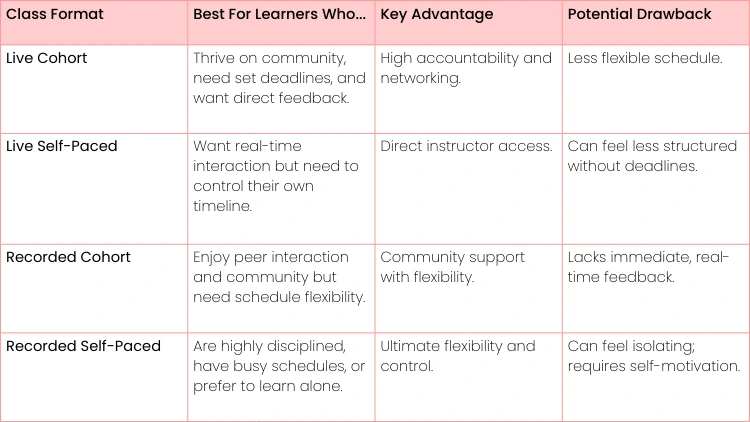
Which Online Art Class Format Is Right for You
Feeling stuck? Use this quick comparison to find the learning style that best matches your goals and lifestyle.
Ultimately, whether you're someone who craves the buzz of a creative community or someone who needs quiet solitude to focus, there's an online class structure built for you.
Finding Your Artistic Focus
So, what story do you want to tell with your art? That single question is the best place to start. The world of online art classes is vast, with a massive catalog of subjects to explore, but diving in without a clear direction can feel like drinking from a firehose.
The key is to think of each discipline not just as a skill to learn, but as a unique language for expressing your ideas.
Think of drawing as the fundamental grammar of art. It doesn't matter if you're using a simple pencil or a sophisticated stylus—learning to draw teaches you the non-negotiables: line, shape, form, and perspective. It's the bedrock that supports pretty much every other artistic path, from painting all the way to animation.
- Actionable Insight: Don't aim for a masterpiece on your first try. Seriously. Just start by sketching something simple, like a piece of fruit on your kitchen table. Focus on capturing its basic shapes and the way light creates shadows. This simple exercise builds the observational skills that are crucial for everything you'll do later.
From Drawing to Painting
Once you’ve got a handle on the "grammar" of drawing, painting is where you really get to play with color and texture. Online classes in oils, watercolors, or acrylics will walk you through using color theory to create a specific mood—like using warm reds to convey passion or cool blues for a sense of calm. For example, a practical assignment might be to paint the same landscape twice: once with a warm palette to evoke a sunny day, and once with a cool palette to suggest a stormy one. You'll quickly see how different brushstrokes can build texture, adding depth and a real sense of life to your work.
The Modern Artist’s Toolkit
Digital art is the modern artist's ultimate sandbox, perfectly suited for both pure creative expression and commercial projects. The flexibility is just incredible. You can undo mistakes in a flash, experiment with endless color palettes, and create work that's instantly ready for print or web.
If you’re leaning toward digital, getting the right tablet is a big deal. You can learn more about finding the best iPad for digital art to get started on the right foot.
This medium isn't just for commercial work, either. It has gained serious respect in the fine art world. Digital art is now a mainstream slice of the global art market, with 51% of high-net-worth collectors having purchased a piece of digital art. This shift has opened up some incredible doors for artists who are skilled in these tools.
Whether you're drawing, painting, or sculpting digitally, the core principles never change. Mastering the fundamentals is your most important task, regardless of the tools you choose.
To really get a grip on these fundamentals, it pays to study the building blocks of all visual creation. This guide on the elements of art and principles of design is a great place to build that foundation.
Bringing Your Stories to Life
Finally, we have animation. This is where you make your characters and worlds move, breathe, and live. It’s a powerful blend of drawing, storytelling, and a deep understanding of motion. Online animation classes can take you through everything from classic 2D frame-by-frame techniques to complex 3D modeling.
- First Project Idea: Animate a bouncing ball. It’s a classic for a reason. This simple exercise teaches you timing, spacing, and weight—three of the absolute cornerstones of good animation.
Choosing your focus isn't about picking one path and being locked in forever. It’s about finding a starting point for your creative journey. Each of these disciplines offers a completely different way to tell your story, and the best online art classes make even the most advanced skills feel approachable right from day one.
How to Choose the Right Online Art Class
With a seemingly endless ocean of online art classes out there, trying to pick just one can feel overwhelming. It doesn't have to be. Once you know what to look for, you can cut through the noise and find a course that genuinely fits your creative ambitions. The trick is to break it down into a few key questions.
Get Clear on Your Personal Art Goals
First thing's first: be brutally honest with yourself about why you're signing up. Is this a chill hobby to help you unwind, or are you seriously trying to build a career in something like graphic design or illustration? Your answer completely changes the game.
If you’re a hobbyist, you can lean into courses that are all about fun, experimentation, and just enjoying the process without the pressure of hard deadlines. But if you're an aspiring pro, you need to hunt for structured programs—the kind that include portfolio-worthy projects and real-world industry advice. For example, a professional course might assign a project to design a book cover based on a real-world creative brief, while a hobbyist course might just encourage you to paint your favorite flower.
- Actionable Insight: Before you even think about enrolling, find the student showcase or gallery for the course. Does the art on display look like the kind of stuff you want to make? This is the quickest gut check to see if a class’s output matches your personal goals.
Size Up the Instructor and Their Teaching Style
A world-class artist isn't automatically a world-class teacher. It's a common trap to fall into. Don't just get wowed by an instructor’s amazing portfolio; dig into how they actually teach. Most platforms will offer preview videos or even a free introductory lesson. Watch them. Closely.
Listen to their communication style. Do they have a knack for breaking down tricky concepts into something you can actually grasp? For instance, do they explain perspective by using a simple example like drawing railroad tracks disappearing into the distance? Is the pace a good fit for you—not too slow, not too fast? Finding an instructor whose vibe clicks with how you learn is absolutely essential for staying motivated when things get tough.
Check Out the Feedback and Community Loop
Art doesn’t grow in a vacuum; it thrives on feedback. This is a big one. Before you commit, you need to know exactly how you’ll get critiques on your work. The quality of this feedback loop is often what separates a good course from a great one.
- Peer Reviews: These are fantastic for building a sense of community and seeing how other students tackle the same problems. You learn just as much from giving feedback as you do from getting it.
- Direct Instructor Critiques: This is the gold standard. Getting personalized, expert guidance can rocket your progress forward. It's usually a feature of more premium or intensive programs.
- Community Forums: Never underestimate an active forum. They’re perfect for asking quick questions, sharing your wins (and struggles), and just feeling connected to others who are on the exact same journey.
The demand for accessible art education is huge. In the U.S., while 37% of eighth graders take art classes, that number swings wildly from 16% to 68% depending on the state. Online learning can bridge that gap, bringing top-tier instruction to anyone, anywhere.
The right class doesn't just hand you a set of skills. It creates a supportive space where you feel safe enough to experiment, make a mess, and actually grow. That support system is almost always built on the back of great feedback and a strong community.
A solid feedback loop is a cornerstone of real learning. If you're looking for that kind of structured support, checking out a top-tier digital design course is a great way to see what a well-designed educational experience looks like in action.
Figure Out the True Value and Cost
Finally, look past the sticker price and think about the total value you’re getting. Is it a one-time payment for lifetime access? That could be a steal if you plan on revisiting the material down the road. Or is it a monthly subscription? Those offer more variety but demand you stay consistent to get your money's worth.
- Actionable Insight: Make the most of any free trials. Don't just passively watch. Jump into the community forums, try a few lessons, and get a genuine feel for the platform’s culture before you pull out your credit card. It’s the single best way to know for sure if a class is the right fit.
Turning Your Artistic Skills into a Career
Finishing your first few online art classes is a huge accomplishment. Seriously, take a moment to celebrate it. But then comes the big question: how do you leap from learning new skills to actually making a living with your art?
The bridge between being a student and becoming a professional artist is built with one thing: a strong, focused portfolio.
So many aspiring artists fall into the trap of thinking they need a massive gallery with dozens of pieces to get noticed. The truth? Quality crushes quantity, every single time. Your goal should be to create 3-5 high-quality "hero pieces" that show off the absolute best of what you can do.
Think of these pieces as your creative handshake. They make that critical first impression on a potential client or employer, so they have to be good.
Building Your Professional Portfolio
Your portfolio isn't just a scrapbook of your favorite creations; it's a precision marketing tool. Every piece you include should be crafted with a specific career in mind, proving you have the exact skills needed for that role.
Let's break it down with a few examples:
- Want to be a freelance illustrator? Your hero piece could be a stunning book cover. A single project like this shows you can translate a story into visuals, design compelling characters, and create a composition that pops off a shelf.
- Dreaming of being a concept artist? Put together a complete character design sheet. We're talking multiple angles, detailed callouts for clothing and gear—everything that proves you can think like a designer for games or film.
- Aiming to be a graphic designer? Design a full brand identity for a fictional company. This means creating a logo, a color palette, and mockups showing the brand in action, demonstrating your strategic and commercial thinking.
Your portfolio should tell a clear story about who you are as an artist and what kind of work you want to do. A focused collection of hero pieces is far more effective than a scattered gallery of unrelated projects.
This targeted approach makes it instantly obvious to an art director or hiring manager that you get what the job requires.
Finding Career Support and Mentorship
The good news is you don't have to figure all this out alone. Many online learning platforms are so much more than just a library of video tutorials; they're communities built to help you grow professionally. Often, they give you direct access to mentors who can offer priceless advice from inside the industry.
These platforms can be an incredible resource for portfolio reviews, where a seasoned pro looks at your work and gives you honest, actionable feedback. That kind of guidance can be the difference-maker, helping you polish your hero pieces until they’re undeniably job-ready. If you're looking for a place to start, check out this article with advice from actual artists on how to become a professional.
By using the structure of online art classes to build a strategic portfolio and actively seeking mentorship, you're creating a clear, actionable plan. This is how you transform your passion from a hobby into a real, exciting career.
Your Next Step on the Creative Path
Well, there you have it—a practical roadmap for making sense of the huge, exciting world of online art classes. We've walked through everything from figuring out which learning style actually fits your life to spotting a great instructor and even sketching out what a creative career could look like.
If there’s one thing to take away from all this, it’s that the perfect time to start is right now. Seriously.
Every single artist you admire, whether they’re an old master or a digital illustrator killing it on Instagram, started exactly where you are: with a blank page and an idea. That first simple mark is all it takes. The only thing standing between the artist you want to be and the artist you are today is that first step.
The most important move you can make is just to start. Forget perfection; aim for progress. Your entire creative adventure is waiting for you on the other side of that initial hesitation.
So, use what you've learned here to make a move. Sign up for that beginner’s drawing course you've been eyeing, or finally dive into a digital painting tutorial. You could even learn how to turn your art into products you can sell. If that last part sounds interesting, you should check out this guide on how to make art prints at home.
All the tools and knowledge you need are right here. Pick a path, commit to that first lesson, and just see what happens. Your artistic future is ready when you are.
Got Questions About Online Art Classes?
Jumping into the world of online art can bring up a few questions. That's totally normal. Let's tackle some of the most common ones so you can get started with confidence.
Do I Really Need a Studio Full of Expensive Supplies?
Absolutely not. This is one of the biggest myths out there. For many foundational courses, especially in drawing, all you need is a pencil and some paper. Seriously, that's it. The goal is to master core skills like line, shape, and value—not to see who has the fanciest gear.
When you're ready to dip your toes into digital art, you can find incredibly affordable drawing tablets that plug right into your computer. Any good course will list the required materials right upfront, and instructors almost always suggest budget-friendly options. Focus on the technique first; the pro-level equipment can come later.
How Do I Stay Motivated When No One's Looking Over My Shoulder?
This is the big one for self-paced learning, isn't it? The key is to create your own structure and find your people.
First, schedule your art time. Block it out in your calendar like you would a doctor's appointment, even if it’s just for 30 minutes a few times a week. Second, get involved in the course community. Post your work in the forums, see what other students are creating, and leave comments. It’s a simple way to build a sense of accountability.
Finally, think small. Instead of aiming to "become a great artist", set a goal to finish one module or complete a single character sketch this week. Ticking off those small wins is how you build real, lasting momentum.
Motivation isn't some magical force you wait for. It’s the result of building small, consistent habits that make practice feel less like a chore and more like a natural part of your day.
Can an Online Art Class Actually Help Me Land a Job?
Yes, but with a major caveat: a certificate of completion won't get you hired. Your portfolio will. The best online programs understand this and are built around helping you create professional, polished pieces that scream "hire me!"
If a creative career is your end game, look for courses that offer more than just video lessons. You want mentorship from industry pros, portfolio reviews that provide honest feedback, and real career guidance. A strong portfolio filled with targeted work is the most direct path to a job. For instance, a great concept art course should leave you with a stunning, fully rendered character sheet—not just a folder of random practice sketches.
Ready to turn your creative passion into a professional path? At Uplyrn, we don't just teach you skills; we connect you with expert mentors and career-focused courses designed to help you build a killer portfolio. Start learning with Uplyrn today.


Leave your thoughts here...
All Comments
Reply