









Online Courses for Professionals: Fast-Track Your Career

Online courses for professionals aren't just a nice-to-have anymore; they've become a core strategy for career survival and growth. In a world where skills can become obsolete almost overnight, continuous learning is the single most direct path to staying relevant, adaptable, and in-demand.
Jump To Section

Earn As You Learn
Earn 25% commission when your network purchase Uplyrn courses or subscribe to our annual membership. It’s the best thing ever. Next to learning,
of course.
Why Online Learning is Now a Career Essential
Think of your professional skill set as a high-performance investment portfolio. Just like your financial assets, your skills need constant, active management to grow in value and avoid depreciation. Stagnation simply isn't an option when massive industry shifts, like the explosion of AI, can redraw job requirements in the blink of an eye.
This is where online learning steps in as your primary tool for managing that "skills portfolio".
For today’s ambitious professionals, this is about strategically using online courses to carve out a competitive edge. It's not just about adding another line to your resume—it’s about building genuine, long-term career resilience.
Building Your Career Resilience
So, what is career resilience? It's your ability to adapt and even thrive when unexpected changes hit your industry or role. Online courses are one of the most direct and effective ways to build this muscle. They deliver targeted knowledge right when you need it, empowering you to tackle new challenges and seize opportunities with confidence.
Here’s a look at how smart professionals are using online learning to stay ahead of the curve:
- Adapting to Industry Shifts: A marketing manager whose team relies on SEO sees that AI-powered search is changing the game.
- Practical Example: She enrolls in a course on "AI for SEO" to learn how to integrate generative AI into their content strategy, keeping their company's rankings high.
- Gaining a Competitive Edge: A software developer wants to lead a major project.
- Practical Example: He completes a micro-credential in "Cloud Architecture with AWS", a skill his company desperately needs, making him the obvious choice for the team lead position.
- Closing Critical Skill Gaps: An operations lead notices projects are consistently late.
- Practical Example: She earns an Agile Project Management certificate online and immediately implements Scrum methodologies, reducing project delivery times by 20% in the next quarter.
The demand for this is real. Research shows that a staggering 70% of employees would think about leaving their current job for a company that invests more in their training and development. This isn't just a trend; it's a clear signal that continuous skill-building is now a core expectation in professional life. You can get a better sense of what it takes by understanding the DNA of a 21st-century employee and how to build those traits yourself.
Actionable Insight: Don't wait for your annual review to discuss training. Proactively identify a skill gap in your team and present your manager with a specific online course that solves it. Frame it as a direct benefit to team productivity or company goals. This turns your learning into a strategic asset for the business.
To truly make online learning work for you, it needs to be part of a bigger picture. Integrating it into a structured career development plan is the key. This approach turns learning from a scattered, reactive tactic into a powerful, proactive strategy for your long-term growth and success.
Decoding the Different Types of Online Courses
Trying to navigate the world of online courses can feel like walking into a massive hardware store. There are countless tools on the shelves, each designed for a very specific job. Picking the right one is everything, and understanding the main formats—from quick skill top-ups to complete career overhauls—is the first step toward making a smart investment in your future.
This decision is a real fork in the road for your career. It helps you figure out whether you need to adapt your current skills, upskill for a promotion, or pivot to something entirely new.
Every growth path starts with a clear goal. From there, your strategy will branch out depending on what you want to achieve. Whether you need a small tune-up or a major career change, there's a learning format built just for that.
Micro-credentials: The Skill Sprints
Think of micro-credentials as targeted skill sprints. They're short, focused courses designed to teach you one specific, in-demand skill—and fast. These are perfect when you need to plug an immediate knowledge gap without signing up for a long-term commitment.
- Practical Example: A marketing manager takes a two-week course on "Generative AI for Content Creation". They aren't trying to change careers. They're adding a powerful tool to their existing skill set to immediately improve the quality and efficiency of their team's blog posts and social media campaigns.
Bootcamps: The Career Accelerators
If micro-credentials are sprints, then bootcamps are intense, immersive marathons built for a rapid career change. These programs usually run for three to six months and are laser-focused on getting you job-ready for a new role, especially in tech fields like coding, UX design, or data science.
- Practical Example: An administrative assistant wants to break into tech. They enroll in a "Full-Stack Web Development Bootcamp". Over 12 weeks, they build a portfolio of four complete web applications. This portfolio, not just the certificate, is what they use to land their first junior developer job.
Professional Certificates: The Paths to Deep Expertise
Professional certificates offer a more structured, comprehensive path to mastering a specific area. They're deeper than a micro-credential but not as all-consuming as a full degree. These programs often bundle a series of related courses that build on each other, giving you a level of expertise that employers really notice.
- Practical Example: An HR generalist aiming for a leadership role might pursue a "Strategic Human Resources Management" certificate. This credential, which covers topics like talent acquisition and compensation strategy, signals a serious commitment and the specialized knowledge needed for a promotion to HR Manager. You can see how these fit into the broader landscape of the digital era of courses, learning, and teaching.
Online Degree Programs: The Foundation for a New Chapter
Finally, we have online degree programs, like a Bachelor's or Master's. These represent the biggest commitment but also offer the most comprehensive education. They are the go-to choice for people looking to make a major career change, enter a field that requires a formal degree, or build the foundational knowledge needed for senior leadership.
The demand for these flexible options is exploding. The professional online courses market is on track to hit $2.87 billion by 2025, largely because they allow professionals to gain qualifications while cutting traditional classroom time by 40-60%.
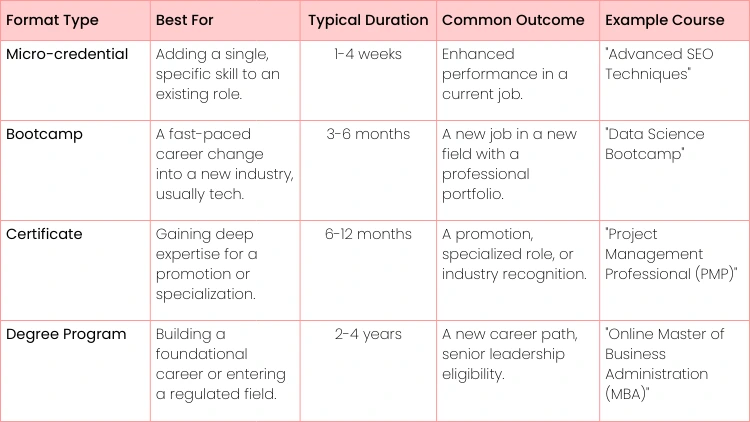
Choosing the right format really depends on where you are and where you want to go. To make it easier, here’s a quick breakdown of how these different options stack up against each other.
Comparing Online Course Formats for Professionals
Each of these paths offers a different kind of value. Your job is to match the format—and the investment of time and money—to your specific career ambitions.
Connecting In-Demand Skills to Your Career Goals
Choosing the right online course isn’t just about picking a topic that sounds interesting. It's about making a strategic move that directly connects your skills to what the job market is actually paying for.
The best online courses for professionals are the ones that build a bridge from where you are today to where you want to be tomorrow. It all starts with getting a clear-eyed view of which skills are truly valuable in your field right now.
Think of it like putting together a puzzle. Your dream job is the final picture on the box, and every in-demand skill is a piece you need to fit perfectly into place. If you start grabbing pieces randomly without looking at the box, you’ll just end up with a mess—and a lot of wasted time and money.
Mapping High-Impact Skills to Specific Roles
The secret is to draw a straight line from a skill you learn to a result you can achieve. Vague goals like "I want to get better at my job" won't cut it. You have to get specific and identify the exact competencies that open doors to promotions, better pay, and exciting new roles.
Let's look at how this plays out in the real world:
- For Tech Professionals: A software developer who wants to move into a senior position needs to get ahead of the curve.
- Practical Example: Focusing on AI and Machine Learning with a specialized certificate allows them to lead the development of a new predictive analytics feature, a high-visibility project that fast-tracks their promotion.
- For Marketing and E-commerce: A digital marketer aiming for a manager role has to prove they understand the bottom line.
- Practical Example: Taking a course in Advanced Digital Marketing Analytics, they learn to build attribution models that prove their campaigns generated a 300% ROI, giving them the hard data needed to justify a leadership position.
- For Operations and Leadership: An aspiring manager in almost any industry needs to show they can get things done.
- Practical Example: Earning a certification in Agile Project Management, like a Certified ScrumMaster, gives them a framework to manage a complex product launch, delivering it on time and 10% under budget.
Actionable Insight: It’s not just about learning for the sake of learning. The real goal is to gain a skill that solves a painful business problem. When you can walk into an interview and explain how your new cloud computing certification will help a company slash its infrastructure costs by 15%, you’ve made yourself indispensable.
Performing a Personal Skill Gap Analysis
Before you click "enroll" on anything, you have to know what you’re missing. This is where a personal skill gap analysis becomes your most powerful tool. It’s a straightforward exercise designed to shine a spotlight on the exact knowledge you need to gain.
Actionable Insight: Open three job descriptions for the role you want next. Copy and paste the key requirements into a spreadsheet. In the next column, rate your current proficiency for each skill from 1-5. Any skill with a score of 3 or less is a prime candidate for an online course. This creates a data-driven learning plan.
For a deeper dive, check out this guide on how to identify skill gaps for a more structured approach.
Consider this mini-case study. Sarah, a project coordinator, was determined to become a Senior Project Manager. After doing her homework, she realized that while she was great at organizing, she had zero formal training in risk management or stakeholder communication. These two skills appeared in 80% of the senior PM jobs she looked at.
She found a PMP certification course that hit those topics hard. Six months after getting certified, she landed the promotion and a 15% salary bump. Her investment paid off because it was targeted, strategic, and directly addressed a clear market need. That’s the power of smart upskilling.
How to Vet and Choose a High-Quality Online Course
With thousands of online courses for professionals out there, telling the difference between a high-value program and a slick marketing gimmick can be tough. Making the right choice means looking past the flashy landing pages to vet the core elements that actually deliver a return on your investment of time and money.
A great course is like a skilled personal trainer; it pushes you, provides a clear plan, and equips you with the tools for real-world success. A poor one is like a broken treadmill—you’ll put in the effort but go absolutely nowhere.
Look Beyond the Course Description
The marketing copy will always promise the moon, but the truth is in the details. A truly effective course is built on a strong foundation of expertise, relevance, and student support. Your first job is to investigate the instructor and the curriculum with a critical eye.
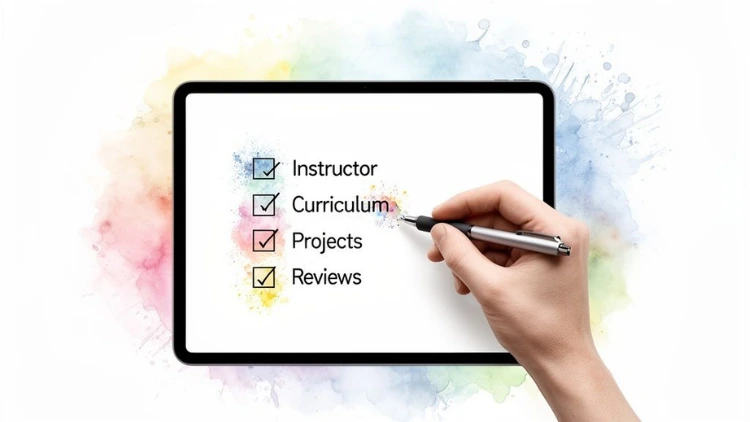
- Instructor Expertise: Don't just look for an academic. The best instructors are often practitioners who have spent years in the field.
- Actionable Insight: Search for the instructor on LinkedIn. Do they currently work in the role they are teaching? Look for recent articles, conference talks, or open-source contributions that prove their expertise is current.
- Curriculum Relevance: A quality syllabus should be your roadmap. Does it clearly list the specific tools, skills, and software you will master? Be on the lookout for a curriculum that explicitly mentions hands-on projects, case studies, or a capstone project—these are essential for building a portfolio that gets you hired.
Evaluate Social Proof and Practical Application
What past students say and what they were able to do after the course are your most reliable indicators of quality. This is where you separate courses that teach theory from those that build real-world skills. Hunt down genuine, detailed reviews that speak to specific outcomes, not just vague praise.
- Actionable Insight: The most important question to ask is this: Does this course force me to build something? Passive learning, like just watching videos, is not enough. You need a program that makes you apply knowledge through projects you can actually add to your resume or portfolio.
- Practical Example: A great coding bootcamp won’t just teach you Python syntax; it will make you build and deploy a full-fledged web application. That final project—a functioning app with a public URL—becomes concrete proof of your new abilities, which is far more valuable to an employer than a simple certificate of completion.
Assess Career Support and Outcomes
Finally, think about the end goal. Does the course provider offer any career support services? While not always necessary, features like mentorship programs, resume reviews, or job opportunities are strong signals that the provider is invested in your success beyond the final lesson.
This focus on career outcomes is why professionals worldwide are flocking to online certificates. The global e-learning market was estimated to hit $325 billion in 2025, and Massive Open Online Courses (MOOCs) are projected to grow at a staggering 39.3% rate as workers pursue credentials in high-demand fields.
Turning Your New Skills Into Career Advancement
Finishing an online course is a huge accomplishment, but it’s really just the starting line. The real victory lap happens when you translate that shiny new certificate into tangible career growth—think a promotion, a raise, or a brand-new job title. Your next move is to strategically show off your upgraded qualifications so they’re impossible for anyone to ignore.
Think of your new skill like a powerful tool. It’s not much good if it just sits in the toolbox. You have to take it out, show people how it works, and use it to solve a real problem. That means actively updating your professional brand to reflect what you can do now.
Updating Your Professional Assets
The moment you complete your course, it's time to broadcast your new skills. If you wait, the momentum fades. Start by giving your most important career documents a refresh that highlights your investment in yourself.
- Your Resume: Don't just list the certificate under a dusty "Education" section. Create a dedicated "Professional Development" or "Certifications" area.
- Actionable Insight: Instead of just "Google Analytics Certificate", write "Google Analytics IQ Certified: Mastered user segmentation, conversion tracking, and custom report creation to drive data-informed marketing strategies". Use bullet points to highlight specific, valuable sub-skills.
- Your LinkedIn Profile: This is your digital billboard, so use it. Add the certification to the "Licenses & Certifications" section—this automatically notifies your network.
- Actionable Insight: Write a post announcing your achievement. Tag the course provider, mention a key skill you learned, and attach a screenshot of a project you built. This provides visual proof of your new capabilities.
Communicating Your Value in High-Stakes Conversations
Your updated profiles will start to get attention, but you also have to be ready to explain your new value in person. Whether you’re in a performance review or a job interview, you need clear, confident talking points that connect your learning directly to business results.
- Actionable Insight: Frame your new skills in terms of solving problems or creating value. Don't just say, "I learned Python". Instead, try this: "I completed a Python for Data Analysis course where I built a script that automates weekly reporting. I estimate it can save our team about five hours of manual work each month."
This approach immediately transforms you from someone who just took a course into a proactive problem-solver. It’s that kind of positioning that justifies a promotion or makes you the standout candidate for a new role. You can learn more in this detailed guide on how to get promoted by moving up strategically.
The professional learning industry has absolutely exploded, with growth expected to jump over 200% within five years of the pandemic's start. Today, a staggering 79% of people taking MOOCs already have degrees. They're reskilling in hot areas like AI and leadership to get a competitive edge. Platforms like Uplyrn are built to bridge that exact gap, offering expert mentorship and job opportunities that help turn course completions into real career advancements.
Common Questions About Professional Online Courses
Stepping into the world of online learning can feel like a big move, and it's natural to have questions before you commit. Professionals need to know they're investing their time and money wisely. Let's tackle some of the most common queries to give you the clarity you need to move forward with confidence.
Are Online Certificates Valued by Employers?
Yes, absolutely, when they represent real skills. The conversation in hiring is changing. More and more, employers are looking past traditional degrees to see what you can actually do. A certificate from a reputable program is a clear signal of modern, relevant skills.
- Practical Example: A hiring manager for a UX Designer role is choosing between two candidates. One has a degree in graphic design. The other has a degree in psychology but also a 6-month UX Design bootcamp certificate and a portfolio of three app prototypes they built during the course. The second candidate often gets the interview because they have proven, hands-on experience.
How Can I Balance a Course with a Full-Time Job?
Juggling a course with a demanding job is all about strategy and consistency. It’s a marathon, not a sprint. First things first, pick a program designed for people like you—one that offers flexible, self-paced schedules. That puts you in the driver's seat right from the start.
Actionable Insight: Use the "Pomodoro Technique". Study in focused 25-minute blocks with 5-minute breaks. This makes it easier to squeeze productive learning sessions into a busy schedule without feeling overwhelmed. A few focused sessions are more effective than one long, distracted one.
Here's a practical weekly plan:
- Block out dedicated time: Schedule two 1-hour sessions on your calendar for Tuesday and Thursday evenings.
- Embrace micro-learning: Watch a 15-minute lecture on your phone during your morning commute.
- Set realistic goals: Aim to complete one module and its quiz each week. This steady progress prevents burnout.
What Is the Difference Between Upskilling and Reskilling?
People often use these terms interchangeably, but they represent two very different career paths. Figuring out which one you're on is key to choosing the right kind of online course.
- Upskilling is about getting better at the job you already have. You’re adding new, more advanced skills to your current toolkit.
- Practical Example: A project manager who learns Agile methodologies to run their teams more efficiently is upskilling.
- Reskilling is about learning a whole new set of skills to pivot into a different career entirely.
- Practical Example: An accountant who completes a data science bootcamp to become a data analyst in the fintech industry is reskilling.
How Can I Get My Employer to Fund My Course?
Getting your company to pay for your training starts with framing it as an investment—for them. You need to connect the dots between the skills you want to learn and a problem the business needs to solve. Start by finding a course that plugs a clear skill gap on your team or in the wider organization.
- Actionable Insight: Build a simple, one-page business case. In it, specify the course, the cost, and 3-4 bullet points on the expected ROI. For example: "By taking this 'Advanced Excel for Financial Modeling' course, I can automate our monthly budget variance reports, saving approximately 8 hours of manual work per month and reducing the risk of human error." This specific, data-driven proposal is much harder to refuse. By presenting a well-reasoned proposal that positions your training as a solution, you dramatically increase your chances of getting a "yes".
Ready to find the course that will fuel your next career move? At Uplyrn, we connect you with industry experts and learning experiences designed for real-world results. Explore our courses today!


Leave your thoughts here...
All Comments
Reply