









What is Adult Learning Theory and How to Use It Effectively
Ever feel like you’re stuck in a high school classroom during a work training? You know the feeling—bored, restless, and wondering when you can get back to your actual job. That’s a classic sign of training that ignores one simple, powerful truth: adults learn differently from children.
This is where adult learning theory comes in. It’s not just some stuffy academic concept; it’s a practical toolkit for creating training that actually works for grown-ups.
Jump To Section

Earn As You Learn
Earn 25% commission when your network purchase Uplyrn courses or subscribe to our annual membership. It’s the best thing ever. Next to learning,
of course.
Unlocking Professional Growth with Adult Learning Theory
The traditional approach to teaching is called pedagogy—the methods used for kids. It assumes the learner is a blank slate, and the teacher is there to fill it with information. This works great when you’re learning your multiplication tables for the first time.
But for adults, this model falls flat. We need andragogy—a term that describes the art and science of helping adults learn.
- Practical Example: Imagine teaching an experienced accountant a new, more efficient software. A pedagogical approach would be a boring lecture on the basics of accounting. An andragogical approach, however, skips the basics and shows them exactly how this new tool solves a real problem, like automating their most tedious monthly reports to save them 10 hours of work. They need to see the "why" right away.
The Shift from Pedagogy to Andragogy
This crucial distinction was brought to the forefront back in 1968 by educator Malcolm Knowles. He argued that adult learning programs fail when they treat professionals like children. Instead, he identified a few core truths about how adults are wired to learn.
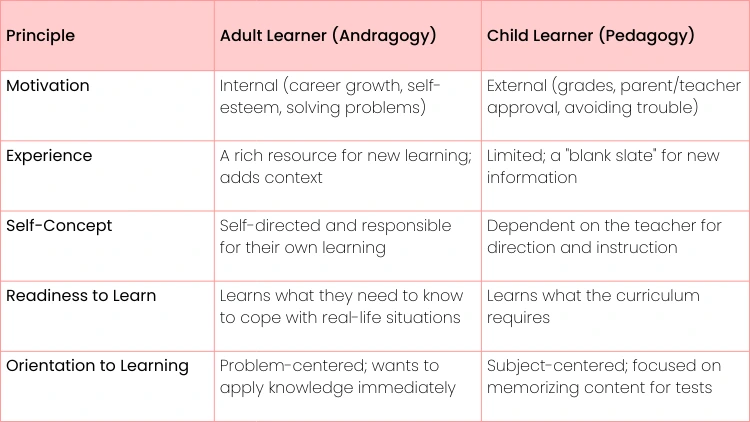
Knowles recognized that adults are generally self-directed, bring a lifetime of experience to the table, and are driven by internal goals—not just gold stars. To help you see the difference clearly, here’s a quick breakdown.
Adult Learning vs Child Learning at a Glance
As you can see from the table below, the entire approach has to change. Unlike kids who follow a rigid curriculum, adults thrive with flexible, relevant training that respects their time and autonomy.
- Actionable Insight: As a learner, don't just sign up for the next available course. Actively seek out learning experiences that are problem-centered and allow for self-direction. Ask yourself: "Does this course solve a real problem I have right now?" If the answer is no, it's probably not the right fit.
This insight is a game-changer. For individuals, it helps you spot effective courses that won't waste your time. For companies, understanding these principles is the key to designing training programs that stick. By focusing on why the training matters and how it applies to real-world challenges, you ensure that every hour spent learning delivers tangible results.
To see how this plays out in a corporate setting, check out this guide on why investing in employee training is so important.
The Core Principles That Define Adult Learners
So, what really separates an adult learner from a kid in a classroom? It all boils down to a handful of core principles that shape their motivations, needs, and the way they absorb information. Getting a handle on these ideas, largely defined by the educator Malcolm Knowles, is the secret to designing training that actually resonates and sticks.
These aren't just fuzzy, abstract concepts; they are practical, road-tested insights into how professionals are wired to learn. Once you start recognizing these traits in yourself or your team, it will completely change the way you approach professional growth.
The Self-Concept of the Learner
First up is Self-Concept. Unlike children, who generally depend on teachers for direction, adults see themselves as being in the driver's seat. They want control over their own learning journey—making choices about what they learn, when they learn it, and how they do it.
- Actionable Insight: When designing training, offer a "learning menu" instead of a fixed meal. Provide a core curriculum but supplement it with optional deep-dive modules, links to extra resources, and flexible project choices. This respects their autonomy and lets them tailor the experience to their specific needs.
The Role of Experience
Adults never show up as blank slates. They bring a lifetime of Experience with them—a rich tapestry of successes, failures, and hard-won wisdom. This past experience isn't just background noise; it's a powerful resource for anchoring new knowledge.
- Practical Example: A seasoned sales professional learning a new CRM system isn't starting from zero. A good trainer will ask them to share stories of past deals they've won (or lost). Then, they can connect the software’s features directly to those real-life scenarios, making the new information far more meaningful and easier to remember.
Readiness to Learn
Adults are most open to learning when it's directly relevant to their life or work right now. This is the Readiness to Learn principle in action. A promotion, a new project, or a nagging problem at work creates a powerful, immediate "need-to-know" moment that you can tap into.
- Practical Example: An employee who just got put in charge of their first big project is suddenly very motivated to take a project management course. The learning directly solves an immediate problem, turning them into a focused and engaged student. For a trainer, this means timing is everything; offering just-in-time learning resources is key.
Problem-Centered Orientation
Kids learn subjects; adults learn to solve problems. This shift to a Problem-Centered Orientation means that grown-ups are looking for knowledge they can apply immediately. They're far less interested in theory for theory's sake and much more focused on finding practical solutions that work.
The Need to Know Why
This might be the most critical principle of all: The Need to Know Why. Before an adult commits their valuable time and energy, they have to understand the value proposition. "Why should I learn this?" is the very first question they'll ask, even if it's just to themselves.
- Actionable Insight: Always start any training session by explicitly stating the "WIIFM" (What's In It For Me). Don't just list learning objectives; frame them as benefits. Instead of "Learn to use pivot tables", say "Master pivot tables to turn confusing spreadsheets into clear, actionable reports in minutes."
Finally, adults are powered by Internal Motivation. Things like self-esteem, job satisfaction, and a desire for personal growth are far more powerful drivers than external rewards like grades or gold stars.
Weaving these principles into your course design isn't just a nice idea—it gets results. Research shows that experiential learning built on these adult-focused ideas can boost retention to a staggering 75% with hands-on practice. You can also explore this guide on the 9 types of intelligence and how they influence learning to further tailor your approach.
Exploring Key Adult Learning Models You Should Know
Beyond the basic principles of andragogy, several other models give us a much clearer picture of how adults really learn. Think of these as specific blueprints that go beyond general traits to explain the process of learning, giving you a solid roadmap for designing training that actually works. Getting a handle on these theories can completely change how you approach professional development.
When you look at the core ideas of adult learning—Self-Concept, Experience, and Readiness—you can see how they all connect and lay the groundwork for these more advanced models. Adult are independent learners; they bring a lifetime of experience to the table and are motivated to learn when they see a direct link to solving a real-world problem they're facing right now.
Experiential Learning: The Hands-On Cycle
One of the most practical and widely-used frameworks is David Kolb's Experiential Learning Cycle. The core idea is simple but powerful: adults learn best by doing, not just by listening. It’s a continuous four-stage loop that turns raw experience into solid knowledge.
Practical Example: Imagine a chef trying to nail a complicated new sauce. Their process is a perfect illustration of Kolb's cycle in action:
- Concrete Experience: The chef makes the sauce for the first time, but it’s a flop—too thin and bland. This is the hands-on, "doing" part of the process.
- Reflective Observation: They take a step back and think about what went wrong. "Was the heat too low? Did I use the wrong kind of thickener? Maybe I didn't reduce it long enough?" This is the crucial "review and reflect" stage.
- Abstract Conceptualization: Drawing from their observations, they form a new plan. They might do a little research, watch a video, and decide that a different emulsifier combined with higher heat is the key.
- Active Experimentation: The chef gets back in the kitchen and tries again, this time with the new approach. It works! The sauce is perfect, and that new knowledge is now locked in.
Actionable Insight: Structure your lessons around this cycle. Don't just present information. Start with a small, hands-on task (Concrete Experience), ask learners to analyze their results (Reflective Observation), introduce the theory behind it (Abstract Conceptualization), and then have them try a more advanced task (Active Experimentation).
Transformative Learning: Shifting Your Perspective
Another major framework you’ll encounter is Jack Mezirow's Transformative Learning Theory. Mezirow argued that true learning for adults often involves a fundamental shift in their entire perspective. This kind of change is sparked by what he called a “disorienting dilemma”—a moment that challenges our core beliefs and forces us to see the world differently.
- Practical Example: A successful but old-school manager swears by micromanagement. When a huge project fails because their team is burnt out and creatively stifled, they hit a wall. This failure is their "disorienting dilemma", forcing them to confront the fact that their trusted leadership style is deeply flawed.
Through self-reflection, honest feedback, and seeing other leadership styles in action, their entire view on what it means to lead can change. This isn't just about learning a new management trick; it's a permanent rewrite of their professional worldview.
When you're exploring different learning models, you'll also find specialized theories for different fields. For example, in language learning, a key concept is understanding what is comprehensible input, which focuses on how learners acquire language naturally.
Putting Adult Learning Theory into Practice
Knowing the theory behind how adults learn is a great start, but the real magic happens when you put it into action. This is where we move from abstract ideas to practical strategies that build real skills—the kind that stick long after a course is finished.
The best learning experiences aren't built on abstract topics; they're anchored in real-world challenges. This simple shift respects that adult learners need to see the relevance immediately. They're wired to solve problems. So, instead of a traditional lecture, you want to create a space where they can roll up their sleeves, use their past experiences, and see the value in what they’re learning right away.
Design with Real-World Problems
Rule number one: make it relevant. Adults are far more motivated when they can draw a straight line from what they're learning to their daily work or career aspirations. Forget generic subjects and start building your courses around solving specific, tangible problems.
- Actionable Insight: Reframe your course titles and descriptions around problems and outcomes. Instead of a dry course titled "Fundamentals of Digital Marketing", reframe it as a challenge: "Create a Digital Marketing Plan to Revive a Struggling Local Business". This instantly gives the learning a clear purpose and attracts engaged learners.
- Practical Example: A software development course could ask learners to build a functional appointment-booking app for a small clinic. This is so much more engaging than just explaining lines of code. It provides a concrete goal and an immediate use for every new function or language feature they learn.
Foster Autonomy and Reflection
Adults need to feel like they’re in the driver’s seat of their own learning journey. Giving them self-paced modules, optional deep-dive resources, and flexible deadlines respects their independence and busy lives. A rigid, one-size-fits-all schedule is a huge turn-off for professionals juggling work, family, and now, your course.
Just as important is building in time for reflection. Learning isn’t just about cramming in new information; it's about connecting the dots.
- Actionable Insight: Build simple reflection prompts into the end of every module. Ask questions like, "How could you apply this technique to a project you worked on last month?" or "What's one thing from this lesson you can try at work tomorrow?"
This simple practice helps knowledge stick and makes it easier to transfer from the course to the real world. If you need some help structuring this, this article on how to create effective training materials offers a fantastic blueprint.
Build a Community of Learners
Learning shouldn't be a solo mission. Your adult learners bring a treasure trove of experience to the table, and creating ways for them to share it can transform your course. A strong community turns a static content library into a living, breathing learning environment.
Here are a few simple ways to get a community buzzing:
- Peer-to-Peer Feedback: Set up assignments where learners review and give constructive feedback on each other’s work.
- Group Projects: Assign collaborative projects that push learners to team up and tackle a complex problem together.
- Discussion Forums: Use moderated forums to hash out tricky topics, share real-world examples, and get questions answered by the group.
When you weave these strategies into your course design, you’re not just teaching—you’re creating an experience that truly respects how adults learn. You empower them by making the content relevant, self-directed, and collaborative.
How Modern Learning Platforms Put These Principles Into Practice
It’s one thing to understand the theories behind how adults learn, but seeing them in action is where things get interesting. Leading online platforms like Uplyrn don't just dump a bunch of videos online; they build entire learning ecosystems around these core principles. The features you see and use every day are there for a reason—they’re designed to respect your needs as an adult professional and make learning stick.
This starts with a deep commitment to flexibility. Adults have jobs, families, and a thousand other commitments, so a rigid, one-size-fits-all schedule is a non-starter. This is a direct nod to Knowles' principle of Self-Concept, where modern platforms put you firmly in the driver's seat.
- Practical Example: On Uplyrn, you’ll find that courses are self-paced. This means a marketing manager can dive into a new analytics tool after putting the kids to bed, or a freelancer can master a new skill between client projects. This isn't just a nice-to-have feature; it’s a foundational requirement for making professional education work.
From Theory to Tangible Skills
The best platforms don't stop at flexibility. They tackle the adult need for relevance and problem-solving head-on, building features that directly connect abstract concepts to real-world results. This turns learning from a theoretical chore into a direct path toward a new job or a long-awaited promotion.
Early research often put adult learners under timed, high-pressure conditions. We now know that's not the full story. Modern studies show that when you remove the ticking clock, adult performance matches that of younger learners. This is precisely why the self-paced, pressure-free model of platforms like Uplyrn is so powerful.
- Actionable Insight: When choosing a learning platform, look beyond the course catalog. Investigate their assessment methods. Do they use project-based assessments that mimic real job tasks? Do they offer mentorship from industry veterans? These are the features that prove a platform understands and applies adult learning theory.
You can see this hands-on philosophy in how modern courses are built and graded. Forget endless multiple-choice quizzes that test memorization. Instead, these platforms use assessments that actually mirror real job tasks.
- Project-Based Assessments: You won't just take a test on coding theory. You'll build a working web app for your portfolio. This satisfies the need for problem-centered learning and gives you something concrete to show potential employers.
- Mentorship Programs: You get paired with an industry veteran who gives you feedback based on their years of on-the-job experience. This taps directly into the idea that adults learn best by drawing on the expertise of others.
- Job Opportunities: Courses are meticulously crafted to teach the exact skills you see listed in today's job descriptions. This immediately answers that critical adult learner question: "Why am I learning this?"
When these elements are woven together, the result is a powerful and effective learning experience. To see how this fits into the bigger picture, take a look at this guide on the digital era of courses and learning. When you find a platform that offers this blend of flexibility, real-world application, and expert mentorship, you've found one that’s built for career success.
Your Blueprint for Lifelong Professional Growth
Think of adult learning theory as your personal superpower for staying ahead in your career. This isn't just some dusty academic concept for teachers; it’s a practical blueprint for anyone serious about professional growth and staying relevant. It all boils down to a few core truths about how you, as an adult, actually learn best.
Let's be honest, you learn most effectively when you're in the driver's seat. New information clicks when it connects to your real-world experience and, more importantly, when it solves a problem you're facing right now. That’s the core of andragogy in action.
- Actionable Insight: Take control of your professional development by seeking out opportunities that are relevant, problem-focused, and respect your autonomy. Before enrolling in any training, ask: "Will this help me solve a specific challenge I have at work this quarter?" This simple question will guide you to effective learning choices.
This simple shift in perspective empowers you to pick platforms and courses that actually work. The old myth that learning ability declines with age has been thoroughly debunked. Thanks to neuroplasticity, our brains can forge new connections throughout our lives. Research shows that older adults can perform just as well as younger learners when time pressure is removed, a key principle that makes reskilling possible at any age.
With this knowledge, you have the clarity to build a career that doesn't just happen to you, but is built by you.
Got Questions About Adult Learning? Let's Get Them Answered.
Even after you get the hang of the core theories, a few practical questions always seem to pop up. Let's tackle some of the most common ones we hear, with straight-to-the-point answers to help you put these ideas to work for your own career.
What’s the Real Difference Between Teaching Adults and Kids?
It really comes down to just two things: experience and motivation.
- Practical Example: A child learns about photosynthesis because it's in their science textbook. Their motivation is to pass the test. An adult, however, might learn about photosynthesis because their expensive house plants keep dying, and they need to solve the problem. Their motivation is immediate and personal.
- Actionable Insight: When you're looking for a course, pay close attention to whether it respects your existing knowledge. A huge green flag is a program that focuses on solving real-world challenges you actually face, not just lecturing on abstract topics. That's how you know it's built on solid adult learning principles.
How Can I Use These Theories to Learn Faster?
To really speed things up, you have to be deliberate. Just passively sitting through lectures won't cut it. You need to actively wrestle with the material. Here’s how:
- Define Your "Why": Before you even start, get crystal clear on the specific problem this new skill will help you fix. This gives you an immediate reason to care.
- Connect New to Old: Actively try to link what you're learning to something you already know. If you’re learning a new project management tool like Asana, think, "How would this have made that chaotic project from last year run smoother?"
- Choose "Doing" Over "Watching": Always, always prioritize courses that are project-based. Building something real forces you to apply knowledge, which makes it stick in a way that watching videos never can.
- Use It or Lose It: Find a way to use your new skill immediately, even if it's just in a small, low-stakes way. That cycle of application and reflection is what truly accelerates skill-building.
Are Some Learning Theories Better for Certain Subjects?
Definitely. The best way to learn something often depends on what you're trying to learn.
- Practical Example: For highly technical skills like coding or data analysis, Kolb's Experiential Learning Cycle is a fantastic fit. It’s a framework built on a loop of doing, failing, reflecting, and trying again—which is exactly how experts get good at hands-on work. A coding boot camp that makes you build five projects embodies this.
But for "softer" skills like leadership or public speaking, Mezirow's Transformative Learning is often a better match. These skills aren’t just about memorizing steps; they’re about changing your perspective and deeply held beliefs. A leadership workshop that uses role-playing and intense group feedback sessions is applying this theory.
The best learning platforms don't just pick one model and stick with it. They smartly blend principles from multiple theories to create an experience that’s both effective and engaging.
Ready to experience learning that’s actually designed for professionals like you? Uplyrn offers mentorship and expert-led courses that turn theory into real-world skills and tangible career outcomes. Start your journey today.


Leave your thoughts here...
All Comments
Reply