









Your Next Annual Performance Review Template and Guide
An annual performance review template does more than just standardize evaluations; it’s about turning subjective feelings into objective, consistent assessments that everyone—from managers to employees—can actually trust. It creates a shared language for performance.
Jump To Section

Earn As You Learn
Earn 25% commission when your network purchase Uplyrn courses or subscribe to our annual membership. It’s the best thing ever. Next to learning,
of course.
The True Cost of Outdated Annual Reviews
Let's be honest. For most people, the traditional annual review is a dreaded, time-sucking ritual. It's an event packed with anxiety, stale questions, and a manager trying to remember what you did eleven months ago. But the real cost of these broken processes goes way beyond wasted hours and frustrated employees. It's a direct hit to your bottom line.
Outdated reviews don't just fail to motivate; they actively disengage your best people. According to Gallup's research, that low engagement adds up to a mind-boggling $8.9 trillion in lost productivity worldwide. At the same time, a stubborn 71% of companies stick to this yearly routine, with managers burning an average of 210 hours just prepping for them.
Here's the flip side: the data shows a much better way. Teams that get regular feedback on their strengths report 8.9% higher profitability and are 12.5% more productive. It's a clear signal that the old way isn't working.
The Hidden Drain on Your Resources
The problem is that most old-school review systems are fundamentally broken. They function as a once-a-year critique instead of what they should be: the final conversation in a year full of continuous growth and feedback. This flawed approach creates a cycle of inefficiency that quietly eats away at company resources. Managers are left scrambling to recall a year's worth of events, while employees feel like their entire contribution is being boiled down to a single, high-stakes meeting.
To get a sense of just how deep this problem runs, consider that Your annual performance review template is broken. Here’s a better way. A modern approach changes the whole game, transforming the review from a chore into a tool for empowerment.
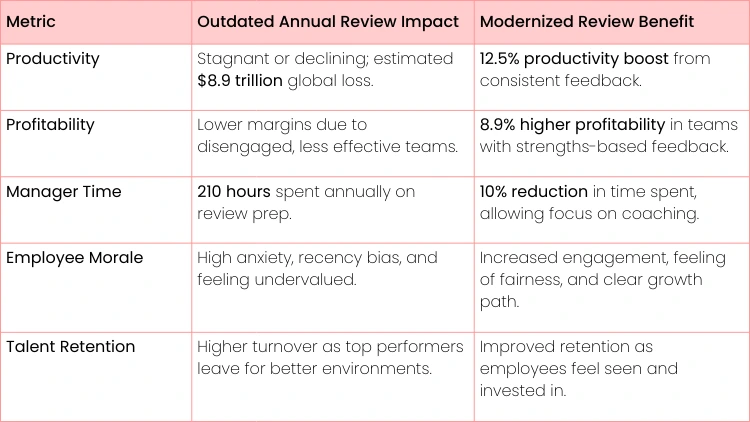
Just look at the numbers. Modernizing your review process has a direct, measurable impact on key business metrics.
The data makes it crystal clear. Shifting to a modern feedback culture doesn't just feel better—it boosts profitability and productivity while giving managers back their most valuable resource: time.
To really see the difference, it helps to compare the two approaches side-by-side. The contrast highlights not just the financial costs but the hidden cultural damage that outdated reviews can cause.
Outdated vs Modernized Performance Review Impact
The table below isn't just about numbers; it's about a fundamental shift in how a company values its people. Moving away from the outdated model is one of the most powerful levers you can pull for building a thriving workplace.
Reframing the Annual Review for Growth
A well-designed annual performance review template is your first step in fixing this broken cycle. Think of it less as a form and more as a strategic tool for connecting individual work to big-picture company goals. By structuring conversations around growth, achievements, and future goals, you can finally turn the review from a backward-looking judgment into a forward-looking dialogue.
- Actionable Insight: An effective review process should be a summary, not a surprise. It should feel like the final, positive chapter in a story that both the manager and employee have been writing together all year through regular check-ins.
This change in perspective is absolutely critical if you want to keep your top talent and build a culture of high performance. The ultimate goal is to create a system where feedback is just a normal, ongoing part of the job. You can dive deeper into creating this kind of environment by checking out this guide on performance management best practices.
Building Your High-Impact Review Template
Alright, let's get practical. Moving from theory to action means building a rock-solid document. A great annual review template is so much more than a checklist; it’s your roadmap for a real, meaningful conversation. The whole point is to build a tool that encourages dialogue, not just a one-way critique.
The first thing you absolutely need is an Employee Self-Assessment. This gives employees the space to reflect on their own performance—the wins, the struggles, and everything in between. It immediately sets a collaborative tone and gives you, the manager, a ton of insight before you even sit down together.
Don't just ask a generic question like, "What did you accomplish?" That gets you generic answers. You have to prompt for deeper reflection with something more specific.
- Practical Example: Instead of "How did you do last year?" ask, "Reflecting on the past year, which project are you most proud of and why? What specific challenges did you overcome, and what did that teach you about your own capabilities?"
See the difference? A question like this pushes the employee to connect their actions to actual results, giving you a much stronger foundation for the conversation.
Structuring for Goal Alignment and Growth
Next up, your template has to connect the dots between past performance and future ambitions. This section is the bridge between what someone has done and where they are going. Break it into two distinct parts: a look back at old goals and a plan for new ones.
When reviewing past goals, it’s all about the outcome, not just the busy work. Ditch the simple "complete" or "incomplete" checkboxes.
- Practical Example (Goal Review): "Let's revisit the goal to 'Increase customer retention by 5%.' The data shows we hit 7%. What specific actions did you take that contributed to exceeding this target? What obstacles did you encounter?"
For future goals, you need a clear, actionable plan. This is where SMART goals (Specific, Measurable, Achievable, Relevant, Time-bound) come into play. They turn fuzzy wishes into concrete objectives.
- Practical Example (Future Goal Setting): "For the next year, let's set a goal: 'Become proficient in using our new CRM software by Q3.' To achieve this, you will complete the advanced training module by the end of Q1 and successfully onboard two new client accounts using only the new CRM by the end of Q2."
Evaluating Competencies and Planning Development
A crucial part of any modern annual performance review template involves looking at core competencies. These are the skills and behaviors that define how someone works—things like communication, problem-solving, and teamwork. A rating scale (like 1-5) can give you a consistent benchmark, but it’s useless without the "why" behind the number.
If you're unsure how to define these standards, this guide on what is a competency framework is a great place to start.
The final, and arguably most important, piece of the puzzle is a forward-looking Professional Development Plan. This isn't just a manager's to-do list; it’s where you and your employee collaborate to turn feedback into a real strategy for growth.
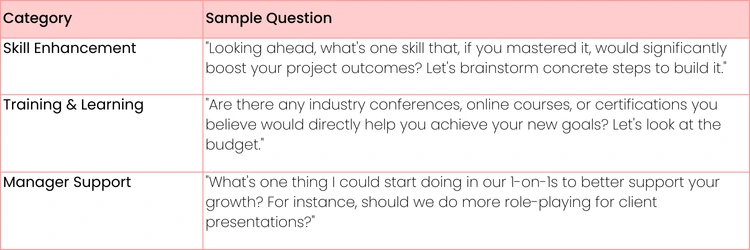
Practical Examples for a Development Plan
When you build a template with these five core sections—self-assessment, goal alignment, competency ratings, manager feedback, and a development plan—you create a genuinely powerful tool. It changes the annual review from a dreaded chore into an energizing conversation that fuels growth for both the employee and the entire organization.
How to Customize Your Template for Different Roles
Let's be honest, a one-size-fits-all annual review template is a waste of everyone's time. It completely misses the mark on what makes a software developer different from a marketing specialist, or a seasoned manager from a brand-new intern.
If you want the feedback to actually land and be useful, you have to tweak your template for the specific role and where that person is in their career.
This simple act of customization turns a boring, box-ticking exercise into a real conversation about focused growth. The secret is adjusting the competencies and goals to match what success actually looks like for each job.
- Actionable Insight: Don't just slap a new job title on the same old form. You need to rethink the core skills and key performance indicators (KPIs) for every role. A marketing manager's success might be measured by lead generation and campaign ROI, while a junior graphic designer's success is about skill acquisition and meeting creative brief requirements.
Tailoring for the Individual Contributor
For your individual contributors (ICs)—the developers, analysts, writers, and other hands-on pros—the review needs to zoom in on skill mastery, execution, and impact. It’s all about the quality and efficiency of their direct work.
So, instead of a vague goal like "be a team player", get specific. For a software developer, you'd want to look at their ability to write solid, scalable code.
Practical Example: Software Developer Competencies
- Code Quality: "Consistently writes well-documented, efficient, and testable code with a low defect rate."
- System Architecture: "Contributes to system design discussions, demonstrating an understanding of scalability and performance."
- Problem-Solving: "Effectively debugs complex issues and proposes robust, long-term solutions."
This kind of specific feedback grounds the conversation in tangible skills that are crucial for their career. It proves you get it—you understand and value their craft.
Customizing for the Manager
When you're reviewing a manager, the script flips. The focus shifts from what they do themselves to leadership, team development, and strategic impact. A manager's performance is ultimately measured by their team's success.
Your template absolutely must have sections that dig into how well they coach, empower, and guide their direct reports. While they can have their own individual goals, the real meat of the review is their leadership.
Practical Example: Manager Competencies
- Team Development: "Actively coaches team members, identifies skill gaps, and creates development plans that lead to promotions or expanded responsibilities." A great way to structure this is by running a skills gap analysis for their team.
- Resource Management: "Effectively allocates budget, headcount, and tools to meet team objectives without overspending."
- Strategic Alignment: "Clearly communicates company vision to the team and ensures their work directly supports broader organizational goals."
Adapting for the Intern or New Hire
For interns or anyone in their first 90 days, the review isn't really about past performance. It’s about learning, integration, and potential. You're looking for signs of skill acquisition and how well they're fitting into the company culture.
Keep the template simple. Focus on the fundamentals and the employee's ability to soak up information and apply what they're learning.
Practical Example: Intern Competencies
- Learning Agility: "Demonstrates a strong ability to learn new tools and processes quickly and actively seeks feedback to improve."
- Initiative: "Asks thoughtful questions and volunteers for tasks to gain more experience."
- Professionalism: "Consistently meets deadlines, communicates proactively, and adapts to workplace norms."
By taking the time to customize your annual performance review for each person, you make the feedback hit home. This targeted approach gives clearer guidance and shows you're genuinely invested in every person's unique career path.
A Guide to Conducting a Productive Review Meeting
Having a great annual performance review template is one thing, but it's the conversation itself that truly sparks change. Think of the document as your agenda; the real growth happens in the dialogue. This is the moment where managers and employees can look beyond the ratings on a page and build a genuine commitment to what’s next.
For any manager, the top priority should be creating a sense of psychological safety from the very first minute. This isn't a trial; it's a forward-looking conversation.
- Actionable Insight: A simple shift in tone can completely change the dynamic. Instead of diving into critiques, try opening with something that frames the meeting as a team effort: "I’m really looking forward to our chat today. I want to spend some time celebrating your wins from this past year, and then I'd love to partner with you on a plan for your growth in the year ahead."
Giving Concrete and Actionable Feedback
Let's be honest: vague feedback is useless. Phrases like "great job" or "needs improvement" are dead ends. They don't give anyone anything to work with. To provide feedback that actually helps, you need to get specific and behavioral, and the best way to do that is with the STAR method.
This framework forces you to tie your comments to real situations and business outcomes.
Here’s how STAR breaks it down:
- Situation: What was the context?
- Task: What was the person's specific responsibility?
- Action: What exact steps did they take?
- Result: What was the outcome of those actions?
Let’s put it into practice. Don't just say, "You need to be more proactive." That’s not helpful. Use the STAR method to paint a clear picture.
- Practical Example: "Remember during the Q3 product launch (Situation)? You were responsible for keeping the marketing team in the loop (Task). I noticed you went ahead and created a shared project tracker on your own and set up weekly check-ins to keep everyone aligned (Action). Because of that, we caught a potential messaging conflict before it became a problem and launched without a hitch (Result). That’s exactly the kind of proactive ownership I want to see more of."
This approach gives clear, actionable proof of what you're talking about, making it simple for the employee to understand and repeat the desired behavior. It’s a game-changer for tough conversations, too. For more on this, check out this guide on how to give constructive feedback.
Preparing as an Employee to Receive Feedback
A productive review is a two-way street. If you’re the employee, your prep is just as critical as your manager’s. Don’t just show up cold. You need to come ready to have a real conversation about your career.
Before you walk in, spend some quality time with your self-assessment. Seriously reflect on your biggest wins, the hurdles you faced, and where you see yourself going next.
- Actionable Insight: During the meeting, switch on your active listening skills. This isn't about waiting for your turn to talk; it's about fully absorbing what your manager is saying. A great way to do this is to paraphrase their points—"So, what I'm hearing is that I need to be more detailed in my client proposals. Is that right?"—and ask clarifying questions to get to the root of the feedback.
But the most crucial part? Don't leave without a plan. The meeting is a failure if it ends without clear next steps. Work with your manager to sketch out a development plan with specific goals, actions, and timelines. This is how you turn a one-hour conversation into real, measurable progress.

The Annual Review as a Capstone, Not a Surprise
An annual review should be a summary, not a surprise. If the only time an employee gets real, meaningful feedback is during that one year-end meeting, your performance management system is broken. A truly effective annual performance review template isn't about that one conversation; it's the final chapter of a story written over an entire year of ongoing dialogue.
This shift away from a single, dreaded meeting toward a continuous feedback culture isn't just about making people feel better. It directly hits the bottom line. The old way of doing things has led to a global employee engagement rate of just 21%, which adds up to a mind-boggling $8.9 trillion in lost productivity. But here's the flip side: companies that simply switch to weekly feedback can see engagement jump by 21%. That's not all—engaged teams are also 18% more productive and 23% more profitable. You can dig into more of these performance management trends and how they impact profitability.
The numbers don't lie. Frequent, consistent conversation is one of the most powerful tools you have to drive performance.
Building a Continuous Feedback Culture
You don't need to launch a massive, company-wide initiative to start building this culture. It really just comes down to forming small, intentional habits that make talking about performance a normal part of the workweek. The idea is to get a steady stream of information flowing between managers and their direct reports.
Here are a few practical examples to implement immediately:
- Structured 1-on-1s: Set aside time every week or two to talk about more than just project updates. A great agenda includes three simple questions: "What was a win for you this week?", "Where did you get stuck?", and "What are your priorities for next week?"
- Peer Recognition: This can be as simple as a dedicated Slack channel (#kudos or #wins) or a 5-minute segment in a team meeting for shout-outs. When employees are recognized publicly for their work, they are 3.6 times more likely to be engaged.
- Project Retrospectives: After a project wraps, hold a 30-minute meeting to discuss what went well, what was a mess, and what you’ll do differently next time. This turns every project into a learning opportunity for the whole group.
Actionable Insight: A go-to trick is to keep a simple shared document (like a Google Doc or a note in your project management tool) for each employee. Use it to log wins, challenges, and key takeaways from your 1-on-1s. It becomes a living log that makes filling out the annual review a breeze, because all the evidence is right there.
Connecting Check-Ins to the Annual Review
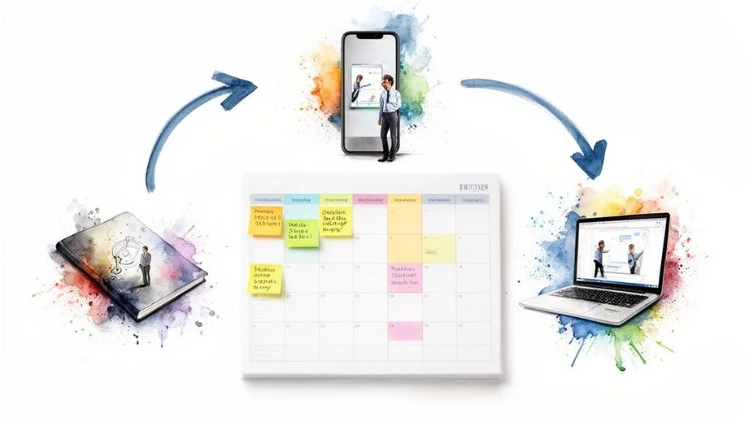
This is where the magic really happens. When you link these regular check-ins to your formal review process, the annual performance review template transforms from a static form into a living document.
Think about it: throughout the year, both you and your employee can be dropping notes and specific examples directly into the template. When a coworker praises someone's collaborative spirit in the team channel, copy and paste that into the "Teamwork" section of their review. When an employee shares a big win during a 1-on-1, they can add it to their "Key Accomplishments" section right then and there.
By the time the annual review rolls around, most of the work is already done. The conversation is no longer about trying to remember what happened six months ago. Instead, it becomes a high-level, strategic discussion about performance trends, personal growth, and goals for the year ahead. This changes the entire dynamic, turning what used to be a stressful judgment day into a productive and genuinely empowering capstone to a year's worth of partnership.
Download Your Free Annual Performance Review Templates
All this theory is great, but it's time to put it into practice. We’ve gone ahead and created three distinct annual performance review template files for you to grab. No need to build anything from scratch—just download the one that fits your needs and start having better conversations.
Each template is available in both Google Docs and Microsoft Word, so you can easily edit and share them with your team. We’ve packed them with the best practices we've been talking about, focusing on clear communication and real growth. These aren't just generic forms; they're tools we've seen work time and again to make reviews less of a chore and more of a genuine opportunity.
Choose Your Template
You’ll find three options, each designed for a different situation.
- The Comprehensive Template: Think of this as your go-to for a classic, in-depth corporate review. It’s got everything: goal alignment, detailed competency ratings, and a structured development plan. This is the one you want for formal, structured evaluations where detail is key.
- The Streamlined Template: Perfect for smaller businesses or teams that move fast. This version cuts straight to the chase, focusing on major wins and what’s next. If you need a quick, high-impact review without the fluff, start here.
- The Skills-Focused Template: This one is all about personal and professional development. It’s built for roles where mastering new skills is the name of the game, with a heavy emphasis on tracking competency growth and setting tangible learning goals.
A Few Common Questions About Performance Reviews
Even with the best template in hand, you're bound to run into a few questions. Let's tackle some of the most common ones we hear from managers and employees so you can handle the review process like a seasoned pro.
How Often Should Performance Reviews Happen?
Don't let the name fool you. Calling it an "annual" review and only talking about performance once a year is a recipe for disaster. That big formal meeting should be a summary of ongoing conversations, not a laundry list of surprises.
- Actionable Insight: Real, effective performance management is all about continuous, informal feedback. A practical way to start is by implementing bi-weekly 1-on-1s. Use a shared agenda where both you and the employee can add topics. This makes feedback normal and helpful, not something to be feared. The annual review then becomes a productive, forward-looking conversation.
What Should I Do If I Disagree with My Review?
It's tough to hear feedback you don't agree with. But how you react in that moment is what really matters. The aim isn't to start an argument, but to open up a constructive conversation. Your first job is to just listen and stop yourself from having an immediate emotional reaction.
Take some time to cool off and process everything after the meeting. Then, here's what you do:
- Bring the receipts: Gather specific, concrete examples that back up your perspective. Think project data, customer emails, or completed work that tells your side of the story.
- Ask for a follow-up: Request a short, separate meeting to discuss your points. You can frame it as wanting to make sure you're both on the same page for your future growth.
- Keep it professional: This isn't about proving them wrong. Focus the conversation on what you can do differently moving forward and finding a path to success together.
Can This Template Work for Remote Teams?
Yes, absolutely. In fact, a structured annual performance review template is even more critical for remote teams. When you don't have those casual, spontaneous office interactions, you need a more deliberate way to connect and give feedback.
- Actionable Insight: With remote reviews, you have to over-communicate. You can’t read body language over an email, so your written feedback needs to be incredibly clear and specific. A great practical tip is to always follow up a written review with a video call. This adds a crucial personal touch and allows for a real, two-way dialogue to clear up any misinterpretations.
If you're looking for more ideas or different formats to get you started, you might find some good inspiration in these 12 Best Performance Review Templates for Managers.
Ready to build a culture where feedback fuels growth and success? At Uplyrn, we give your team the tools to master essential skills like communication, leadership, and goal setting through expert-led mentoring and courses. Explore our courses and start developing your team today.


Leave your thoughts here...
All Comments
Reply