









How to Forgive Yourself and Actually Move On

Learning how to forgive yourself usually comes down to three things: Acknowledge what happened without beating yourself up, Accept that messing up is part of being human, and Act with intention to learn from it all. It’s a simple framework that can turn regret from an anchor into a launchpad.
Jump To Section

Earn As You Learn
Earn 25% commission when your network purchase Uplyrn courses or subscribe to our annual membership. It’s the best thing ever. Next to learning,
of course.
Why You Can't Afford to Skip Self-Forgiveness
We've all been there—stuck replaying a mistake on a loop, letting that inner critic poison our next move. This emotional weight doesn't just feel bad; it actively sabotages your growth and holds you back from taking that next big step, whether it’s in your career or your personal life.
It’s time to start seeing self-forgiveness as a core skill for resilience. It's not about letting yourself off the hook. It’s about taking responsibility for your own healing so you can actually move forward. For example, instead of endlessly thinking, "I can't believe I lost my temper in that meeting", self-forgiveness shifts the focus to, "What can I do now to repair the relationship and manage my stress better next time?"
The Real Cost of Holding On
Trying to move forward while clinging to self-blame is like driving with the emergency brake on. You might inch along, but you’re burning a ton of energy and causing unnecessary strain.
- Stagnated Growth: When you're consumed by a past error, you're far less likely to take smart risks, pitch new ideas, or step up. You might turn down a leadership opportunity because you still feel guilty about a past project's failure.
- Damaged Relationships: Persistent guilt can make you withdraw or project your insecurities onto others, straining both personal and professional bonds. For instance, you might snap at a colleague who asks a simple question because you're internally berating yourself for an earlier mistake.
- Mental Health Impact: Unresolved self-blame is a well-known contributor to anxiety and depression, draining the mental fuel you need to perform at your best.
Think about a project manager who can't stop replaying a missed deadline. They might become overly cautious, start micromanaging their team, and completely stifle creativity—all because they haven't forgiven their past self. The path to healing and forgiveness is about breaking these kinds of cycles.
Forgiveness as a Universal Skill
This isn't just a personal feeling; it’s a global pattern. The Global Flourishing Study, which surveyed nearly 200,000 adults across 22 countries, found that around 75% often or always forgive others. This suggests a powerful link between forgiveness and overall well-being.
Self-forgiveness isn’t about erasing the past; it’s about refusing to let the past erase your future. It's an active choice to learn and move forward with wisdom.
This process is what empowers you to turn missteps into lessons. By understanding the power of forgiveness, healing, and growth, you build the resilience to face future challenges with confidence instead of fear.
To get a clearer picture of what this looks like, let's break down the three core actions into a simple framework.
The 3 A's Framework for Self-Forgiveness
This framework isn't a one-and-done fix, but it's a reliable map to guide you through the process whenever you feel stuck.
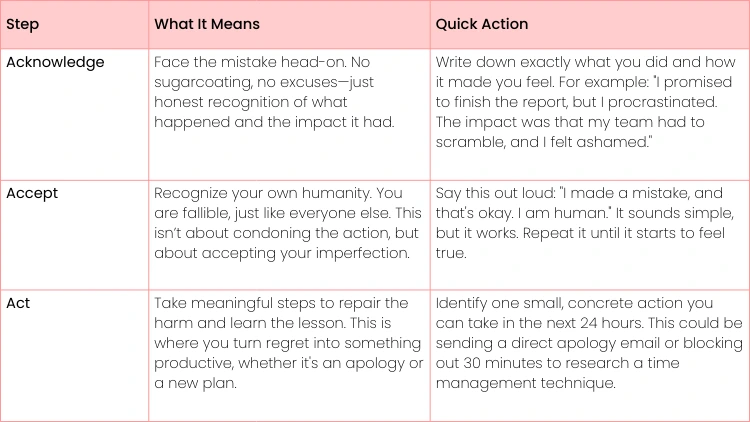
Acknowledge Your Actions Without Shame
Alright, let's get into the first, and honestly, the toughest part of this whole process: looking at what happened with unflinching honesty. This isn't about dragging yourself through the mud or wallowing in self-blame. It’s about clearly seeing your actions for what they were, without the sugar-coating, the excuses, or the harsh judgment.
Think of it as the foundation. Without this solid base of real acknowledgment, any forgiveness you build on top will be shaky at best.
To do this right, we need to draw a hard line between two powerful emotions that often get tangled up: guilt and shame.
Guilt is behavior-focused. It’s that internal nudge that says, "Hey, what I did there was not okay." Shame, on the other hand, is a toxic internalization of the mistake. It's the voice that whispers, "You are fundamentally bad."
Guilt says, "I did something bad." Shame says, "I am bad."
The key to self-forgiveness is learning to sit with the discomfort of guilt without letting it fester into shame. Guilt can actually be useful—it's a powerful motivator for change. Shame just keeps you stuck, spinning in a painful loop of self-criticism. Before you can really move forward, it's critical to first pause to understand your reactions to what happened.
Separate the Action from Your Identity
One of the most powerful things you can do here is to create some distance. Start by thinking of yourself as a neutral third party, like a journalist just documenting the facts of the event, no emotional commentary allowed. This little bit of mental space is what allows you to look at the situation objectively.
Let's look at a couple of real-world scenarios:
- The Project Manager: A manager pushes her team to the brink to meet an unrealistic deadline she set. The shame narrative is, "I'm a terrible leader." A factual, guilt-based acknowledgment sounds like this: "I mismanaged expectations and failed to protect my team from burnout." See the difference? It focuses on the action, not her entire identity.
- The Developer: A developer accidentally ships buggy code that takes down a system for an hour. He immediately thinks, "I'm a fraud; I can't do this job." A factual acknowledgment is, "I missed a critical bug during testing, which caused a production issue." This reframes the event as a specific, correctable mistake, not a personal failing.
Ready to try this for yourself? Grab a notebook and let's do a quick journaling exercise.
- Just the Facts: Write down what happened as if you were reporting on it for a newspaper. Who was there? What was done or said? What was the outcome? Crucially, avoid emotional language. No "I stupidly..." or "I selfishly..." For example: "During the 3 PM team meeting, I interrupted a colleague twice while they were presenting."
- Your Role: Get specific. What exact actions did you take, or fail to take, that played a part in this? Example: "My actions were speaking out of turn and not waiting for them to finish their point."
- The Impact: What were the direct consequences of your actions, both for you and for anyone else involved? Example: "The impact was that my colleague lost their train of thought, and the meeting's flow was disrupted. I felt embarrassed afterward."
This isn't an exercise in self-flagellation. The whole point is to create a clear, factual record. It helps you see the mistake for what it is: a single event in your life, not the defining story of who you are.

Embrace Imperfection Through Self-Compassion
Okay, so you've taken that hard first look and owned what happened. The next move is crucial: meeting that mistake with kindness instead of beating yourself up. This is where self-compassion comes in, and it's a total game-changer. Think of it as treating yourself the way you’d treat a good friend who messed up. It’s about silencing that harsh inner critic for a minute and offering yourself some genuine care.
Let's be clear: self-compassion isn't about letting yourself off the hook. It’s about creating an internal space that’s safe enough to actually learn and grow from the experience. To get a better handle on this, it's worth exploring what self-compassion truly means.
This whole practice is built on three core ideas that, when put together, can really shift your perspective.
The Three Pillars of Self-Compassion
- Self-Kindness vs. Self-Judgment: This is an active choice. Instead of layering on the criticism, you consciously choose to be gentle and understanding.
- Actionable Insight: When you catch yourself thinking, "That was so stupid," pause and rephrase it: "That was a difficult moment, and I did the best I could with what I knew then."
- Common Humanity vs. Isolation: This is a big one. You have to remember that messing up is part of the human experience. Seriously, everyone fails. You are not some uniquely flawed person who is alone in their imperfection.
- Practical Example: Think of a mentor or public figure you admire. Search for an interview where they discuss their own failures. This normalizes mistakes as part of a successful journey.
- Mindfulness vs. Over-Identification: This means looking at your negative feelings and thoughts without getting totally swept away by them. It's about finding a balance—acknowledging the pain without letting it become your entire identity.
- Actionable Insight: Try a "name it to tame it" exercise. When a wave of shame hits, say to yourself, "This is shame. It is a feeling. It will pass." This separates you from the emotion.
Let’s make this real. Imagine an entrepreneur who burns through their seed funding and feels like a total disaster. Their immediate, shame-filled thought is, "I'm a failure. I've ruined everything."
A self-compassionate response flips that script: "Wow, this is painful. But a lot of new business owners hit bumps like this. I'm disappointed, for sure, but this single mistake doesn't define my worth or my potential."
See the difference? That shift isn’t just feel-good fluff; it has real, measurable benefits. A 2020 study looking at over 54,000 nurses discovered that self-forgiveness was responsible for 20% of the variance in their psychological health. That translated to better sleep and lower rates of depression. You can read the full research about these well-being findings if you want to see the data for yourself.
To put this into practice, think about someone you respect in your field. They have a list of mistakes they made on their way to success. This simple mental exercise is a powerful reminder that imperfection is just part of the journey. To really build on this, it helps to pause to know you are enough and untangle your actions from your inherent value as a person.

Create Your Personal Plan for Repair and Growth
Feeling sorry is one thing, but true self-forgiveness isn't just a feeling—it’s an action. This is the part where you roll up your sleeves and turn what you’ve learned into a real plan. It's how you make amends where you can and, just as importantly, make sure you don't repeat the same mistake.
Think of it as transforming the raw material of a past screw-up into fuel for your future.
We're going to build a "growth plan". Don't think of this as punishment. It’s a proactive strategy for becoming a slightly better, wiser version of yourself. This is how you prove to yourself that you're taking this seriously.
Let's say you made a bad financial decision that hurt your family. Your plan isn't just about saying "I'm sorry" over and over. It's about taking real steps, like sitting down with your partner to create a budget or even enrolling in a financial literacy course. That's the leap from regret to genuine repair.
Building Your Actionable Growth Plan
Your plan needs to have two distinct parts: repair and growth. Repair is all about addressing the external harm you may have caused. Growth is about the internal changes you need to make so it doesn't happen again.
Here are a couple of prompts to get the wheels turning:
- For Repair: Who do I owe a conversation to? What, exactly, do I need to say? Often, the most powerful thing you can do is offer a simple, sincere apology without any excuses attached.
- Actionable Step: Write out a script. For example: "Hi [Name], I want to apologize for [specific action]. I understand it caused [specific impact], and I am truly sorry." Practicing it helps remove the emotion and deliver it clearly.
- For Growth: What's one skill I could learn that would have made a difference? Maybe it’s about communicating more clearly, managing your time better, or just getting a handle on your emotional reactions.
- Actionable Step: If you snapped at someone due to stress, your growth action might be to download a 5-minute meditation app and use it before high-stakes meetings.
And this isn't just feel-good advice. A 2021 trial showed that people who followed structured forgiveness programs saw significant drops in both depression and anxiety. Having a clear process flat-out works.
A genuine plan for change is the most powerful apology you can offer yourself. It proves that you're not just sorry for what happened; you're committed to ensuring it doesn't happen again.
By mapping out your next steps, you're not just crossing your fingers and hoping for change—you're actively building it. This kind of intentionality is a cornerstone of any effective personal development plan and will be your guide as you move forward.

Navigating Setbacks on Your Forgiveness Journey
Learning to forgive yourself is almost never a straight line. It's really more of a practice, and just like any other skill you're building, it’s going to have its ups and downs. You might feel great for a week—compassionate, clear-headed, and focused on the future—only to wake up one morning with a tidal wave of guilt or shame washing over you.
If this happens, please know: this is completely normal. These moments aren't signs of failure. They’re just part of the messy, human process of healing. The goal isn’t to dodge these setbacks but to know what to do when they show up.
When Old Feelings Resurface
One of the most common bumps in the road is the sudden return of self-blame. It can be triggered by almost anything—a song on the radio, a conversation, or even just a quiet moment alone with your thoughts. When that old script starts playing, it's so easy to think, "See? I knew it. I'm not really over this. I don't deserve to move on."
But instead of letting that thought pull you under, try to see it as a signal—a check-in alert from your mind.
- Acknowledge the feeling, but don't fuse with it. You can simply say to yourself, “I’m noticing that old feeling of guilt is here again.” Just naming it helps create a little space and takes away some of its power.
- Go back to your plan. Pull out your journal or whatever you used to map out your repair plan. Remind yourself of the concrete steps you've taken and the very real progress you've made. For instance, read the apology you sent or look at the certificate from the course you took.
This isn’t about shoving the feelings down. It's about meeting them with the new tools and perspectives you’ve been working so hard to build.
The goal isn’t to never feel bad again. It’s to shorten the time you spend stuck in that feeling and to respond with compassion instead of criticism.
The "Worthy of Forgiveness" Trap
Another huge hurdle is that deep, nagging belief that you're somehow the exception to the rule—that everyone else messes up, but your mistake makes you fundamentally unworthy of forgiveness. This single thought can bring your progress to a screeching halt.
When you feel this way, here's a powerful and practical exercise you can try right now.
The Compassionate Friend Technique:
- Imagine a dear friend comes to you. They tell you they did the exact same thing you did and are drowning in the same feelings of self-blame. For example, they forgot a crucial family birthday.
- What would you tell them? How would you comfort them? Write down your genuine advice and words of support. You might write: "You made a mistake, but it doesn't mean you're a bad person. You can apologize and find a way to make it up to them. Be kind to yourself."
- Now, read that advice back to yourself, out loud if you can. This is the compassion you also deserve.
This simple shift in perspective is incredibly effective because it bypasses your inner critic. It helps you remember to offer yourself the same grace you'd so readily give to someone you love, keeping you on the path toward healing.
Still Have Questions About Self-Forgiveness?
As you start working on forgiving yourself, it's totally normal for a few questions and tricky situations to pop up. Let's walk through some of the most common ones I hear from people navigating this path.
How Long Does It Take to Forgive Yourself?
There’s no magic number here. Forgiveness is a deeply personal journey; a small slip-up might feel resolved in a few days, while a deeper wound could take months or even years to fully heal.
The real goal isn't speed—it's consistency. Focus on making small, compassionate steps forward each day instead of pushing for a huge, overnight breakthrough. Remember, healing isn't a straight line. Some days will be better than others, so just be patient with yourself through the whole process.
Practical Tip: Track your progress not by how you feel, but by the actions you take from your growth plan. Did you practice your new skill today? That's a win.
Can I Forgive Myself If Someone Else Hasn't Forgiven Me?
Yes, absolutely. Self-forgiveness is about mending the relationship you have with yourself, and that is 100% within your control. Whether or not someone else forgives you is part of their own story and their own timing.
While making genuine amends is a crucial part of your own healing, putting your self-forgiveness on hold until you get it from someone else gives away your power. Your healing can and should start on your own terms.
- Practical Example: You might have apologized to a friend who is still not ready to reconnect. Your self-forgiveness means accepting you did what you could to repair the situation and now focusing on learning from it, rather than waiting for their validation to feel okay.
Forgiveness isn't about pretending what you did was okay. It’s about accepting that it happened and choosing to free yourself from the painful cycle of self-punishment so you can actually move forward and grow.
Excusing your behavior is one thing; that sidesteps responsibility. True self-forgiveness, on the other hand, demands that you take full ownership first. Only then can you compassionately let it go.
When Should I Seek Professional Help?
If you feel like you're stuck in a loop of self-blame and it's starting to take a toll on your daily life—messing with your work, your sleep, or your relationships—that's a clear sign it's time to reach out for professional support.
A therapist can offer a safe space and structured tools to help you work through the deeper issues that are holding you back. For those looking into various options, there are also effective alternatives to therapy for depression and anxiety that can be a great support on your mental health journey.
- Actionable Step: If you're hesitant, commit to one "discovery call" with a potential therapist this week. Many offer free initial consultations. It's a low-risk way to explore if it's the right fit for you.
Ready to turn your personal growth into a structured plan? At Uplyrn, we provide courses and expert guidance to help you build the skills for a more resilient future. Explore our offerings and start your journey today.


Leave your thoughts here...
All Comments
Reply