








How to Future Proof Your Career in a Changing World

Think of "future-proofing your career" as more than just a buzzword. It's an active strategy. It's about building a versatile set of skills that keep you valuable, no matter how your industry twists and turns. This isn't a one-and-done task; it's a commitment to continuous learning and adaptability, making sure you’re not just surviving, but actually thriving through big technological and economic shifts.
Jump To Section

Earn As You Learn
Earn 25% commission when your network purchase Uplyrn courses or subscribe to our annual membership. It’s the best thing ever. Next to learning,
of course.
Why You Can't Afford to Ignore Future-Proofing
Let’s be honest, the old idea of a stable, lifelong job is pretty much gone. We're all working in an environment of constant change, fueled by lightning-fast AI advancements, unpredictable global economies, and business models that can upend an entire industry overnight. Proactively managing your career isn't just a good idea anymore—it’s a basic requirement for staying in the game.
But this isn't about panicking. It's about taking control. Future-proofing is a totally manageable process of building skills that ensure you’re always in demand. It’s about making adaptability your single greatest professional asset.
The Hard Numbers on Job Market Disruption
The data tells a clear story. The World Economic Forum's Future of Jobs Report is pretty direct, predicting that technological shifts will shake up 22% of all roles by 2030. This massive churn means 92 million jobs might disappear, but it will also create 170 million new ones. The takeaway? Adaptability is far more important than any job title you hold today.
This transformation means we all have to evolve. Think about a marketing manager whose key tasks, like analyzing campaigns or creating content, are increasingly handled by AI. They have a choice: learn to use these powerful new tools to focus on higher-level strategy, or risk their role becoming obsolete.
- An actionable insight here is to start experimenting with AI tools like ChatGPT or Jasper.ai for content ideation, not to replace your creativity, but to speed up your workflow and free up time for strategic planning.
The real challenge is this: employers expect that nearly 40% of the core skills needed for any given job are going to change. This is creating a massive skills gap, but for you, that gap is a golden opportunity.
It's No Longer About Your Role, It's About Your Skills
In this new reality, your value isn't tied to your job title; it's tied to your unique collection of skills. This requires a completely different way of thinking. Instead of "I am an accountant", start thinking "I have deep skills in financial analysis, data visualization, and strategic forecasting".
This small shift in perspective opens up a world of possibilities. When you focus on your skills, you can:
- Jump into new industries by spotting which of your abilities are transferable.
- Step into emerging roles that didn't even exist a few years back.
- Create unique value by blending skills from completely different fields.
Getting a handle on this skills gap is the first real step toward building a career that can withstand anything. The next sections will give you a practical roadmap for spotting risks, identifying the skills of the future, and creating a personalized plan to keep growing.

Identifying the Skills That Actually Matter
If you want to build a career that lasts, you can't just guess what skills will be valuable. You need a clear map of the professional landscape, one that helps you separate the fleeting buzzwords from the foundational, in-demand abilities that companies will be hiring for years from now.
This isn't about chasing every new piece of tech. The most resilient professionals are the ones who build a hybrid skill set. They masterfully blend timeless "human" strengths with high-growth technical know-how. Think of it as becoming a "T-shaped" professional: you have deep expertise in one core area, but you also have a broad understanding of how other pieces fit together.
How to Conduct a Personal Skills Audit
A personal skills audit is your starting point. It's a straightforward but incredibly powerful way to see where you stand now versus where the market is headed.
Here’s a practical, step-by-step way to do it:
- Map out your current skills. Grab a notebook or open a doc and create two columns. In one, list your "hard skills" (like Python, financial modeling, or Google Analytics). In the other, list your "soft skills" (like negotiation, team leadership, or public speaking).
- Actionable insight: Ask a trusted colleague or manager to review your list. They might spot strengths you’ve overlooked.
- Look into the future. Head over to LinkedIn or your favorite job board and search for roles you’d love to have in three to five years. Don't get hung up on the exact titles; instead, dive deep into the "Requirements" and "Qualifications" sections. Copy and paste the top 5 recurring skills into a separate list.
- Find your growth opportunities. Now, compare the two lists. What skills keep popping up in those job descriptions that aren't on your list? That's it. That’s your learning roadmap. For a more detailed breakdown, you can check out this guide on how to identify skill gaps.
Here's a real-world example: A project manager noticed that senior PM roles at her target companies all required experience with data visualization tools like Tableau. She was an expert at managing budgets and timelines, but this was a gap. She immediately added "Learn Tableau basics" to her development plan. That one small addition didn't just add a new skill; it amplified her existing expertise, making her a much stronger candidate for leadership.
As you build this list, remember that improving verbal communication skills is a universal career accelerator. Being able to articulate your ideas clearly and persuasively ensures that all your other hard-earned skills get the attention and credit they deserve.
The Hybrid Skills Advantage
Today's workplace isn't just looking for a coder, and it's not just looking for a great communicator. It’s looking for the coder who can walk non-technical stakeholders through a complex solution and get them excited about it. That blend is where your real, defensible value is.
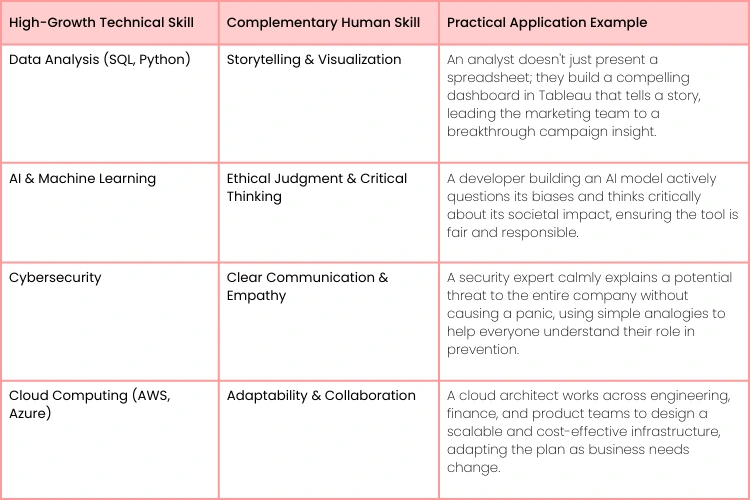
By 2026, technical skills like AI, data analytics, and cybersecurity will undoubtedly be at the top of every company's wish list. But here's the kicker: they'll be most powerful when paired with uniquely human skills like critical thinking, creative problem-solving, and emotional intelligence. In fact, 60% of employers say they value these human skills more now than they did just five years ago.
This hybrid approach is your best defense against automation. As machines take over routine, repetitive work, the truly valuable people will be those who can provide the high-level insight, strategy, and collaboration that algorithms can't.
Below is a quick look at how these skills pair up in the real world.
Hybrid Skills for the Modern Professional
This combination is what separates a good technician from a true strategic partner.
Building Your Personal Learning Plan
Knowing which skills you need is a huge step, but it’s really only half the battle. The real work begins when you have to build a structured, sustainable plan to actually learn them.
A vague goal like "I should probably learn more about AI" is pretty much doomed from the start. To get anywhere, you need to turn that fuzzy ambition into a concrete roadmap that fits into your actual life.
This is where a framework like SMART goals becomes so valuable. It forces you to get specific about your objectives, making them Specific, Measurable, Achievable, Relevant, and Time-bound. This simple discipline can turn a wish into a real project with a clear finish line.
From Ambition to Action with SMART Goals
Let's make this real. Imagine a graphic designer who sees the writing on the wall and wants to pivot into the more future-proof field of User Experience (UX) design. Instead of just "learning UX", they can set a much more powerful SMART goal:
- Specific: "I will complete a certified UX design course and build two full portfolio projects—a mobile app and a responsive website—that show off my research, wireframing, and prototyping skills."
- Measurable: Progress is easy to track: course completion and two finished projects. Done.
- Achievable: It’s a challenge, for sure, but totally realistic for someone who already has a design background.
- Relevant: This directly builds the exact skills and portfolio pieces needed to land a junior UX role.
- Time-bound: "I will get this done within the next six months."
Suddenly, that big, scary goal feels real and manageable. It’s a clear target to aim for. You can kickstart your own journey by mapping out your objectives in a personal development plan.
But before you even set those goals, you need to narrow your focus. The trick is to first audit what you can already do, identify the skills that are actually in demand, and then prioritize what makes the most sense to learn next.
Creating a Blended Learning Approach
Your plan shouldn't just be "take a course". The most effective learning happens when you mix different methods to absorb and, more importantly, apply new knowledge. A blended approach makes sure what you learn actually sticks.
The goal isn’t just to consume information; it's to build demonstrable competence. Real skill development happens at the intersection of learning, doing, and getting feedback.
A solid blended plan might look something like this:
- Formal Education: Kick things off with a structured online course on a platform like Uplyrn to get your foundational knowledge down. This gives you a curriculum and a clear path to follow.
- Hands-On Projects: Immediately put what you’re learning into practice. Build a small app, analyze a real dataset, or create a mock marketing campaign.
- Practical example: If you're learning Python for data analysis, don't just do the course exercises. Find a public dataset on a topic you love (like sports statistics or movie ratings) and create your own mini-analysis project. This is where head-knowledge turns into an actual skill.
- Mentorship and Feedback: Find a mentor or join a peer group to get eyes on your work. That feedback loop is absolutely essential for catching mistakes early and speeding up your growth.
By combining these elements, you create a powerful learning cycle. You learn the theory, you apply it in the real world, and you get expert guidance to refine your approach. This is how you build skills that aren't just certified, but proven.
Crafting a Personal Brand That Gets Noticed
Look, having the right skills is fantastic, but it’s only half the battle in building a career that lasts. If nobody knows what you can do, your growth is going to hit a ceiling. Fast. This is exactly where your personal brand comes into play—it's how you broadcast your unique value and expertise to the world. It ensures you're not just skilled, but also visible.
A strong personal brand is like a magnet for opportunities, pulling them toward you so you're not constantly chasing the next thing. It’s your professional story, told consistently across every platform you use.
Think about a software developer you admire. They don't just write code, right? They probably contribute to open-source projects, write a blog breaking down tough concepts, or share what they're learning on LinkedIn. They’ve gone from being just an employee to a recognized voice in their field. That's branding in action.
Optimize Your Digital Footprint
Let's be real: your online presence is your new first impression. It's what recruiters, potential clients, and future collaborators see long before they ever speak to you. It needs to scream competence and a forward-thinking attitude.
Start with a quick audit of your professional profiles.
- Rethink Your LinkedIn: Your LinkedIn profile is so much more than a digital resume; it's a living, breathing portfolio. Stop just listing your job duties. Use your headline to declare your value—something like, "Data Analyst Specializing in Consumer Behavior Insights". Use the "About" section to tell the story of your professional journey and, crucially, highlight the new skills you're picking up.
- Show, Don't Just Tell: Build a simple digital portfolio or a personal website. This is a no-brainer for a graphic designer, but it’s just as powerful for a project manager. You could showcase successful project case studies, complete with the results you delivered and a few testimonials.
- Actionable insight: Create a simple one-page case study for your top three projects. For each, use the STAR method (Situation, Task, Action, Result) to clearly articulate your contribution and the measurable outcome. This is tangible proof of what you're capable of.
Your personal brand is what people say about you when you're not in the room. A curated digital presence ensures you're shaping that conversation, highlighting your commitment to growth and expertise.
Engage Authentically and Add Value
Building a brand isn’t about shouting into the void about how great you are. It’s about contribution.
Find the online communities where people in your industry hang out—whether it's a niche subreddit, a professional Slack group, or industry forums—and just start participating. Answer questions. Share helpful resources. Offer your unique take on emerging trends.
- A practical example: Set a goal to spend 15 minutes, three times a week, on LinkedIn. Don’t just scroll. Leave a thoughtful comment on a post from an industry leader, share an interesting article with your own one-sentence takeaway, or answer a question in a relevant group. This kind of genuine engagement positions you as a helpful expert, not just another person looking for a job. To really make your mark, you have to understand how to build a personal brand from the ground up by clearly defining what makes you valuable.
This simple shift turns networking from a chore into a natural extension of your professional growth. If you want to dive deeper, this detailed guide on how to build a personal brand is the perfect place to start.
Growing Your Network of Mentors and Allies
Let's be honest: you can't future-proof your career all by yourself. A strong professional network is your safety net, your sounding board for candid advice, and your ticket to opportunities that never even make it to job boards.
Building this network is about more than just collecting contacts on LinkedIn. It’s about cultivating real, genuine relationships with mentors, peers, and allies who are invested in your long-term success.
Think about it. A mid-level finance professional gunning for a leadership role could spend years trying to map out the path alone. Or, they could find a mentor who’s already walked that path, build a peer group of ambitious colleagues for accountability, and get there ten times faster. A solid network gives you the real-world perspectives you need to navigate big career moves with confidence.
Finding and Engaging Mentors
A good mentor is so much more than a sounding board. They're a guide who can offer specific advice based on their own hard-won experience. But let’s face it, finding the right one can feel pretty intimidating.
Start by looking for professionals who are just one or two steps ahead of you in a role you admire. You don't need the CEO of a Fortune 500 company; you need someone who can give you practical, relevant advice for your next move.
- Make a specific ask. Ditch the vague "will you be my mentor?" request. Try something more focused: "I've been following your work on [Project X] and was really impressed. Would you be open to a 20-minute virtual coffee? I'd love to ask a few questions about your transition from analyst to manager."
- Always come prepared. Their time is valuable, so respect it. Have a few thoughtful questions ready to go. Ask about the biggest challenges they faced, the skills they had to learn on the fly, and the one piece of advice they wish someone had given them sooner.
For a deeper dive into making that first move, check out this guide on how to ask someone to be your mentor.
Mentorship is a two-way street. The best relationships are built on mutual respect and value. Always look for ways to help your mentor in return, whether it's sharing a relevant article or offering a fresh perspective on a problem they're facing.
The Power of Peer Groups and Allies
While mentors offer guidance from above, your peer group provides crucial support from the side. These are your allies—a small, trusted circle of colleagues who hold you accountable, cheer on your wins, and help you workshop new ideas.
This kind of support system is more critical than ever as work continues to shift. With the rise of remote work, "remote readiness" has become an essential skill, and strong professional connections are what keep you from feeling isolated and out of the loop.
Just look at the numbers. With over 380,000 annual vacancies in roles like customer service due to churn, the ability to build and maintain relationships digitally is a massive advantage. This proves the need for hybrid skills that blend technical know-how with genuine human connection, a trend you can discover more insights here.
- Actionable insight: You can form your own "mastermind" group with a few peers from your industry. Send an email to 3-4 trusted colleagues and propose a recurring monthly call to talk through challenges, share resources, and set goals. This built-in accountability is incredibly powerful for keeping your career development on track.

Making Lifelong Learning a Sustainable Habit
Future-proofing your career isn’t some project with a start and end date. It's a mindset. It’s a habit. The real goal is to weave learning so deeply into your professional life that it stops feeling like a chore and starts feeling like second nature. This is how you build a real, sustainable cycle of growth.
The good news? This doesn’t mean you have to lock yourself away to study for hours every night. It’s all about small, consistent actions, not massive, unsustainable bursts of effort. You just need to find the pockets of time that already exist in your day.
Weave Learning into Your Daily Routine
The trick is to make skill development a practice you can actually stick with.
- A practical example: Block off a recurring weekly 'power hour' in your calendar—just one, single, focused hour dedicated to nothing but learning. Maybe it’s 8 AM on a Friday you set aside for a new module on Uplyrn, or a Monday lunch break you use to catch up on industry analysis. Treat it like any other important meeting.
Here are a few other actionable insights to get this going:
- Turn your commute into a classroom. Instead of music, pop on an industry podcast or an audiobook. That 30-minute drive or train ride can easily become a valuable lesson on AI trends or new leadership strategies.
- Embrace the five-hour rule. Made famous by leaders like Bill Gates, the idea is simple: dedicate five hours a week (or one hour each workday) to deliberate learning. It’s a tiny investment that pays off big time in the long run.
- Think in micro-moments. Use those short breaks between meetings. Spend 15 minutes watching a quick tutorial on a new software feature or reading a summary of a relevant business book. It all adds up.
The most resilient professionals don't just learn when they're forced to. They build a system that makes learning an automatic, even enjoyable, part of their career journey.
From One-Time Plan to Continuous Action
This is the habit that ties everything else together—from spotting market shifts and picking up new skills to building your brand and growing your network. It turns a linear, step-by-step process into a constantly repeating loop.
Every new skill you learn introduces you to new people. Those new connections, in turn, clue you into new industry trends you need to watch. By committing to this cycle, you shift from passively reacting to change to proactively driving your own evolution. You’re no longer just along for the ride; you're in the driver's seat, ready for whatever the future throws your way.
Got Questions About Future-Proofing Your Career?
Thinking about the future of your career can feel like staring into a crystal ball—a lot of uncertainty and even more questions. Let's tackle some of the most common ones we hear from professionals who are trying to build a career that lasts.
How Often Should I Really Be Re-evaluating My Skills?
Think of your skills less like a static resume and more like a living, breathing portfolio. A full-on skills audit is something you should probably tackle annually, but the real magic happens with more frequent, smaller check-ins.
- Actionable insight: Set a recurring 30-minute calendar reminder for the first Friday of every quarter. Use that time to scan 5-10 job descriptions for roles that are one or two steps ahead of where you are now. It’s a simple habit, but it keeps you tuned into what the market is demanding long before you’re actually looking for a new job.
I'm Feeling Totally Overwhelmed. What's the First Step?
If you're staring at a mountain of potential new skills, the worst thing you can do is try to climb it all at once. You'll just burn out.
Instead, pick one high-impact skill that builds on what you already know. For example, if you're a project manager and you keep seeing requests for data-driven reports, don't sign up for a Ph.D. in data science. Start by learning the basics of a single data visualization tool like Tableau. This approach gives you a quick win and builds momentum.
The goal isn't to master everything overnight. It's to take small, consistent steps that compound over time. Each little skill you add makes you progressively more valuable in your field.
Ready to turn these ideas into a real plan? Uplyrn offers the structured courses and expert mentorship you need to start building the skills of tomorrow, today. Take control of your professional future and start your learning journey with us.


Leave your thoughts here...
All Comments
Reply