









How to Improve Work Performance: Tips for Peak Productivity

Ever feel like you're just spinning your wheels at work? Improving your performance isn't about logging more hours or succumbing to burnout culture. It's about figuring out where the real gaps are and making your current hours count for more.
This guide is designed to help you do just that. We'll walk through how to diagnose your own performance challenges, set goals that actually move the needle, and build smarter habits that stick.
Jump To Section

Earn As You Learn
Earn 25% commission when your network purchase Uplyrn courses or subscribe to our annual membership. It’s the best thing ever. Next to learning,
of course.
Redefining High Performance in Today's Workplace
Let's be real for a moment—the old-school model of equating success with being the last one to leave the office is completely broken. True high performance is about strategic effort, not sheer volume. It’s about being deeply engaged in what you're doing and seeing a clear line between your daily tasks and the bigger picture.
It’s about transforming your output without just piling more onto your plate.
Think of a project manager who boosted her team's results not by adding more meetings, but by implementing an AI tool to automate routine status updates. That one change freed everyone up for more creative problem-solving and big-picture thinking, completely changing their collective impact. That's the new benchmark for what it means to improve at work.
- An actionable insight here is to look at your most repetitive tasks and ask, "Can this be automated or simplified?"
The Power of Engagement
The link between how you feel about your work and how well you do it is undeniable. When you're just going through the motions, it shows.
Gallup's research is pretty eye-opening here: only 21% of employees are truly engaged at work. That translates to a massive loss in productivity. On the flip side, people who feel connected to their company's mission produce 39% more output. Engaged teams don't just work harder; they work smarter and with more purpose.
This guide will give you a clear path forward by focusing on three core pillars:
- Honest Self-Assessment: Pinpointing your specific areas for growth before they become real problems.
- Strategic Goal Setting: Creating clear, actionable goals that directly tackle your performance gaps.
- Continuous Skill-Building: Proactively learning new things to stay valuable and ahead of the curve.
The ultimate goal is to shift from being busy to being productive. High performers aren't the ones who do the most; they're the ones who achieve the most with focused, intentional effort.
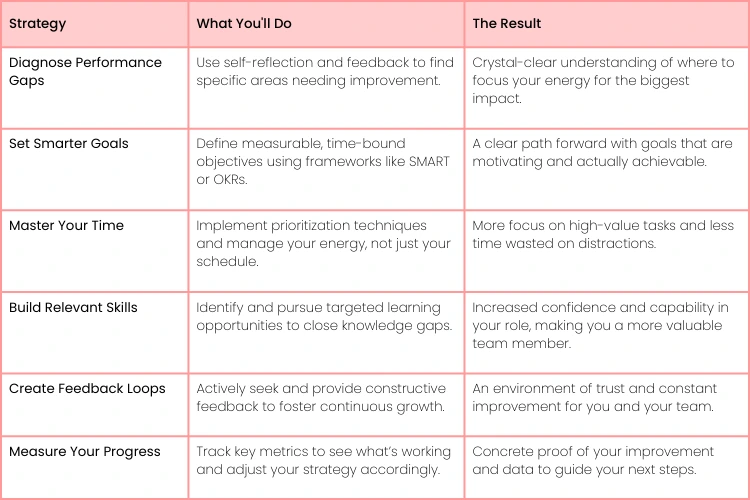
To give you a clearer picture of how these pieces fit together, here’s a quick roadmap of what we'll cover.
Your Roadmap to Better Work Performance
By mastering these areas, you can take real control of your professional development. Adopting the right performance management best practices is a game-changer for anyone aiming for excellence. Now, let’s get into the specifics of turning your ambition into measurable achievements.
Find Your Performance Gaps Before Someone Else Does
You can't fix what you don't know is broken. The absolute first step to making any real improvement at work is taking an honest look in the mirror to see where you can get better.
Waiting for your annual review to find out where you’re falling short is a rookie move. Top performers don't wait to be told—they’re proactive. They’re constantly taking their own temperature.
This isn’t about gut feelings. It’s about creating a clear benchmark for your performance by looking at your job description, your team's current goals (or OKRs), and where you personally want to go in your career.
Start Your Self-Audit
One of the most effective ways to structure this kind of reflection is the 'Start, Stop, Continue' method. It’s a dead-simple but surprisingly powerful tool for spotting the specific habits that are either helping or hurting you.
Carve out 30 minutes. No distractions. Ask yourself these three direct questions:
- Start: What new skill, process, or habit should I start doing to get better results? (e.g., "Start dedicating the first 30 minutes of my day to deep work before checking emails.")
- Stop: What am I doing that's just wasting time, getting poor results, or actively holding me back? (e.g., "Stop multitasking during team meetings and give my full attention.")
- Continue: What's working right now? What am I doing that’s directly contributing to my success? (e.g., "Continue sending a weekly progress summary to my manager; it keeps us aligned.")
Imagine a sales rep whose numbers have gone flat. They could use this framework and realize they need to start personalizing follow-up emails instead of relying on a generic template. They might decide to stop spending their first hour on low-impact admin tasks and dedicate that prime time to prospecting instead. And they’d recognize they should continue their weekly client check-in calls because that’s where they get consistently great feedback.
This isn't an exercise in self-criticism. It's about building self-awareness. The goal is to walk away with a handful of concrete actions you can start on immediately.
How to Get Honest Feedback
Self-reflection is critical, but it’s only half the story. To get the full picture, you need an outside perspective—especially from your manager.
But here’s the thing: asking a vague question like "How am I doing?" is pretty useless. It puts your manager on the spot and usually gets you a generic, unhelpful answer.
You have to be specific. Frame your request around a concrete piece of work.
Try this next time: "I've been working on making my project proposals more compelling. When you have a moment, could you look over the draft for the Q3 initiative? I'm specifically wondering if the data visualization is clear enough to justify the budget increase."
An approach like this does two things: it shows you're already engaged in improving your own work performance, and it gives your manager something tangible to react to. Combine that kind of targeted feedback with your own self-audit, and you’ll have a rock-solid foundation for what comes next.
If you want to go even deeper, this guide on how to identify skill gaps offers more structured techniques for nailing this crucial first step.
Setting Goals That Actually Drive Results
Once you’ve taken an honest look at your performance gaps, it’s time to turn those insights into action. Let’s be real: vague goals like “get better at presentations” just don’t work. To see genuine improvement, you need goals that are specific, measurable, and tied directly to the results you’re after.
This is where the classic SMART framework comes in. It’s not just corporate jargon; it’s a powerful tool for turning a fuzzy wish into a concrete battle plan.
Let's see how this plays out in the real world. Imagine a software engineer who figured out that buggy legacy code is behind a ton of painful deployment rollbacks.
- Specific: Instead of a fuzzy goal like "improve code quality", they get precise: "Reduce deployment rollbacks caused by legacy system X."
- Measurable: The target is clear. They aim to cut rollbacks by 20% over the next quarter.
- Achievable: This isn't a pipe dream. The engineer has the right skills and has already pinpointed the exact code modules causing the trouble.
- Relevant: This goal matters. It solves a huge headache for the team and makes the entire product more stable.
- Time-bound: There’s a deadline: the end of the current quarter (say, September 30th).
Suddenly, the engineer has a clear mission, not just a vague idea. We dive deeper into this process in this guide on how to set personal goals.
Prioritize What Truly Matters
Okay, so you have clear goals. That’s a huge step. But your energy is a finite resource, and you can't do everything at once. This is where prioritization becomes the secret weapon of top performers. A couple of simple frameworks can help you focus your efforts where they’ll have the biggest impact.
First up is the Eisenhower Matrix. This simple grid helps you sort tasks by urgency and importance. It forces you to distinguish between what’s screaming for your attention and what actually moves the needle, saving you from a day spent putting out tiny fires.
Another game-changer is the 80/20 Rule, also known as the Pareto Principle. The idea is simple: roughly 80% of your results will come from just 20% of your efforts. Your job is to find that critical 20%.
For our software engineer, the 80/20 rule is a breakthrough. They might analyze the data and discover that a small handful of old modules are responsible for the vast majority of the rollbacks.
Instead of trying to refactor the entire ancient codebase, they decide to block out one day every two weeks to only fix those specific, high-impact modules. This is the 80/20 rule in action—a highly focused effort that delivers the biggest bang for the buck.
When you pair SMART goals with smart prioritization, you create an unstoppable action plan. You stop being merely busy and start being strategic, investing your time and energy where it produces real, measurable results. If you want to really master this, check out this ultimate guide to goal setting for more essential steps.

Work Smarter, Not Harder: Tools and Habits of Top Performers
High-achievers have a secret weapon, and it's not just raw talent. They've figured out how to make their environment and their tools work for them, not against them. The real key to boosting your performance is optimizing your entire workflow, whether you're at home, in the office, or bouncing between the two.
It's all about turning technology into a partner that supercharges your output instead of a constant source of distraction. When you get this right, you build a system that frees you up to do your best, most meaningful work.
Put Repetitive Tasks on Autopilot
Let’s be honest: how much of your day is spent on boring, repetitive tasks? We're talking about things like manual data entry, scheduling yet another meeting, or sending the same follow-up email for the tenth time. This is low-hanging fruit for productivity gains.
Productivity software isn't just a fancy to-do list; its real power is in making entire chunks of your work disappear.
Imagine a marketing coordinator who uses a tool like Zapier to automatically push new leads from a website form directly into the company CRM and a tracking spreadsheet. That simple automation could easily save them 30 minutes of mind-numbing copy-pasting every single day. That’s time they can now pour back into creative campaign ideas.
The trick is to build good habits that actually stick. Challenge yourself to automate just one small task each week. By the end of the month, you’ll be amazed at how many hours you’ve clawed back.
Make AI Your Secret Weapon
Artificial intelligence has moved from sci-fi to the mainstream, and it’s one of the most powerful tools you can use to amplify your performance. Think of it as a practical, on-demand assistant that can handle the grunt work, freeing you up for the high-level thinking only a human can do.
Here’s how you can put it to work right now:
- Tame Information Overload: Got a dense, 50-page market research report? Use an AI assistant to get a bulleted summary of the key takeaways in less than a minute.
- Actionable insight: Paste the report text into ChatGPT and prompt it with: "Summarize the key findings, opportunities, and risks from this report in five bullet points for a senior executive."
- Beat Writer's Block: Stuck staring at a blank screen trying to compose a tricky email? Ask an AI to whip up a professional first draft that you can quickly tweak and personalize.
- Speed Up Technical Work: A developer can prompt an AI to generate boilerplate code for a common function, which slashes development time and cuts down on silly manual errors.
The real magic of AI isn't that it replaces human skill—it's that it enhances it. By offloading the mechanical parts of our jobs, we create more mental space for creativity, strategy, and complex problem-solving. That’s where true high performance lives.
The data on this is pretty staggering. A 2025 PwC survey found that 75% of workers who use AI reported a boost in both their productivity and the quality of their work. Even more telling, the study showed that top performers are 242% more likely to be using it.
This isn't just about being more efficient anymore; it's about gaining a serious competitive edge.

Why Continuous Learning Is Your Greatest Advantage
In a world where entire industries can pivot on a dime, the most dangerous assumption you can make is that you already know enough. The very skills that made you an asset yesterday could be table stakes—or even obsolete—tomorrow. This is precisely why continuous learning isn't just some fluffy HR buzzword; it's your single greatest career accelerator.
It’s about making a conscious shift. You move from passively "doing your job" to proactively owning your growth. And no, this doesn't mean you need to drop thousands on another degree. It's about building a personal development plan that directly plugs the gaps in your performance and aligns with where you actually want to go.
Craft a Blended Learning Strategy
The best learning plans don't just stick to one method. They're a mix of different approaches that keep you engaged and ensure the knowledge actually sticks. Think of it like building a well-rounded diet for your brain.
Let’s say you're a marketing specialist with your eyes on a leadership role. Your plan might look something like this:
- Enroll in an advanced digital analytics course to get your hands dirty with the hard data side of the business.
- Find a mentor who’s already in a senior marketing position for monthly check-ins and honest career advice.
- Dedicate 30 minutes every morning to reading top industry newsletters or listening to a marketing podcast during your commute.
This kind of blended strategy builds both the hard, technical skills and the soft skills you need to lead a team and make an impact. The real goal is to weave learning so deeply into your routine that it becomes second nature. A great place to start is by figuring out how to learn effectively in the flow of work so it doesn't feel like a chore.
Don't just wait for your company to send you to a training seminar. Take the reins of your own skill development. The people who truly get ahead are the ones who are always learning, always adapting, and always ready for what’s next.
Turn Found Time into a Competitive Edge
"I don't have time" is the number one excuse for not learning, but modern work often has hidden pockets of opportunity. For example, remote workers are getting back an average of 29 extra minutes of productive time each day, leading to a 22% boost in deep-focus work.
This is a goldmine for anyone looking to upskill, especially diving into demanding tech or creative arts courses. When you strategically use that newfound flexibility for dedicated learning, you turn an average Tuesday into a powerful investment in your future. Over time, that growth compounds.
Building Your 90-Day Performance Growth Plan
Alright, let's pull all this together. We've talked about finding your performance gaps and setting solid goals. Now it's time to turn those ideas into a concrete roadmap for the next three months.
A 90-day performance growth plan isn't some remedial tool for when you're in trouble. Think of it as your personal blueprint for deliberate, focused career growth. It’s how you shift from simply wanting to get better to actively making it happen.
The magic of the 90-day timeframe is that it’s long enough to build real momentum but short enough to keep you locked in without feeling overwhelmed. It’s your chance to take the wheel and steer your own professional development.
From Ambition to Actionable Steps
A truly effective growth plan has a few key ingredients that all work together. You'll want to define one major focus area, attach a SMART goal to it, and then map out the specific moves you’ll make to get there. It’s also smart to think ahead about what resources you’ll need and how you’ll check your progress along the way.
Let's look at a real-world example. Imagine Sarah, a customer support agent, who realized after her self-audit that her customer satisfaction (CSAT) scores weren't where she wanted them to be.
Example 90-Day Growth Plan: Sarah, Customer Support Agent
- Focus Area: Improve customer satisfaction and first-call resolution.
- SMART Goal: Increase personal CSAT score from 85% to 92% and boost my first-call resolution rate by 10% by the end of Q3.
- Actionable Steps:
- Month 1: Complete the advanced communication course on active listening and de-escalation techniques. Actionable Insight: Block out 1 hour on my calendar every Tuesday and Thursday morning for course modules.
- Month 2: Shadow Alex, our team's top performer, for two hours each week to pick up on his best practices. Actionable Insight: Come to each session with three specific questions about how he handles difficult customer scenarios.
- Month 3: Proactively follow up with five customers each week to confirm their issues are fully resolved and gather feedback. Actionable Insight: Create an email template for follow-ups to make this process fast and consistent.
- Required Resources: Access to the company's learning budget for the course and dedicated time carved out with my mentor, Alex.
- Milestones: I'll check my CSAT and resolution metrics at the 30, 60, and 90-day marks to see what’s working and tweak my approach if needed.
This isn't just a to-do list; it's a strategic commitment. By writing it down, Sarah transforms a vague desire into a clear, step-by-step process she can execute every single day.
This kind of plan often follows a natural progression, moving from learning new things to applying them with guidance.
The biggest takeaway here? Growth doesn't stop when the course is over. The real magic happens when you start using those new skills on the job and get feedback from someone who's been there before.
Your Template for Success
You can easily borrow this structure for your own goals. It doesn't matter if you're a developer trying to master a new programming language or a manager working to boost team engagement—the core principles are exactly the same.
A well-designed plan is a game-changer for anyone serious about improving their work performance. For managers, in particular, structuring your first few months is critical. You might find it helpful to create a 30-60-90 day plan to outline your team's objectives and your own leadership goals.
Ultimately, this process gives you clarity, focus, and a tangible way to measure what you've accomplished, turning your career ambitions into real-world achievements.


Leave your thoughts here...
All Comments
Reply