









How to Study More Effectively: Tips for Smarter Learning

To really get better at studying, you have to make a fundamental shift. It’s about moving away from just passively rereading your notes and embracing an active approach built on three pillars: planning, engaging, and reviewing. This isn't about logging more hours; it's about making the hours you do spend count.
Jump To Section

Earn As You Learn
Earn 25% commission when your network purchase Uplyrn courses or subscribe to our annual membership. It’s the best thing ever. Next to learning,
of course.
Your Foundation for Smarter Studying
So many students fall into the same trap: they use methods like cramming and highlighting because they feel productive. We've all been there. You spend hours with a textbook and a highlighter, and at the end, the page is a rainbow of color. It feels like you accomplished something, right?
The hard truth is that research consistently shows these passive habits are a fast track to burnout and terrible retention. The real key to studying more effectively isn't about studying longer; it's about studying smarter.
This starts with building a solid foundation. First off, you absolutely need a plan. Without clear goals and a schedule, study sessions just drift. You end up wasting time on the wrong things. Second, you have to actively engage with the material. Don't just read a chapter—wrestle with it. Question it, try to summarize it in your own words, and constantly test yourself.
A huge part of this foundation is how you take in information in the first place. If you can learn to actively engage with what you're reading from the get-go, you’ll find it much easier to remember later. It’s one of the best ways to improve your reading comprehension skills.
The central challenge isn't a lack of effort but a lack of effective strategy. Many students work incredibly hard using methods that are scientifically proven to be inefficient.
Shifting from Passive to Active Learning
To build better study habits, you first have to see the difference between passive and active learning. Honestly, this distinction is the cornerstone of every single effective study strategy out there. For a deeper dive, you should explore this complete guide on how to improve your study habits.
But for now, let’s look at what this shift actually looks like in practice.
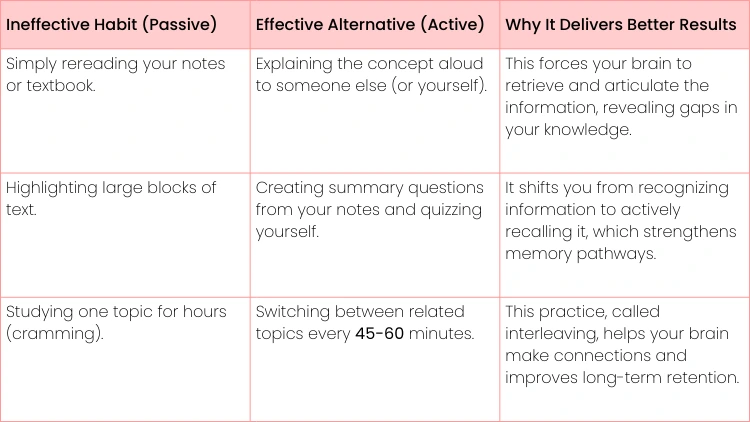
Comparing Passive vs Active Study Habits
Here's a quick look at common ineffective study habits and their powerful, science-backed alternatives you can start using today.
As you can see, the active methods force your brain to work to retrieve information, which is exactly how strong, lasting memories are built. The passive ones just create a false sense of familiarity.
Unlock Your Memory with Active Recall and Spaced Repetition
Ever feel like you’re reading a textbook but nothing is sticking? That "in one ear and out the other" feeling is incredibly common. The good news is, the problem usually isn't your brain—it's the method you're using to get information in there.
Let's ditch the passive habits we've been taught, like highlighting and rereading. It's time to bring out the big guns: two powerhouse techniques that fundamentally change how you learn and remember.
The first is active recall, and it's a total game-changer. Instead of just looking at your notes again, active recall forces your brain to pull information out of your memory from scratch. This retrieval process is what forges strong, lasting neural pathways. Think of it like a bicep curl for your brain; the effort is what builds the muscle.
Putting Active Recall Into Practice
So, how do you actually do this? The core idea is to constantly test yourself. After you finish a chapter or watch a lecture, close the book, shut the laptop, and try one of these moves:
- Explain It Out Loud: Pretend you're teaching the main concepts to a friend.
- For example, after studying photosynthesis, try explaining the entire process to your dog or a houseplant. You'll instantly find out where the gaps in your understanding are.
- Upgrade Your Flashcards: Don't just put a term on one side and a definition on the other. Write a question that forces you to explain the concept in your own words. Instead of "Mitochondria", the card should ask, "What is the primary function of mitochondria and why is it called the powerhouse of the cell?"
- Quiz Yourself: At the end of a study block, jot down three to five tough questions about what you just covered. The very next time you sit down to study, start by trying to answer them before you look at your notes.
The science on this is crystal clear. One landmark study showed students who used active recall remembered 80% of the material a week later. The students who just reread their notes? They only remembered 30%. The effort pays off.
Make Knowledge Stick with Spaced Repetition
Active recall is powerful on its own, but when you pair it with spaced repetition, it's almost unfair. This technique is all about fighting the "forgetting curve"—that natural process where memories fade over time.
Instead of cramming everything in one marathon session, you review information at increasing intervals. You strategically revisit the material right as you're on the verge of forgetting it.
Spaced repetition works with your brain's natural rhythm, not against it. It systematically moves information from your fragile short-term memory into your robust long-term memory.
A simple schedule might look something like this:
- First review: 1 day after learning it.
- Second review: 3-4 days after that.
- Third review: 1 week later.
- Fourth review: 1 month later.
Actionable Insight: Set up calendar reminders for each review session. When you learn a new chapter in history on Monday, immediately create calendar events for Tuesday, Friday, and for one week and one month later. This automates the process so you don't have to remember to remember.
This approach feels way less stressful than cramming but is infinitely more effective for building knowledge that lasts. It's a hugely popular technique for a reason—for example, the benefits of spaced repetition for language learning are massive for locking in vocabulary.
Combine active recall with spaced repetition, and you have a bulletproof system. If you want to dive deeper into making information permanent, check out this complete guide on how to retain information better.
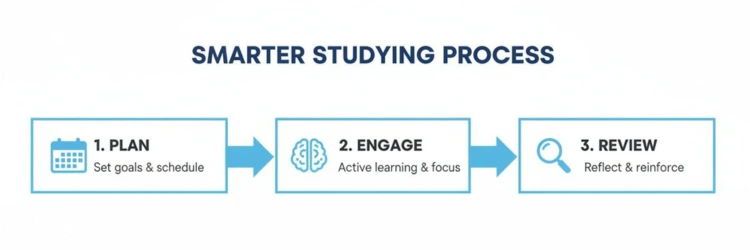
This simple flowchart breaks down the process. It's not just about hitting the books; it’s a cycle of smart planning, active engagement, and strategic review.
As you can see, learning isn't a one-and-done event. It’s a continuous loop where you plan your attack, wrestle with the material, and then circle back to make sure it sticks.
Sharpen Your Focus and Overcome Procrastination
Even the most brilliant study techniques are useless if you can’t actually sit down and concentrate. Let’s be real: the modern world is a battlefield for your attention. Winning that battle is non-negotiable if you want to study effectively.
This means we have to tackle the two biggest hurdles every learner faces: a constant barrage of distractions and that all-too-familiar urge to procrastinate.
Mastering your focus isn't about having some kind of superhuman willpower. It's about building a practical toolkit of strategies to direct your attention where you want it to go. And it all starts with how you manage your time.
This brings us to one of the most celebrated focus methods out there: the Pomodoro Technique. Invented by Francesco Cirillo in the late 1980s with a simple tomato-shaped kitchen timer, this system is beautifully simple. You work in focused, 25-minute sprints followed by short 5-minute breaks.
- Actionable Insight: Set a physical timer (your phone on airplane mode works) for 25 minutes and place it just out of arm's reach. Your only goal for that block is to work on a single, pre-defined task. When the timer goes off, get up and walk away from your desk for your 5-minute break. This physical separation is key.
Don't let the simplicity fool you. Studies show it can slash study time by 40-60% while doubling focus. One analysis even found that users boosted their productivity by 25% and saw a 30% drop in errors. It’s a game-changer.
Design a Distraction-Free Study Zone
Your environment sends powerful cues to your brain. Trying to study on your bed basically tells your mind it’s time to relax. Working at a messy desk surrounded by notifications is an open invitation for your thoughts to wander.
To get into a state of deep concentration, you need a dedicated, optimized study space. This doesn't mean you need a separate home office; it’s about creating a psychological boundary. Here are a few ways to build your own focus fortress:
- Go on a Digital Diet: Use browser extensions like StayFocusd or Freedom to block distracting websites for set periods. Out of sight, out of mind.
- Silence the Noise: Turn off all non-essential alerts on your phone and computer. Every ping and pop-up is a tiny assassin for deep work.
- Create Physical Separation: If you can, make your study space only for work. When you sit there, your brain will know it’s time to get down to business. When you leave, you can fully switch off.
Your study environment should make focus the easiest option and distraction the hardest. Every small adjustment you make removes a point of friction between you and your work.
Actionable Tips to Beat Procrastination
Procrastination usually isn't about laziness. It's an emotional response—our brain's way of avoiding a task that feels overwhelming or stressful. The trick is to make starting so ridiculously easy that your brain doesn't have time to put up a fight.
One of the best psychological hacks for this is the Two-Minute Rule. The idea is simple: if a task takes less than two minutes to start, just do it.
- Need to study a chapter? Practical Example: Just open the book and read the first paragraph. That's it.
- Have to write an essay? Practical Example: Just open a document and write one single sentence—even if it's "This is the first sentence of my essay on the Roman Empire."
- Need to watch a lecture? Practical Example: Just press play and watch the first two minutes.
This tiny action shatters the initial resistance and builds momentum. Once you’re moving, it’s so much easier to keep going. For a deeper dive into the psychology behind this and other powerful strategies, check out this complete guide on how to overcome procrastination.
When you combine a clean environment with small, achievable starting steps, you create a powerful one-two punch against delay.

How to Create a Study Schedule That Works for You
Having the best study techniques is only half the battle. Seriously. If you don’t have a plan for when to use them, you’ll almost certainly fall back on old habits like late-night cramming sessions fueled by caffeine and regret.
A well-designed study schedule is your roadmap. It’s what turns those big, ambitious learning goals into small, manageable actions you can tick off every single day.
But here’s the secret: the key is creating a plan you can actually stick to. It has to be realistic and flexible, built around your own life and energy levels. A rigid, unforgiving schedule is just setting yourself up for failure before you even start.
- Actionable Insight: Spend 15 minutes tracking your energy levels for a few days. Note when you feel sharp and focused versus when you feel sluggish. You might discover your brain is primed for difficult problem-solving at 10 AM but is better suited for reviewing flashcards at 3 PM. Schedule your toughest subjects during these peak energy hours.
From Weekly Roadmaps to Daily Time Blocks
So, how should you structure this plan? It really depends on your personality. Some people love a high-level weekly overview, while others need the detail of an hour-by-hour agenda to stay on track.
Let's break down two popular methods.
- The Weekly Roadmap: Think of this as a bird's-eye view of your week. You assign subjects to certain days and set broad goals.
- Practical Example: Tuesday is for "Biology - Review cell division" and Thursday is for "Statistics - Complete practice problems for Chapter 5". This approach gives you a ton of flexibility.
- Daily Time Blocking: This is a much more granular method. You assign a specific task to every single block of time in your day.
- Practical Example: 4:00-4:50 PM is for "Biology Flashcards (Meiosis)", followed by a 10-minute break, then 5:00-5:50 PM is dedicated to that "Statistics Problem Set".
Honestly, a lot of people find their sweet spot with a hybrid model. They use a weekly roadmap to set the general direction, then create a detailed time-block schedule for the next day or two. This gives you both long-term vision and immediate, actionable steps. If you want to go deeper, there is a whole guide on time management strategies for students that explores more options.
A schedule doesn't restrict your freedom; it creates it. By deciding in advance what to work on, you free up mental energy to actually do the work.
Prioritize Your Topics Intelligently
Let's be real: not all subjects are created equal. Some are way harder, some are more urgent, and some just plain count for more of your final grade. A simple tool like the Eisenhower Matrix can be a game-changer for sorting this out. It helps you divide tasks into four quadrants based on urgency and importance.
- Actionable Insight: Grab a piece of paper and draw the four quadrants. Now, list your study tasks. Is "Reviewing last week's calculus concepts" important but not urgent? Put it in Quadrant 2. Is "Finishing the assignment due tomorrow" important and urgent? That's Quadrant 1. Focus your prime study time on Quadrant 2 to prevent tasks from becoming last-minute crises.
This kind of strategic planning is what makes a study schedule truly effective. It's the foundation for powerful techniques like spaced repetition, which is proven to cement information in your long-term memory. In fact, one 2011 study found that students using spaced repetition scored a massive 55% higher on tests compared to crammers.
Finally, the most important rule of all: build in flexibility. Life happens. You'll get sick, an assignment will take longer than expected, or you'll just need a break. If you miss a study session, don't let it derail your entire week. A good schedule has buffer zones and catch-up periods built right in, ensuring you stay on track without burning out.
Using Technology to Support Your Study Habits
Let's be real: technology can be your biggest distraction or your most powerful study partner. The secret is to be intentional. Instead of letting tech pull you in a million directions, you can make it work for you, especially when it comes to powerhouse techniques like active recall and spaced repetition.
The right digital tools can completely transform how you apply these methods. They remove the friction and make good habits the easiest path to follow.
Think about active recall. You could spend hours handwriting flashcards, or you could build a digital deck on your phone during your bus ride and study it anytime, anywhere. It's a game-changer.
Apps for Active Recall and Spaced Repetition
The best apps don't just show you digital cards; they automate the entire spaced repetition schedule for you. They use smart algorithms to show you a concept right as it's about to slip from your memory. This makes your review sessions brutally efficient.
Here are a couple of go-to recommendations:
- Anki: This is the heavy-hitter. Anki is a powerful, no-frills flashcard app with a sophisticated spaced repetition algorithm. It's a long-time favorite among med students and language learners for a reason—it works incredibly well for memorizing massive amounts of information.
- Quizlet: If you find Anki a bit intimidating, Quizlet is much more user-friendly and collaborative. It offers different ways to interact with your material, like "Learn" mode and practice tests. A huge plus is that you can often find pre-made study sets from other students, which can save you a ton of time.
Actionable Tip: Don't just make flashcards with simple definitions. Push yourself to create cards that ask "Why?" or "How does this connect to X?" For a history class, instead of a card for "The Treaty of Versailles", make one that asks, "What were the three main ways the Treaty of Versailles contributed to the start of WWII?" This forces a much deeper level of understanding.
Tools for Focus and Time Management
Knowing what to study is only half the battle. You still have to sit down and actually do it without getting sidetracked by a dozen notifications.
This is where focus apps come in. The Pomodoro Technique—working in focused 25-minute sprints with short breaks—is practically made for digital timers and apps.
- A great example is Forest. It gamifies the process by growing a virtual tree while you stay in the app and focused on your work. If you switch to Instagram? Your tree withers and dies. It's a simple, surprisingly effective trick to keep your hands off your phone.
Technology should serve your study system, not the other way around. Select tools that remove friction from effective habits like active recall and focused work, making them the easiest path to follow.
Combining these tools is a cornerstone of smart, modern learning. For an even deeper dive into creating the perfect digital study environment, check out this guide with more tips for successful online learning.

Common Questions About Studying Effectively
Even with the best plan in hand, questions always bubble up when you’re trying to lock in better study habits. You might find yourself wondering if you're sinking enough time into a topic, or if there’s a smarter way to lay out your sessions. Let's tackle some of the most common sticking points with clear, no-nonsense answers to help you get unstuck and move forward.
Knowing the theory is one thing, but actually putting it into practice day-to-day is a whole different ball game. These insights are all about bridging that gap.
How Long Should a Study Session Be
The real answer here isn't about the total number of hours you clock in, but about the intensity of your focus. We’ve all tried those marathon, library-til-closing-time sessions, and we all know how they end: with diminishing returns and a foggy brain.
Instead of blocking out a massive four-hour chunk, try thinking in shorter, more powerful sprints. From experience and what the science shows, the most effective study sessions usually last somewhere between 25-50 minutes.
This timeframe is the sweet spot. It’s long enough to get into a state of deep work but short enough to keep you from burning out. It also pairs perfectly with methods like the Pomodoro Technique. The key is to follow each sprint with a real mental break—about 5-10 minutes. Step away from your desk. Stretch. Grab some water. After three or four of these cycles, take a longer, well-deserved break of 20-30 minutes to completely reset.
Is It Better to Study One Subject All Day or Switch
It can feel incredibly productive to dedicate an entire day to a single subject. You feel like you're "immersing" yourself. But the research is pretty clear: this strategy, known as "blocking" is actually one of the less effective ways to build lasting knowledge.
A much better approach is a method called interleaving.
Interleaving simply means switching between different (but related) subjects or topics within a single study period. So, instead of grinding through three straight hours of calculus, you might try something like this:
Practical Example:
- 50 minutes: Work on calculus problems (e.g., integration by parts).
- 10-minute break.
- 50 minutes: Switch to a related physics chapter (e.g., kinematics).
- 10-minute break.
- 50 minutes: Jump back to calculus, but tackle a different type of problem (e.g., differential equations).
This forces your brain to work harder. It can't just settle into one comfortable groove; it has to constantly retrieve different sets of information. That little bit of extra effort is what strengthens the neural pathways, leading to much better long-term memory and a deeper feel for how different concepts actually connect.
The single biggest hurdle for students isn't an unwillingness to use effective strategies, but rather a struggle with the time management required to implement them. Committing to shorter, interleaved sessions is often more a matter of planning than willpower.
What Is the Single Most Effective Study Technique
Look, if you only have the mental energy to add one new strategy to your routine, make it this one: Active Recall. It is, without a doubt, the most powerful tool in your learning arsenal.
Active recall is just the simple act of pulling information out of your brain, rather than just passively putting it in. It's the difference between rereading a chapter and actually being able to explain it. This one habit directly fights the "illusion of competence"—that false sense of security you get from just recognizing material on a page. You might recognize a term, but can you explain it from scratch without looking?
Here’s how to put it into action right now:
- After reading a section of a textbook, close it. Try to summarize the key points out loud, as if you were teaching someone.
- Go through your notes and turn the headings and subheadings into questions.
- Practical Example: If a heading is "The Causes of the French Revolution", turn it into the question, "What were the three primary social and economic causes of the French Revolution?" Then, try to answer it without peeking.
- Use flashcards, but don't just flip them. Force yourself to explain the concept in your own words before you check the answer.
This single habit flips the switch, turning you from a passive consumer of information into an active participant in your own learning. It's the fastest way to find out what you truly know versus what you merely recognize, so you can focus your precious time exactly where you need it most.
Ready to stop guessing and start learning with a proven system? At Uplyrn, we connect you with expert-led courses and mentors who can help you master not just your subjects, but also the art of effective learning itself. Discover a smarter way to study and achieve your goals faster. Find your perfect course today.


Leave your thoughts here...
All Comments
Reply