









What is Self Directed Learning? Master Your Future in 2026

Let's be honest: the old model of education often feels like you're just a passenger on someone else's ride. You're told where to go, what to look at, and when to get back on the bus. But what if you could grab the steering wheel, choose your own destination, and map out the entire journey yourself?
That's the core of self-directed learning. It’s the shift from being a passive student to becoming the active architect of your own growth.
So, What Exactly Is Self-Directed Learning?
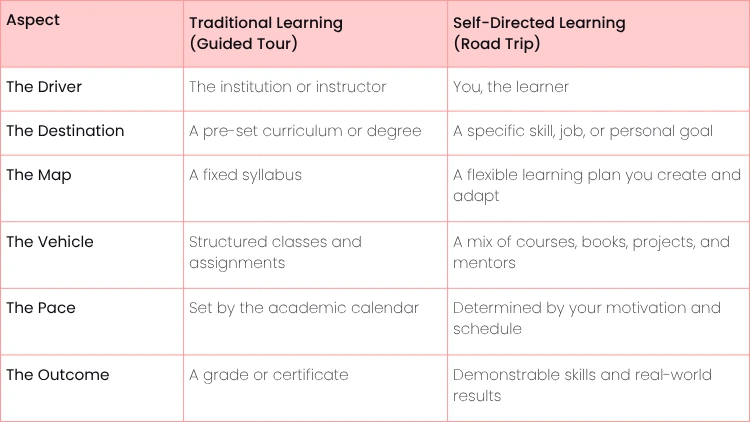
Think about the difference between a pre-packaged guided bus tour and an epic, cross-country road trip you plan yourself.
Traditional learning is that guided tour. The itinerary is set, the stops are non-negotiable, and your main job is to listen and follow along. You might learn something, sure, but the experience is rigid and someone else is in control.
Self-directed learning, on the other hand, is your personal road trip. You pick the final destination (your learning goal), you chart the route (your learning plan), and you decide which scenic detours and exciting side-quests are worth your time. You're in the driver's seat.
- Practical Example: A university student follows a fixed curriculum for a marketing degree (traditional learning). In contrast, a marketing professional decides they need to learn TikTok advertising, finds a top-rated online course, builds a test campaign with a small budget, and analyzes the results to improve (self-directed learning).
Taking the Wheel of Your Own Growth
When you embrace this approach, you stop being a simple recipient of information. You become an active participant in every single stage of the process.
This means you’re now in charge of:
- Spotting Your Gaps: Honestly assessing what skills or knowledge you need to get where you want to go.
- Actionable Insight: Look at job descriptions for the role you want in 1-2 years. What skills appear in every listing that you don't have? That's your starting point.
- Setting Your Destination: Defining clear, meaningful goals. What does "done" look like?
- Stocking Your Toolkit: Hunting down the best resources—be it books, online courses, mentors, or hands-on projects.
- Driving the Car: Choosing how you'll actually learn and practice. Will you build a project? Shadow an expert?
- Checking the Dashboard: Regularly assessing your own progress and deciding if you're still on the right track.
This is more than just a new study habit; it's a fundamental mindset shift. It’s what separates the people who wait to be trained from the ones who actively build their own value.
The big idea is simple but incredibly powerful: You move from being taught to actively learning. This proactive stance is the secret weapon of high-achievers in a world that never stops changing.
And the professional world is catching on. A recent analysis of over 1 million learners found that employees now spend 72% more time on learning they seek out themselves compared to training assigned by a manager. The message is clear: the future of career growth is personal initiative.
Jump To Section

Earn As You Learn
Earn 25% commission when your network purchase Uplyrn courses or subscribe to our annual membership. It’s the best thing ever. Next to learning,
of course.
The Four Pillars of Successful Self-Directed Learning
Turning random curiosity into real, valuable skills isn't just about willpower. It takes a solid framework. Think of it like building a structure—without the right supports, the whole thing can feel wobbly and might even collapse.
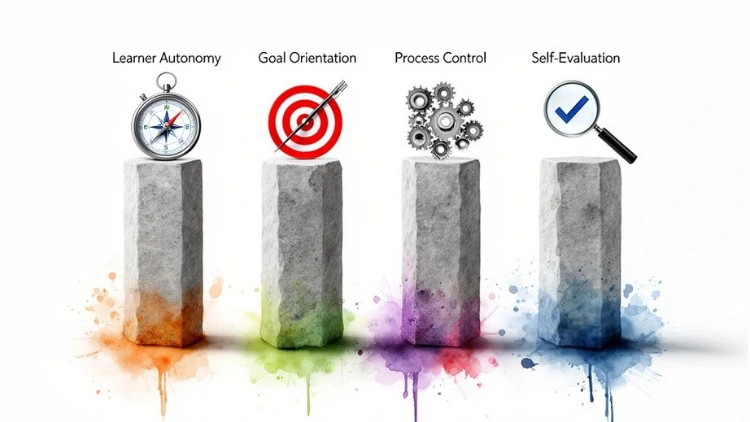
Successful self-directed learning stands on four essential pillars. Get these right, and you'll have a powerful, reliable engine for growing your skills for years to come.
These pillars give you the stability and focus you need to navigate your own education. They are the core of what is self directed learning in the real world.
Pillar 1: Learner Autonomy
This is where it all begins. Learner autonomy is about taking the wheel and owning your educational journey, starting with your "why". It’s that internal fire that gets lit when you’re chasing a goal that genuinely matters to you.
- Practical Example: A developer isn't just learning a new programming language because it's popular; she's learning it because she has an idea for a mobile app she's passionate about building. That passion is her 'why'. This sense of ownership is a huge part of building a growth mindset to unlock your true potential.
Pillar 2: Goal Orientation
Okay, you’ve got your "why". Now you need a "what". Goal orientation is the pillar that gives you a destination, a clear target to aim for. It’s all about setting specific, measurable outcomes.
A self-directed learner doesn't just say, "I want to learn SEO". They set a concrete goal: "I will learn on-page and technical SEO over the next three months to increase organic blog traffic by 20%."
- Actionable Insight: Frame your learning goal as a project with a clear deliverable. For example, instead of "learn video editing", your goal could be "produce a 2-minute promotional video for my side business by the end of the month." This creates a natural finish line.
Pillar 3: Process Control
With your destination set, this pillar is all about charting your "how". Process control means you are the architect of your own learning plan. You get to actively pick the resources, methods, and timeline that work for you.
Practical Example: A learner wanting to master public speaking might combine a Toastmasters membership (for practice), a book on storytelling (for theory), and watching TED Talks (for inspiration). They control the mix, not a rigid syllabus.
- Curating Resources: Hand-picking the best mix of online courses, books, expert articles, or even podcasts for your goal.
- Designing Activities: Deciding if you’ll learn best by building a project, writing an analysis, or shadowing a mentor.
- Managing Your Time: Creating a realistic schedule that fits your life, not the other way around.
Pillar 4: Self-Evaluation
The final pillar is what keeps you on the right path. Self-evaluation is the crucial habit of checking in on your own progress and asking, "Is this actually working?"
This isn’t about grading yourself. It’s about creating a feedback loop. You test your new knowledge with practical projects, ask for feedback from mentors or peers, and aren't afraid to tweak your plan if it's not delivering.
- Actionable Insight: Schedule a "review and reflect" session in your calendar every two weeks. Ask yourself three questions: 1) What did I learn? 2) How can I apply it? 3) What am I stuck on? This simple check-in keeps your learning on track.
Navigating the Benefits and Common Roadblocks
Taking charge of your own learning is a game-changer. It fundamentally alters how you look at growing your skills, both for personal projects and your career. This path gives you something far more valuable than just knowledge on a topic—it makes you more effective, resourceful, and ready for a job market that never sits still.
One of the biggest wins is tapping into deep, intrinsic motivation. When you're the one calling the shots—picking the topic, setting the goal, and mapping out the journey—the whole process just means more. That internal fire is way more powerful than any deadline a boss or teacher could ever set.
The Rewards of Taking Charge
But the perks go way beyond just feeling motivated. They spill over into every corner of your professional life. Here are some of the key rewards you can bank on:
- Sharper Critical Thinking: You stop being a sponge for facts and start learning to ask the right questions, size up your sources, and connect the dots between different ideas. A self-taught graphic designer, for instance, doesn't just learn how to use a tool; they dig into why certain design principles work, making them a much more strategic problem-solver.
- Superior Adaptability: The world of work is always changing. A self-directed learner gets comfortable with uncertainty and becomes skilled at picking up new skills on the fly.
- Practical Example: When AI writing tools emerged, a self-directed copywriter would immediately start learning how to use them to enhance their workflow, rather than waiting for a company training session.
- A Real Boost in Confidence and Initiative: When you successfully teach yourself something, it builds an incredible amount of self-belief. That confidence shows up at work. You become the person who doesn’t just spot a problem but takes the initiative to learn what's needed to fix it.
This isn't just talk; the research backs it up. A study following 754 students found that those who engaged in self-directed learning became much more focused on genuine understanding over just memorizing things. Their deep-learning strategies consistently improved while surface-level cramming fell off, proving the lasting impact this has on how well you learn.
Tackling the Common Roadblocks
Of course, the road isn't always perfectly paved. When you're your own guide, you're also your own support system. Knowing the common hurdles is the first step to clearing them.
The real test of a self-directed learner isn't just their ability to start, but their resilience in the face of inevitable hurdles. The key is to have a toolbox of micro-strategies ready.
Here are the most common challenges you’ll face and an actionable tip for each:
- Roadblock 1: Information Overload. The internet is a massive, endless library, and it can be completely paralyzing. Where do you even start?
- Your Move: Be a curator, not a collector. Instead of bookmarking 50 articles you’ll never read, pick the three best, most reputable sources you can find. Commit to mastering those before you even think about looking for more. For a specific skill, find one comprehensive course, one project to build, and one expert to follow on social media.
- Roadblock 2: Procrastination. With no one setting deadlines, it’s dangerously easy to keep pushing your learning to "tomorrow".
- Your Move: Try the Two-Minute Rule. Just commit to working on your learning task for two minutes. That's it. More often than not, that tiny start is all you need to break the inertia and keep going. For more on this, check out this guide on how to overcome procrastination.
- Roadblock 3: Doubting Your Progress. Without grades or tests, it's easy to wonder, "Am I actually getting anywhere?"
- Your Move: Put the "Teach to Learn" method into practice. After you study a concept, try explaining it out loud to a friend or just write a quick summary for yourself. If you get stuck, you've found exactly where you need to focus and review. A weekly blog post or LinkedIn update about your progress is a great way to do this publicly.
Alright, theory is one thing, but turning those big ideas into a real plan is where the magic happens. A personal learning roadmap is your blueprint for getting from A to B, taking a fuzzy goal and breaking it down into steps you can actually take. This isn't about locking yourself into a rigid schedule; think of it as a flexible guide that keeps you focused, motivated, and pointed in the right direction.
Let’s walk through the four key stages of building a roadmap that genuinely works.
Step 1: Define Your Mission with SMART Goals
First things first: you need to know exactly where you're going. A vague idea like "I want to learn copywriting" is just asking to get lost along the way. What you need is a SMART goal—that’s Specific, Measurable, Achievable, Relevant, and Time-bound.
- Bad Goal: "Learn to code."
- SMART Goal: "I will learn the fundamentals of Python, including data structures and functions, over the next three months by completing an online course and building a simple web scraper to gather public data from my favorite sports website."
That level of detail gives you a clear finish line and makes your mission feel tangible. If you're trying to figure out which skills to zero in on, this guide on how to identify skill gaps is a fantastic place to start.
Step 2: Curate Your Learning Toolkit
With your destination set, it’s time to pack your bags. Try to avoid the trap of hoarding endless resources. Instead, become a curator, carefully picking a balanced set of tools that work for how you learn best.
- Actionable Insight: Create a simple "Learning Toolkit" in a document with three sections: Core Content (your main course/book), Practice Projects (the specific things you'll build/do), and Supplemental Learning (podcasts/blogs for your commute). This keeps you focused.
Your toolkit should have a good mix:
- Structured Content: This is your foundation. Think online courses, a solid textbook, or a dedicated learning path.
- Practical Application: This is where you get your hands dirty. Plan for small projects, coding challenges, or real-world tasks that force you to actually use what you're learning.
- Supplementary Resources: Fill in the cracks with things like podcasts, expert blogs, or documentaries. They offer different viewpoints and keep things interesting.
As you start your journey, building strong study habits is a game-changer. It's worth exploring some focused note-taking techniques to really make sure the information sticks.
Step 3: Structure Your Time and Overcome Roadblocks
Your time is your most precious asset, so guard it fiercely. Use simple methods like time-blocking to carve out specific, non-negotiable slots in your calendar just for learning. Honestly, 30 minutes a day is way more powerful than a frantic five-hour cram session once a month.
Of course, even the best-laid plans run into trouble. Everyone hits a wall at some point.
The key takeaway here is that feeling overwhelmed or unsure isn't a sign of failure—it's a normal part of the process. Having a plan in place is what helps you push through it instead of getting stuck.
Step 4: Measure Your Wins and Seek Feedback
Finally, you have to know if you're actually making progress. Evaluating your own work is a huge part of self-directed learning, but it's something a lot of people struggle with.
Create a feedback loop for yourself. For every major concept you tackle, create a small "proof of work"—a short blog post, a one-page code project, a designed graphic—and share it with a mentor or peer to get their thoughts.
Your readiness for this kind of learning is a strong predictor of success, but it's a skill you can build. Research shows a clear link between self-directed learning readiness and academic achievement, yet one survey found that nearly 60% of learners have trouble with self-evaluation. By building a roadmap with clear goals and feedback checkpoints, you're tackling that common hurdle head-on.
Accelerate Your Journey with the Right Tools
Having a personal learning plan is a great first step. But even the best map is useless if you don't have a reliable way to travel. The right platform can be your vehicle, giving you the structure and resources to make your self-directed journey a whole lot smoother.
Let’s see this in action. Imagine Alex, a sharp project coordinator with a clear goal: become a product manager within the next year. Alex is highly motivated but knows that just reading a few articles isn't going to cut it.
From Ambition to Action Plan
First things first, Alex needs to turn that ambition into a concrete plan. This curated path instantly becomes a personalized roadmap. It shows the exact skills needed, from user story mapping to the principles of A/B testing. This solves one of the biggest problems in self-directed learning—that overwhelming feeling of not knowing where to start.
With a map in hand, Alex starts building that crucial foundation. They dive into several key courses from the learning path, starting with product lifecycle management and market research. The hands-on lessons and practical projects give Alex the core knowledge to start speaking the language of product management.
A well-designed platform doesn’t just throw information at you; it provides a clear structure. It transforms a random pile of resources into a coherent, step-by-step journey.
Overcoming Roadblocks and Landing the Job
While working through a tough module on data analysis, Alex hits a wall. The concepts are tricky, and the material just isn't clicking. This is a classic point where many self-directed learners get discouraged and quit.
Instead of getting frustrated, Alex books a session with a Mentor, who happens to be a seasoned product leader. In a single 45-minute call, the mentor breaks down the confusing ideas using real-world examples from their own career. This targeted advice is exactly what Alex needed to get unstuck.
As Alex nears the end of the learning path, the focus shifts from learning to doing. The final step is turning all these new skills into a job offer. Alex works with a career coach. Together, they polish Alex's resume, create a portfolio from the course projects, and run through mock interviews.
This shows you how a single platform can support every stage of what is self directed learning. It helps you set the destination (learning paths), gives you the vehicle (courses), provides roadside assistance (mentorship), and guides you to the finish line: a new career. To stay on track, you can also explore some of the best productivity apps for students out there.
Your Questions on Self Directed Learning Answered
Even the most committed self-learner runs into a few roadblocks. It's completely normal. Let's get into some of the most common questions that pop up and tackle them with real-world, practical answers.
How Do I Stay Motivated When No One Is Watching?
It’s easy to feel fired up on day one, but what happens on week six when there’s no professor or boss checking in on your progress? That's when your motivation can really start to fade.
- Actionable Insight: Link your learning to a tangible reward. If you complete your learning goal for the month (e.g., finish the Python basics module), treat yourself to something you enjoy. This creates a positive feedback loop. Also, tell a friend, mentor, or even a colleague one new thing you learned each week. It creates accountability and forces you to really understand the material.
How Do I Know I Am Learning the Right Skills?
This is a big one. Nobody wants to spend months learning a skill only to find out it’s not what employers are actually looking for. To make sure you’re on the right track, you need to do a little detective work.
- Scour Job Descriptions: Pull up 3-5 job postings for the role you’re aiming for.
- Build Your Hit List: Make a simple checklist of the technical and soft skills that keep showing up. That’s your curriculum.
Practical Example: If you're learning Python for data analysis, don't just stop at reading. Grab a public dataset from a site like Kaggle and try to build a simple one-page report answering a specific question. Getting feedback from an expert on something you actually built is the fastest way to know if you're learning the right stuff.
To really cement what you learn, try using a powerful memory technique like Spaced Repetition. It’s a method that works with your brain’s natural rhythm to make things stick.
Can I Really Apply This at My Current Job?
You absolutely can—and you should. Your current job is the perfect real-world lab to test out your new skills in a low-stakes environment.
- Practical Example: Look for a small, annoying inefficiency your team deals with. Maybe your meetings are a total mess and nothing gets done. Spend a couple of hours learning about effective meeting facilitation. Next time, volunteer to run the meeting with a clear agenda, time limits for each topic, and a plan to send out action items afterward.
You'll deliver immediate value, get a chance to practice, and show your boss that you're taking initiative. It's a win-win-win.
Is This Just Watching Tutorials Online?
Not even close. Watching a tutorial is like looking at a map. Self-directed learning is actually getting in the car and driving to the destination.
Passively watching videos is a tiny piece of the puzzle. True self-directed learning is the whole system: you identify a goal, you pull together a mix of resources (yes, tutorials, but also books, articles, and projects), you create a schedule, and you constantly apply and test what you’re learning.
- Actionable Insight: Follow a 1:3 ratio. For every one hour you spend watching or reading, spend three hours practicing, building, or applying that knowledge.
Ready to get in the driver's seat? With Uplyrn, you get the roadmap, the tools, and the expert pit crew all in one place. Explore your Learning Paths and find your destination today.


Leave your thoughts here...
All Comments
Reply