









What is Talent Development: A Guide to Growing Your Team

Talent development is all about strategically nurturing your team's skills so they line up with where your organization is headed. It's so much more than just the occasional training workshop. Think of it as a continuous, deeply integrated strategy for building a workforce that's not just capable, but truly resilient.
This approach ensures that as your company grows and changes, your people are right there with you, ready for what's next.
Jump To Section

Earn As You Learn
Earn 25% commission when your network purchase Uplyrn courses or subscribe to our annual membership. It’s the best thing ever. Next to learning,
of course.
Understanding What Talent Development Truly Means
A great way to think about talent development is to picture a professional sports team investing in its players. A championship team doesn't just sign athletes for their current stats; it actively develops their skills, sharpens their strategic thinking, and cultivates leadership for the long haul.
In the same way, a forward-thinking organization focuses on what its employees can become, not just what they can do today.
This strategic mindset is critical. The job market is in constant motion, with new technologies and global shifts changing the game every day. A core part of talent development is driving performance by strategically recognizing and rewarding growth. As this resource on Unlocking Potential with Recognition and Rewards points out, acknowledging progress is just as important as creating it.
The Urgency of Skill Evolution
This need for constant growth isn’t just a nice idea—it’s a business reality. Employers now predict that a staggering 39% of core skills will change by 2030. That number highlights a crucial truth: the abilities that make someone successful today could easily be obsolete tomorrow.
This constant evolution means talent development isn't just a "nice-to-have" HR function anymore. It's a core business strategy for survival and growth.
The Four Pillars of Talent Development
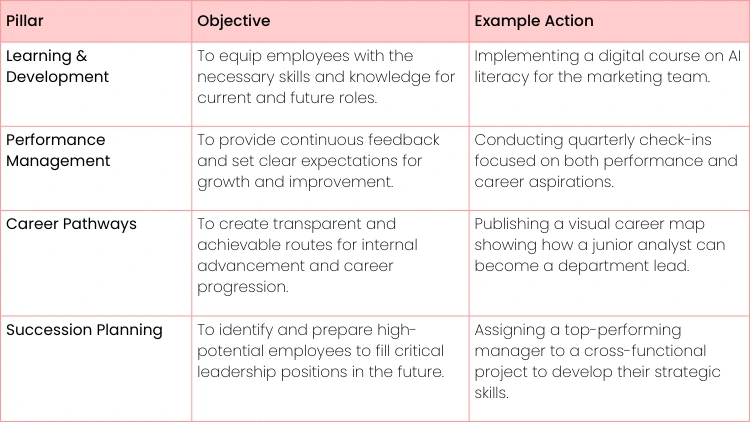
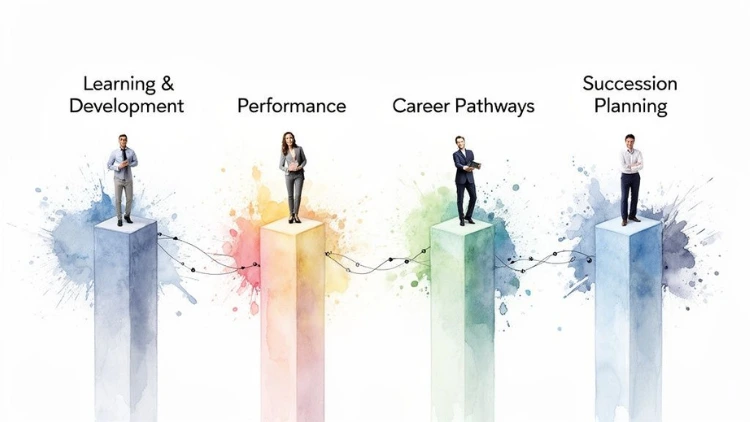
A strong talent development program is built on four interconnected pillars. Each one addresses a different part of an employee's journey, and they all work together to create an environment where people can truly thrive. These pillars are what turn abstract goals into concrete actions.
To go deeper, check out this guide on building a learning and development strategy.
Here’s a quick look at the core components that make a talent development strategy whole.
Together, these four pillars create a powerful framework that not only supports individual growth but also strengthens the entire organization from the inside out.
Exploring the Four Pillars of Talent Development
If you want to build a truly effective talent development program, you have to start with a solid foundation. That foundation rests on four essential pillars that, when working in harmony, create an environment where your people—and your company—can thrive.
Think of these not as separate HR functions but as interconnected systems that feed into one another, driving continuous improvement across the board.
Let's break down each pillar and see how they actually work in the real world.
Learning and Development
This is all about arming your team with the skills they need to crush it, both today and down the road. It's so much more than just sending everyone to a generic training course once a year. Real learning and development is targeted, ongoing, and woven right into the daily workflow.
- Practical Example: Imagine a sales team is struggling to close deals on a new product. Instead of a long, boring seminar, the company rolls out a microlearning program. Reps get daily five-minute videos sent to their phones, each tackling a specific feature or a common objection. It's learning on the fly, and it’s immediately useful.
- Actionable Insight: Look beyond the usual courses. For a software team, this could be peer-led workshops where a senior dev teaches a new coding framework. This doesn't just build skills; it celebrates in-house expertise and makes the whole team stronger.
Coaching and Mentoring
People often lump these two together, but they serve very different—though complementary—purposes. Coaching is all about performance. It’s usually short-term and focused on cracking a specific, immediate challenge. Mentoring, on the other hand, is about the long game. It's a relationship-based journey focused on broad career guidance.
Here's a simple way to tell them apart:
- Practical Example (Coaching): A manager works with an employee to nail their presentation skills for a huge client meeting next week. The goal is to improve performance, right now.
- Practical Example (Mentoring): A senior director takes a junior specialist under their wing for a year. They offer advice on everything from navigating office politics to building a professional network and mapping out a five-year career plan.
- Actionable Insight: Start a "reverse mentoring" program where younger, tech-savvy employees mentor senior leaders on digital tools and social media trends. This flattens hierarchies and ensures knowledge flows in both directions.
These pillars don't operate in isolation. They form an ecosystem where learning fuels career growth, coaching sharpens performance, and succession planning ensures the organization's future is secure. This interconnectedness is what fosters a true culture of continuous growth.
Career Pathways
Let's be honest: people are far more likely to stick around when they can see a real future for themselves at a company. Career pathways make that future visible. They're basically roadmaps that show employees the different roles they can grow into and exactly what skills they'll need to get there.
- Practical Example: A marketing team has a transparent career progression map. It clearly shows how a Marketing Coordinator can move up to Specialist, then Manager, and eventually Director. Crucially, each step lists the specific competencies required, like mastering SEO analytics for the Specialist role or developing budget management skills for the Manager position.
- Actionable Insight: Don't just hand out a static PDF. Make your pathways interactive. Link each skill on the map to an internal course or a relevant mentor. Suddenly, that map becomes a living, breathing development tool. To see how this fits into the bigger picture, you can learn more about building a learning culture that underpins these pathways.
Succession Planning
Succession planning is simply the art of identifying and grooming your internal talent to fill key leadership roles down the line. This isn't just about finding a replacement for the CEO. It's about ensuring your business doesn't skip a beat when critical roles at any level become vacant.
- Practical Example: A retail company identifies high-potential store managers for future regional director roles. They are put on a "leadership track" that includes managing a flagship store, leading a company-wide project (like a new inventory system rollout), and being mentored by a current director.
- Actionable Insight: Create "stretch assignments". Give a high-potential employee a project that is just outside their current comfort zone and skill set, but provide them with the support to succeed. This is a low-risk way to test and develop their capabilities for a bigger role.
Building Your Strategy with Proven Frameworks
Knowing what talent development is, is one thing. Actually making it happen requires a solid blueprint. That's where frameworks come in—they provide the structure you need to turn abstract goals into an actionable, focused plan.
Think of it this way: instead of trying to invent a whole new process from scratch, you can adapt these established models to fit your company’s unique culture and goals. This saves a ton of time and gives you a clear, logical path for nurturing your team's potential.
The Classic 70-20-10 Model
One of the most battle-tested frameworks out there is the 70-20-10 model. At its core, this model argues that real, lasting learning comes from a mix of different experiences, not just from sitting in a classroom.
It breaks down skill-building into three key areas:
- 70% Experiential Learning: This is all about learning by doing. The vast majority of development happens right there on the job—tackling tough assignments, leading a new project, or solving real-world problems.
- 20% Social Learning: This chunk comes from other people. We're talking about mentorship, coaching from a manager, getting feedback from peers, and just plain old collaborative work.
- 10% Formal Learning: This is the most traditional piece of the puzzle. It includes structured training like workshops, online courses, and seminars.
Practical Example: A manufacturing company applies this model to develop future supervisors. New candidates might spend 70% of their time on the factory floor shadowing a seasoned supervisor and leading small team projects, 20% in peer review sessions discussing quality control and team management challenges, and the final 10% in formal leadership and safety certification courses.
Actionable Insight: Formalize the 70%. Don't leave on-the-job learning to chance. Create a checklist of key experiences an employee needs to have in their role over the next year to grow. This turns everyday work into a structured development opportunity.
Agile Learning Methodologies
While the 70-20-10 model gives you a sturdy foundation, modern approaches like agile learning offer the kind of flexibility today's fast-moving businesses need. Borrowing ideas from agile software development, this framework is all about rapid, iterative learning cycles, often called "sprints".
An agile approach puts speed, collaboration, and continuous feedback front and center. Instead of a long, drawn-out training program, teams learn a new skill in a short burst, apply it immediately, and then huddle up to reflect on what worked.
- Practical Example: A tech startup could use agile "sprints" to get up to speed on a new programming language. The team might spend a week learning the basics (the sprint goal), another week building a small project with it (application), and then gather to share what they learned and plan the next sprint (retrospective). This cycle ensures skills aren't just learned in theory but are quickly put into practice. You can see how this ties into a structured, skills-first strategy in this article on the competency-based training approach.
Ultimately, the smartest strategy often involves blending elements from different frameworks. The Global Talent Competitiveness Index (GTCI) 2025 reveals that top-performing nations excel at turning educational investments into a productive workforce by focusing on adaptability. For instance, Singapore equips 77% of its AI-exposed workers with global exposure and crucial soft skills, proving how powerful a multi-faceted approach can be. You can discover more insights about global talent competitiveness here.
How to Measure the Impact of Your Program
A brilliant talent development strategy is only as good as its results. Without a clear way to measure what’s working—and what isn’t—you're essentially flying blind. Tracking the right metrics is how you demonstrate the program's value, justify the investment, and make smart, data-driven decisions to fine-tune your approach.
This means looking beyond the simple stuff. Sure, knowing how many people completed a course is a start, but it doesn't tell you if their skills or performance actually improved. A huge part of any talent initiative is figuring out how to measure training effectiveness and prove it’s making a real difference.
Gathering Actionable Data
So, how do you collect all this information? The key is to build a system that captures both hard numbers and human insights. This isn't about getting lost in complex spreadsheets; it's about using simple, effective tools to listen to your team and observe performance.
Consider mixing a few of these methods:
- Practical Example (Pulse Surveys): Short, frequent surveys can give you a quick read on employee satisfaction and perceived skill growth. A simple monthly question like, "Do you feel you have the resources to grow in your role?" can be incredibly revealing.
- Practical Example (Performance Data): Tie your efforts to real business metrics. For a sales team, you might look for a 15% increase in close rates after they complete a new negotiation skills workshop. That’s a tangible result.
- Actionable Insight (360-Degree Feedback): This process gives you a complete, well-rounded view by gathering anonymous feedback from an employee's manager, peers, and direct reports. It's one of the best ways to see if new behaviors are actually sticking. Use a simple, free tool to start and focus on just 2-3 key competencies you want to measure.
When you combine these methods, you create a powerful feedback loop. You can dive deeper into structured evaluation with frameworks like the Kirkpatrick Model for evaluating L&D impact. This doesn't just help you prove your program’s ROI; it allows you to continuously adapt it to what your business and your people need most.
Connecting Actions to Outcomes
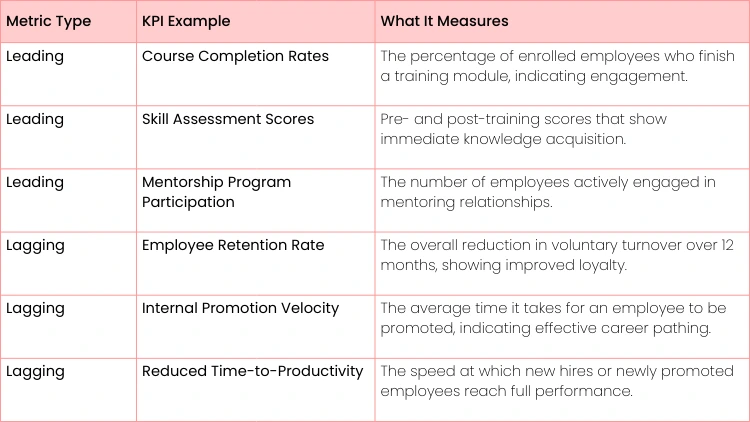
To get the full picture, you need to track both leading and lagging key performance indicators (KPIs). Leading indicators are predictive; they measure the immediate engagement and progress happening inside your program. Lagging indicators, on the other hand, are all about outcomes; they show the long-term business impact of all that hard work.
Think of it like steering a ship. Your leading indicators are like checking the compass and engine speed—they tell you if you're on the right course right now. Lagging indicators are like confirming you've arrived at your destination—they prove the journey was a success.
Here’s a look at how these two types of metrics work together.
Leading vs Lagging KPIs in Talent Development
This table breaks down the difference between predictive (leading) and outcome-based (lagging) metrics, giving you a balanced way to see if your programs are on track and delivering results.
By tracking both, you get a story. The leading KPIs give you early warnings if something is off, while the lagging KPIs confirm your strategy is paying dividends down the line.
A Step-by-Step Guide to Implementation
Knowing what talent development is and why it matters is one thing. Actually doing it is another beast entirely. So, let's get practical and walk through how to bring your strategy to life.
Think of this five-step guide as your roadmap for turning ambitious goals into a program that actually gets results.
1. Align Development with Business Objectives
Here’s the golden rule: your talent development efforts can't just be a side project. They need to be directly plugged into what your company is trying to achieve.
- Practical Example: If the big goal is expanding into a new market, then your program should be building skills like cross-cultural communication or market analysis.
- Actionable Insight: Start by asking one simple question in your next leadership meeting: "What skills will our people need for us to win in the next three to five years?" Your answer is your North Star. It ensures every dollar spent on training is pushing the business forward.
2. Identify Critical Skill Gaps
Once you know your destination, you have to figure out where you are right now. This is where a thorough skill gap analysis comes in. You can’t build a bridge to the future if you don't know how wide the canyon is.
- Practical Example: A software company realizes its senior engineers are nearing retirement, but mid-level developers lack leadership experience. The gap is "leadership and project management skills for technical staff".
- Actionable Insight: Create a simple "skills matrix" in a spreadsheet. List team members in rows and critical skills in columns. Rate each person's proficiency (e.g., 1-5). The low-scoring columns immediately show you where your biggest organizational gaps are.
For example, the demand for project management talent is expected to jump by 64% between 2025 and 2035, yet many companies are facing a huge shortfall. You can learn more about the global project management talent gap. A gap analysis that flags this early allows you to start building those skills internally before it becomes a five-alarm fire.
3. Design Personalized Learning Journeys
A one-size-fits-all training program is a fast track to bored, disengaged employees. The real magic happens when you create personalized learning journeys that meet people where they are.
- Practical Example: For the software company mentioned above, a junior dev's journey might focus on advanced coding courses. A mid-level dev's journey would blend those technical skills with a "Managing Your First Project" workshop and a mentorship with a senior leader.
- Actionable Insight: Let employees have a say. Give them a small annual learning budget to spend on books, courses, or conferences of their choice, as long as it aligns with their development plan. This ownership dramatically increases engagement. If you're looking for ideas, this guide on how to create training materials is a great place to start.
4. Launch and Champion the Program
Kicking off a new program is about more than sending a company-wide email. You have to build real excitement and get people on board from day one. Your most important allies here are your managers—get them involved early and often.
- Practical Example: Host a launch event where the CEO talks about the importance of growth. Feature a panel of employees who have been promoted internally to share their stories.
- Actionable Insight: Create "cheat sheets" for managers that outline the new programs and provide talking points for their 1-on-1s. This makes it easy for them to become effective champions of the initiative.
5. Continuously Evaluate and Iterate
Finally, a talent development program is never really "finished". It’s a living thing that needs constant attention. You have to create a continuous cycle of measuring, analyzing, and refining to keep it sharp.
This feedback loop is what keeps your program agile. Use pulse surveys, check performance data, and hold regular check-ins to see what’s working and what isn’t.
- Practical Example: After a 6-month leadership program, you find that while knowledge scores are high, participants are not applying the skills (seen through 360-degree feedback). You iterate by adding a mandatory project where they must apply their new skills and present the results.
- Actionable Insight: Schedule a formal program review every six months. In this meeting, look at your KPIs and ask: "What should we stop, start, and continue doing?" This prevents programs from becoming outdated.
Got Questions About Talent Development?
When leaders and their teams start digging into talent development, a few practical questions almost always surface. Getting clear on these points is the first step to turning good ideas into a great strategy. Let's tackle some of the most common ones.
What’s the Difference Between Talent Development and Training?
Think of it this way: training is a single class, like teaching someone to use new software. Talent development is the entire college degree.
Training is a specific, tactical event designed to fix an immediate skill gap. It's essential, but it's just one piece of a much bigger puzzle.
Talent development, on the other hand, is the whole strategic journey. It’s a long-term commitment that includes training but also weaves in coaching, mentorship, and clear career planning.
- Practical Example: Training is a one-day workshop on Excel pivot tables. Talent development is a year-long program for a junior analyst that includes the Excel workshop, a presentation skills course, mentorship from a senior analyst, and a project to build a new financial model.
How Can Small Businesses Afford Talent Development?
This is a common myth—that talent development requires a massive budget. In reality, it’s far more about fostering a growth-oriented mindset than it is about spending a ton of money. Small businesses can be incredibly effective by focusing on high-impact, low-cost strategies.
Here are a few practical, low-cost ideas:
- Launch an internal mentorship program. Pairing seasoned experts with junior team members is a powerful—and free—way to transfer institutional knowledge.
- Encourage "lunch and learns" where team members share skills. The person teaching project management one week might be learning about social media marketing the next.
- Use your experts. Have your top salesperson run a session on closing techniques for the rest of the team.
Actionable Insight: Create a shared resource library. This could be a simple Google Drive folder where people add links to great articles, free webinars, and insightful podcasts related to your industry. It's a zero-cost way to encourage continuous learning.
How Does Talent Development Improve Employee Retention?
People stick around when they feel valued and can see a clear path forward. Talent development hits both of these notes, making it one of the most effective retention tools you have.
- Practical Example: A company found its mid-level managers were leaving after 2-3 years. They implemented a "Future Leaders" program offering executive coaching and strategic project opportunities. A year later, voluntary turnover in that group dropped by 40%.
When you invest in an employee’s growth, you're sending a powerful message: "We believe in you and want you to build a future here."
A lack of growth opportunities is consistently a top reason why employees start looking for new jobs. By showing a genuine commitment to their professional journey, you give your best people a compelling reason to stay and grow with you.
What Is the Manager's Role in Talent Development?
Managers are the linchpin. You can have the best program in the world, but if managers aren't on board, it will fall flat. They are on the front lines, seeing their team's strengths and growth opportunities in real-time.
- Practical Example: Instead of just approving a course request, a great manager sits down with their team member to discuss why they want the training and how they'll apply it. After the course, they schedule a follow-up to discuss what was learned and assign a project to put the new skill into practice.
- Actionable Insight: Make "development conversations" a mandatory part of your quarterly check-ins. Provide managers with a simple template with questions like: "What skill do you want to build next?" and "What support do you need from me to get there?" This embeds development into the natural rhythm of work.
Ready to build a culture of continuous growth and unlock your team's full potential? At Uplyrn, we provide the tools and courses to create personalized learning journeys that drive real results. Discover how Uplyrn can supercharge your talent development strategy.


Leave your thoughts here...
All Comments
Reply