









What is Upskilling and Reskilling for Modern Career Growth

When you boil it down, upskilling is all about getting better at the job you already have. On the other hand, reskilling is about learning what you need to do a completely different job. One sharpens your current toolkit, while the other helps you build a new one from scratch.
Jump To Section

Earn As You Learn
Earn 25% commission when your network purchase Uplyrn courses or subscribe to our annual membership. It’s the best thing ever. Next to learning,
of course.
The Two Paths of Professional Growth
Let's think of your career like a classic car. Upskilling is like souping up the engine for more horsepower on the same road—you're adding skills to boost your performance right where you are. Reskilling is more like swapping out that gas engine for an electric one so you can drive on a brand-new highway. You're learning a whole new set of skills to pivot to a different job, maybe even in a new industry.
These aren't just trendy buzzwords; they're real strategies for staying ahead in a job market that never stands still. The best way to see this in action is through real-world personal growth stories, which show just how powerful intentional skill development can be.
What Is Upskilling?
Upskilling is all about adding to your current skill set. The idea is to become more effective in your role, especially as new technologies or responsibilities pop up. You’re building on the foundation you already have to stay competitive and bring more to the table.
- Practical Example: Imagine a marketing specialist who learns search engine optimization (SEO) and data analytics to get better results from their campaigns. They aren't changing careers—they're becoming a much more capable and valuable marketer.
- Actionable Insight: Pinpoint one part of your job that’s being changed by technology. Find a quick online course or a weekend workshop to get up to speed on that one thing. For instance, if you're in sales and your team just adopted a new CRM, take a 2-hour online course to master its advanced features. It’s a small step that can make a huge difference in your performance.
This kind of learning isn't just a nice-to-have anymore. One report found that a staggering 60% of workers will need some form of training by 2027 just to stay relevant. For many, that training will be upskilling to keep up with the demands of their current jobs.
What Is Reskilling?
Reskilling, in contrast, is about learning entirely new skills to move into a different role. This is what people do when their current job is at risk of becoming obsolete or when they simply want to make a complete career change.
Reskilling is about building a bridge to a new future. It’s an acknowledgment that the job you have today might not be the job you have tomorrow, and it’s about proactively preparing for that change.
- Practical Example: Think of a retail store manager whose role is shrinking due to e-commerce. They might learn coding and UX design through a 6-month bootcamp to become a web developer. That’s a fundamental career shift, not just an upgrade.
- Actionable Insight: Look up job descriptions for roles that intrigue you. List the top 3-5 required skills that you don't have yet. This creates a clear, targeted roadmap for your reskilling journey. This is the kind of proactive planning that helps you stay ahead of the curve and close the skills gap that so many professionals face. Speaking of which, you might find this interesting: understanding the skills gap and why many workers need upgrading.
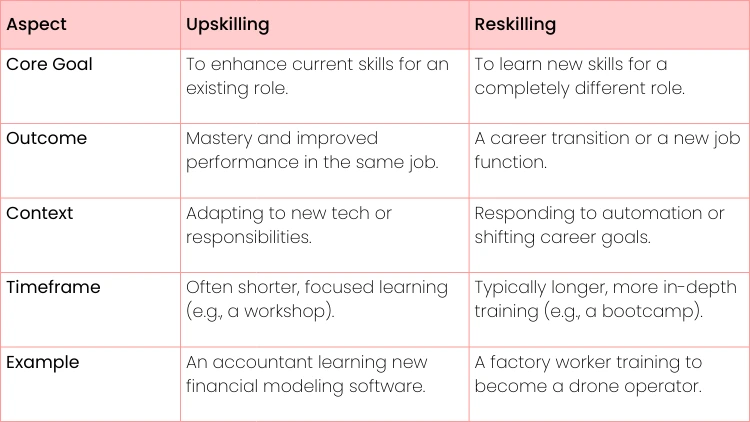
Upskilling vs Reskilling at a Glance
Sometimes a quick side-by-side comparison makes all the difference. Here’s a simple breakdown to help you see the core differences between these two powerful strategies.
While the table shows them as two distinct paths, remember that in the real world, your career journey might involve a mix of both. The key is to be intentional about what you're learning and why.
Why Skill Development Matters More Than Ever
The ground beneath the modern workforce is constantly shifting. Think about it: the skills that were once considered the gold standard now have a much shorter shelf life, a bit like last year's smartphone model. This rapid change is being fueled by huge technological shifts like artificial intelligence and automation, which are completely reshaping entire industries.
But this isn't a story of doom and gloom. It's one of adaptation. Continuous learning through upskilling and reskilling is no longer just a nice-to-have for getting ahead—it's become the new baseline for job security and real career growth. If you're not learning, you're not just standing still; you're falling behind.
The Double-Edged Sword of Technology
Technological progress is a powerful force, and it cuts both ways. While it’s true that some roles are becoming redundant, technology is also carving out entirely new opportunities that we couldn't have imagined a decade ago. This creates a professional reckoning where standing still is the riskiest move you can make.
- Practical Example: The rise of AI-powered content tools means a traditional copywriter might need to upskill in AI prompt engineering and content strategy to stay relevant. At the same time, this same technology creates new reskilling opportunities, like becoming an AI ethics consultant or a machine learning operations specialist.
- Actionable Insight: Spend 30 minutes this week reading industry reports or top trade publications related to your field. Look for mentions of new technologies or shifting trends. This proactive research will help you spot opportunities for upskilling or reskilling before they become urgent necessities.
The scale of this shift is massive. While automation and AI are expected to displace 92 million jobs globally by 2030, these same forces are projected to create 170 million new roles. That’s a net gain of roughly 78 million jobs. The catch? The jobs of tomorrow will demand a whole new set of skills. This underscores the urgent need for both workers and companies to adapt. For a deeper dive, read this post on preparing employees for the future of work.
Tangible Benefits for Individuals and Companies
For individuals, the upside of continuous learning is crystal clear. Picking up new skills isn’t just about future-proofing your career; it opens doors to real personal and financial growth.
- Higher Earning Potential: When you have in-demand skills, you have more leverage. This directly translates to better-paying roles and stronger negotiating power.
- Greater Career Resilience: A diverse and up-to-date skillset acts as a professional safety net, making you less vulnerable to industry slumps or company shake-ups.
- Increased Job Satisfaction: There's a deep sense of fulfillment that comes from mastering new challenges and seeing yourself grow professionally. It keeps you engaged and motivated.
From a broader perspective, understanding the core competencies that drive success is vital. Exploring the essential entrepreneur characteristics and skills needed in today's market can provide a valuable roadmap for personal development, regardless of your specific career path.
The smartest companies see this from their own perspective, too. They know their most valuable asset isn’t their product or their technology—it's their people. By investing in employee training, they aren't just offering a perk; they're making a strategic bet on their own future. It’s how they boost innovation, drive productivity, and maintain a sharp competitive edge.
Simply put, this investment is what separates the market leaders from the ones who get left behind.
Choosing Your Path: Upskill or Reskill?
Knowing the definitions is one thing, but how do you actually decide which path to take? This isn't a random guess; it's a strategic choice that comes down to how you feel about your current job, what you want for your future, and where your industry is headed.
Let’s make it real with a couple of quick examples. Imagine a project manager who takes a course on agile methodologies to get better at leading tech projects. That’s upskilling. She’s adding a valuable new skill to crush it in her current role.
Now, picture a retail manager watching foot traffic dwindle. He decides to learn digital marketing, SEO, and e-commerce analytics to pivot into a brand new role as an online brand manager. That’s reskilling—building a completely different skillset to jump onto a new career track.
Key Questions to Ask Yourself
Before you dive into any courses, take a minute to ask yourself these questions. Your answers will basically draw a map pointing you toward either sharpening your existing skills or building a whole new foundation.
- How Happy Are You at Work? If you genuinely enjoy your job and industry but want to climb the ladder or make your position more secure, upskilling is your move. If you’re feeling stuck, uninspired, or see your industry shrinking, reskilling is your ticket to a fresh start.
- What’s the Five-Year Plan? Do you see yourself in a leadership role at your current company? If so, upskilling is the most direct route. But if you dream of a totally different profession, you’ll need to reskill to make it happen.
- What’s Happening in Your Industry? Is technology like AI changing how your job gets done? If new tools are just updating your daily tasks, upskilling will keep you ahead of the curve. If automation could make your entire role disappear, it’s time to seriously consider reskilling for a more future-proof career. For anyone thinking about a major pivot, exploring different online courses for a career change is a fantastic way to see what’s out there.
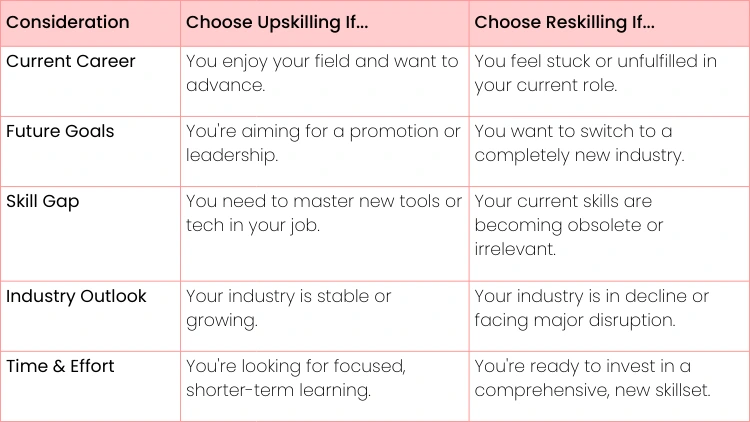
Decision Matrix: Upskill or Reskill?
Still on the fence? This table breaks it down even further. Think of it as a checklist to help you see which column you fall into.
Ultimately, this choice is about steering your own professional future. Both paths are powerful, but the right one for you is the one that lines up with where you truly want to go.
Upskilling invests in your current trajectory, while reskilling creates a new one.
How to Build Your Personal Learning Strategy
Knowing you need to upskill or reskill is one thing. Actually turning that realization into a new skill set—and maybe a new job—is another thing entirely. You need a playbook.
A solid personal learning strategy is your roadmap from where you are today to where you want to be tomorrow. It breaks the journey down into manageable steps so you're not just spinning your wheels, but investing your time and energy in skills that actually move the needle on your career.
This isn't about collecting a random pile of certificates. It's about strategically building a toolkit that opens doors. Here are five practical steps to build a plan that truly works for you.
Step 1: Define Your Destination
You’d never start a road trip without a destination plugged into your GPS. Your career is no different. Your "destination" has to be a specific, tangible goal. Vague wishes like "I want a better job" are impossible to plan for.
Get laser-focused. Is your goal a promotion to Senior Marketing Manager within the next 18 months? Or is it a total pivot to a UX Designer role at a tech startup?
- Practical Example (Upskilling): A junior accountant wants to become the go-to person for financial forecasting on their team. The destination: Lead the quarterly forecasting process within one year.
- Practical Example (Reskilling): A customer service rep sees AI chatbots handling more and more of their work. Their new destination: Become a Junior Data Analyst within a software company in the next 18 months.
When you know exactly where you're headed, the path to get there becomes a whole lot clearer.
Step 2: Map Your Current Skills
Once you know where you’re going, you have to be honest about where you’re starting. This means taking a frank inventory of your current skills. Think of it as creating a personal balance sheet of your professional talents.
- Actionable Insight: Create a simple two-column list. In the first column, list all your current skills—both hard (like Python, Excel) and soft (like communication, teamwork). In the second column, list the skills required for your target role (from Step 1). The gaps between the columns are your learning plan.
Don't just list your job duties. Dig deeper. Break them down into hard skills (like knowing how to use specific software or being fluent in a language) and soft skills (like your knack for communication or project management). This step is critical because it highlights the gap between who you are now and who you want to become. If you need a hand with this, this guide on how to identify and address skill gaps offers a great framework.
Step 3: Research High-Value Skills
Okay, you’ve got your destination and your starting point. Now it's time to figure out exactly which skills will bridge that gap. The best way to do this is to put on your detective hat and start combing through job descriptions for the role you want.
- Actionable Insight: Scour 5-10 job postings on sites like LinkedIn for your target role. Create a spreadsheet and track how many times each skill or tool is mentioned. The ones that appear most frequently are your top-priority, high-value skills. Focus on learning those first.
By analyzing what employers are actively seeking, you eliminate guesswork. You're no longer just learning; you're strategically acquiring the exact skills that will get you hired or promoted.
Step 4: Design Your Learning Plan
Now for the fun part: building your own curriculum. This is more than just picking a few courses. It’s about creating a structured plan with timelines, resources, and milestones that fit your real life.
- Choose Your Resources: Will you use online courses, attend workshops, find a mentor, or dive into some good old-fashioned books?
- Set a Timeline: Break your bigger goal into bite-sized pieces. For example, "Month 1: Learn the basics of Python", "Month 2: Complete a data visualization project".
- Schedule Learning Time: Actually block out time in your calendar each week dedicated to learning. Remember, consistency is more important than intensity.
Step 5: Apply Your Knowledge
Learning something in a vacuum is a waste of time. The final, and most important, step is to take what you've learned and do something with it. This is how you prove to employers—and yourself—that you have what it takes.
- Practical Example: If you’re reskilling for a data analyst role, don’t just complete tutorials. Find a public dataset on a topic you love (like sports stats or movie ratings) and use your new skills to build a simple analysis and visualization. Post it on LinkedIn or GitHub to create a public portfolio.
This practical application is what turns head knowledge into real, demonstrable expertise.
From Learning Plan to Career Success
It’s one thing to map out a brilliant learning plan; it’s another to see it through to a promotion. That first rush of motivation is powerful, but it can quickly fizzle out when you’re up against a packed schedule, unexpected roadblocks, or that quiet voice in your head wondering if you’re "good enough" to really master something new.
This is exactly where most professional development plans start to collect dust. It’s almost never about a lack of ambition. The real enemy is the friction of everyday life. The secret to turning your goals into a real career jump is to face these hurdles head-on with a few practical strategies.
Overcoming Common Roadblocks
Let's get real for a second. Finding a few extra hours in the day can feel like a fool's errand, and that nagging self-doubt can be absolutely paralyzing. But here’s the thing: everyone feels this way. These aren't unique problems, which means they have proven solutions. It's all about reframing the challenge and using a strategy that fits into your life, not one that fights against it.
Here are a few battle-tested ways to get past the most common obstacles:
- The Time Crunch: Forget trying to block out two hours for studying. Instead, get into micro-learning. Break your topics into tiny, 15-minute chunks you can knock out during a coffee break or on your commute. Consistency is what builds momentum, not cramming.
- The Confidence Gap: Feeling like an impostor when learning something new is completely normal. Find a mentor—maybe a senior colleague or someone you admire in your industry. They can offer guidance, help with tough questions, and, most importantly, remind you that every single expert was once a beginner.
- Losing Momentum: A plan without deadlines is just a wish. Set small, achievable goals every week and actually reward yourself for hitting them. For instance, finish a course module and treat yourself to a movie. This creates a positive feedback loop that tricks your brain into wanting to keep going.
Bridging the Execution Gap
This isn't just a personal struggle; it’s a massive issue in the business world. Companies know that skills development is urgent, but there's a huge gap between knowing and doing. While 63% of employers point to skills gaps as a top barrier to hitting their targets, only 36% of organizations are truly great at fostering career development for their people.
This gap is a ticking time bomb. It's estimated that about 39% of workers' core skills could be obsolete by 2030, leaving a lot of people in a tough spot. If you want to dive deeper, you can read the full story on the global reskilling revolution.
The gap between knowing you need to learn and actually doing it is the single biggest obstacle to career growth. Success comes from building systems and habits that make learning a consistent part of your routine.
At the end of the day, your career trajectory depends on your ability to follow through. The tools and strategies for upskilling and reskilling are out there, but they’re useless if you don't use them. For anyone with their eye on the next rung of the ladder, this guide on how to get promoted and move up the ladder has some great insights.
By knowing what obstacles are coming and having a plan to deal with them, you can make sure your learning journey actually leads to a real, rewarding outcome.
Frequently Asked Questions About Upskilling and Reskilling
Diving into professional development brings up a lot of real-world questions. It's one thing to understand the definitions of upskilling and reskilling, but it’s another thing entirely to figure out how they apply to your career.
Let's clear up some of the most common questions people have. The goal here is to give you the clarity and confidence to stop just planning and start making real moves toward your career goals.
How Long Does It Take to Upskill or Reskill?
This is probably the most common question, and the honest answer is: it depends. There’s no magic number here. The timeline is shaped by how complex the new skill is and what you're trying to achieve.
- Practical Example (Upskilling): A project manager who just needs to learn Asana to work with a new team could probably get the hang of it in a few focused weeks. That’s upskilling—adding a specific tool to your existing expertise.
- Practical Example (Reskilling): An administrative assistant aiming to become a data analyst is looking at a much bigger commitment. That’s reskilling, and a total career shift like that could take anywhere from six months to two years, often through structured courses or a dedicated bootcamp.
Actionable Insight: Don't get hung up on speed. The real key is finding a learning path that fits your life and allows for consistent progress. It’s a marathon, not a sprint. Focus on making steady, weekly gains instead of trying to cram everything in at once.
Can I Learn New Skills Without My Employer's Help?
Absolutely. In fact, you probably should. While company-sponsored training is a great perk, taking the initiative on your own is one of the most powerful moves you can make for your career.
Plenty of successful professionals fund their own learning to get a promotion faster or pivot to a new industry altogether. When you invest in yourself, it sends a clear message to employers (both current and future) about your drive and commitment. It shows you aren't waiting for permission to grow, which gives you a serious competitive edge.
- Practical Example: Imagine a graphic designer who wants to break into UI/UX design, but their company isn't offering that kind of training. They enroll in an online certification on their own time, build a small portfolio with a few personal projects, and within a year, they land a fantastic new role as a UI/UX designer.
How Do I Prove My New Skills to Employers?
This is critical. Just listing a course you finished on your resume isn't going to cut it. Hiring managers have seen it all before. You have to show, not just tell.
The best way to make your new skills believable is with tangible proof. Of course, you should update your LinkedIn profile and resume with what you’ve learned. But the game-changer is creating a small portfolio of work that demonstrates you can actually do the thing you say you can do.
- Actionable Insight: Let's say you just learned the fundamentals of digital marketing. Don't just list "SEO" on your resume. Instead, put together a one-page report analyzing the website of a local coffee shop. Point out three specific, actionable SEO improvements they could make. That simple, practical project is a thousand times more convincing than any certificate.
Ready to turn your career goals into a reality? Uplyrn provides the courses, mentorship, and job opportunities you need to upskill or reskill with confidence. Start your journey today.


Leave your thoughts here...
All Comments
Reply